Confident Children Reach Further: A Singapore Parent’s Guide
The Quiet Question Every Singapore Parent Carries
We live in a city that asks a great deal of parents. Singapore has built a society of extraordinary ambition, and that ambition begins at home, in the earliest years, in the weight of a question that many parents carry without ever saying aloud: Am I enough?
The question is natural. It arises from love. It is amplified by a culture that has elevated parenting into something that feels increasingly like performance, where every choice carries the weight of consequence, where the market of parenting advice offers certainty and social media offers comparison.
Somewhere in between, parents find themselves wondering whether their child needs them less with each passing day, whether choosing quality care means accepting a smaller place in their child’s heart. If this fear has ever visited you, know that you are not alone. It is one of the most common tensions we hear from Singapore families exploring childcare options. And it deserves an honest, evidence-based answer.
What Quality Childcare Actually Builds
Developmental psychologists have studied the relationship between external care and attachment for decades. The findings are consistent: quality external care, provided by trained and responsive caregivers working in partnership with parents, does not undermine attachment. It contributes to it.
Consider the distinction between clinging and reaching. The clinging child reaches for a parent only in anxiety. They cannot be soothed by anyone else. They collapse at separation and cannot be comforted.
This is not the child who is most attached. This is the child who is uncertain of their security.
The reaching child runs confidently at reunion. They can explore a room and return. They are curious and calm. They reach toward the world and then back toward the people they love.
This is the child who has internalized a secure base—what researchers call an internal working model of attachment. When a child consistently receives the message that the world responds when they reach, that there is someone there when they need them, and that they can explore and still be held, they develop a template of security that shapes their confidence, curiosity, and connection throughout their lives.
Here is what many parents do not expect: the child in quality care all day often comes home more ready to reach for you, not less. They come home replenished from a day of responsive attention, ready to play, ready to be silly, ready to show you the block tower they built, ready to sit in your lap and feel the particular comfort of your presence—which is unique and irreplaceable precisely because they have also experienced reliable comfort elsewhere.
What This Looks Like in Real Life
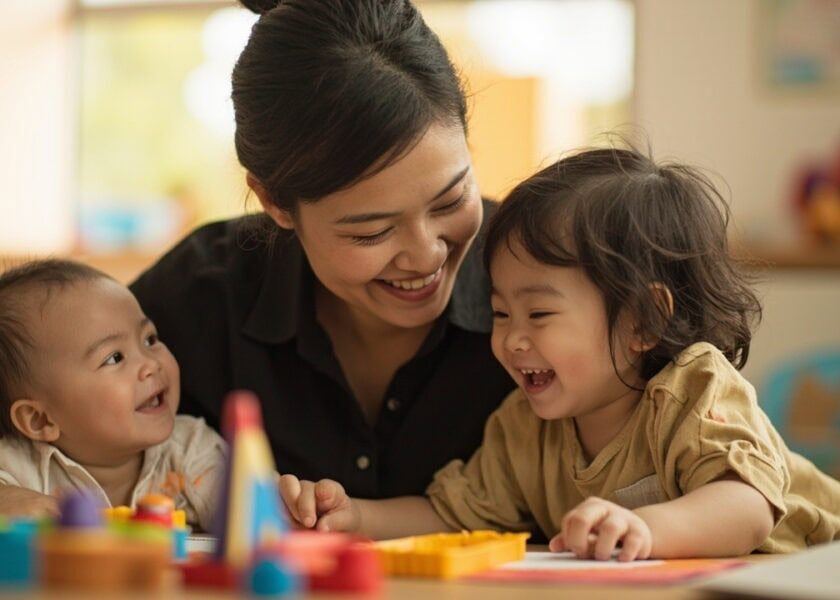
Consider a practical example. Your eighteen-month-old spends the morning with a responsive childminder who notices their tired cues, offers comfort when they stumble, and celebrates their discoveries. When you arrive at pickup, your child has been held and engaged all morning. They are not depleted from attention. They are replenished.
They run to you with the confidence of a child who knows that people can be trusted, that comfort is reliable, and that they can miss you while also feeling secure with someone else. You are not competing with your child’s caregiver. You are both building the same secure base.
Why This Message Matters in Singapore
Parents in Singapore face particular pressures that make this reframing especially important. The cost of living, the demands of careers, the long hours of a global city, the expectations of extended family, the awareness that every early choice feels decisive—these are the realistic circumstances of modern family life in Singapore. Parents should not have to carry guilt for navigating these circumstances responsibly.
The question is not whether you should feel guilty for working. The question is whether the care you choose is the kind that builds your child’s security, and whether you can trust yourself to recognize that you are not failing by seeking it.
Quality childcare in Singapore should not be positioned as a compromise. It should be designed and chosen as a developmental partnership—one that works in the same direction as attachment, reinforcing what you are building at home.
When care includes responsive attention, warm engagement, consistent routines, partnership with parents, and age-appropriate ratios, it creates the conditions for what thoughtful childminding partnerships call it: not a handoff, but a dialogue. Not a replacement, but a reinforcement.
Addressing the Concerns You May Carry
Parents exploring childcare options often carry unspoken questions beneath the surface of their thinking. These concerns are worth addressing directly.
Will my child still need me?
The answer, grounded in everything we know about human development, is: your child will not need you less. Your child will need you differently, and that difference is a gift.
The child who is truly secure in their attachment does not cling to their parent because they are afraid of loss. They sit in your lap because they choose to. They tell you about their day because they trust you with it. They reach for you at the end of the day not because you are the only one who can comfort them, but because your particular comfort is irreplaceable—not because no one else can do what you do, but because you are their parent, and that bond is unique in the architecture of their life.
Am I failing by choosing external care?
The guilt of working. The guilt of needing help. The guilt of wanting time for yourself, or time for your marriage, or time to be a full person in the world. These are not moral failures. These are the realistic circumstances of modern family life.
A securely attached child is not a child who is dependent on one person for survival. A securely attached child is a child who has internalized the capacity for connection itself. They trust that people will be there. They trust that love is reliable. And so they can explore, they can grow, they can welcome new experiences, and they can return. They are not diminished by the world. They are made larger by it, and they bring that largeness home to you.
How do I know the care is truly quality?
Ask questions. Visit. Observe the caregiver’s interactions with children. Notice whether the environment allows for responsive attention—small ratios matter. Ask about training, communication practices, and how the childminder works with parents. Quality care welcomes these questions because quality care has nothing to hide.
The right care should feel like an extension of your family, not a departure from it. Trust your observations. Trust your child’s response. And trust that seeking quality care for your child is an act of love, not a failure of it.
What to Look for in a Care Partnership
For families in Singapore, not all childcare arrangements are the same. Understanding what quality looks like can help you make a decision with confidence rather than compromise.
- Responsive ratios: Small ratios matter. A caregiver who can notice a child’s cues, respond to distress, and celebrate discoveries in real time is doing something fundamentally different from one who is managing a larger group.
- Trained, intentional caregivers: Look for childminders who are trained in child development, not just childcare logistics. The difference shows in how they engage, how they communicate, and how they observe.
- Transparent partnership: Quality care communicates openly with parents. Updates, observations, and honest dialogue about how your child is doing are signs of a genuine partnership, not just supervision.
- ECDA-aligned standards: In Singapore, the ECDA Childminding Pilot sets a framework for quality childminding that goes beyond basic childcare licensing. Arrangements aligned with these standards are designed with infant and child development in mind.
- Accessible to working families: Care should be structured around the reality of working parents—reasonable hours, accessible fees, and support for schemes like CDA and Baby Bonus.
These are the conditions that allow a childminder to become a genuine developmental partner rather than simply a substitute supervisor. They are the conditions that EduNanny Singapore is designed to provide under the ECDA Childminding Pilot.
The Secure Child Reaches Further
Choosing quality care is not a diminishment of your role as a parent. It is an investment in your child’s capacity to fully receive you.
We do not promise perfection. No honest partner in care does. What we promise is commitment: to care informed by developmental science, to communication that keeps you informed, to ratios that allow for genuine responsiveness, and to a vision of what childcare can be when it is designed not to substitute for parents but to serve families as a whole.
Because that is what this is really about. Family wholeness. Not the false choice between being a good parent and being a working parent, or between developmental excellence and emotional security. The research and the practice both tell us these are not in tension. The child who thrives in quality care comes home more ready to thrive with you. The child who is securely held by a responsive caregiver reaches for their parent with greater confidence, not lesser.
So here is the image I want to leave you with, the one that opened this conversation. You pick up your child. They see you. They run. Not because they must, but because they want to. Because they are sure of you. Because they have been secure all day, and now they are secure enough to run, to reach, to give you their full and joyful self.
That child is what we are working toward. That reunion is what thoughtful, developmental childminding exists to make possible.
You are not in competition with your child’s caregiver. Together, you are building the secure base from which your child will reach for the world and return to you, again and again, for the rest of their lives.
Explore what developmental partnership could look like for your family.
Connect with EduNanny Singapore to learn more about our approach, our standards, and how we work with families across Singapore under the ECDA Childminding Pilot.