What Singapore Parents Miss on a Childcare Centre Visit
Reading the Visit: What to Watch For
Before going deeper, here are the essential signals every parent should watch for during a childcare visit:
- Watch what is not prepared for you. Quality lives in unguarded moments, not the polished lobby.
- Observe caregiver responsiveness. Does the adult respond to the child, even the non-verbal kind?
- Read the children’s behaviour. Children who feel safe explore with ease and express a full range of emotions.
- Ask about turnover and continuity. Consistency is not a luxury for infants; it is a developmental necessity.
- Notice the environment’s warmth. Does it feel inhabited and human, or sterile and institutional?
- Trust your observations, not just your impressions. The feeling of a place matters, but it must be combined with attention.
You are not a passive guest on that tour. You are a diagnostician, whether you feel equipped for that role or not. The question is not whether you have the right to evaluate — you do. The question is whether you have the language and the attention to do it with accuracy.
The Difference Between What You Are Shown and What You Are Told
When you walk into any facility, you are being shown something. The lobby is often the most polished space — fresh flowers, clean surfaces, carefully arranged display boards celebrating children’s work. The tour route is designed. The timing is chosen. Staff know when visitors are coming.
This is not deception. It is simply the nature of hospitality. But it means that the surfaces of a visit — the aesthetics, the scripted warmth, the prepared answers — are not where quality lives.
Quality lives in the moments that are not prepared for you.
A child wandering unsupervised toward a door while a caregiver’s back is turned. A question asked by a two-year-old that goes unanswered for thirty seconds, then a minute, while the caregiver finishes what she is doing. The temperature of a room — not just whether it is climate-controlled, but whether it feels inhabited, warm, human. The sound level. The way children move through the space — rushed and corralled, or at ease and purposeful.
These are the honest signals. They cannot be rehearsed. They reveal what a centre is in its unguarded moments, and those moments are what matter most when your child is the one who will inhabit them daily.
What Responsive Caregiving Looks Like
Consider what you are actually observing when you watch a caregiver interact with a child. Not the posed photograph on the wall. Not the scripted activity demonstration. The real interaction, in real time, between a real adult and a real child.
Responsive caregiving is one of the most reliable indicators of quality, and it is also one of the most misunderstood. Parents often look for warmth — a smiling face, a gentle tone. These matter. But warmth without responsiveness is just performance.
What you want to watch for is this: does the caregiver respond to a child’s communication, even the non-verbal kind?
- A nine-month-old reaches toward a toy and makes a sound that is not yet a word. Does the caregiver notice and interpret? “You want the red one?”
- A toddler stumbles and looks up, startled by their own loss of balance. Does the nearest adult glance up, offer a calm “I’m here,” and then let the child recover on their own?
- A child approaches a caregiver during free play. Does the caregiver crouch down, make eye contact, speak directly? Or does she remain standing, issuing instructions from above?
These are small moments. They happen in seconds. But they are the vocabulary of your child’s daily emotional life.
Watch for the quality of attention. Does the caregiver’s gaze follow the children, or is it fixed on paperwork, on a screen, on the door? When a child approaches, does the caregiver physically come down to their level? Does she put away whatever she was holding to give her full attention?
The body tells its own truth. Trust the body.
What Children Reveal About a Facility
Children are not good at performing. They are spectacular at being themselves. And this is precisely why a childcare visit, if you know how to read it, is one of the most honest assessments available. The children in a facility are its most unguarded witnesses.
Signs of Emotional Safety
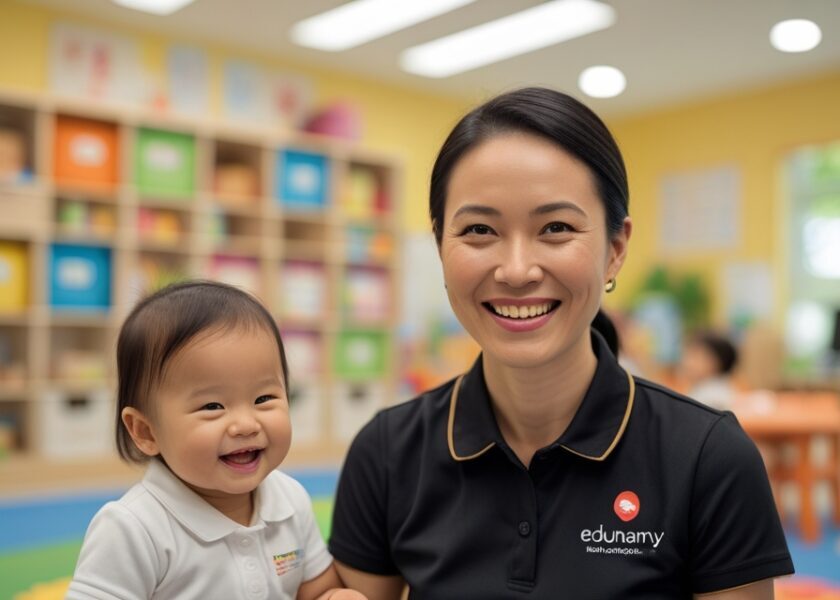
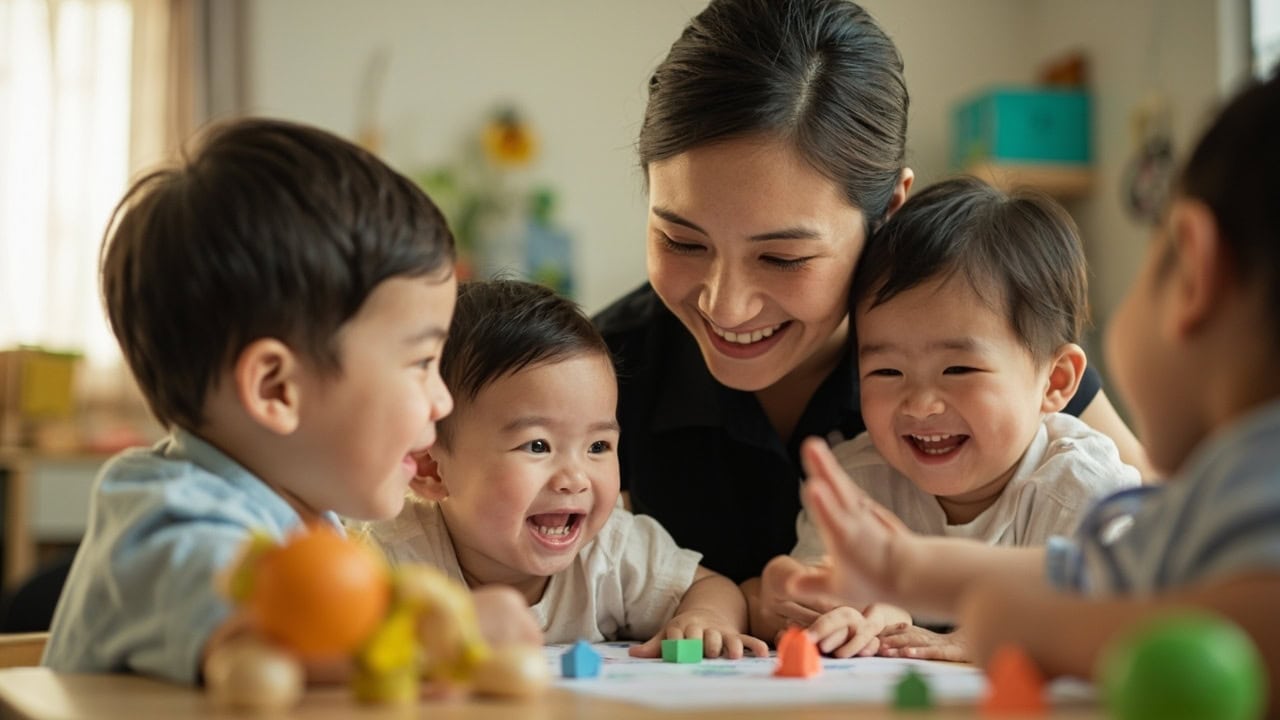
Watch how they move through the space. Children who feel safe explore. They move away from caregivers with the easy confidence of those who know they can return. They engage with materials — toys, books, sensory tables — not because they are directed to, but because they are curious.
Children who are anxious move differently. They cluster near adults. They watch the door. They cry more, or they have learned to suppress crying because it does not bring comfort.
The absence of distress is not the same as the presence of ease. You are looking for ease.
The Full Range of Expression
Notice the range of emotional expression you observe. A high-quality childcare environment is not a place where children are constantly happy. It is a place where children feel safe enough to be sad, frustrated, or angry — and where adults respond to those emotions with steadiness rather than suppression.
Watch for the child who is having a difficult moment. Does a caregiver move toward them? Does the caregiver offer presence, or does the caregiver offer distraction — a screen, a toy, a sharp redirect?
Distraction may calm a behaviour. It does not address a feeling. And it is feelings that build the architecture of a child’s developing mind.
This is not to say that every caregiver interaction you observe will be perfect. Perfection is not the standard. The standard is attunement — the consistent orientation toward a child’s emotional reality, the willingness to see and respond rather than simply manage.
Questions That Reveal Truth
There is a question that Singapore parents often feel embarrassed to ask: what questions should I actually be asking? The fear of seeming difficult, of being perceived as overbearing or distrustful, prevents many parents from gathering the information they need.
This is understandable, and it is also a mistake.
The right questions are not confrontational. They are diagnostic. And the most revealing questions are often the simplest ones — asked not to trap, but to understand.
Ask About Caregiver Turnover
This is one of the most significant and underappreciated factors in quality. A facility with high staff turnover is a facility where relationships cannot form. For infants and toddlers, consistency is not a luxury — it is a developmental necessity.
Attachment theory is not abstract here. It is embodied in the specific adult who knows how your child likes to be comforted, what soothes them, what their particular cry means.
Ask about turnover rates, ask about how new staff are integrated, ask about continuity of care for individual children. If the answers are vague or evasive, that itself is information.
Ask About Routines and Individualisation
Ask about how feeding and sleep routines are handled. In infant care, these are not peripheral concerns. They are the core of the daily rhythm.
- Is feeding on schedule or responsive to the child’s cues?
- Are sleep environments safe and individualized?
- Are parents’ documented preferences respected and tracked?
- What happens if a child is ill, or refusing food, or having a difficult day?
These questions reveal operational philosophy. A facility that has thoughtful, individualized answers is a facility that has thought about your child as a specific person, not a category.
Ask About Communication
How will you know what happened today? Singapore’s more progressive childcare providers have moved toward greater transparency — some with dedicated apps, daily updates, and photo sharing.
Ask not just whether communication exists, but what form it takes and how consistently it is delivered. For working parents who spend their days away from their child, regular, meaningful updates are not a luxury. They are the thread that keeps you tethered to your child’s life.
These questions do not signal distrust. They signal love applied intelligently. The parent who asks is not the difficult parent. The parent who asks is the parent who is paying attention.
Your Honest Assessment: A Quick Reference
Use this guide to structure your observation during any childcare visit or home-based care arrangement evaluation:
| What to Observe | Signs of Quality | Signs to Note Carefully |
|---|---|---|
| Caregiver attention | Gaze follows children; crouched to child’s level; full presence | Fixed on paperwork, screen, or door; speaks from above |
| Child movement | Confident exploration; comfortable distance from adults; purposeful engagement | Cluster near adults; watch the door; rushed or corralled |
| Emotional expression | Full range allowed; caregivers move toward distress | Suppressed crying; distraction used instead of presence |
| Responsiveness | Interpreted non-verbal cues; calm “I’m here”; acknowledgment | Unanswered questions; rushed rescues; warm but inattentive |
| Environment tone | Warm, inhabited, human-scale; sounds of engaged children | Sterile, institutional; TV constant; loud without purpose |
Addressing Common Concerns
“I don’t want to seem difficult.” Many parents worry that asking questions will mark them as problematic or distrustful. This concern is understandable but misguided. A quality provider expects questions. They are not threatened by parents who care deeply about their child’s care. If a facility responds defensively to reasonable inquiries, that itself is informative.
“What if my gut feeling is wrong?” The instinct most parents feel in that moment is to trust their gut. And gut instinct is not nothing. It is shaped by a lifetime of experience, by the accumulated wisdom of your own values and priorities. But gut instinct alone, without the framework to interpret what you are actually observing, can be misled.
A beautiful lobby can feel reassuring even when the infant room is understaffed. A charismatic director can inspire confidence even when the operational details are shaky. The feeling of a place — its warmth, its aesthetic, its emotional tone — is not irrelevant. But it is not sufficient. It must be combined with observation, with questions, with the willingness to look past what is shown to you and ask what is true.
“How do I know if the tour is misleading?” Request a second visit, ideally unannounced if possible. Ask if you can observe during different times of day — morning routine, nap time, feeding. Ask to speak with current parents. The answers to these questions, and the willingness with which they are answered, will tell you a great deal about what the facility is like when no one is preparing for a tour.
Choosing With Clarity: The Informed Parent
The parent who leaves a childcare visit with clarity — who knows what questions to ask, who can read the signals, who understands the difference between warmth and responsiveness, between performance and practice — that parent has done something genuinely difficult.
They have held their love and their judgment together. They have refused to be a passive impression-taker. They have chosen with their eyes open.
And here is what that parent will find, again and again: when you know what quality looks like, you will recognize it.
- You will see it in the way a caregiver moves toward a child.
- You will hear it in the way a question is answered — whether with genuine thought or rehearsed deflection.
- You will feel it in the atmosphere of a room: whether it is sterile and institutional or warm and inhabited.
Quality is not a secret. It is simply specific. And the parent who learns those specifics gains something invaluable: not just a better childcare choice, but a deeper understanding of what their child needs and deserves.
The Relationship That Matters Most
Beyond ratios and routines and operational philosophy, what matters most is the daily relationship your child will have with their caregivers — and the relationship you will have with those caregivers.
A childcare arrangement is not a transaction. It is the daily context of your child’s earliest experience of the world outside your home. That context should be warm, safe, stimulating, and marked by genuine human relationship. It should not be adequate. It should be excellent.
The relationship is built in small moments:
- A caregiver who remembers that your daughter does not like her hair touched.
- A daily note that says not just “had a good day” but “played with blocks for twenty minutes, seemed very proud of her tower.”
- A phone call when something small happened, because you would want to know.
These are not extraordinary gestures. They are ordinary ones. But ordinary attentiveness, sustained over time, is how trust is built — and how your child learns that the world outside your home can be trusted too.
Begin With Confidence
The childcare visit is not a test you pass or fail. It is a conversation you learn to have — with the space, with the people, with the children who inhabit it, and ultimately with yourself about what you believe quality to be.
When you walk into a childcare centre with informed eyes, you do not lose the joy of the decision. You gain the confidence that comes from knowing you chose with clarity.
That confidence is not for you alone. It is a gift to your child. Because the parent who trusts their own judgment is the parent who can relax into trust with their child’s caregivers. And the child who feels that relaxed trust — who senses that their parent is at ease with where they are — is a child who feels safe in the very best way.
Singapore parents are not looking for the cheapest option or the most convenient one. They are looking for the right one — care that is safe, warm, stimulating, and human. Caregivers who love their work. A partner in the earliest and most consequential years of their child’s life.
These are not unreasonable expectations. They are the minimum.
And they are achievable. Not perfectly, not without effort, but consistently, sustainably, and with the kind of attention that every infant deserves.
Ready to visit a childcare arrangement with informed confidence? At EduNanny Singapore, we welcome parents who ask these questions — because they are the questions that matter. Speak with our team to learn more about how we approach infant care, or explore our ECDA-licensed childminding programme as an alternative model for thoughtful, relationship-centred childcare in Singapore.
#SingaporeChildcare #InfantCareSG #ChildmindingSingapore #EduNannySG #EarlyChildhoodDevelopment