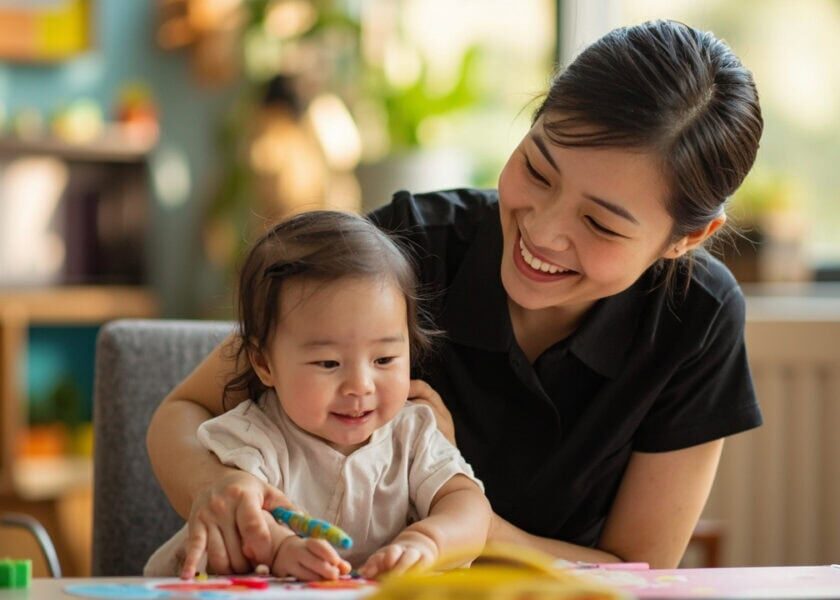
The Singapore Parent’s Guide to Childcare Decisions Made with Confidence
The Question Every Singapore Parent Asks at 2am
It arrives quietly. Not when you’re scrolling through parenting forums or touring childcare centres with their polished brochures and carefully arranged classrooms. It comes in the small hours, when the house is still and your child is finally asleep, and the weight of the day settles into something heavier than exhaustion.
The question sounds like this: Am I doing enough?
In Singapore, where the standards for parenting can feel impossibly high, where childcare conversations often reduce to outcomes and costs, and where mentioning that someone else will care for your child—even for a few hours—can produce a subtle, unmistakable shift in the room, this question carries specific weight. It is not philosophical. It is lived.
If you have felt this, you are not alone. And you are not failing. You are navigating one of the most complex emotional landscapes modern parenthood offers—because the decision to seek childcare support is, at its heart, a decision made from love.
This article is for parents in Singapore who are in the thick of this tension. Who are reading brochures and lying awake wondering if they are making the right call. Who want clarity without being dismissed, and support without being sold to. We are going to explore what quality childcare actually looks like, why the conventional framing of this decision misses the point entirely, and how the right childcare arrangement can become the thing that strengthens—not replaces—your family.
The Love and Cultural Weight Behind This Decision
Choosing childcare is not simply a logistical decision. It is an emotional one. It is a declaration about what you believe your family needs and what you believe you are capable of providing.
The fear that many Singapore parents carry—that needing help means something is wrong—is not irrational. It is the sign of a parent who cares deeply. And it is reinforced by a cultural script that tells parents, often through well-meaning relatives or casual comments at family gatherings, that family should be the primary network of care, and that turning outside that network is both a practical necessity and a quiet admission that the family unit has somehow fallen short.
Singapore families navigate a beautiful and complicated layer that cannot be ignored: the multigenerational dimension of family life. Grandparents often play active, daily roles in children’s lives—and that role carries expectations, traditions, and sometimes unspoken judgments about what good parenting looks like. The message can feel clear: wanting time to return to work, to pursue a career, to reclaim a sense of self beyond parenthood, is something to be justified rather than celebrated.
So parents carry two burdens simultaneously: the genuine, love-driven difficulty of being away from their child, and the additional weight of navigating a cultural narrative that makes that difficulty feel like a personal failing.
Reframing the Question Entirely
After years of working alongside families in Singapore, and after listening carefully to what parents actually say when they feel safe enough to be honest, a pattern emerges: the childcare question is never really about childcare.
It is about what kind of family you want to build. It is about whether you believe your family can be strong enough, flexible enough, and loving enough to hold everyone in it—including you—in a way that allows each person to grow.
We have been asking: Who will take care of my child while I am away? Or at best: Will this childcare centre provide good enough care?
But the question that actually matters—the question that, when answered honestly, transforms the entire childcare decision from a source of guilt into an act of family leadership—is this:
What kind of family do I want this to make us?
Family as a Living System
A family is not a collection of isolated parent-child dyads. It is a living system—an intricate ecology of relationships, needs, rhythms, and growing edges.
When one member of that system is struggling—whether it is a parent who is depleted, a child who needs more stimulation than one exhausted adult can provide, or a sibling whose needs are being monopolised by a demanding infant—the entire system feels it.
Consider a mother who returns to work when her infant is ten months old. She spends her days in meetings, managing teams, making decisions. She pumps in bathrooms and counts hours. By the time she picks up her child in the evening, she is running on reserves. She loves her daughter desperately, but the love sometimes feels buried under the exhaustion. Bedtime becomes rushed. Play feels obligatory. Reading her daughter’s cues—the subtle signals of what she needs—becomes harder because she is not as present as she once was when she had the luxury of time.
Now consider the same mother, but in a different scenario. Her daughter is in a warm, safe, developmentally rich environment during the day—not just being babysat, but engaged, stimulated, observed by caregivers who notice her emerging personality, who respond to her curiosity, who create the kind of responsive environment that builds foundations for emotional regulation, language, and social trust.
And the mother arrives each evening not as a depleted version of herself, but with something left to give. Bedtime becomes a sanctuary. Play becomes joyful. She notices things about her daughter that she would have missed if she had spent the whole day in a fog of fatigue.
Her daughter, who has been building secure attachments all day in a high-quality environment, runs to her mother with the full, trusting confidence of a child who knows she is loved—not because her mother was present every single hour, but because the presence that matters most was present when it counted.
This is not hypothetical. This is what families describe when childcare is working the way it should: a transformation from feeling like they are drowning to parenting with intention.
What Quality Childminding Actually Looks Like
Quality is a word that gets used loosely, so let us be precise about what it means in the context of infant care and childminding.
Quality Is Relational
It is the ratio of attentive adults to children in a room. Research consistently shows that when one caregiver is responsible for fewer infants, each infant receives more attention, more responsiveness, and more of the early relational experiences that shape brain development.
In infant care settings, the ECDA Childminding Pilot framework establishes guidelines that reflect this reality. Maintaining ratios of up to one caregiver to three infants in infant care settings is not an arbitrary standard—it reflects the simple truth that the depth of attention an infant receives in those critical early months is a foundation, not a luxury.
Quality Is About Continuity
It is about consistent, warm responsiveness that allows an infant to build the secure attachment that becomes the template for every relationship they will ever have. Infants do not simply need supervision. They need reliable, attuned caregivers who can read the difference between a cry of mild frustration and a cry of genuine distress, and respond accordingly.
Quality Is About Partnership With Parents
It includes regular updates, transparent reporting, and communication practices that build trust rather than anxiety. When parents feel connected to what is happening during the day, they arrive home more present. The anxiety that seeps into bedtime routines—the second-guessing, the worrying—dissolves when trust is structural, not just emotional.
Trust in the childcare relationship is not a soft, sentimental idea. It is a structural requirement. A parent who does not trust their child’s caregiver cannot be fully present when they are with their child. The anxiety follows them home. It seeps into the bedtime routine. It makes them second-guess every decision.
Quality Is About Caregiver Investment
A childminder is not a babysitter performing a function. A childminder is a developmental partner in a child’s early life, and that role deserves recognition, training, and dignity. When we talk about raising the standard of infant care in Singapore, we are talking about elevating the professional identity and emotional capacity of the people who spend their days with our youngest children.
Addressing the Concerns You Actually Have
“Am I outsourcing love?”
You are not outsourcing love. You are not buying your way out of parenting. You are making a sophisticated, love-driven decision about the ecosystem your family needs to thrive.
The quality of connection between parent and child is not improved by sheer proximity. It is improved by presence. And presence is not measured in hours—it is measured in attentiveness, in responsiveness, in the emotional quality of the interactions that take place when parent and child are together.
“Will my child feel abandoned?”
When children are in responsive, consistent, warm care environments, they build secure attachments—not just with their primary caregivers, but with the concept of being safely held by trusted adults. This is protective. It teaches children that the world contains people who will respond when they call, who will notice when they need something, who will keep them safe.
Children whose parents return to them each evening with presence, patience, and emotional availability—not because they are depleted, but because they have had space to refill—do not suffer from abandonment. They thrive on the security of knowing their parents chose care that honours them.
“What will people think?”
This concern is real, and it deserves honest acknowledgement. The multigenerational expectations in Singapore families add genuine complexity to this decision. The cultural script that frames family care as the only legitimate form of care is powerful.
But here is the reframe: choosing quality care is not a retreat from parenting. It is an investment in the very conditions that make great parenting possible. It is family leadership—the recognition that a family unit thrives when every member of it has what they need to grow.
“How do I know if it’s actually good?”
Look for relational indicators, not just facilities. The questions that matter most:
- What is the caregiver-to-child ratio?
- Who are the caregivers, and what training have they received?
- How is continuity of care maintained?
- What does communication with parents look like?
- How does the environment support developmental exploration?
- What fee structures are available, and how do they align with practical accessibility?
A Framework for Choosing Infant Care in Singapore
Every family has a unique ecology. There is no single right answer. But there is a framework that can help you make a decision from clarity rather than anxiety.
Step 1: Name What Your Family Actually Needs
Not what the parenting books say you should need. Not what your relatives expect. What does your specific family need right now to function at its best?
Is a parent depleted? Does a child need more social stimulation? Does a sibling need more individual attention? Is there a practical reality—work, health, circumstances—that requires support?
Step 2: Define What “Success” Looks Like for Your Family
If the measure of successful childcare is only child outcomes—developmental milestones, school readiness—you are asking an incomplete question. The complete question includes parent wellbeing, sibling relationships, and the quality of the home environment.
Success looks like: parents who arrive home with something left to give. Children who are secure, curious, and growing. Siblings who each feel seen. A home that is warm, patient, and connected.
Step 3: Evaluate Fit, Not Just Reputation
A centre with a prestigious reputation may not be the right fit for your family’s values, rhythms, and needs. What matters is alignment: does this arrangement support the ecosystem you are trying to build?
Consider home-based childminding if you want your child in a more intimate, family-integrated environment. Consider centre-based care if social development and peer interaction are priorities for your family right now.
Step 4: Ask About Partnership
The best childcare arrangements are not transactions. They are ongoing conversations. Ask how the provider communicates with parents. Ask how concerns are addressed. Ask how they handle the transitions and adjustments that every family experiences.
You deserve a childcare partner who understands that this is not about them replacing you—it is about them supporting you.
Begin the Conversation
You are not making a compromise. You are making a choice made from love, in service of your family’s long-term flourishing.
The family unit thrives when every member of it has what they need to grow. A parent who is burnt out, isolated, or depleted is not a better parent simply because they refused help. The love you have for your child is not measured in hours—it is measured in the quality of presence you bring when you are together.
Choosing quality care is not a vote of no confidence in your parenting. It is a vote of confidence in your family’s capacity to grow, to adapt, and to hold everyone in it with love.
That is family leadership. That is what this decision really is.
If you are in the thick of this decision—reading brochures, touring centres, searching for something that feels right for your family’s unique ecosystem—we invite you to begin a conversation with EduNanny Singapore. Not to be sold to. Not to be convinced. But to explore whether a partnership built on trust, quality, and genuine respect for what your family needs is possible.
Because you deserve a childcare arrangement that amplifies your family’s love, not one that competes with it. And your family deserves the chance to flourish—not just in the outcomes you hope for, but in the daily experience of being together with warmth, patience, and presence.
That is what we are here for. Not a replacement. A partner.
At EduNanny Singapore, we believe childcare support should feel like an extension of your family’s love—not a departure from it. Learn more about our approach, or reach out to begin a conversation.