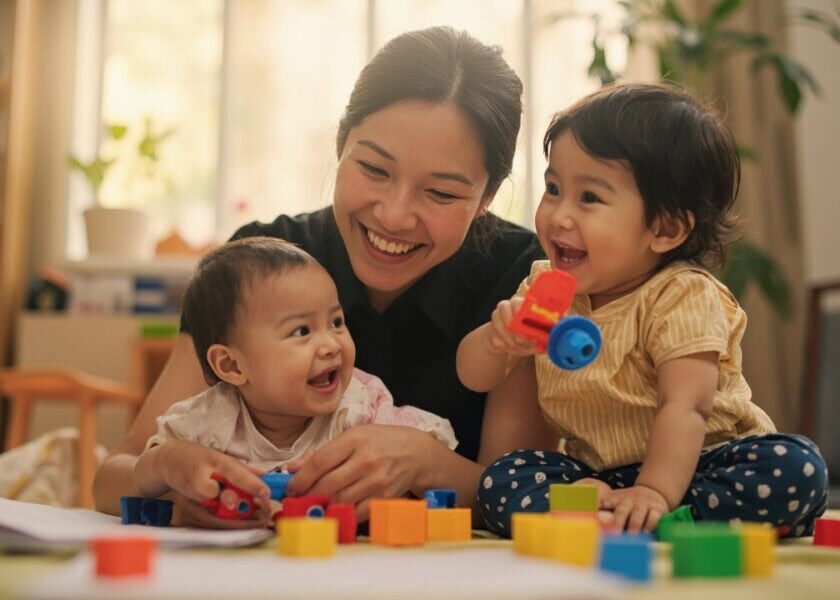
The Daily Reassurance Gap Singapore Parents Carry After Drop-Off
The Silence After the Goodbye: Understanding the Daily Reassurance Gap
There is a particular silence that follows the morning goodbye. You have kissed your child’s forehead, adjusted their collar, handed their bag to a caregiver, and walked out the door. The space behind you is filled with everything you cannot control—your child’s face in that moment of watching you leave, the particular quality of their day ahead, whether they will feel secure or anxious, whether they will eat well, sleep enough, be seen for exactly who they are in those small, significant hours when you are not there.
You carry this silence with you into your day, into meetings and commutes and tasks that require your full attention, while somewhere inside you a question keeps turning: how do I really know they are okay?
This is not a failure of trust in yourself or your choices. It is the fundamental condition of modern parenting in Singapore—the hours between morning drop-off and evening pickup are hours lived at a distance from your child’s most intimate experiences, and that distance creates something most childcare discussions completely ignore.
It creates a daily reassurance gap, and it is one of the most universal, unspoken tensions that Singapore parents carry.
When you enrolled your child in childcare, you made a decision based on research and recommendations and visits and gut feeling. You chose a place you believed could be a worthy extension of your care. But enrollment is a single moment, and what you actually live with is every day after—the repeated act of entrusting your child to someone else’s hands and then waiting, often in the dark, for evidence that this trust was warranted.
The daily reassurance gap is not about doubting your choice. It is about the simple, profound reality that love makes you need to know things you cannot witness. And the quality of your childcare relationship is measured, more than anything else, by what happens in that gap—in the hours you cannot see, the communication you do or do not receive, the difference between wondering and knowing.
What Most Childcare Communication Actually Provides
Most childcare communication operates on a simple model: a morning handover that may be hurried, a daily report that lists activities and meals, perhaps a photograph sent in the afternoon. These are not bad things. They are professional standards, and they represent genuine effort.
But they answer a different question than the one you are actually asking. You are not primarily asking: what did my child eat for lunch? You are asking: how did my child feel today? Did they feel safe? Did they laugh? Did they struggle with something, and if so, how was it handled? Did the person caring for my child truly see them—not just supervise them, but understand them, notice them?
This is the reassurance gap. It is not a gap in service quality, necessarily. It is a gap in communication philosophy. Most childcare providers communicate what happened. Premium childcare communicates who your child is and how they are becoming.
The difference seems subtle until you have experienced both—until you have lived through months of receiving activity logs and suddenly encountered a caregiver who tells you, unprompted, that your daughter spent twenty minutes watching a butterfly outside the window and seemed deeply peaceful in a way that was different from her usual energy. That detail is not in any checklist. It exists only when someone is paying the kind of attention that sees your child as a whole person rather than a set of needs to be met.
Why Bridging the Gap Matters for Your Whole Family
The answer to this question has consequences that extend far beyond parental peace of mind. Research consistently shows that when parents feel securely connected to their child’s daytime care—when they have meaningful information that answers their real questions—something shifts in the entire family ecosystem.
- Parents are less anxious in the evenings. They are more present during the hours they do have with their children because they are not spending those hours in a state of wondering.
- The bedtime routine is calmer. The weekend is richer.
- The primary attachment relationship strengthens. A parent who feels genuinely informed can relax into the irreplaceable role of being the primary attachment figure, rather than feeling like they are constantly managing uncertainty.
Children feel this too, in ways that are measurable even if they are not immediately visible. A child whose parents are calm and confident picks up on that security. A child whose parents are quietly anxious about the childcare relationship absorbs that tension, even when no words are spoken.
When childcare is truly excellent—when it includes thoughtful, daily, developmentally-informed communication—the whole family system benefits. The reassurance gap is not just a parent problem. It is a family problem, and closing it properly creates conditions for better outcomes for everyone.
What Quality Childminding Actually Looks Like
Understanding the reassurance gap helps you evaluate childcare options with a clearer lens. Here is what to look for when you are assessing whether a provider can genuinely bridge the distance between drop-off and pickup:
Communication That Tells You Who Your Child Was That Day
Quality childminding is not just about activities logged and meals recorded. It is about developmental narrative—the story of your child’s day told in a way that connects to who they are becoming.
- Updates that describe how your child approached something, not just what they did
- Observations that name emotional states: “Your son seemed more tired than usual this morning and we adjusted his routine accordingly”
- Small moments that reveal personality: “Your daughter discovered she could make the block tower taller than herself today and was absolutely delighted”
- Communication that invites partnership: “Today your child seemed interested in the book about animals—would you like us to have more of those available this week?”
Caregiver Attention That Sees the Whole Child
The ratio of caregivers to children matters—not as a marketing claim but as a structural reality. When ratios are genuinely low, caregivers can:
- Notice the subtle shift in mood that might indicate tiredness or discomfort
- Celebrate the small triumphs that happen in ordinary moments
- Build knowledge of each child over time that informs how they respond to different situations
- Provide comfort and continuity in a way that large groups simply cannot replicate
Transparency and Communication Tools
Some days you need more than a written description. You need to see. Providers who offer meaningful transparency—through measures like CCTV access where deployed—demonstrate a different kind of confidence in their care. When what you are told matches what you can see, trust becomes a foundation rather than a hope.
Singapore parents are managing real complexity: careers and commutes and the particular pressures of raising children in one of the world’s most demanding urban environments. You do not have time to decipher vague updates or piece together fragments of information. Quality childminding reduces friction in communication rather than adding to it.
The EduNanny Approach: Structure That Enables Excellence
EduNanny operates within the ECDA Childminding Pilot, part of a carefully structured ecosystem designed to make quality childminding accessible and affordable for Singapore families. The pilot framework allows us to maintain the kind of attention and communication standards that would be difficult to sustain in a less intentionally designed environment.
Our home-based and community pathways, alongside our centre-based options, offer families different settings while sharing the same foundational commitment to quality. Key features include infant ratios up to 1:3, affordable fee structures, and CDA and Baby Bonus access—so that financial considerations do not need to be a barrier to quality care.
What You Actually Receive with EduNanny
Ratios and frameworks are the foundation. But what you live with every day is the communication. What you experience is the daily touchpoint that tells you not just that your child was safe, but who they were.
Your child tried to climb the low stool today and was so proud when they managed it. That observation tells you something about their physical development, their emerging confidence, their sense of determination. It is not a data point. It is a window into who they are becoming.
When caregivers observe and share emotional patterns—not just behaviour but the feeling behind it—you gain insight that helps you respond to your child more attuned when you reunite in the evening. “Your son seemed more tired than usual this morning and we adjusted his routine accordingly” is not just information. It is care that continues across the distance.
Quality childminding is not a one-way broadcast. It is an ongoing dialogue. When we notice your child’s emerging interests, we share them with you—not to report, but to involve you. “Today your daughter seemed interested in the book about animals, would you like us to have more of those available this week?”
Tools and Transparency That Support Connection
We have introduced Thomas, our AI-powered chatbot, as part of how we make communication easier for families. Thomas is not a replacement for human communication—nothing replaces a caregiver who knows your child’s face and can tell you something real. But Thomas is a tool that closes gaps in information flow. If you have a question during the day, you can ask it and receive a considered response. If you want to know about your child’s recent developmental patterns, Thomas can draw on our records and observations to give you a coherent picture.
We also understand that some days you need more than a written description. You need to see. Where deployed, CCTV measures provide an additional layer of confidence. We want you to have that access, because there is no ambiguity in honesty. When you can see, and when what you see matches what we tell you, trust is not a hope. It is a foundation.
Questions Parents Actually Ask
“Am I being unreasonable to want this much information?”
You are not being unreasonable. You are being a parent. The need to know that your child is seen, safe, and thriving in ways that matter is not an unreasonable expectation. It is the most reasonable expectation in the world. The question is not whether your need is valid—the question is whether your childcare provider treats it as valid.
“Isn’t this just helicopter parenting?”
No. There is a profound difference between hovering and partnering. Hovering is anxiety-driven and disrupts the child’s developing independence. Partnering is trust-driven and supports the child’s security while respecting the caregiver’s role. When you choose childcare that bridges the reassurance gap, you are not controlling what happens during the day. You are receiving honest information that helps you show up better as a parent when you are with your child.
“Can’t I just trust that everything is fine?”
Trust is built through consistent evidence, not blind faith. You can choose to trust your childcare provider while still wanting to understand what your child’s day looked like. These are not contradictory. In fact, the providers who are most worthy of trust are usually the ones most committed to transparency.
“Is this kind of care affordable for us?”
It should be. The ECDA Childminding Pilot framework was designed with accessibility in mind. CDA and Baby Bonus schemes can be applied, which means financial considerations do not need to be a barrier to quality care. We believe excellent childminding should be available to Singapore families across different circumstances.
What to Look for When You’re Choosing
When you are evaluating childcare options, here are the questions that actually matter:
- What will I know about my child’s day, and how will I know it? Ask specifically about the daily touchpoints. Will you receive narrative updates or just activity logs?
- What are the actual caregiver-to-child ratios? Ask for specifics, not marketing language.
- How does the provider handle developmental observations? Are they trained to notice and share meaningful moments, or just document activities?
- What does the handover process look like? Is there dedicated time for you to share and receive information, or is it hurried?
- How does the provider communicate about emotional wellbeing? Will you know if your child seemed anxious, tired, or unusually withdrawn?
- What transparency measures are in place? Is there anything beyond written updates that helps you feel connected?
- How does the provider handle concerns or questions? Is there a clear channel for you to ask questions during the day?
The childcare provider you choose should welcome these questions. If a provider seems defensive or vague when you ask about communication practices, that itself is information.
Choosing Partnership Over Transaction
There is something worth naming here about what it means to choose childcare that takes the reassurance gap seriously. When you choose a provider that bridges this gap—when you receive meaningful, daily, developmentally-informed communication about your child—you are not just making a practical decision. You are making a statement about what you believe your family deserves.
You are rejecting the idea that good enough is good enough. You are insisting that the hours between drop-off and pickup, which constitute so much of your child’s waking life, deserve to be understood and shared and honored in the way that you, as their parent, need them to be.
This choice has a compounding effect:
- When you know more, you worry less
- When you worry less, you are more present
- When you are more present, your relationship with your child deepens
- When your confidence grows, the whole experience of being a working parent in Singapore becomes more sustainable
You did not stop being your child’s parent when you dropped them at childcare. You became a parent who needs information to parent well across distance. And the right childcare provider recognizes this need and builds their entire approach around meeting it.
Singapore families are strong, but they are also stretched. Parents here are committed and loving and doing their best under conditions that would challenge anyone. What they deserve is not guilt or judgment about working and parenting. What they deserve is a childcare partner who takes seriously the weight of what it means to hold someone’s child in your hands—and promises to treat that trust with the daily attention it deserves.
Our Promise
EduNanny was built for this. We know that the morning goodbye is hard. We know that the hours between drop-off and pickup can feel very long. We know that you need to know—not just believe, but know—that your child is seen, safe, and thriving in ways that matter.
So when you leave your child in our care, leave them knowing that:
- The silence after the goodbye is a silence we take seriously
- Every day, we are earning the right to be trusted with what matters most to you
- When you pick them up in the evening, you will have answers to the questions you carried all day
- Not perfect answers, because no child and no day is perfect—but real answers, honest answers, answers that tell you who your child was that day and how they are becoming who they will be
We believe every Singapore family navigating this reality deserves access to care that treats their need for reassurance as legitimate, important, and worthy of serious response. That is why EduNanny exists—not as another option in a crowded market, but as an answer to a question that has gone largely unasked:
What would childcare look like if the daily reassurance gap was treated as its central problem?
The answer is care that sees your child completely. Care that tells you who they were today, not just what they did. Care that welcomes your questions and answers them with honesty. Care that uses every tool available—human attention, structured observation, technology, transparency measures—to make sure that the silence after the morning goodbye is not a void, but a space filled with genuine, trustworthy information.
Care that earns your confidence through consistency, day after day, until trust is not something you hope for but something you simply know.
Your child is ready.
And so are we.
If you are ready to explore childcare that bridges the reassurance gap, we invite you to connect with our team or learn more about EduNanny’s approach to quality childminding in Singapore. We would welcome the opportunity to answer your questions and help you find the right fit for your family.