The Invisible Hours That Shape Your Child’s Future
The Science Behind the Invisible Hours
When your child enters a quality childcare environment, something profound happens that most parents never witness and most childcare descriptions never explain. Your child is not simply occupying space until you return. They are engaged in one of the most significant developmental processes of their early life—the ongoing construction of trust, the refinement of their internal working model of how the world responds to their needs.
This is attachment science. And it is the most important thing you have never been told about what happens in childcare.
Understanding How Attachment Works
Attachment theory, developed by British psychiatrist John Bowlby and expanded through decades of research, tells us that children are not simply attached to their parents. They are attached to the patterns of care they experience. And these patterns shape not just their immediate emotional wellbeing, but the architecture of their relationships for the rest of their lives.
The first thousand days—this phrase you have heard in parenting books and prenatal classes—is not just a slogan. It is a scientific window. During this period, a child’s brain is building its fundamental understanding of whether the world is trustworthy, whether people are reliable, whether their needs will be met.
Here is what changes everything: this process does not pause when your child is in someone else’s care. It accelerates. The hours your child spends with their caregiver are hours in which their attachment system is actively forming, testing, and refining.
This is why the question is not simply, “Is my child being cared for?” It is: “What kind of attachment relationship is my child forming during the hours I am not there?”
The Secure Base: What Quality Care Looks Like
There is a concept within attachment science that helps translate this research into something you can recognize. It is called the secure base.
The secure base is what a child needs from their caregiver—not just in infancy, but throughout early childhood. It is a psychological experience of safety that allows the child to do two things that seem opposite but are actually deeply connected: it allows them to explore, and it allows them to seek comfort.
Think about what this looks like in practice. When a child feels truly secure—with you, with their caregiver, with anyone who has become a reliable attachment figure—they venture out. They climb the ladder at the playground because they trust that someone will catch them if they fall. They approach other children because they believe they can return to safety if the interaction becomes overwhelming.
And then, when they need to, they return. They seek proximity. They reach out their arms. They cry, not in panic, but in the secure knowledge that this cry will be heard and answered.
How Trained Caregivers Build Security
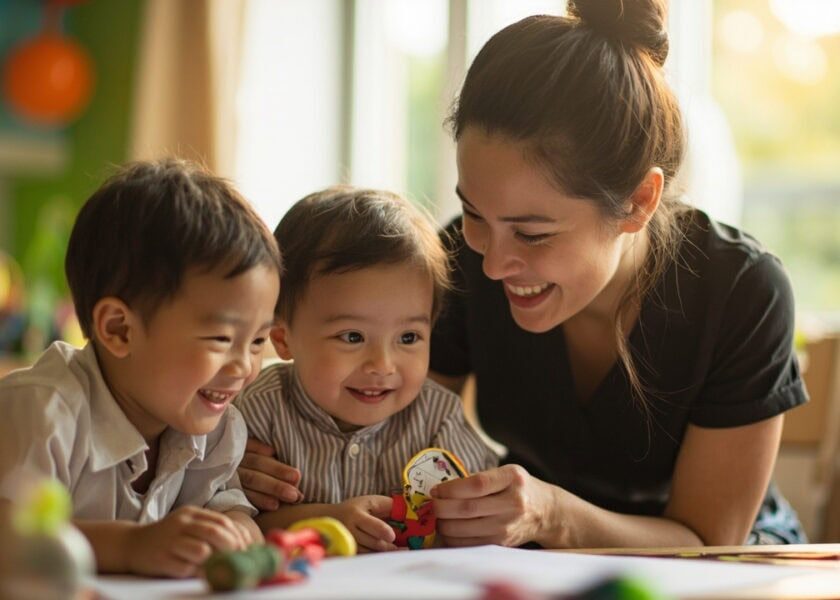
A caregiver who understands attachment science does not simply supervise children. They read them. They learn each child’s signals—the particular cry that means hunger versus the cry that means overstimulation, the body language that signals an approaching meltdown, the face that means curiosity is beginning to tip into fear.
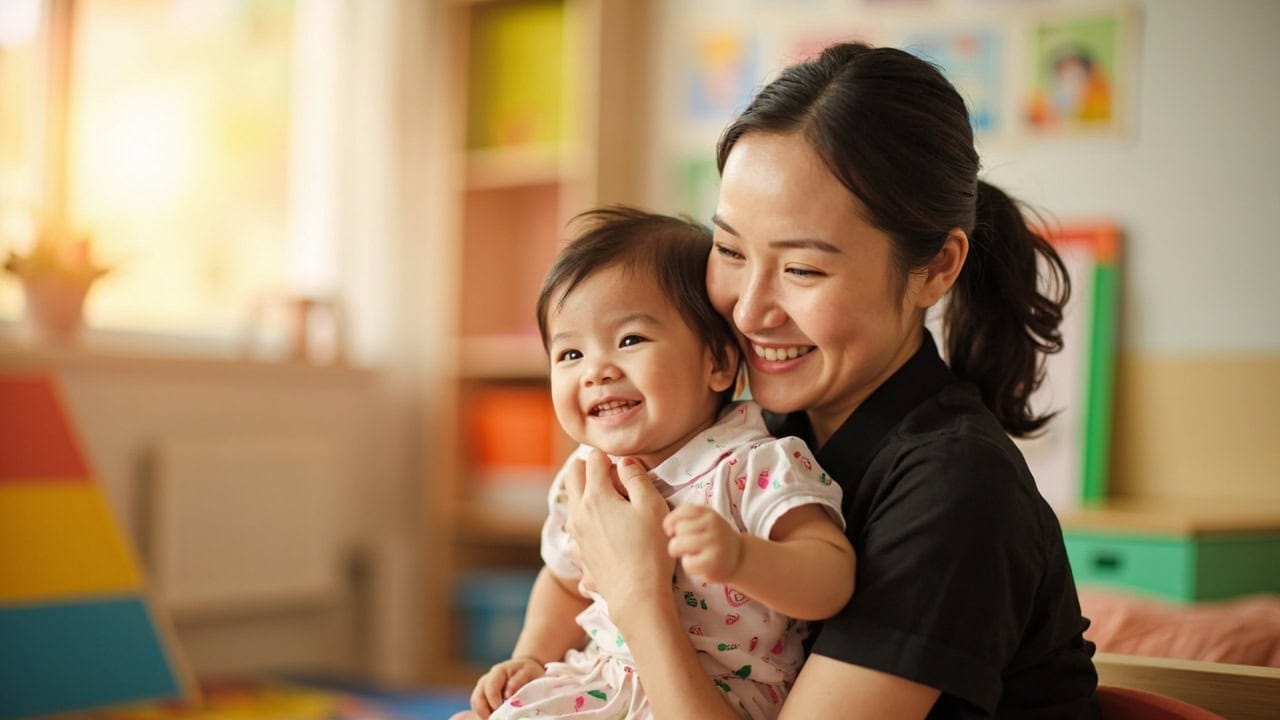
In quality infant and toddler care, this responsiveness is everything. When a child cries and is picked up promptly and held in a way that communicates safety, that child learns something that will serve them for the rest of their lives: when I need someone, someone will come.
This is not intuition alone. Caregivers who understand secure-base behavior know how to calibrate their responsiveness. They know that some children need more physical comfort and others need more verbal reassurance. They know that a child’s behavior at the beginning of a week might differ from their behavior on a Wednesday because of accumulated fatigue. They know that separation anxiety is not a problem to be eliminated but a signal to be honored—a sign that the child has formed an attachment that matters.
This is why caregiver-to-infant ratios matter so profoundly. A ratio of one caregiver to three infants means that in those moments of need, there is time to respond. It means that a crying child does not wait. It means that the invisible hours are filled not with institutional routine but with attuned, responsive care.
The Truth About Separation and Guilt
Let me speak directly to you about what this means for you, as a parent in Singapore.
You are likely working. Both of you, or perhaps you are a single parent carrying this weight alone. You know the statistics: Singapore has one of the highest rates of dual-income households in the world. You know the reality: the average commute in this city is not short, and the hours between drop-off and pickup can stretch into something that feels like a small lifetime when your child is still small.
And you know the guilt. The quiet, persistent guilt that suggests you are somehow failing your child by being away from them. That suggests other mothers—stay-at-home mothers, or mothers in slower economies, or mothers in some other life you might have lived—would be doing better.
Let me tell you what the research consistently shows: it is not maternal employment that shapes a child’s attachment security. It is the quality of care the child receives in the parent’s absence.
What harms children is not separation. What harms children is insensitive, unresponsive care. Care that does not read their signals. Care that prioritizes the schedule over the child. Care that treats them as a unit to be managed rather than a person whose needs matter.
So when we talk about building our entire approach around answering your question, we mean the real question. The one you carry every morning as you close the door: What happens in the hours I cannot see?
Something important. Something that matters. And we have organized our entire practice around ensuring that what happens is worthy of your trust.
How to Know If Your Child Is in Good Hands
Trust requires more than good intentions. It requires evidence. Here are the observable signs that your child is receiving attachment-aware care:
Signs of Security in Your Child
- Calm separation: Your child settles within a reasonable time after you leave, not in prolonged distress
- Warm reunions: Your child shows genuine pleasure seeing their caregiver at drop-off, running to greet them
- Confident exploration: Your child ventures away from caregivers to play and investigate, returning periodically
- Comfort-seeking: Your child asks for help when upset and accepts comfort when offered
- Emotional regulation: Your child can tolerate age-appropriate frustration without prolonged collapse
- Curiosity over caution: Your child approaches new situations with interest rather than fear
Signs of Quality Caregiving
- Responsive communication: Caregivers share specific details about your child’s day—not just “they ate well” but “they tried the new blocks and loved building towers”
- Knowledge of your child: Caregivers reference your child’s preferences, rhythms, and patterns accurately
- Honest updates: Caregivers tell you when your child had a hard time, not just the good moments
- Patient transitions: Caregivers help your child move between activities with calm guidance
- Respectful interaction: Caregivers get down to your child’s level, make eye contact, speak warmly
Questions to Ask When Choosing Infant Care
When you visit a childcare centre or meet a childminder, these questions help assess whether they understand attachment-aware practice:
- What training have your caregivers received in infant and toddler development?
- How do caregivers learn to recognize and respond to different crying patterns?
- What is your approach to separation anxiety?
- What is the caregiver-to-infant ratio?
- How is the daily schedule structured—around child needs or adult routines?
- How will I know what happens during the day?
- What does settling-in look like at your programme?
- How do you help children adjust to changes in caregivers, routines, or environments?
What EduNanny Singapore Offers
We have built our practice around a simple conviction: the invisible hours are not lost hours. They are hours in which your child’s brain is building its capacity for relationship, for resilience, for trust. They are hours in which the seeds of your child’s future emotional life are being planted—and we take that responsibility seriously.
EduNanny Singapore operates the ECDA Childminding Pilot, offering both home-based and centre-based pathways for infant care and childminding. We maintain up to one-to-three infant ratios because we believe this is not a staffing decision but a developmental one. Our caregivers are trained in the principles of attachment-aware practice—not as a marketing point, but as a foundational philosophy that shapes every interaction.
Transparency and Accountability
For parents in our programme, this means open lines of communication. Not just updates at pickup, but genuine sharing of your child’s day—their moments of wonder and moments of struggle, the small victories and the small challenges. If your child had a hard separation this morning, you will know, and you will know they were comforted.
In our centre settings, CCTV measures where deployed offer additional assurance—not as surveillance, but as accountability. The knowledge that the environment is accountable. The knowledge that what happens in those hours can be seen, if needed.
Accessibility for Singapore Families
We believe that accessing quality care should not require wealth. The ECDA Childminding Pilot operates within fee structures designed to make infant care and childminding accessible to families across Singapore. Your Child Development Account can be used. Your Baby Bonus can be applied.
Support Beyond the Hours
Because we know that parenthood raises questions constantly—at midnight when you cannot sleep, on the commute when something your child said that morning starts nagging at you—we have built something we are proud to offer. Our Thomas AI Chatbot, available through EduNanny, is a resource for parents navigating the questions of infant care and childminding. Not a replacement for human guidance, but a complement to it.
What We Believe About Your Child, and About You
We believe that working parents deserve more than reassurance. They deserve to understand what is happening, why it matters, and how to evaluate whether it is being done well. We believe that this understanding is itself a gift—that when you know what to look for, when you understand the science of attachment, you are not just a worried parent but an informed one. An empowered one.
We believe in the dignity and expertise of caregivers. The women and men who do this work—who respond to crying infants with patience, who observe the smallest shifts in a child’s mood, who build relationships with children that are genuine and warm and responsive. This work is not easy. It requires skill, and knowledge, and a kind of sustained emotional attention that is genuinely demanding.
And we believe in you. In the parent who feels the weight of that morning goodbye and carries it anyway. In the parent who wants to be present at work and present at home and wonders how to be both. In the parent who lies awake at night wondering if they are doing enough, if they are being enough.
You are doing something extraordinarily difficult. And you are doing it with love. That love is visible—in the care with which you chose your childcare provider, in the questions you ask, in the worry you carry. That love is real. And it matters.
The Question to Carry Forward
There is a question I want to leave you with today.
When your child is grown—past the years of early childhood, past the years when every goodbye is hard, past the years when they need you in the immediate, physical way they do now—what do you want them to carry with them from these years?
I believe the answer is this: you want them to carry a sense of security. Not the absence of struggle—life will bring struggle—but the presence of trust. The knowledge that the world can be navigated, that people can be relied upon, that they are capable and worthy and loved.
This is what attachment security gives a child. This is the gift of being known, in the hours when you could not be there, by someone who cared enough to pay attention.
We do not promise to replace you. We do not pretend that what we do is the same as what you do. Your relationship with your child is irreplaceable, and nothing here should suggest otherwise.
But we do promise to honor the hours we share with your child. To bring knowledge and attention and genuine care to the invisible moments that matter so much. To be the kind of caregiver team that makes it possible for you to go to work, to provide for your family, to live the life you have chosen—without carrying the weight of worry about what is happening in your absence.
You have trusted us with the most important thing in your life. We do not take that lightly.
The hours are invisible. The care does not have to be.
Begin Your Search with Confidence
If you are exploring infant care or childminding options in Singapore, we welcome you to learn more about EduNanny Singapore. We are happy to answer your questions, share more about our approach, and help you understand whether we might be the right fit for your family.
Choosing childcare is one of the most important decisions you will make. It should feel like an informed choice—guided by understanding, shaped by trust, and made by parents who know what matters.
Discover how our ECDA Childminding Pilot programme can support your family, or reach out to speak with our team directly.