What Your Child Builds in the Hours You’re Not There
The Building That Happens in Your Absence
The story of childcare is not really about the parent who leaves. It is about the child who stays.
The door closes behind you. Your child registers your absence — truly, they do, and we do them a disservice when we pretend otherwise. But here is what happens next, in the minutes and hours that follow, in the world your child enters when yours ends.
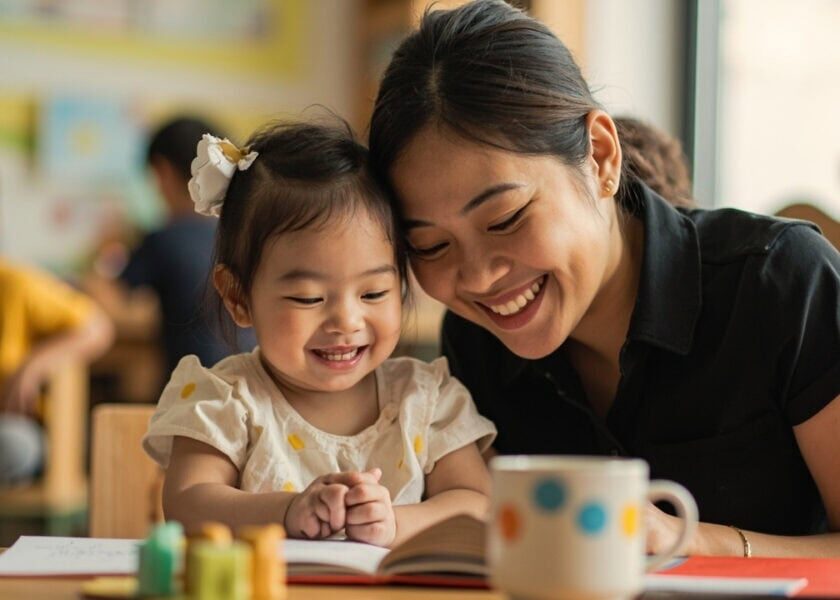
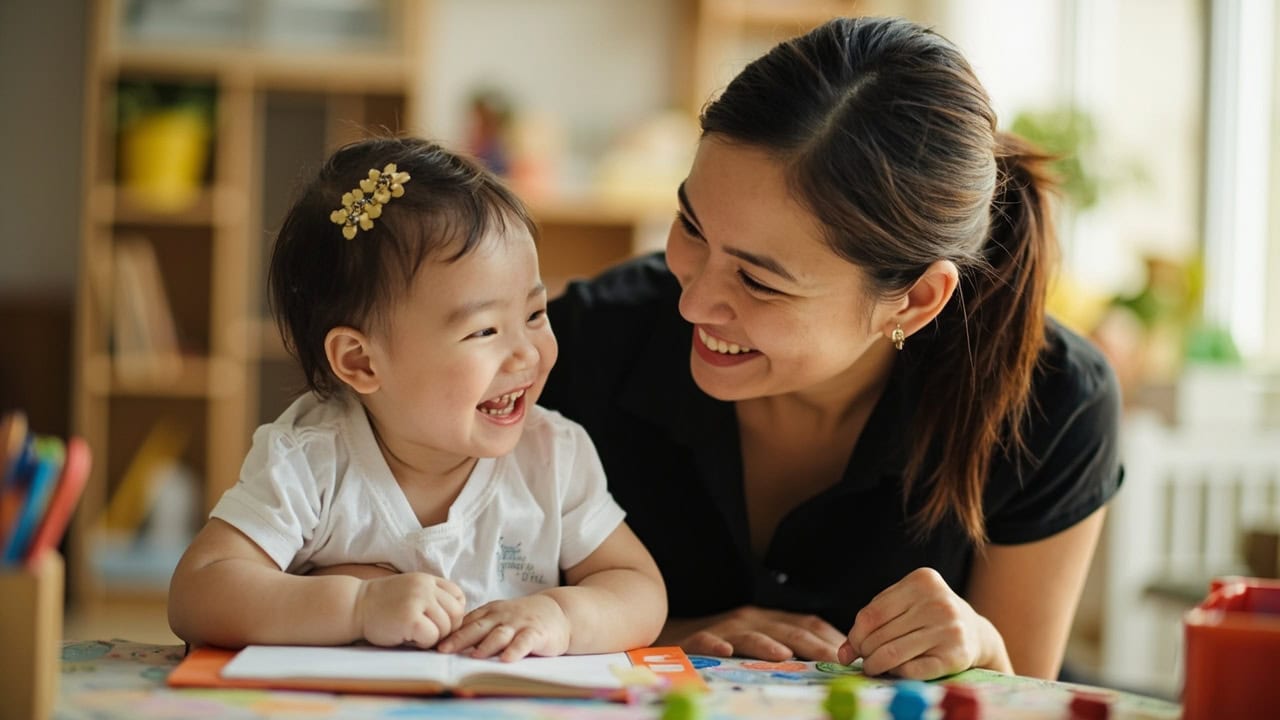
A caregiver bends down. Not with hurry, not with the mechanical efficiency of a transition, but with presence. With the particular attunement that separates a qualified minder from an extraordinary one.
Your child meets their eyes. There is a moment of calibration — who is this person, can I trust them, is this place safe — and then something shifts. The child breathes. The caregiver speaks. And the first brick is laid.
What Your Child Builds
- Secondary attachment — A trusting bond with a skilled caregiver, expanding who your child knows they can rely upon
- Social intelligence — Through peer interaction, the ability to navigate difference, negotiate, read cues, and understand that others have feelings too
- Emotional regulation — Practice managing frustration in a group setting, learning that feelings are survivable and manageable
- Community belonging — The discovery that they are a person who can belong to more than one world, beyond the family
- Independence as development — Separation as the engine of growth itself, not deprivation
That interaction, that small negotiation of trust, is not incidental. It is foundational. Developmental psychologists call it a secondary attachment figure — a person who holds your child’s emotional world with competence and care, who can read their cues and respond with precision, who becomes, over time, a source of security that is real and meaningful and different from what you provide at home.
Not instead of. In addition to.
Because children are not containers that hold a fixed amount of love. They are expanding beings whose capacity for connection grows the more connection they experience.
The World of Peers
And then, gradually, something else begins.
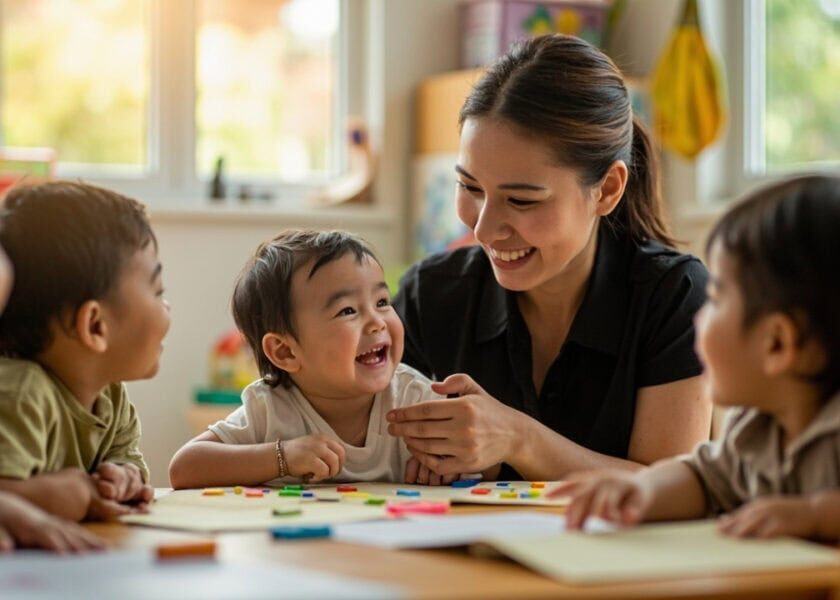
Your child notices the others. There is a toddler at the water table, pouring with concentration. There is a baby crawling toward a shelf of wooden toys. There is a small group gathered near the window, watching a bird on the ledge with the focused intensity that only young children can muster.
And your child, who has known only the adults and siblings of home, begins to encounter peers as a daily, consistent presence in their world.
When a child plays alongside another child, when they reach for the same toy and must navigate whose hands arrived first, when they watch another child cry and see adults respond with care — these are not small things. These are the raw materials of social intelligence.
Social intelligence, research consistently shows us, is built not in isolation but in relationship. It is built through friction, through negotiation, through the gentle collision of one small self against another.
Learning to Manage Big Feelings
Consider what happens when a toddler at childcare encounters frustration. A peer takes their toy. The caregiver does not rush in immediately. Instead, there is a pause — an invitation for the child to practice. To feel the heat of upset, to notice their own body, to learn that this feeling is survivable, that a solution exists, that the world has not ended.
And then, if needed, the caregiver guides. Names the feeling. Offers words. Suggests an alternative.
This is emotional regulation in its earliest, most crucial form — not the suppression of feeling but the mastery of response. Children who learn this in groups, with skilled guidance, are building something that no amount of one-on-one attention at home can replicate. Not because home is insufficient, but because group experience is irreplaceable.
Discovering Themselves in Relation to Others
Your child learns something else in these hours, something quieter but no less profound. They learn that they are a person who exists in relation to others. That their actions have consequences in a social field. That they have preferences, and others have preferences, and sometimes these preferences align and sometimes they do not, and this is simply the texture of human life.
They learn to read faces with increasing subtlety, to understand that the same expression can mean different things in different contexts, to sense the emotional weather of a room before they could ever name what weather is.
This is not something that happens to your child. This is something your child does. Actively. With agency. With the same curiosity they bring to learning to walk and learning to talk and learning the ten thousand other skills that define early childhood.
Your child is an architect. And in the hours you are apart, they are constructing.
What Quality Childcare Actually Requires
What children can build in quality group care does not happen automatically. It is not a feature of any childcare simply because it is childcare. The architecture I am describing requires specific conditions.
It requires ratios that allow for attunement. It requires caregivers who are trained not just in safety but in development. It requires environments that are designed for children’s agency, not just their supervision. It requires continuity — the same faces, day after day, building trust through consistency.
These are not luxuries. They are the prerequisites for the good I have been describing.
When ratios are too high, caregivers cannot attune. When training is insufficient, caregivers cannot respond to the subtle cues that precede a tantrum or a withdrawal. When environments are generic, children encounter stimulation but not invitation. When there is no continuity, children spend their energy on adaptation rather than construction.
What to Look For
| Element | Why It Matters |
|---|---|
| Caregiver-to-child ratio | Lower ratios allow for individual attunement — your child is seen, noticed, and responded to |
| Caregiver training | Beyond safety: understanding child development, reading cues, guiding emotional learning |
| Environment design | Spaces that invite exploration and agency, not just occupy children |
| Continuity of care | Consistent faces build trust over time; children are not constantly re-adapting |
| Communication practices | Transparency about your child’s day — what they did, how they felt, who they played with |
The Caregiver: Guide to Your Child’s Expanding Universe
A great caregiver is not a substitute parent. A great caregiver is a guide to your child’s expanding social universe — the bridge between your child’s known world and the wider world of peers, of routines, of shared spaces and shared experiences.
They translate your child’s needs into language the group can understand. They translate the group’s dynamics into language your child can understand. They are diplomats, interpreters, and sometimes guardians of the small, fragile negotiations that allow children to grow.
The work of a great caregiver is invisible when it is done well. You will not always see the intervention that prevented a conflict. You will not always see the word offered at exactly the right moment. You will not always see the comfort given before it was needed.
But you will see the evidence. You will see it in the way your child navigates a playdate now with an ease that did not exist before. You will see it in the vocabulary that has expanded beyond what you taught them at home. You will see it in the confidence with which they approach new situations, new people, new challenges. You will see it in the way they return to you at pickup not diminished by your absence but expanded by it.
Speaking Directly to the Guilt You Carry
The fear is this: that by leaving your child, you are subtracting something essential. That every hour apart is an hour of loss. That children need only one thing above all else, and that thing is parental presence, and anything less is harm.
This fear is not irrational. It is constructed by a culture that sells parenting as perfection, that tells mothers they should be present for every milestone and fathers they should be present for every tantrum, that positions childcare as a necessary concession rather than a positive good.
The truth is more generous than this fear allows.
Children are resilient. Children are adaptive. Children are, by nature, explorers who seek out the world beyond the arms that hold them. The drive toward independence is not a symptom of neglect; it is the engine of development itself.
Your child’s separation from you is not evidence of your failure as a parent. It is evidence of their success as a human being in the process of becoming.
What Your Child Gains
- Social competence — The ability to navigate difference, to communicate across it, to find common ground with strangers. In the interconnected, multicultural world of Singapore and beyond, this is essential.
- Emotional literacy — The vocabulary for what they feel, the tools for managing what they feel, the understanding that feelings are information rather than threats. Children who learn this early carry these tools into school, into work, into every relationship they will ever have.
- A sense of belonging beyond the family — Home is where love lives, but the world is where community lives. Children who have experienced consistent, caring communities outside their families develop a broader sense of who they are and where they fit.
- Expanded trust — Not abstract trust that comes from being told adults are trustworthy, but earned trust from experience. Your child learns that the world contains reliable, responsive, attuned adults who are not their parents. This expands their map of safety.
EduNanny Singapore: Where the Architecture Is Built With Intention
This is where the architecture I have been describing comes into sharpest focus. Not as a brand delivering a service, but as a framework built around what children actually need to grow.
EduNanny by BUTLER operates within the ECDA Childminding Pilot, a structure that takes childminding seriously — not as a stopgap, not as a convenience, but as a developmental pathway worthy of rigour and resources. The pilot reflects a commitment to standards: ratios that allow for genuine attunement, training that goes beyond compliance, a model of care grounded in developmental science.
Pathways for Singapore Families
EduNanny offers pathways that recognise the diversity of Singapore families.
Home-based care for families who value the intimacy of a minder in a domestic setting. Community and centre-based options for families who value the peer environment I have been describing. The ratios — up to one to three for infants — are designed to ensure that every child is seen, noticed, and responded to, not as an abstraction but as a specific, individual person.
Monday to Friday care blocks align with the realities of working parents. CDA and Baby Bonus usability removes financial friction from the equation. These are not incidental details. They are the conditions that make it possible for families to access quality care without choosing between excellence and affordability.
Trust Through Transparency
And then there is the question of trust, which is always the question underneath the question.
Parents need to know what is happening when they are not there. EduNanny addresses this with communication, transparency, and CCTV measures where deployed — not because surveillance equals care, but because transparency supports trust, and trust is the foundation of everything.
When parents know what is happening, they can relax into the knowledge that their child is not just being minded but being built up in the hours they cannot be present.
Choosing Well: A Note for Singapore Parents
Choosing childcare is one of the most consequential decisions a parent can make. Not because children will be harmed by the wrong choice — children are resilient, and most childcare is adequate — but because the right choice makes possible a kind of growth that the wrong choice forecloses.
When you visit a potential childcare setting, ask yourself:
- Do the caregivers seem present, or hurried?
- Are the children engaged, or merely occupied?
- Do the environments invite exploration, or just contain it?
- Do the same faces appear day after day?
- How does the setting communicate with parents?
The answers to these questions will tell you whether your child will simply be cared for, or whether they will be built up.
Closing: The World Your Child Is Building
There is a version of childcare that is merely adequate. That keeps children safe, fed, entertained, and returned to parents at the end of the day. This version is not bad. It is simply insufficient.
There is another version — one that treats childcare not as a service transaction but as a developmental environment. One that understands that children are not passive recipients of care but active architects of their own growth. One that invests in ratios, training, continuity, and communication because these are not luxuries but requirements.
There is a moment at the end of most childcare days that I find quietly extraordinary. You arrive at pickup. Your child looks up. There is the recognition — of course, there is always the recognition, the glad surge of seeing you return — but there is something else too. There is the casual confidence of someone who has been living a full life in your absence. There are stories that are not about you. There is evidence of having been engaged with a world beyond the two of you.
What does your child bring home? A drawing, perhaps. A song learned from a caregiver. A game invented with a peer. A new word. A new way of climbing, or building, or asking for what they want.
But underneath these surface treasures, something more significant: a version of themselves that has been tested and confirmed in a social context. A self that belongs, not just to you, but to a community. A self that has learned, in the hours you were away, how to be a person among people.
This is not a loss. This is a gift. You gave your child the capacity for this gift by choosing to let them go. By trusting the process. By believing, even when it was hard, that the world beyond your arms was not a threat but a territory.
If you are a parent in Singapore carrying the quiet weight of morning goodbyes, I want you to know: your child is not missing you in the way you fear. Your child is building a world. And in the best childcare environments, that world is rich, and warm, and designed for the particular kind of construction that only group experience makes possible.
EduNanny is not asking you to stop feeling what you feel. The worry, the tenderness, the ache of separation — these are not problems to solve. They are signs of love.
But EduNanny is asking you to trust, a little more each day, that the hours apart are not a subtraction. They are an addition. They are the hours in which your child’s world expands, and in that expansion, your child becomes more fully themselves.
And that, in the end, is what every parent wants. Not a child who needs them forever, but a child who is ready to fly.
EduNanny is honoured to be part of that readiness. To be part of the architecture your child is building. To be a place where, in your absence, your child’s world grows richer and more capable of holding everything they will become.
Ready to explore what EduNanny Singapore can offer your family? Schedule a visit to see the environment where your child’s world expands.
EduNanny Singapore is a trusted, development-oriented childcare and childminding service for families across Singapore. Part of the ECDA Childminding Pilot, EduNanny is committed to quality standards, meaningful caregiver-child ratios, and the kind of thoughtful care that supports every child’s growth.
Learn more about EduNanny · About EduNanny · Get in touch