How to Know If Your Child Is Growing in Singapore Childcare
The Neuroscience Is Clear: Environment Shapes Everything
Let us begin with what we know to be true about the first years of life.
The brain does not develop at a steady, measured pace. It builds itself in waves—and the most significant waves occur before a child turns three. Neural connections form at a speed that will never be matched again. Language acquisition happens almost as if by spontaneous generation: one day a child has no words, and then suddenly they have dozens, and then sentences, and then questions that stop you in your tracks.
Motor skills, social awareness, emotional regulation, the capacity for sustained attention, the ability to play imaginatively—these emerge not in isolation but in relationship, in response to the environment, in direct proportion to the quality of stimulation and care a child receives.
This is why the question of whether your child is growing matters so deeply. It is not an abstract concern. It is a neurological and developmental reality. The environments, the relationships, and the interactions your child experiences in these years are not incidental to their development. They are, in a very real sense, building it.
The Gap Between Reassurance and Evidence
And yet, most parents are given no framework for understanding what this looks like in practice. Updates say had a good day and played well and ate all his lunch. These messages are reassuring. But they do not answer the question that lingers in that car silence. They do not tell you whether your child is learning to communicate, to collaborate, to solve problems, to regulate their emotions, to persist at something difficult, to create something new.
The question of quality in childcare is often framed as a binary: either the care is good, or it is not. Either you trust it, or you do not. But this framing obscures a more useful and more honest question:
How do I know whether my child is developing here, and what should I look for to find out?
We live in a culture that tells new parents to trust their instincts—and while this advice is well-intentioned, it is incomplete. Instinct tells you when something feels wrong. It does not tell you what right looks like when everything feels fine but you cannot quite see the growth. Instinct tells you to protect. It does not always tell you what to look for when you are trying to evaluate whether protection has been accompanied by genuine investment in your child’s development.
What parents need—and what quality childcare should provide—is not permission to feel, but a language for seeing. This is the gap that EduNanny Singapore was designed to bridge.
Six Areas Where Growth Becomes Visible
The following six domains represent the key areas where genuine development becomes visible in quality childcare. You do not need to become a developmental specialist. But learning to observe with intention will change the way you read those daily updates, those app photos, and those pickup moments.
1. Language and Communication: Beyond Vocabulary
In a quality childcare setting, you will begin to notice changes that extend beyond the acquisition of new words.
A child who has been enrolled for a few weeks begins to use language differently. They do not simply label objects—they begin to narrate. They say I want and help me and look what I did. They understand that language is a tool for negotiation, for connection, for making their needs known and their ideas understood.
You may notice this in small moments. Your child comes home and points to a picture of a dog and says dog—but they also point to a picture of a horse and say no, horse, as if they are already beginning to sort the world into categories. They hear a new sound during circle time and come home attempting to replicate it.
What to look for: Not a child who is reciting vocabulary, but a child who is communicating—who is using the language they have to do something in the world.
2. Social-Emotional Development: The Least Visible, Most Important Domain
In quality childcare, children are learning to be in relationship with others who are not their parents. This is not a simple thing. It requires learning to share space, to wait, to tolerate frustration, to read the faces and bodies of other children who do not yet have words for what they feel.
What this looks like in practice:
- Your child begins to show awareness of other children. They look at another child who is crying and pause, as if processing.
- They may offer something—a toy, a touch, a word.
- They begin to understand the concept of mine and yours and the negotiations that follow.
- They seek out certain children, and resist others.
- They begin to express opinions, to test boundaries not out of defiance but out of a dawning understanding that they are a person with agency in a world full of other people with agency.
A quality caregiver does not just manage these moments. They coach them. They help children name what they feel. They model how to ask for something you want, how to wait when waiting is hard, how to say I don’t like that without hitting. They create an environment where big emotions are not suppressed but guided.
3. Motor Skill Progression: Body as Problem-Solver
This domain is perhaps the most immediately visible to parents, because motor skills often translate into achievements that parents love to celebrate—the first time a baby sits up without support, the first steps, the first time a toddler climbs something new or uses a spoon with increasing coordination.
In a quality childcare environment, motor development is supported not through contrived exercises but through an environment that invites movement:
- Open spaces for crawling and walking
- Materials that invite grasping, stacking, pulling, pushing
- Outdoor time where children can run, climb, and explore different surfaces
- Art activities that involve tearing, squeezing, spreading
- Music and movement sessions that develop body awareness and coordination
What to observe over time: A child whose body is becoming more capable, more intentional, more expressive. They are not just moving randomly—they are solving problems with their bodies. How do I get to the top of this? How do I open this? How do I make this mark on paper?
If you are picking up your child after months of care and they seem physically the same—same posture, same range of motion, same hesitation—this is worth noting. Children this age grow and develop at remarkable speed. The absence of observable change in physical confidence is itself a signal worth exploring.
4. Play Complexity: Where the Mind Reveals Itself
This is where you will see your child’s mind at work.
Early play begins with objects—a baby shakes a rattle, drops it, watches it fall, picks it up again. This is not random behavior. This is the scientific method in miniature. The baby is forming hypotheses and testing them.
As children develop, their play becomes more complex:
- They begin to use objects symbolically—a block becomes a car, a banana becomes a telephone
- They begin to engage in parallel play, then cooperative play
- They begin to create scenarios, to assign roles, to follow rules they have invented or agreed upon
- They begin to return to play again and again, extending and elaborating each time
In a quality childcare setting, caregivers do not just watch play. They document it. They notice which children gravitate toward which materials, which kinds of play emerge spontaneously, which children are beginning to move from parallel play to true collaboration. They take notes, they share observations, they track the progression.
This documentation is not bureaucratic. It is one of the most important tools a parent can have. When a caregiver tells you, I noticed your child has started initiating pretend play—this is a new development we have been observing, that is not small talk. That is your child’s mind revealing itself.
5. Caregiver Responsiveness: The Foundation of Everything
This may be the most important indicator of all, because it undergirds every other domain of development.
When you observe your child’s caregiver, notice how they respond to your child’s cues:
- Do they notice when a child is frustrated and intervene before the frustration escalates?
- Do they get down to the child’s level, making eye contact, matching their tone?
- When a child points at something, does the caregiver follow the child’s lead, naming and engaging with what the child is attending to?
Responsive caregiving is the foundation upon which all development is built. A child who is responded to promptly and appropriately learns that they matter, that their communications have power, that the world is a place where their needs will be met and their interests will be honored. This is not softness. This is the most sophisticated form of education there is.
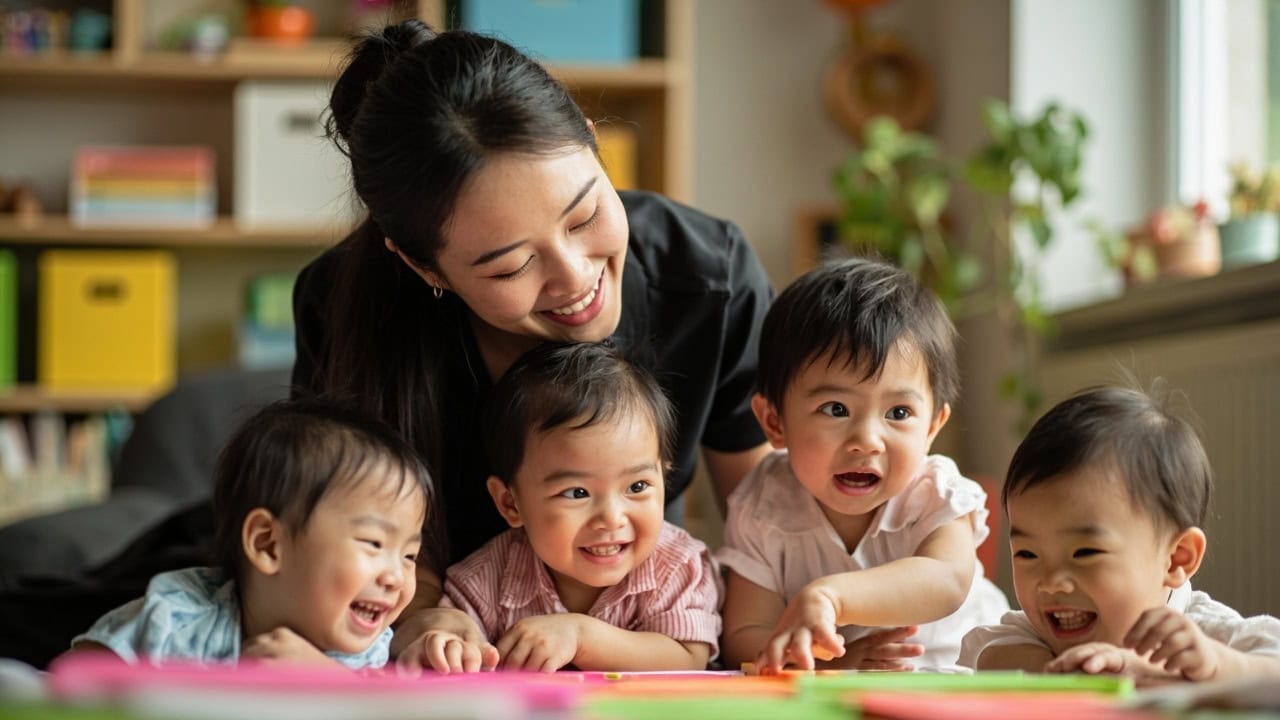
What to look for: A caregiver who gets down on the floor and meets your child where they are—not just watching, but engaging. Not just supervising, but nurturing.
6. What Your Child Brings Home
This is where the framework comes full circle. A child who is genuinely developing in a quality childcare environment will show it—not only in what happens at the centre, but in what happens when they are with you.
- They may come home and attempt to recreate something they did during the day—a song, a game, a routine
- They may use words or phrases they have picked up and apply them in new contexts
- They may show increased confidence in their physical abilities, their social interactions, their willingness to try new things
- They may reference the caregiver by name, and describe something that happened with a specificity that tells you they were paying attention—that the time was meaningful to them
This is the evidence you are looking for. Not just that your child was safe, or happy, or busy. But that something happened during those hours that is now part of who they are becoming.
What Quality Childminding Actually Looks Like
In an infant care setting with a low caregiver-to-child ratio, this kind of development is not left to chance. Caregivers narrate actions throughout the day. They name emotions before children can name them themselves. They repeat back approximations of words with delight, modeling the back-and-forth rhythm of true conversation. They read books not as a ritual to check off, but as an invitation into a world of language.
At EduNanny Singapore, caregiver responsiveness is not assumed. It is trained, observed, and continuously refined. In the ECDA Childminding Pilot framework that EduNanny participates in, caregivers are supported with structured guidance, regular reflection, and peer observation. The result is a consistency of care that allows children to form the secure attachments that research consistently shows are essential for healthy development.
EduNanny Singapore was built on the understanding that Singapore parents deserve more than a place that keeps their children safe. They deserve a place that invests in their children’s development—and that gives them the tools and transparency to see that investment for themselves.
This is why EduNanny maintains low caregiver-to-infant ratios, supports its caregivers through the ECDA Childminding Pilot framework, and creates multiple pathways for care—whether in a home-based setting, a community environment, or a dedicated centre. Communication is built into the model: regular updates, structured observations, and where deployed, transparent measures that allow parents to feel connected to what their child is experiencing throughout the day.
Evaluating Quality Beyond the First Visit
Many parents make their childcare decision based on the visit day—a clean facility, a friendly staff member, a warm greeting. These things matter. But they are not enough to answer the question you are really asking.
Quality reveals itself over time. Here is what to look for beyond the initial impression:
- Consistency of caregiver relationship: Does the same person care for your child most days, or does turnover feel high?
- Communication that goes beyond logistics: Do updates tell you something about your child’s day that you could not have guessed? Do they reference specific moments, preferences, discoveries?
- Responsiveness to your questions: When you ask about your child’s development, do you get more than a general answer? Can the caregiver tell you something specific?
- Documentation: Are observations being recorded and shared? Is there a system for tracking milestones?
- Your child’s reaction over time: Is your child forming an attachment to the caregiver? Do they seem comfortable, or does each drop-off feel traumatic weeks later?
The best childcare does not resist parental scrutiny. It welcomes it—because the work being done is real, and it can withstand examination.
Partnership, Not Surveillance
When a parent asks, How do I know my child is growing here? the answer is not a vague reassurance. The answer is:
Let me show you.
Let me show you the observations we have documented. Let me show you the milestones we have tracked. Let me show you the difference between what your child could do three months ago and what they can do now.
You are asking the right questions. The fact that you have read this far suggests you are not looking for permission to stop wondering. You are looking for a way to know.
So ask the question. Learn to see. Look for language that is being used, not just heard. Look for social awareness that is emerging. Look for motor confidence that is growing. Look for play that is deepening. Look for a caregiver who gets down on the floor and meets your child where they are. Look for your child to come home carrying something new—not just in their backpack, but in themselves.
And when you find a place where all of this is happening—where the caregivers are not just watching but nurturing, not just feeding but documenting, not just supervising but genuinely investing in your child’s development—hold onto it.
The first thousand days of your child’s life are happening now. They are not practice. They are not a rehearsal. They are the foundation upon which everything else will be built.
You deserve the right answers. And there are places, like EduNanny Singapore, where those answers are ready to be given—not because they have to be, but because the work has already been done.
Your child is growing. And now, you can see it.
Ready to explore what quality developmental care looks like? Speak with EduNanny Singapore to learn how our caregivers are trained to observe, document, and share your child’s growth every step of the way.
At EduNanny, we believe that every parent deserves to see their child’s development unfold with clarity and confidence. Learn more about our approach to developmental childcare or get to know our team.