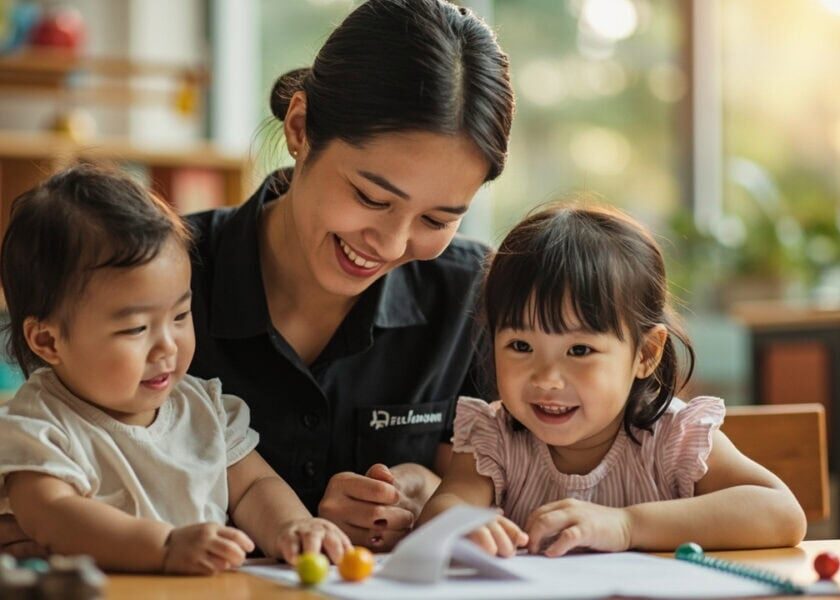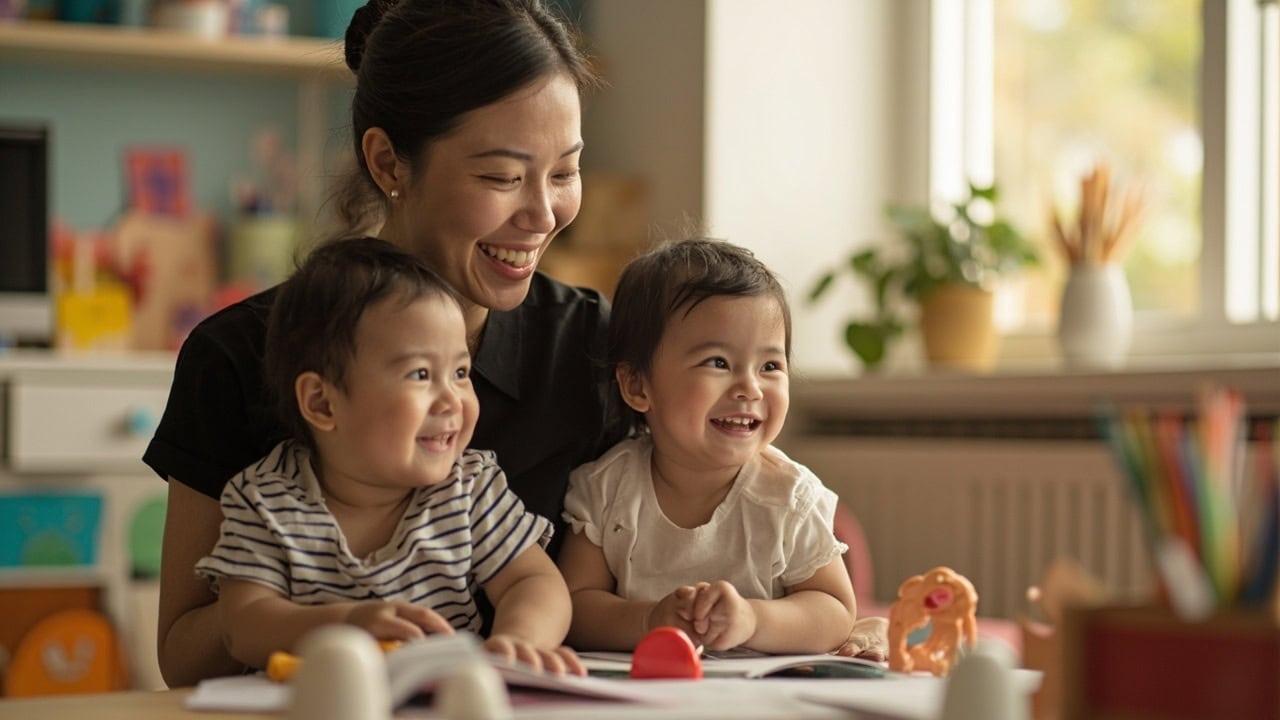
The Unseen Hours What Quality Childcare Looks Like When You Cannot Be There
The Moment After the Door Closes: What Quality Childcare Actually Looks Like When You Cannot See It
There is a moment, familiar to every parent who has placed their child in someone else’s care, that arrives without warning and without mercy. It is the moment just after the handoff, when you have stepped back from the door and your child has moved beyond your line of sight. Your hand is still warm from theirs. The corridor stretches ahead of you, ordinary and indifferent, and somewhere behind a closed door your child is encountering a world you cannot see.
This is where the day truly begins for both of you — but only one of you gets to walk forward into it. The other stays behind in that closed room, in the unseen hours, and you carry that image with you everywhere.
Perhaps it ambushes you mid-meeting, mid-transit, mid-grocery run. You are physically present in your life, but part of you remains at that threshold. You cannot stop wondering: Is my child comfortable? Is she being held when she needs holding? Is he having a good morning or a difficult one? Is anyone noticing the things I notice?
These are not anxious questions born of doubt. They are the natural language of love — the way the mind translates care into surveillance when surveillance is all that is available.
And so you do what any responsible parent does. You research. You visit. You ask questions. You read reviews. You try to read your child’s face at pickup, searching for evidence, for signals, for the reassurance that the hours apart were hours of quality.
This article is for you. Not to promise what cannot be promised, but to show you — in concrete, sensory detail — what quality care actually looks like inside that room. So that when you stand in that corridor again, you know what is happening behind the door. And knowing changes everything.
The Invisible Hours: Why Every Singapore Parent Carries That Weight
Singapore parents are not short on information. You can tour centres, interview caregivers, review licensing records, join parenting forums, and read testimonials until your eyes ache. The research phase of choosing childcare is exhaustive by design — because the stakes feel infinite.
But here is what no tour can fully answer: what happens in the actual hours between drop-off and pickup? What does your child’s day actually contain?
- Is she genuinely seen, or merely supervised?
- Is he developing language through rich interaction, or watching screens?
- Is she held when she needs holding, or is comfort deferred until the next scheduled activity?
You cannot be in the room. And that knowledge gap — that invisible distance between what you can research and what you can witness — is where parental anxiety lives. Not because you distrust the care you have chosen, but because love does not rest easy when it cannot verify.
Through years of work alongside parents and caregivers in Singapore, we have come to understand something precious: the hours you cannot see are not a void. They are a world. A vivid, textured, profoundly intentional world that your child is living inside right now. And that world can be described. It can be understood. It can be made visible to you.
A Day in Quality Care: What Actually Happens Behind the Door
Let us walk through a day together. Not an abstract day, not a checklist day, but an actual day as it happens inside quality care — what it sounds like, what it looks like, what it feels like for a child moving through it.
Before Your Child Arrives
The morning begins before the child arrives. This is something parents rarely consider, but it is where quality care starts — not at the door, but in the preparation of space, of attention, of readiness.
A quality caregiver does not simply wait for children to arrive. They prepare. The room is warm without being stifling. Light enters at an angle that is gentle on young eyes. Surfaces are clean but not antiseptic. There are toys arranged not randomly but with intention — some at standing height, some within reach from a seated position, some that invite investigation and others that invite comfort.
The space itself is a language, communicating to every child who enters: you belong here, this place was made with you in mind.
The Arrival Ritual
When the first child arrives, the morning ritual begins. But here is what distinguishes routine from ritual — a routine is a schedule; a ritual is an acknowledgment.
In quality care, arrival is not a transaction. It is a moment of meeting. The caregiver kneels or bends to the child’s level — not because protocol demands it, but because children deserve to be greeted at their own height, in their own world, not looked down upon from above.
There is eye contact. There is a greeting by name. Perhaps a small ritual has been established — a particular way of saying good morning that belongs only to that child and that caregiver, a touch on the head, a specific phrase, a brief pause that says: I see you, I am glad you are here, you are known.
This is not sentimentality. This is the architecture of security. When a child arrives and is genuinely seen, the stress hormone cortisol begins to settle. The nervous system receives a message: this place is safe, this person is safe, I can explore from here. That biological fact is the foundation upon which everything else is built.
Reading the Room in Real Time
As the morning unfolds, the caregiver is reading the room with a quality of attention that most parents assume only parents possess. But attentive caregivers develop this same sensitivity over time.
They notice when a child who usually engages with others is standing slightly apart, carrying something heavier than usual — perhaps a disrupted night, perhaps a small worry, perhaps nothing that can be named but something real nonetheless. And they respond not with interrogation but with presence.
They move closer. They offer a toy, not as distraction but as an invitation. They sit nearby without crowding. They give the child the gift of company without the pressure of conversation.
This is what responsiveness looks like in real time. It is not a reaction to a meltdown. It is the presence that prevents the meltdown from needing to happen. It is the quiet offer of connection before the child has to ask for it, or before the asking becomes desperate.
Attunement: The Difference Between Supervision and Genuine Care
There is a word used often in childcare circles — attunement — and it can sound clinical, academic, removed from the messy reality of a room full of young children. But attunement, practiced well, is one of the most intimate human experiences available.
It is the caregiver feeling the room as a single organism, noticing the tempo, the energy, the emotional weather. When it shifts, they shift with it.
- When a child is tired, the pace slows before the yawn arrives.
- When a child is energised, the activity rises to meet that energy and channel it.
- When two children are approaching a conflict over a toy, the caregiver is already moving — not to intervene but to redirect, to offer an alternative, to hold space for two children who both need to feel that their needs matter.
This is the difference between supervision and care:
| Supervision | Genuine Care |
|---|---|
| Watches | Responds |
| Counts heads | Counts feelings |
| Ensures safety through proximity | Ensures safety through relationship |
| Child may be physically safe and emotionally adrift | Child is both safe and anchored |
A child under supervision may be physically safe and emotionally adrift. A child in care is both safe and anchored.
Rhythm as a Container for Security
The hours move in rhythms calibrated to the developmental needs of young children. Rhythm is not rigidity. A quality day does not proceed according to a clock that children must fit themselves around. Rather, the rhythm is a container — a structure flexible enough to hold the individual needs of each child while maintaining the overall shape that young children require for their emotional regulation.
A young child thrives when they know what comes next, not because they are incapable of surprise, but because predictability is the ground from which curiosity can safely grow. When a child knows that morning snack comes after free play and before circle time, they can relax into free play without the background anxiety of not knowing what is coming.
That relaxation is what makes genuine exploration possible. That is what makes a child bold enough to stack blocks, to ask for help, to try words that are not yet perfect, to venture away from the caregiver’s side and return when ready. The rhythm is not a cage. It is the fence around a garden that makes the garden safe to play in.
Language Woven Through Every Moment
Within that rhythm, language is everywhere. In quality care, language is not reserved for lesson time. It is woven through every interaction, every transition, every ordinary moment.
When a child reaches for a cup of water, the caregiver does not simply hand it over. She says: Here is your water cup, it is blue, just like your shirt. Would you like to hold it with both hands?
This is not a lesson. It is a conversation. But in that conversation, the child is hearing new words, encountering colour concepts, feeling the satisfaction of being responded to, and learning that communication is a bridge between wanting and having.
When a child points at a bird outside the window, the caregiver does not say yes, that is a bird and move on. She says: Yes, a bird, it has a yellow chest, do you see how it is hopping on the branch? It is looking for something to eat.
Those extra sentences — five, six, ten more words — may seem insignificant in isolation. But across hundreds of such moments over weeks and months, they become the architecture of a child’s language development. They become the difference between a child who speaks in sentences and a child who speaks in fragments.
This is why quality care matters — not as a convenience, but as an intervention in the truest sense, a deliberate shaping of the conditions in which a child grows.
The Moments No Curriculum Captures
And then there are the moments that no curriculum captures, the moments that happen only because a human being is present who genuinely cares.
The moment when a child falls and skins a knee, and the caregiver does not rush in with panic but moves in with calm, picking up the child, saying I know, that hurt, let me see, and wrapping the wound with a tenderness that communicates far more than words: you are not alone in this, pain is real and so is comfort.
The moment when a child is fighting sleep at naptime, exhausted but resistant, and the caregiver lies down nearby and hums without asking the child to sleep, just offering the sound, the company, the permission to rest whenever the body is ready.
The moment when a child accomplishes something small — successfully puts on their own shoe, builds a tower that does not fall — and the caregiver notices, and celebrates, and names the feeling: You did it, you worked so hard and you did it, you feel so proud right now.
That last moment is perhaps the most important of all, because it teaches children to know themselves. When a caregiver names a feeling for a child, the child begins to understand what is happening inside them: I am not just experiencing pride. I am experiencing pride, and this is what it is called, and this person sees it in me.
That self-knowledge, planted early, becomes the foundation of emotional intelligence, of self-regulation, of the capacity to understand others because you first understood yourself.
The Afternoon and Pickup
As the afternoon deepens, the pace changes. Transitions are managed with the same intentionality as everything else. Snack time again, outside time if weather permits, quiet activities that prepare the body and mind for the slow winding down.
The caregiver begins preparing the room for departure — putting away the morning’s toys, dimming the lights slightly, lowering voices. The children feel these changes and their own bodies begin to respond.
Quality care does not end with pickup. The final moments of the day are as considered as the first. The caregiver speaks with parents — not a rushed report card but a real exchange.
My child had a wonderful morning, she played with the blocks and we read three books, she was a bit tired after nap so we kept things calm in the afternoon.
Or perhaps: he seemed a bit out of sorts today, we noticed he might be cutting a tooth, we gave him extra cuddles and he recovered well.
These are not status updates. They are continuations of the relationship between caregiver and parent, the invisible thread that connects what happens at home and what happens in care — so that the child experiences consistency rather than fragmentation.
What Changes When You Know
Now. Let us return to you. The parent standing outside the door. The one who has spent the morning carrying that familiar weight of not knowing.
What does it mean for you to understand what we have just described? What changes when you know, in concrete sensory detail, what quality care looks like inside?
Everything changes. Not because the anxiety disappears entirely — love does not stop asking questions — but because the questions find answers.
- When you know that arrival is a ritual of acknowledgment, you can trust that your child was greeted with presence, not mere obligation.
- When you know that responsiveness is a practiced skill, you can trust that your child’s subtle cues are being read and honoured.
- When you know that language is woven through every moment, you can trust that your child is growing even in the ordinary hours.
- When you know that emotional attunement is the operating philosophy, you can trust that your child is known, not just watched.
This is why visibility matters. Not visibility as surveillance, not cameras in every corner — though where such measures are in place they serve a purpose. But visibility as understanding. Knowing what to look for. Understanding the architecture of a day that is built for children, not just built around them.
This kind of visibility transforms parental anxiety into something more grounded: informed confidence. You are not guessing anymore. You are choosing from a place of knowledge.
Making the Unseen Hours Visible
At EduNanny Singapore, this understanding shapes everything we do. We believe that parents deserve more than promises — they deserve to see the architecture of care that surrounds their child each day. EduNanny operates within the ECDA Childminding Pilot, offering both home-based and community-based pathways that meet families wherever they are in Singapore.
Singapore parents are not asking for permission to work, or to grow their careers, or to pursue their ambitions. They already know they have that permission. What they were asking for — and what EduNanny listened to — was a way to leave their child with the certainty that the hours apart would be hours of genuine care. Not just supervision. Not just safety. Care.
What EduNanny Provides
- Thoughtful infant ratios — carefully maintained at up to one caregiver to three infants, ensuring every child receives the attention that quality demands
- Accessible fee structures — designed so that financial constraints do not become barriers to quality care
- Flexible payment options — including CDA and Baby Bonus, because affordability matters
- Structured rhythm — Monday through Friday care blocks that respect both family routines and the developmental rhythms children need
- Transparent measures — where CCTV is deployed, it serves transparency, not as a substitute for trust but as a bridge to it
EduNanny’s Thomas AI Chatbot, available across platforms, offers guidance when uncertainty creeps in — a presence that reminds parents they are not navigating this alone. Technology, in our hands, is not a replacement for human care. It is an extension of it.
Questions to Guide Your Search
When evaluating any care arrangement, these questions can help you understand what lies behind the door.
Questions to Ask
- How would you describe your approach to a child’s first hour of the day?
- What does a typical day’s rhythm look like, and how do you accommodate individual children’s needs within it?
- How do caregivers respond when a child is showing signs of distress?
- What does language development look like in everyday interactions here?
- How do you communicate with parents about their child’s day?
- What is your caregiver-to-infant ratio, and how is it maintained?
What to Observe During a Visit
- The physical environment — is it warm, clean, and intentionally arranged?
- How caregivers kneel or bend to children’s level when greeting them
- Whether children appear relaxed and engaged, not merely occupied
- How transitions between activities are managed — with calm or chaos?
- Whether there is rich verbal interaction, not just commands and corrections
Trust What You Feel
After visiting a potential care arrangement, notice how you feel. Not just intellectually, but in your body. Do you sense warmth? Is there an atmosphere of genuine engagement? Or does something feel off — even if you cannot name it?
Your instincts as a parent are not irrational. They are finely tuned by love. If something feels uncertain, ask more questions. If something feels right, trust that too.
You Are Not Asking for Too Much
The anxiety you carry about childcare is not a sign of overprotectiveness. It is a sign of deep engagement with one of the most consequential decisions you will make in your child’s early years.
Singapore parents are not asking for perfection. They are asking for something more fundamental: the assurance that when they hand their child to someone else, that child will be seen. Known. Cared for with the same attention they would receive at home.
This is not a small request. It is, in fact, the most important request a parent can make.
And it is a request that EduNanny was built to honour.
So when you return to that threshold — when you feel your hand release your child’s hand and you step back into the corridor — carry this with you:
The hours you cannot see are not lost hours. They are hours filled with greeting and response and language and rhythm and named feelings and gentle hands and calm voices and the quiet work of making a small human being feel that the world is safe to explore.
Your child is not in a void. Your child is in a world, and that world can be good.
EduNanny Singapore was built for parents who felt that anxiety and refused to accept it as inevitable. For parents who wanted more than supervision, more than safety, more than a transaction. For parents who understood that the unseen hours matter more than almost anything else in the early years, and who deserved a partner that understood that too.
The door closes. But behind it, there is care. Real, present, intentional, quality care.
And now, you know what it looks like.
If you are searching for infant care or childminding in Singapore and want to understand how EduNanny makes the invisible hours visible, we invite you to speak with our team, ask your questions, and visit to see for yourself what quality care looks like when you are there — so you can trust it even when you are not.
Every child deserves to be known. And every parent deserves to know that this is true.
To learn more about EduNanny Singapore and our approach to quality childminding, please visit our homepage or read about our story.