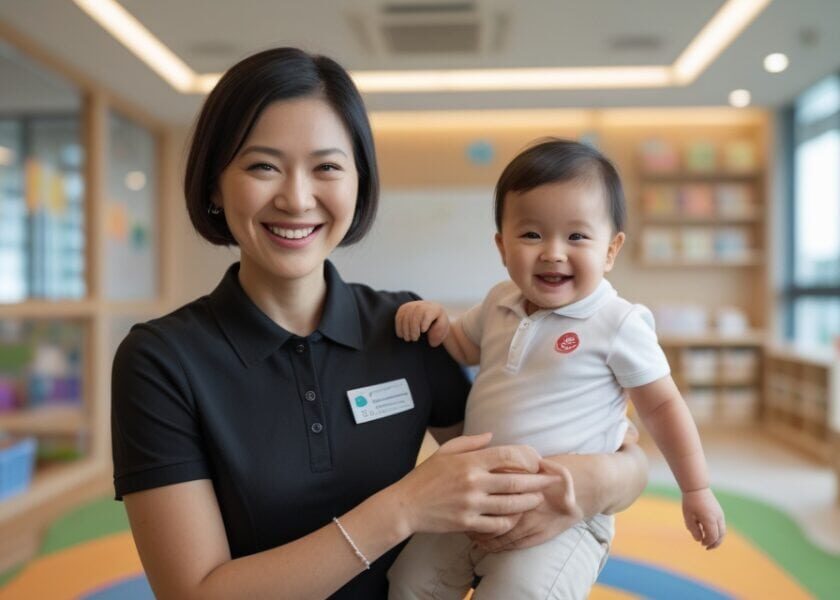
Beyond Supervision: What Quality Childcare Means for Singapore Parents
The Silence Between Us: Understanding the Knowledge Gap
There is a particular silence that every working parent in Singapore knows. It is the silence of the morning commute, when your child is still soft with sleep beside you, and you are calculating in your head the exact hours until you will see them again.
It is the silence of the office, when your phone sits face-down on the desk and you wonder whether the morning’s small distress — the clinginess at drop-off, the food left untouched — has resolved or deepened.
It is the silence of the homecoming, when your toddler greets you with a hug that tells you almost nothing about the ten hours that came before it.
We call this silence the knowledge gap, and it is one of the most quietly devastating experiences of modern parenthood.
Why Most Childcare Was Not Designed for This
You are not failing as a parent. This distance you feel — the hours of separation without visibility, the fear that important moments are happening without you, the worry that small signs of distress or joy are being missed — this is not a personal shortcoming. It is a structural reality of contemporary life in Singapore.
Dual-income households here are not a trend but a necessity. Parental leave is precious and finite. And in that tension lives a specific kind of anxiety that is rarely named honestly.
The truth is that most childcare arrangements were built for supervision — for safety, for logistics, for the practical management of a child’s body and schedule while parents work. And safety and logistics matter. They are the foundation upon which everything else rests.
But supervision alone leaves a specific hunger unmet. Parents do not only want to know that their child was safe and fed. They want to know who their child was today. They want to understand the texture of their child’s hours. They want to feel, when they pick up their child at six o’clock, that they are picking up a person they still know.
The Attunement Mirror: What Quality Caregiving Actually Looks Like
Quality childcare — the kind that recognizes it is not just managing a schedule but holding the emotional and developmental world of a young person — creates something different. It creates a communication architecture. Not the kind built on documentation for its own sake, or daily reports that reduce a child’s rich, nuanced day into checkboxes and stock phrases.
When this architecture works, something remarkable happens. The morning handoff stops feeling like a leap of faith and starts feeling like the beginning of a relay. You pass the baton knowing it will be held with care, and you will receive it back at the end of the day with a full account not just of what happened, but of what it meant.
Translation, Not Just Reporting
Consider what this looks like in practice. A quality caregiver notices that your two-year-old has been gravitating toward the water play table all morning — not just dabbling in it, but deeply focused, pouring and repouring with a concentration that signals a developmental leap in hand-eye coordination and cause-and-effect thinking.
This observation is not just noted for a daily report. It is held, and then it is shared. Not as data, but as insight.
Today she discovered she could make the water go wherever she wanted it to go. She was so proud. You might notice she’s reaching for cups and containers at home now — she’s in that pouring phase.
This is what we mean by translation. The caregiver has seen your child in a context you cannot access, and instead of leaving you to wonder or guess, they have translated that experience into language you can receive and understand. They have given you a thread to follow back to your own child.
Why Ratio Matters
This translation work is not incidental to quality childcare. It is central to it. And it is why the ratio of caregivers to children matters so profoundly.
When a caregiver is responsible for six, eight, or ten children at once, there is simply no bandwidth for this kind of observation. The child’s day becomes a blur of activities and transitions, and what is lost is precisely the attunement that transforms supervision into understanding.
At EduNanny, operating under the ECDA Childminding Pilot, the infant care ratio is kept at up to one to three. This is not a technical specification. It is a philosophy made visible. It means that when your infant is in our care, there is genuine space for a caregiver to know them — to notice the shift in their mood before a meltdown, to recognize the expression that means tiredness rather than hunger, to understand each child as a specific person rather than a general responsibility.
The Guilt of Not Being First to Know
Parents often come to us carrying a particular guilt. It is the guilt of not being the first to know. Of learning that their child took their first steps at childcare, or said a new word, or overcame a fear, and feeling a strange grief alongside the pride.
“I wasn’t there.” They say. “I didn’t see it happen.”
And while this guilt is understandable, it points to a misunderstanding of what quality childcare is meant to be.
Quality childcare is not meant to be a parallel universe to your family. It is meant to be an extension of it. When a caregiver notices your child’s first steps and tells you about them with the same delight you would have felt, the moment is not lost to you. It is translated and shared. The distance collapses.
You may not have been standing in the room, but you are not a stranger to what happened. You know your child in that moment because someone you trust helped you know them.
Information Is Not Understanding
We should also be honest about what this is not. It is not information overload.
Parents do not need more data. Most parents who have received a daily childcare report — the kind that lists lunch at 12:15, nap from 12:45 to 2:30, snack at 3:00 — know that this kind of reporting tells you nothing. It is the skeleton of a day without the life in it.
What parents need is less volume and more meaning. They need fewer checkboxes and more context. They need to feel that the person caring for their child is capable of noticing what matters and capable of sharing it in a way that builds understanding rather than anxiety.
At EduNanny, communication is built around this principle. Our caregivers are trained not just to care for children but to observe them — to understand what each child’s day means, not just what it contained. Where CCTV measures are deployed, parents have the option of visual access that brings transparency without intrusion. Where caregiver reporting is used, it is designed to carry insight rather than inventory. The goal is always the same: to close the knowledge gap, not to widen it with more noise.
What You Should Expect from Quality Childcare
If you are evaluating childcare options in Singapore, here are the questions that actually matter:
Communication That Builds Understanding
- Does the arrangement create genuine partnership between you and the caregiver, or just transaction?
- Will you receive insight into what your child’s day meant, not just what it contained?
- Is there space for two-way conversation about your child’s development and needs?
Observation That Enables Attunement
- What is the caregiver-to-child ratio? Is there bandwidth for genuine observation?
- Do caregivers have the training to read non-verbal cues in infants and toddlers?
- Will your child be known as an individual, or treated as part of a group?
Accessibility That Supports Working Families
- Are the care hours aligned with actual working hours, including commute time?
- Can you use CDA or Baby Bonus funds directly, removing administrative burden?
- Is the arrangement flexible enough to accommodate Singapore working life?
The Case for Home-Based Childminding
There is a reason the ECDA Childminding Pilot exists, and it reflects a growing national recognition that home-based and community-based childcare pathways offer something that larger centre-based arrangements cannot replicate at scale: intimacy of ratio, warmth of environment, and the space for genuine attunement.
EduNanny operates within this framework. Our care blocks run Monday through Friday, designed around the rhythms of working family life. For families using CDA or Baby Bonus funds, our arrangements allow for direct and straightforward use of these resources, removing one more layer of administrative complexity from parents who are already navigating plenty.
The work of infant care is deeply skilled. It requires patience and attention, observational acuity and emotional intelligence, the ability to read a child’s non-verbal cues and respond with attunement. This work is often undervalued in the broader culture, treated as entry-level or low-skill. But what a skilled infant caregiver does is profound.
At EduNanny, our caregivers are not interchangeable agents in a logistical system. They are professionals who bring genuine expertise to one of the most consequential tasks any society undertakes: caring for its youngest members. And it is this professionalism — this trained attunement — that makes the kind of communication architecture we have described possible.
Close the Gap — Begin the Conversation
You should expect more from your childcare arrangement. You should expect to feel connected to your child’s day, not through intrusive surveillance but through genuine partnership. You should expect your caregiver to know your child as a person, not just as a responsibility. You should expect communication that helps you understand rather than simply documents.
EduNanny was founded on a simple but radical premise: that the distance between parents and their children’s daytime lives should not have to be a permanent feature of modern parenthood. That quality care can be designed not just for supervision but for understanding. That the knowledge gap is not an inevitable cost of working life but a solvable problem — solvable through intentional ratio structures, through caregiver training that prioritizes observation and communication, and through a partnership model that treats parents and caregivers as collaborators rather than separate parties.
If you feel the distance we have been describing — the hours of not knowing, the guilt of missing small moments, the fear that your child is becoming someone you cannot quite reach — we want you to know that this feeling is not a character flaw. It is a sign of how much you care.
And it is a problem that quality care can address.
EduNanny is that bridge. Not because we promise you every moment of your child’s day — no honest childcare provider can or should promise that. But because we promise you the honest, attentive, communicative partnership that allows you to know your child through your absence. To trust that what matters is being noticed and shared. To feel, at the end of each day, that you are still close to the person who matters most.
Ready to explore what a genuine partnership in your child’s care could feel like? Reach out to EduNanny to learn more about our infant care and childminding services, and discover how we can help you close the knowledge gap in your family’s life.
At EduNanny, we believe that working parenthood and deep parental connection are not in conflict. Learn more about our approach to quality childminding in Singapore.