What to Look For When Visiting a Childcare Centre in Singapore
The Framework: Four Dimensions of Quality
Before we go deeper, here is the core framework we will explore together:
- The Sensory Environment — How a space sounds, looks, and feels is a developmental signal, not just a design choice
- Relational Attunement — The single most revealing observation you can make during a centre visit
- Quality of Transitions — How children move between activities reveals a centre’s true values
- The Cultural Fingerprint — What a centre celebrates, how it handles difficulty, and what children do when no one is watching
If you take nothing else from this article, carry this: the best childcare does not need to be marketed. It needs to be seen. And once you learn where to look, you will never experience a centre visit the same way again.
The Space Speaks Before Anyone Says a Word
Walk into most childcare centres and you will notice the obvious things first: the color of the walls, the arrangement of furniture, the size of the play areas. These are the things centres want you to notice. They have thought carefully about what is visible. But the trained eye moves past the visible, toward something more telling. It asks: What does this space feel like to be inside?
The Texture of Sound
Notice the noise. Not whether it is quiet — young children make noise, and good care is not silent care. Notice instead the texture of the sound. Is there an echo? Does laughter bounce off hard surfaces and become harsh? Or is there a softness to the acoustics, a sense that the space was designed for the comfort of small ears and developing nervous systems?
In Singapore’s warm climate, many centres rely on air-conditioning throughout the day. But a well-designed space also considers how to bring natural ventilation and sound-absorbing materials into the infant and toddler areas. Good childcare environments are built with the body’s experience in mind, not just the eye’s.
What Light Tells You
Natural light is not a luxury; it is a signal. When a centre has made the effort to bring daylight into infant and toddler spaces, it is making a statement about what it values. These are not minor considerations. The sensory environment of a childcare centre is not decorative. It is developmental. The way a space sounds, looks, and feels is shaping the children who live inside it, hour after hour, day after day.
A centre that has thought carefully about sensory quality is a centre that has thought about your child as a whole being — not just a mind to be taught, but a body and a nervous system that needs to feel safe, calm, and engaged.
Children in Motion
Now look at the children themselves. Not at what they are doing, but at how they are moving. Is there room for them to move freely? Can a toddler walk across the room without being redirected? Can a baby reach for a toy without it being placed in their hand?
Movement is not a distraction from learning. In the first years of life, movement is learning. It is how children explore causality, build spatial awareness, develop coordination, and construct their understanding of what their bodies can do in the world.
A space that allows for movement is a space that respects your child’s development.
What Happens Between People
When you visit a childcare centre, you will likely arrive during a moment of performance. The teachers know you are there. The children, if they are old enough to notice, have been prepared in some way for your presence. Everyone is a little more attentive, a little more presentable.
This is natural and unavoidable. But it is also precisely why the obvious moments tell you the least.
The meaningful information is in what happens when no one is performing. You cannot see what happens after you leave. But you can learn to read the residue of those moments. You can learn to notice the quality of the interactions you are permitted to witness, not for their content but for their texture.
The Most Revealing Observation
Watch how a teacher speaks to a child who is not looking at her.
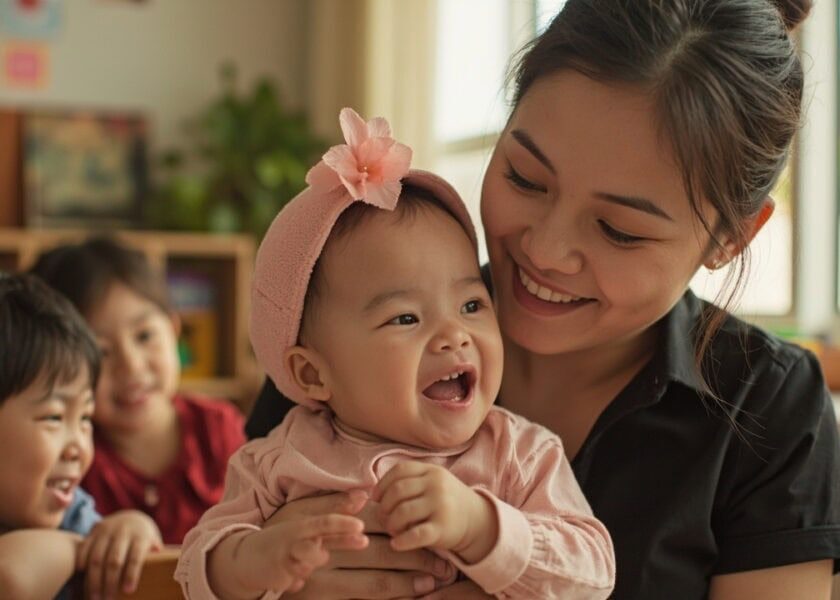
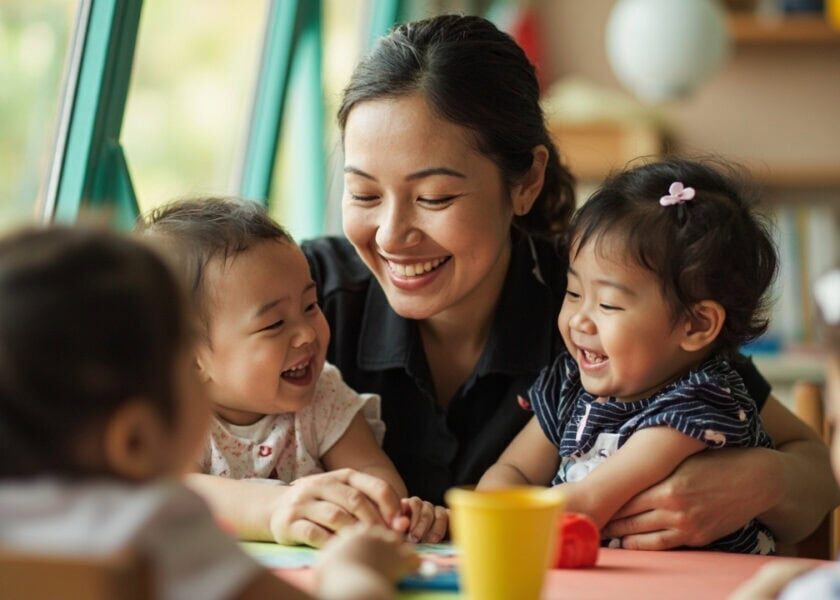
When a child is engaged with a toy, absorbed in an activity, and a teacher approaches, notice what happens. Does she wait? Does she lower herself to the child’s level, physically and vocally, before speaking? Does she follow the child’s lead, entering into what the child is doing rather than redirecting it?
Or does she speak across the child, announcing her presence with a question or a command, asking the child to turn away from their exploration to acknowledge her?
This distinction matters more than most parents realize. Genuine attunement is not about the words a teacher uses. It is about the willingness to meet the child where they are. It is the discipline of pausing, of observing before acting, of allowing the child’s internal state to set the pace of the interaction.
A teacher who can do this — who can enter a child’s world without pulling them out of it — is practicing something rare and precious. A teacher who cannot, however warm their smile, is relating to the performance of the child rather than the child themselves.
Listen to the Tone
Not to what the teachers say to you, but to what they say to each other and to the children when they think no one is listening. The tone of voice tells you everything.
When a child is crying, is the response one of gentle curiosity — What are you feeling? What do you need? — or is it administrative, task-oriented, focused on restoring order rather than understanding the child?
Neither response is wrong, but they come from profoundly different philosophies of care.
Ask yourself: when a teacher describes a difficult moment — a child who bit, a tantrum, a conflict over a toy — how do they speak? Is there a curiosity in their voice? A sense of trying to understand the child’s experience, to find the meaning behind the behavior? Or is the language clinical, behavioral, focused on managing rather than understanding?
The difference is not subtle. It is the difference between care that sees your child as a set of problems to be solved and care that sees your child as a person to be known.
The key to reading relational quality is simple, though it requires courage. Stop asking so many questions. Start watching. The teachers in a truly excellent centre will not feel interrogated by your presence, because they will be confident that what you see, when you see it clearly, will speak for itself.
Rhythm and Transition: Where Truth Becomes Visible
There is a third dimension of observation that most parents overlook entirely, and it may be the most important of all. It is the dimension of time — specifically, the quality of daily rhythm and transition.
A childcare centre’s schedule is not merely organizational. It is a statement of values. It reveals what the centre believes about children, about learning, and about the relationship between structure and freedom.
What Good Transitions Look Like
Watch what happens when one activity ends and another begins. This is where the truth of a centre’s philosophy becomes visible. Transitions are difficult for young children. They require what developmental psychologists call executive function — the capacity to stop one thing, hold that experience in mind, and prepare for the next.
For infants and toddlers, whose executive function is still emerging, transitions can be sources of real stress. How a centre handles these moments reveals everything about whether it sees your child as an individual or as a unit in a schedule.
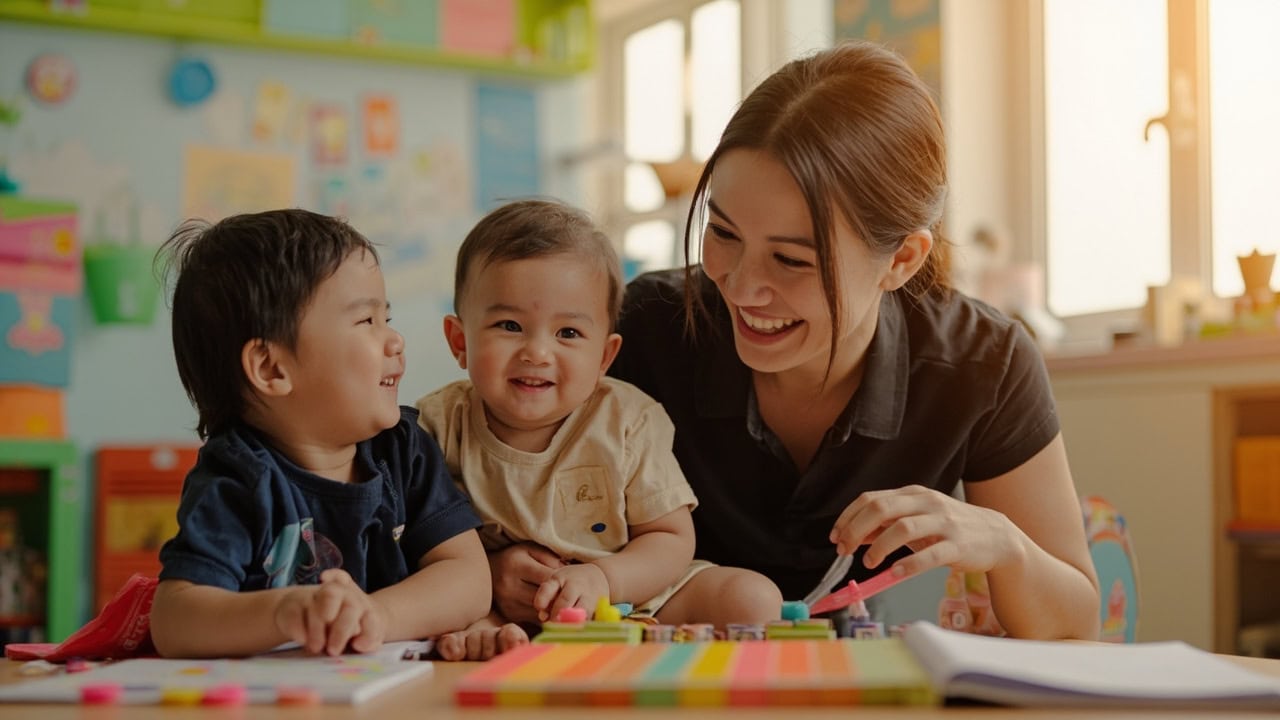
In the best centres, transitions are gentle. They are preceded by signals — a song, a phrase, a change in lighting — that help children prepare. Teachers move with the children, not ahead of them. The pace is slow enough to allow for the natural hesitation and curiosity that young children bring to change. There is no rush from one corner of the room to another, no sense that the schedule is a master that children must serve.
In less thoughtful centres, transitions are moments of administrative efficiency. Children are moved quickly, redirected firmly, the next activity beginning before the last one has fully landed. The pace is set by the clock, not by the children. And the message — whether intended or not — is clear: the schedule matters more than your child’s internal experience.
The Rhythm of the Day
Notice the rhythm of the day itself. Is there a balance between active and quiet times? Between structured activities and free play? Between time together and time alone? Young children need all of these, and they need them in a pattern that their bodies can come to anticipate and trust.
A day that feels chaotic or unpredictable is not just developmentally suboptimal; it is a source of anxiety for young children who are still learning to feel safe in the world.
If you can, arrive early or stay late. Watch the beginning and end of the day. Watch how children settle into the morning and how they are gathered at closing time. These moments — often the most hurried and the least observed — are where the real quality of care is tested.
The Cultural Fingerprint: What Cannot Be Hidden
There is a fourth and deepest layer of observation. It is the layer that cannot be manufactured, cannot be performed, and cannot be hidden. It is the cultural fingerprint of a centre — the invisible architecture of values, beliefs, and practices that shapes everything else.
Every childcare centre has a culture. It is the accumulated effect of the people who work there, the training they have received, the leadership they are given, and the philosophy that guides them. You will not find this culture described in any brochure or mentioned in any tour. You will only discover it through the smallest, most ordinary moments — the ones that happen when no parent is present and no evaluation is being conducted.
What Gets Celebrated
The cultural fingerprint reveals itself in what it celebrates. When a child achieves something — climbs a new ladder, says a new word, masters a new skill — how is that achievement received? Is there genuine delight? Do teachers and children pause together to acknowledge the moment? Or is it noted briefly and moved past, in the constant forward motion of a busy day?
How Children Are Spoken About
The cultural fingerprint reveals itself, too, in how the centre speaks about children when children are not present. Listen — if you can — to how teachers talk about the children in their care when they are among themselves.
Is there warmth in their voice? Do they speak of children with respect, with curiosity, with something like love? Or is the language perfunctory, administrative, focused on tasks and behaviors rather than on persons?
How Difficulty Is Handled
Most revealing of all is how a centre responds when something goes wrong. When a child is hurt, when a conflict escalates, when a moment of difficulty occurs — and these moments are inevitable in any setting where young children gather — how does the centre respond?
Is there accountability? Is there learning? Do the staff speak about the incident with a sense of ownership, a willingness to reflect on what could have been done differently? Or is the response defensive, blame-shifting, focused on protection rather than growth?
These are not questions you can ask directly and expect honest answers. They are questions you must learn to read in the silences, in the hesitations, in the language that is used when parents are present and the language that is used when they are not.
And this is why the best centres do not fear scrutiny. They welcome it. Because they know that when parents learn to see clearly, what they see is something worth seeing.
Your Next Centre Visit
Before your next visit, leave the checklist at home. Walk in with open eyes instead. Here is what to notice:
- When you arrive, stand still for a moment. Feel the room before you interact with anyone. What is the texture of the sound? How does the light feel on your skin?
- Find a teacher and watch her. Not how she greets you — how she relates to a child who is not paying attention to her. Does she wait? Does she follow the child’s lead? Or does she redirect?
- Notice the transitions. When one activity ends, what happens? Is there a signal? Do teachers move with the children? Is the pace set by the clock or by the children?
- Look at the children when they think no one is watching. Are they at ease? Do they move freely? Do they engage with each other and with the environment with curiosity and confidence?
- Listen to the tone. When teachers speak to each other, is there warmth? When a child struggles, is there patience?
Ask fewer questions. Observe more. And trust that when you see quality, you will know it in your body before anyone tells you.
Common Questions Parents Ask Themselves
“Am I being too demanding?”
No. The standards you are looking for — genuine attunement, thoughtful transitions, a space designed for children’s bodies and nervous systems — are not demanding. They are basic. Your child deserves them, and you are right to look for them.
“What if I visit and everything looks fine but it’s not?”
This is exactly why observation skills matter. The surface can always be managed. What cannot be managed is the texture of how a teacher speaks to a child who isn’t looking at her. What cannot be managed is the pace of transitions. What cannot be managed is the ease in children’s bodies when they think no one is watching. These are the signals that reveal quality — or its absence.
“What if the centre seems good but my child struggles to settle?”
Adjustment takes time. Some children settle quickly; others need weeks to feel safe in a new environment. What matters is how the centre responds during that adjustment. Do they offer flexibility? Do they communicate with you honestly about how your child is settling? Do they see your child’s initial hesitation as normal and worthy of patience rather than a problem to be solved?
A Place Worth Finding
We speak with parents every week who describe the same experience. They visited centre after centre. They felt something wasn’t quite right but could not articulate why. They worried they were being too picky, too anxious, too demanding. And then they visited a setting where everything aligned — the space, the people, the rhythm, the feeling — and they finally understood what they had been looking for all along.
What they had been looking for was not a perfect centre. No such thing exists. What they had been looking for was a place where their child would be known. Where the small moments of their child’s day would matter. Where someone would notice when their baby reached for something new, or when their toddler sorted the blocks by color without being asked.
This is not a luxury. It is the foundation of what early care should be.
What EduNanny Singapore Was Built On
EduNanny Singapore was built on a conviction that the best care does not need to be marketed. It needs to be seen. When you visit an EduNanny setting, certain things will speak for themselves.
You will notice the caregiver ratios we maintain — attentive enough to honour each child’s need for individual recognition. You will notice the environment we have built: designed not to impress, but to support. Light, acoustics, movement, sensory quality — these are not afterthoughts. They are foundational.
You will notice the way our teachers speak to children. Not because they have been trained to perform for parents, but because they have been shaped by a culture of genuine attunement. You will notice how they handle transitions, how they respond to difficulty, how they speak about the children in their care when they think no one is listening.
We are part of the ECDA Childminding Pilot, which means our approach is grounded in standards that go beyond licensing compliance. We offer both home-based and community pathways, because families are different and quality care should not require your family to fit a mold.
Transparency as Invitation
We believe that visibility builds trust. Where CCTV is deployed, it exists not as surveillance, but as an open invitation for you to feel connected to your child’s day. Where communication tools support the relationship between caregiver and family, they do so without replacing the human connection that matters most.
We offer Monday through Friday care blocks, because consistency is not a bonus feature of good childcare. It is its foundation. Our fees are structured to be accessible within the pilot framework, and we make it simple to use what you already have — your Child Development Account funds, your Baby Bonus — so that financial logistics never become a barrier to the care your child deserves.
Seeing Clearly From Here
The gap you have been feeling — the gap between what you know you should be looking for and what you are actually able to perceive when you walk through a centre door — is not a failure of yours. It is a gap that was created by a system that has not yet taught parents how to see.
You have been told that quality matters. You have been told that the early years are critical. You have been told to research, to compare, to ask the right questions. But no one has taught you what quality looks like when it stands before you. No one has given you the framework, the vocabulary, the way of seeing that allows you to trust your own observation.
That is what we want to give you. Not a sales pitch. Not a brochure. A literacy.
The next time you visit a childcare centre — any centre, including ours — walk in without a checklist. Walk in with open eyes. Notice the space. Listen to the sound. Watch how teachers speak to children who are not looking at them. Notice what happens in transitions. Look at how children move when they think no one is watching.
And ask yourself: Does this feel like a place where children are known? Where they are seen? Where the small, ordinary moments of their days are treated as worthy of attention?
If the answer is yes, you will know it. You will feel it in your body, in the settled quality of the room, in the ease of the children, in the warmth of the teachers. You will not need anyone to tell you. You will see it.
And if the answer is no, you will know that too. And you will keep looking, because your child deserves nothing less than a place where the answer is yes — where every day, in the smallest ways, your child is seen.
Your child deserves to be known. And you deserve to know that they are.
If you would like to learn more about what thoughtful, development-oriented childminding looks like in Singapore, we welcome you to explore EduNanny or get in touch with our team. We believe the best care speaks for itself — and we are here when you are ready to see it.