The First Five Years: Why Language Development Is Biology, Not Just Parenting
The Language Window Is Real — And It Has a Closing Time
For most parents, the question dissolves as quickly as it arrives. They file it under childhood mysteries, alongside the way a toddler suddenly knows how to use a spoon after weeks of refusing, or the day a baby learns to wave goodbye without ever being explicitly taught.
But the question itself is worth sitting with, because it points to something that the science of early childhood has been quietly confirming for decades: in the years before a child ever walks through a school gate, they are building something extraordinary. And the people who build it with them are not only parents.
The early years — from birth to around age five — represent the most critical window for language acquisition that any human being will ever experience. This is not a metaphor. It is not a gentle pedagogical suggestion. It is biology.
During the first five years of life, the brain forms more than one million new neural connections every second — a pace that will never be matched. Synaptic density in the language regions of the brain peaks before a child turns three and then, through a process neuroscientists call pruning, settles into the architecture that will carry them through school, work, and relationships for the rest of their lives.
The neural pathways that carry language — that allow a child to hear a sound, connect it to meaning, store it in memory, retrieve it under pressure, and use it to build a sentence that has never been spoken before — these pathways are laid down primarily in the first five years of life. After that, they are refined, enriched, and deepened. But the foundation is built early, and it is built fast.
What this means for parents is both empowering and quietly urgent. The hours your child spends in care during these years are not filler. They are hours during which the architecture of language is being constructed — by someone, for better or worse, with intention or by accident.
And this is why the question that surfaces at the dining table — where did that come from — is actually one of the most important questions a Singapore parent can ask.
Hearing Language Is Not the Same as Learning Language
Here is what research has shown, and what every experienced early childhood educator knows: language does not develop in children because they hear language. It develops because they are responded to.
There is a profound difference between passive exposure and active conversational scaffolding, and that difference is the difference between a child who knows many words and a child who can use language to think, to connect, to solve problems, and to feel understood.
Passive language exposure is the television left on in the background, the radio playing in the car, the ambient hum of a language-rich environment. Children absorb something from this, certainly. But active conversational scaffolding is something altogether more powerful — and it is the mechanism at the heart of every quality childcare environment.
What Active Scaffolding Actually Looks Like
Active conversational scaffolding happens when a caregiver notices what a child is attending to — a bird on a branch, a truck reversing, a child’s hands closing around a cup — and narrates it in real time. Not from a script. Not from a curriculum. From genuine, moment-by-moment responsiveness to the child’s own experience.
The caregiver speaks about what the child is looking at. The child responds — in a sound, a gesture, a coo. The caregiver waits for that response, and responds in turn.
This back-and-forth, this extended conversational turn-taking, is not a teaching technique. It is a biological trigger. It is the precise stimulus that activates the neural circuits responsible for language acquisition in the developing brain.
A caregiver does not say “bird” and move on. A caregiver says, “You’re looking at that bird. What is the bird doing? The bird is eating something. Do you see how it hops? Let’s watch it hop again.”
In this expansion — this patient, extended, child-paced narration of the world — the child absorbs not just vocabulary but the grammar of language, the music of conversation, the rhythm of meaning-making that precedes and underlies every academic skill they will ever be assessed on.
It is unhurried. It is attentive. It requires a ratio of adults to children that makes this kind of responsiveness possible. And it is happening thousands of times a day in the right environment — building something inside a child that no worksheet, no flashcard, no screen, and no amount of well-meaning but distracted interaction can replicate at the same scale.
Singapore’s Language Landscape: Opportunity and Challenge
Singapore presents a language environment unlike almost any other in the world, and this matters enormously when we talk about quality childcare.
We are a city-state that genuinely values language. We invest in tuition, in bilingual enrichment, in speech and drama classes that begin before a child turns five. We understand, at a cultural level, that language is not just communication — it is access, it is opportunity, it is the medium through which a child will learn everything else.
The Bilingual Advantage — If It Is Delivered Well
What many parents may not fully appreciate is that the bilingual environment of Singapore is not merely an aspiration — it is a genuine developmental opportunity. Young children have a neurobiological capacity for language acquisition that adults do not. The infant brain is not confused by two languages; it is efficient. It builds parallel language systems with remarkable flexibility, and the cognitive benefits of bilingual exposure — in attention, in cognitive flexibility, in executive function — are well documented in the research literature.
The Tension Most Singapore Parents Are Living With
But here is the tension that most Singapore parents are living without fully naming: this extraordinary opportunity has a delivery problem.
Bilingual exposure at home, especially in households where both parents work full time and extended family support is geographically limited, is often inconsistent. Children may hear Mandarin from one grandparent and English from a television programme and Malay from a helper — and not enough of any single one to build the deep, responsive, conversational language environment that the research tells us they need.
Quality childcare fills this gap — but only if the care itself is language-rich. Not just safe. Not just warm. Not just well-supervised. Language-rich.
A childcare environment that understands bilingual development does not simply alternate between languages on a schedule. It responds to the child in the language the child is using in that moment. It builds vocabulary in both languages through genuine, extended interaction. It creates the conditions for a child to absorb the sounds, the rhythm, the structure, and the meaning of two languages simultaneously — not through instruction, but through the same responsive, narrative, conversational scaffolding that builds language in any single tongue.
What You Can Actually Observe: Language Milestones From Birth to Primary One
One of the most practical things I can offer you is a vocabulary for observing language development in your own child — not through assessments or developmental checklists, but through the words and phrases they bring home.
The First Year: Before Words Appear
In the first year, before words appear, language development shows up in the sounds a child makes — the variety of babbling, the responsiveness to voices, the turn-taking quality of their cooing. You should notice your child experimenting with a range of sounds, responding to their name, and beginning to understand simple words like “no” or “wave bye-bye” even before they can say them.
The Second Year: The Vocabulary Explosion
In the second year, the explosion begins: single words, then two-word combinations, then the startling acceleration of vocabulary that researchers call the vocabulary spurt, when a child can acquire new words at a rate of eight to ten per day.
You will notice your child naming familiar objects, pointing to things they want, and beginning to combine words like “more milk” or “daddy go.”
Around Age Three: Sentences and Questions
By age three, most children are speaking in sentences of five or six words, asking why questions constantly, and beginning to narrate past events. They can tell you what happened at childcare. They can describe a picture in a book. They are building the narrative capacity that will underpin all future learning.
Around Age Four: Stories and Social Language
By age four, they are telling stories, engaging in sustained imaginative play with language at its centre, and beginning to understand that words can be written down and read back. They can hold a conversation that goes beyond the immediate moment. They can negotiate, explain, and express opinions.
What Matters Is Not Just the Presence of These Milestones — But Their Quality
Is your child using words to regulate themselves — saying “I’m frustrated” instead of simply crying? Is your child beginning to use language to negotiate rather than to overpower? Is your child growing more confident not just in speaking but in listening — in following a longer story, in attending to a peer’s words in a group?
These are the deeper indicators of language development, and they are the ones that will determine not just how your child performs in school but how they navigate friendship, manage emotion, and build the social confidence that makes the transition to Primary One something to look forward to rather than dread.
How to Evaluate a Childcare Environment for Language Development
So when you are evaluating a childcare environment — and I know that for many of you this decision carries a weight that is almost impossible to articulate — here is what to listen for.
Walk Into a Room and Listen First
Don’t look at the furniture first. Don’t look at the artwork on the walls. Listen. What do you hear?
Is there conversation? Is there a caregiver speaking to a child about what the child is experiencing in that moment — not reciting a lesson, not giving instructions, but genuinely narrating the world to the child? Or is the room largely quiet, punctuated by commands: sit down, don’t touch, share?
Notice Whether the Caregiver Follows the Child’s Lead
The highest-quality language environments are child-led in their responsiveness. A caregiver who names what a child is interested in — who expands on a child’s focus rather than redirecting it — is doing something neurologically significant. They are building language on the architecture of the child’s own attention, which is the way language is naturally and most effectively acquired.
Notice Whether the Caregiver Waits
The pause between a child’s sound and the caregiver’s response is not empty time. It is the space in which language learning happens.
A caregiver who rushes to fill every silence is stealing from a child’s language development. A caregiver who waits — who creates space for the child’s response — is providing the most valuable thing a developing brain can receive.
Notice How the Caregiver Speaks
Not just what they say, but how. Is their language rich and unhurried? Do they use complete sentences? Do they model the complexity of language in a way that is responsive to the child’s level, just slightly above it — what educators call the “language one step ahead”?
A child whose caregiver speaks in clipped imperatives all day is not receiving the same developmental nutrition as a child whose caregiver speaks in narrative, in explanation, in full, grammatically complete sentences that the child can absorb and eventually reproduce.
Notice Whether Children Are Speaking to Each Other
Language develops through peer interaction as well as adult interaction. A quality environment creates space for children to talk to each other — to negotiate, to narrate shared experience, to use language for social purposes. This peer language development is where the social dimension of communication is built, and it is a critical indicator of a truly language-rich environment.
These are the things to listen for. They do not require technology or curriculum or expensive materials. They require attention, training, intentionality, and the kind of environment where a caregiver can actually be present to a small number of children rather than spread thin across many.
What EduNanny Singapore Is Built to Do
This is precisely the philosophy behind EduNanny Singapore, and I want to speak about it with the clarity and honesty it deserves.
EduNanny by BUTLER operates within the ECDA Childminding Pilot, and this is not merely an administrative detail. It reflects a deliberate commitment to an approach to childcare that is different in kind, not just in degree, from the larger centre-based model.
The Pilot was designed to explore how home-based and community-based childcare pathways can serve Singapore families with a quality and personalisation that the larger system has struggled to deliver. EduNanny’s participation in this initiative is a statement of belief — that the ratio, the intimacy, the responsiveness, and the developmental depth that home-based care makes possible are not nostalgic luxuries but essential components of the language-rich environment that every child deserves.
The Ratio Is the Point
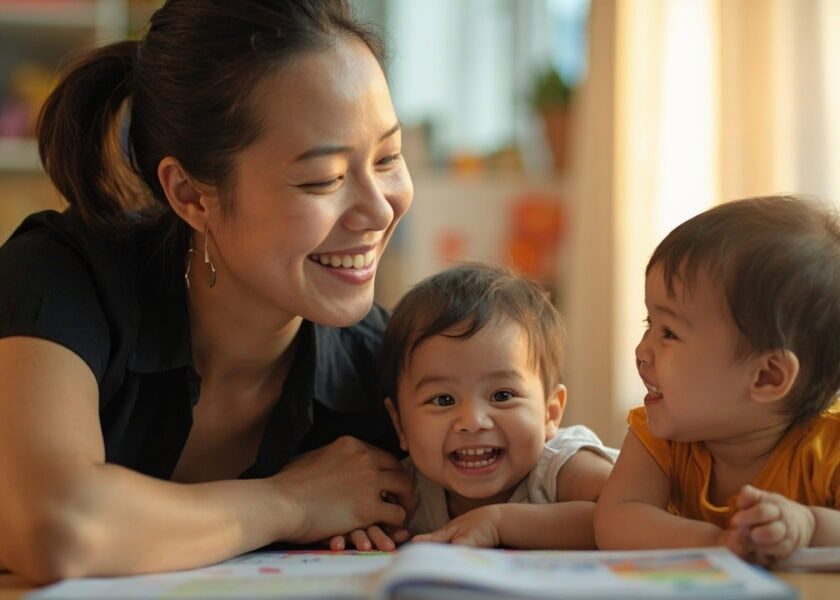
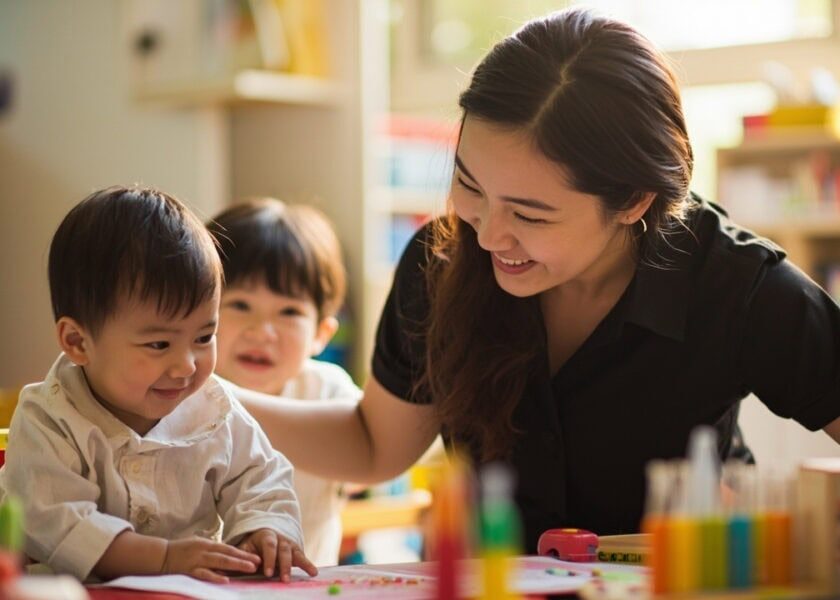
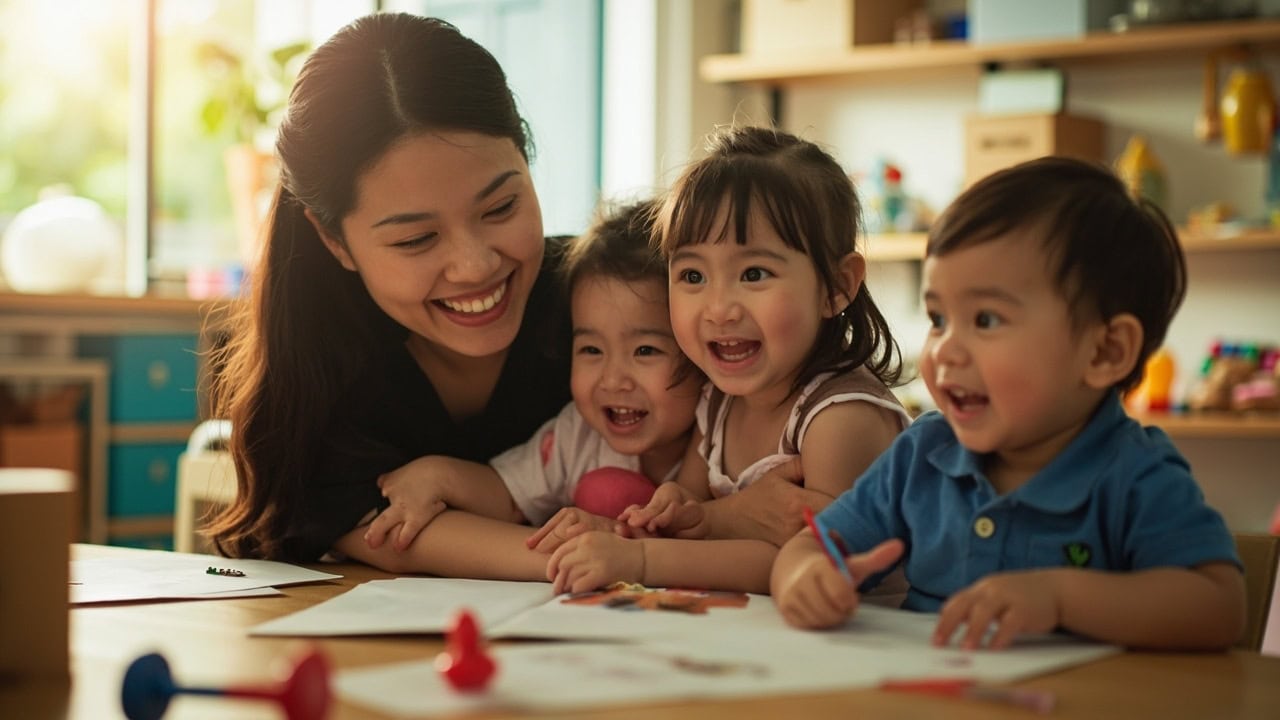
In home-based EduNanny settings, the ratio of caregiver to infant can be as intimate as one to three. Think about what that number means.
In a space where one adult is present for three infants, every sound receives a response. Every coo is heard. Every moment of curiosity is noticed and narrated. There is no group management imperative pulling the caregiver’s attention away from the individual child. There is no schedule so rigid that the child’s spontaneous language moment gets passed over for the next activity.
The intimacy of the ratio is not a comfort feature. It is a language development feature. It is the structural guarantee that the responsive interaction at the heart of language acquisition can actually occur.
Practical for Singapore Families
For parents navigating the real pressures of Singapore’s working life — the full weekday schedule, the cost of quality care, the need for transparency and trust — EduNanny integrates these practical realities without compromising the developmental vision.
Care operates on Monday through Friday blocks that align with standard working patterns. Fees are structured within the Pilot’s framework to be affordable and accessible. CDA and Baby Bonus funding can be applied, reducing the financial weight on families without requiring them to accept a lower standard of care.
For parents who want — and every parent deserves — to know what their child’s day looks and sounds like, communication and transparency measures including daily updates and, where deployed, CCTV access ensure that you are not left guessing. You hear about the new word your child said. You see the caregiver who said it with them. You know.
Questions Parents Often Ask
Will my child bond with the caregiver? In a home-based setting with a consistent caregiver and a small ratio, the conditions for attachment are actually more favourable, not less. Your child is not one of fifteen children in a room. They are one of three. The caregiver can learn your child’s rhythms, preferences, and communication style in a way that is simply not possible in a larger group setting. Many parents find that the bond between their child and their EduNanny caregiver becomes one of the most reliable and trusted relationships in their child’s early years.
How do I know quality care is actually happening? Language development is your evidence. When your child comes home with new words, new phrases, new ways of expressing themselves, you are watching the results of quality care in real time. You can hear it. You can measure it. It is not abstract or hidden. It is the observable proof that the responsive interaction at the heart of language acquisition is happening in your child’s care environment.
Those Words Are Not Accidents
So let me bring this back to that dining table moment, because that is where every parent will recognise themselves.
Your child came home with a word. A phrase. A sentence they had never spoken before. And in that moment, something shifted in your understanding of what quality care does.
It is not simply keeping your child safe. It is not simply occupying their hours while you work. It is building the very thing through which they will experience everything else — their schooling, their friendships, their confidence, their ability to ask for help, to express disagreement, to tell you they love you in a way that means something.
Language is not what your child learns. Language is how your child exists in the world.
And the question that follows from that understanding is one of the most consequential you will ever ask: is the environment where my child spends their most language-intensive hours — in the first five years of their life, during the only window when this architecture is being built — is it genuinely, intentionally, professionally language-rich?
That is the question this article has been building toward. Because the answer matters not just for school readiness, though it does matter for that. Not just for academic performance, though that follows.
It matters because a child who has been spoken to, listened to, responded to, and built up through thousands of rich, unhurried, individually attentive language moments arrives at Primary One not just with vocabulary but with something deeper — the confidence that their voice matters, that they can be heard, and that the world will make sense because they have the words to understand it.
That is what quality childcare does. That is what EduNanny Singapore is built to do.
And that is why the words your child brings home are not accidents. They are the proof.
If you would like to explore whether EduNanny Singapore is the right fit for your family, we welcome you to reach out. We are happy to answer your questions, share more about our approach, and help you understand what a language-rich home-based care environment looks and sounds like in practice.
The early years are brief. The language window does not stay open forever. And the people who care for your child during these years are doing work that matters — work that deserves your attention, your questions, and your trust.
We are here to earn all three.
Learn more about EduNanny’s ECDA Childminding Pilot or read about our approach.