How Your Child Builds Trust: The Science Behind Secure Attachment in Childcare
The Science Behind Your Child’s Need for Connection
A child’s brain is not a smaller version of an adult brain. It is a construction site, and it builds itself based on experience. Every interaction, every response, every moment of being soothed or stimulated or ignored — these do not merely pass through a child’s day. They lay down architecture. They shape the circuits that will one day govern how your child manages stress, forms relationships, takes intellectual risks, and recovers from disappointment.
The first thousand days — from conception to approximately age three — are not just a period of growth. They are a period of foundational construction. The quality of care during this time writes code that will run for a lifetime.
This is not alarmism. It is developmental science, and it is precisely why the early years matter so much.
Developed through decades of research by pioneers like John Bowlby and Mary Ainsworth, attachment theory describes the deep emotional bond that forms between a young child and their primary caregivers. When this bond is secure — when the caregiver consistently responds to the child’s needs with warmth, predictability, and attunement — the child develops an internal working model of the world as safe and of people as trustworthy.
This becomes the template for all future relationships. It becomes the emotional platform from which a child can venture out, explore, learn, and eventually separate with confidence, knowing they can always return.
When this bond is absent or inconsistent, the child adapts. They may become clingy, anxious, hypervigilant — always watching for the next abandonment. Or they may learn to suppress their needs, to self-soothe prematurely, to seem independent before they are ready. These adaptations are not character flaws. They are survival strategies. But they come at a cost to the child’s emotional development and, ultimately, to their capacity for the very independence we hope to foster.
What Secure Attachment Looks Like in Everyday Childcare
Here is where the theory meets the threshold of your daily life.
When you leave your infant or toddler in someone else’s care, you are not just entrusting them with supervision. You are placing them into a relational context that will shape their developing sense of security. The caregiver — whether in a centre, a community setting, or a home-based arrangement — is not just an employee performing tasks. They are, for the hours your child is in their care, a significant attachment figure.
Children form attachments not only to their parents but to any consistent, responsive caregiver who meets their needs over time. This means that the quality of the relationship your child has with their caregiver is not a secondary consideration. It is a developmental one. It is the soil in which everything else grows.
But what does secure attachment actually look like in a childcare setting? Not in a research paper, not in a psychology textbook — but in the observable, everyday moments of a child’s day?
It looks like a caregiver who bends down to a child’s level before speaking, not because it is in the training manual, but because they have learned that this child feels intimidated by voices from above.
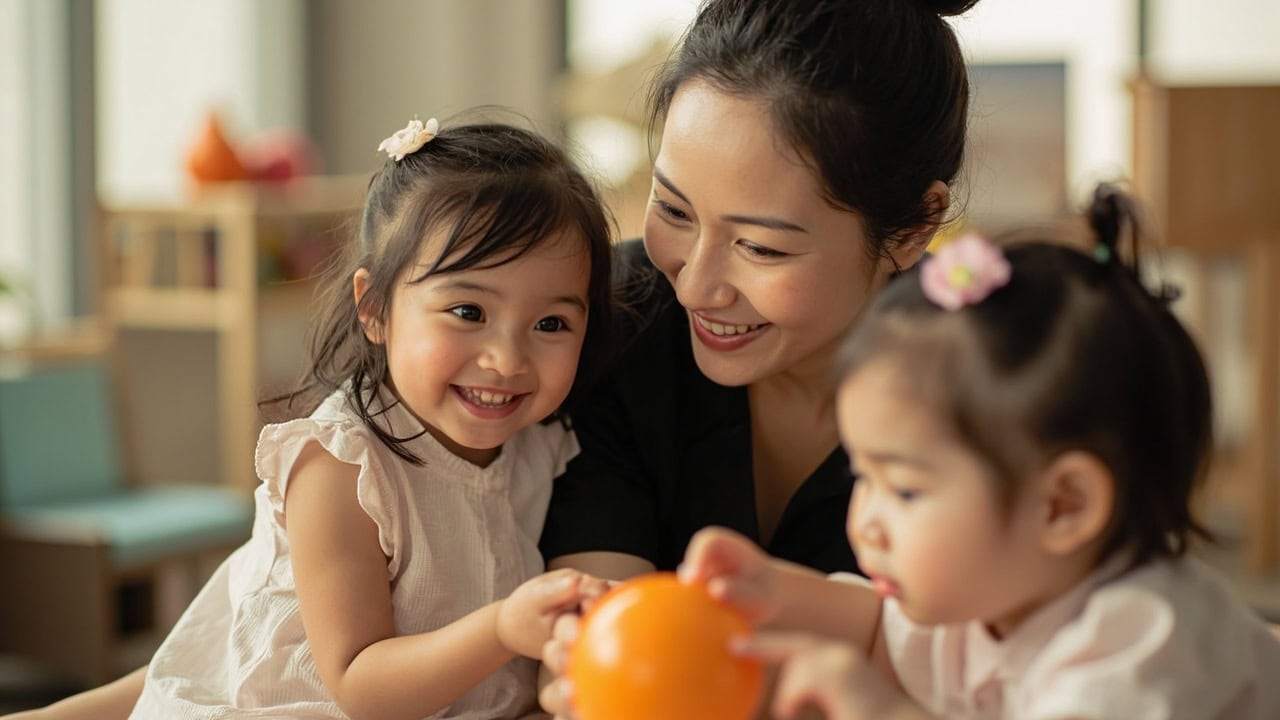
It looks like a caregiver who notices a child reaching for a toy and pauses, not to tease, but to give the child the satisfaction of completing the reach on their own — because they have learned that this particular child needs to feel competent, and the premature handing-over of the toy would steal something from her.
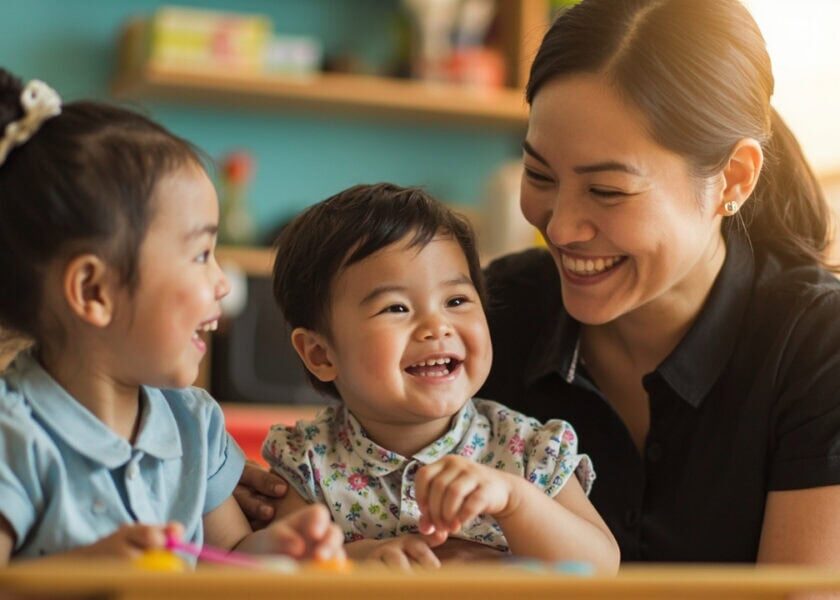
It looks like a caregiver who sits with a group of toddlers at lunch and is not just managing the logistics of eating, but is present — watching, commenting softly, laughing at the same joke a two-year-old finds hilarious.
It looks like a caregiver who, when a child falls and looks startled, does not rush in with excessive alarm, but who reads the situation, offers a steady hand, and stays close enough that the child knows they are not alone.
It looks like a caregiver who, three days later, remembers that this child is going through a phase of separation anxiety and adjusts the morning drop-off routine accordingly — slower, quieter, more reassuring.
These are not grand gestures. They are not dramatic interventions. They are the small, continuous acts of attunement that, accumulated over months and years, build a secure foundation.
The Difference Between Technically Competent and Relationally Rich Care
These moments are not accidental. They are not purely personality. They are the result of a caregiver who has been trained not just in safety protocols and developmental milestones, but in the discipline of noticing, of observing, of staying emotionally present to a small human being who cannot yet articulate what they need.
A centre may have excellent facilities, low ratios, and a curriculum that checks every box. But if the caregiver is going through the motions, if they are warm but not attuned, if they respond to needs but do not read the signals before the needs become cries — then the relational foundation is thinner than it should be. The child may be safe. The child may be learning. But the child may not feel, in the deepest sense, that they matter.
Conversely, a care arrangement with lower ratios — or even a home-based setting with a single caregiver — can provide extraordinary relational depth if that caregiver is trained, present, and committed to attunement. Because what young children need most is not variety of stimulation. It is consistency of response. It is the repeated experience of being understood.
Signs That Tell You Your Child Is Developing a Secure Bond
How do you evaluate something so subtle, so internal to the child’s experience? Here are the windows that allow you to see.
At Pickup: Notice How Your Child Responds
Not just whether they are happy to see you — though that matters — but whether they are also content where they are. A child who is developing a secondary attachment to their caregiver will often show what researchers call a “secure base” phenomenon: they will be glad to see you, but they will not be in distress when they are in care. They will have negotiated the separation without trauma. They will show you the things they have been doing. They will, in subtle ways, indicate that this place is not alien to them.
In Conversation: Notice the Language Caregivers Use About Your Child
When caregivers speak about a child with specificity — not “she was great today” but “she spent the whole morning building with the blocks, and she was so proud when the tower didn’t fall” — that specificity is a sign of attention. It is a sign that your child is being seen as an individual, not managed as a group member.
In Distress: Notice the Caregiver’s First Instinct
When a child is upset, is the caregiver’s first instinct to calm or to correct? Not that correction is wrong — guidance is essential. But a caregiver who reads the distress first, who connects before they redirect, is demonstrating attunement. They understand that a crying child needs comfort before lesson, presence before instruction.
In Description: Notice Whether Your Child Is Seen as a Full Person
Does the caregiver talk about your child as a person who has an inner life — who has preferences, moods, strategies, and a developing sense of self? This language is a window into how they understand their role. A caregiver who sees the children in their care as complete human beings, not as tasks to be managed, is a caregiver who is capable of secure attachment.
Trust Your Own Intuition
You know your child. You know, in ways that no checklist can capture, when your child feels safe. If your child shows signs of dread before each drop-off, if they seem withdrawn or vigilant in care, if they regress in ways that concern you — these are not symptoms to be managed. They are signals. And a good care arrangement, a genuinely attuned one, will be as concerned about your child’s emotional experience as you are.
Is Home-Based Care as Good as a Centre?
The answer depends on what you mean by “good.” If you are measuring purely by curriculum breadth or facility size, a large centre may have advantages. But if you are measuring by the quality of the relational bond your child develops — by whether they are known, seen, and securely attached — then a smaller setting with a consistent, attuned caregiver can offer something extraordinary. What young children need most is not variety of stimulation. It is consistency of response.
How Do I Know My Child Is Truly Safe Emotionally?
Emotional safety is not a checkbox. It is built through hundreds of micro-interactions over time. The signs described above — how your child responds at pickup, how caregivers speak about your child, how distress is handled — are your windows into this. Trust your intuition. Look for a care arrangement that welcomes your questions, shares your child’s experience openly, and treats your concerns as partnership rather than complaints.
What If My Child Has Separation Anxiety?
Separation anxiety is not a problem to be solved. It is a sign that your child has formed a healthy attachment to you — and that they need time to form a similar attachment to their caregiver. A secure caregiver will not push through this anxiety or dismiss it. They will slow down the transition, provide predictable routines, and give your child the time and patience they need to build trust. This patience is itself a form of attunement.
Can a Caregiver Really Replace What I Provide?
No one can replace you. But your child can form a secondary attachment — a supportive, safe relationship with another adult — that complements rather than competes with your bond. In fact, when this secondary attachment is secure, it frees your child to explore the world with more confidence, not less. Your child does not have to choose between loving you and trusting others. With secure attachment, they can do both.
A New Lens for Choosing Childcare
You are right to ask the practical questions. Safety, curriculum, qualifications, communication. These matter. But do not let them be the only questions you ask.
Ask also:
- Does my child feel held here?
- Is there someone who knows them — their moods, their preferences, their particular ways of being in the world?
- When they are not at their best — when they are tired, or frustrated, or inconsolable — will they be met with patience and presence, or efficiency and distance?
- Do the caregivers speak about my child as a complete person, with an inner life that matters?
- When I visit unannounced, or ask questions, does the response feel open or guarded?
These are not naive questions. They are the most important questions. Because in the first years of life, what a child learns about themselves and others is not learned from what you tell them. It is learned from what they experience, again and again, in the arms of the people who care for them.
The Paradox of Secure Attachment
When a child feels secure in their care relationship, they do not just feel happy. They feel free.
- Free to explore because they trust that their base is solid.
- Free to struggle because they trust that help is available.
- Free to individuate because they trust that the bond does not break with distance.
This is the paradox of secure attachment: it is the foundation of independence. The child who feels held takes risks. The child who feels known ventures further. The child who trusts their caregiver’s presence can tolerate their absence.
This is not wishful thinking. This is developmental psychology, translated into the language of observable childhood.
EduNanny Singapore: Where the Relationship Is the Foundation
EduNanny Singapore has built its approach around a principle that may not appear on most childcare marketing materials: the relationship is the intervention. Everything else — the observation practices, the communication structures, the developmental support — flows from and depends on the quality of the bond between caregiver and child.
EduNanny is part of the ECDA Childminding Pilot, and this is significant not just as a regulatory detail, but as a philosophical alignment. The Childminding Pilot represents a recognition, at the national level, that childcare is not a one-size-fits-all equation. That some children thrive in smaller, more relational settings. That home-based care, when professionally supported and held to rigorous standards, offers something that larger centres cannot always replicate: the intimacy of a consistent caregiver, the predictability of a homelike environment, the depth that comes from a child being known over time rather than just managed.
Pathways Designed for Relational Depth
EduNanny offers both home-based and centre-based pathways, recognizing that families are different and that the right fit depends on your child’s temperament, your family’s rhythms, and your own values. Across both pathways, the ratio philosophy is designed to support relational depth.
With up to a one-to-three infant ratio in our most intimate settings, every caregiver has the capacity to truly know each child in their care — not just their schedule and preferences, but their particular rhythms of comfort and distress, their ways of expressing curiosity and fear, their individual timelines for trust.
This is not accidental. This is structural.
Transparency as Partnership
You cannot observe every moment. But you should have windows into your child’s relational world. Whether through daily updates, photographic moments, or the kind of open dialogue that treats you as a partner rather than a client — this transparency is not a luxury feature. It is evidence of a culture that believes your child’s inner life matters, that what happens between caregiver and child is not proprietary or hidden, but shared.
Practical Support for Singapore Families
EduNanny offers structured Monday to Friday care blocks designed to work with the rhythms of working families, and fee structures that make quality care accessible within the pilot framework. CDA and Baby Bonus can be used, reducing the financial burden at a time when every dollar counts. Across all these practical dimensions, the commitment to the relational bond remains central — not as an aspiration, but as a practice.
Finding Care Where Your Child Will Be Known
Let us return, for a moment, to that morning threshold. The hand-off. The small hand releasing yours. The caregiver bending to receive your child.
What you are doing, in that moment, is not simply outsourcing childcare. You are entering into a relationship — you, your child, and the caregiver — that will shape your child’s first experience of trust beyond the family. You are trusting someone else to hold the relational space that you hold at home.
And this is an enormous act of faith.
What EduNanny asks of itself, and what it asks of its caregivers, is that this faith be warranted. Not through promises alone, but through the daily, unglamorous, emotionally demanding work of attunement. Of noticing. Of staying present to a small person who is learning, one interaction at a time, whether the world is a safe place.
EduNanny Singapore believes that every child deserves to be known. Not just minded. Not just managed. Known — in their particularity, their complexity, their small and enormous developing self.
This is not a service feature. It is a commitment. It is the foundation on which EduNanny stands, and the promise it makes to every family who trusts it with the most precious thing in their life.
If you are exploring care options for your infant or toddler — or reflecting on the care your child already receives — EduNanny welcomes the conversation.
Speak with the EduNanny team to learn more about their pathways, their standards, and the approach that sets relational care at the centre of everything they do.
Because your child is not just looking for supervision. They are looking for someone who will notice them. Know them. Stay present to them.
This is what EduNanny is here to provide.
Learn more about who EduNanny is and the standards behind their approach to childcare in Singapore.