The Social-Emotional Foundation Your Child Builds at Childcare
The World Your Child Builds When You Are Not in the Room
There is a moment, every evening, that many parents know. It comes after pickup—after a day of work and life has taken you away from your child. You arrive, the reunion happens, and then, as you walk to the car or stand in the fading afternoon light, you notice something. Your child seems different. Not just quieter or tireder in the ordinary way. There is a quality to them—a kind of settledness, an ease in their body, perhaps a new word or a gesture you have not seen before. And you think, without quite knowing how to name it: something happened today. Something good.
You are not wrong. Something did happen. And understanding what that something is—and why it matters so profoundly for your child’s development—is what this article is about.
The Question You Are Really Asking
For most parents in Singapore, the decision to place your child in care carries a particular kind of weight. It is not just logistics, though logistics matter. It is not even the expense, though that is real. It is something deeper, something that lives in the body as much as the mind.
It is the question: will my child be okay? Will they feel safe? Will they feel loved? Will the hours we are apart leave a mark on them that I cannot see and cannot undo?
This question is not a failure of confidence. It is evidence of something beautiful—your deep commitment to your child’s wellbeing. It is the oldest form of parental love expressing itself in a modern context that our grandparents never imagined.
So let us say clearly: that flicker of worry or ambivalence at the door of a childcare setting does not make you a lesser parent. It makes you a parent who understands that your child’s inner world matters. And that understanding is exactly where we need to begin.
The question you are asking is not whether time apart will harm your child. The question is: What is your child building in those hours apart, and are the relationships and environments they are entering capable of building it well?
What they are building, in those hours, is something extraordinary. They are building the architecture of their social-emotional world.
Inside Your Child’s Social-Emotional Development
We often treat social-emotional development as a phrase—a category, a checkbox to slot alongside cognitive development or physical milestones. But if you watch children in quality care settings, you see it not as a category but as a living, breathing process.
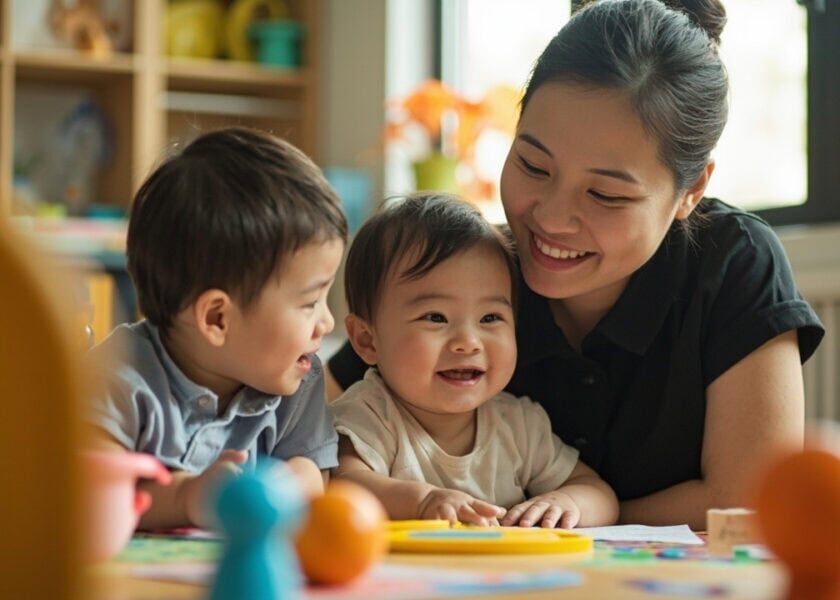
You see it in the moment a toddler falls and scrapes their knee, and instead of completely falling apart, they pause. They look around. They see their caregiver’s calm face, and something in them steadies. They may cry, but it is a different kind of cry—bounded, recovering. A cry that says: I am upset but I am not lost. And within minutes, they are back at play.
That moment of steadying is not small. It is emotional regulation—one of the first and most profound competencies a human being develops. And it develops not in isolation, but in the presence of a consistent, attuned adult who has shown the child, over and over, that big feelings are survivable. That someone will stay. That the world, even when it is hard, remains safe enough to return to.
Attachment researchers call this the secure base. The psychologist Mary Ainsworth described it decades ago, and what we now understand more deeply is that the secure base does not only exist within the parent-child relationship. It exists wherever a child finds consistent, responsive, emotionally intelligent care.
When a caregiver in a quality setting responds to your child’s distress not with alarm but with calm presence, not with dismissal but with acknowledgment, they are doing something that echoes far beyond that moment. They are teaching your child’s nervous system that emotions are manageable. They are giving your child a template for self-regulation that will serve them not just today, but in school, in friendships, in the teenage years and beyond.
This is not something you can give your child alone. Not because you are not enough—never that. But because development requires variety. Your child needs multiple relationships to develop the full spectrum of their social-emotional capacity.
A parent is irreplaceable. A quality caregiver is not a replacement. They are an expansion. They are a second voice, a second pair of arms, a second steady presence that says to your child: the world is large, and it has room for you, and there are people in it who will catch you.
The Social-Emotional Competencies Quality Care Builds
Quality childcare builds the social-emotional architecture your child cannot develop at home alone. Here is what your child is actually learning during those hours—competencies that are not soft skills but the foundational capacities that determine how they will move through the world.
Emotional Regulation
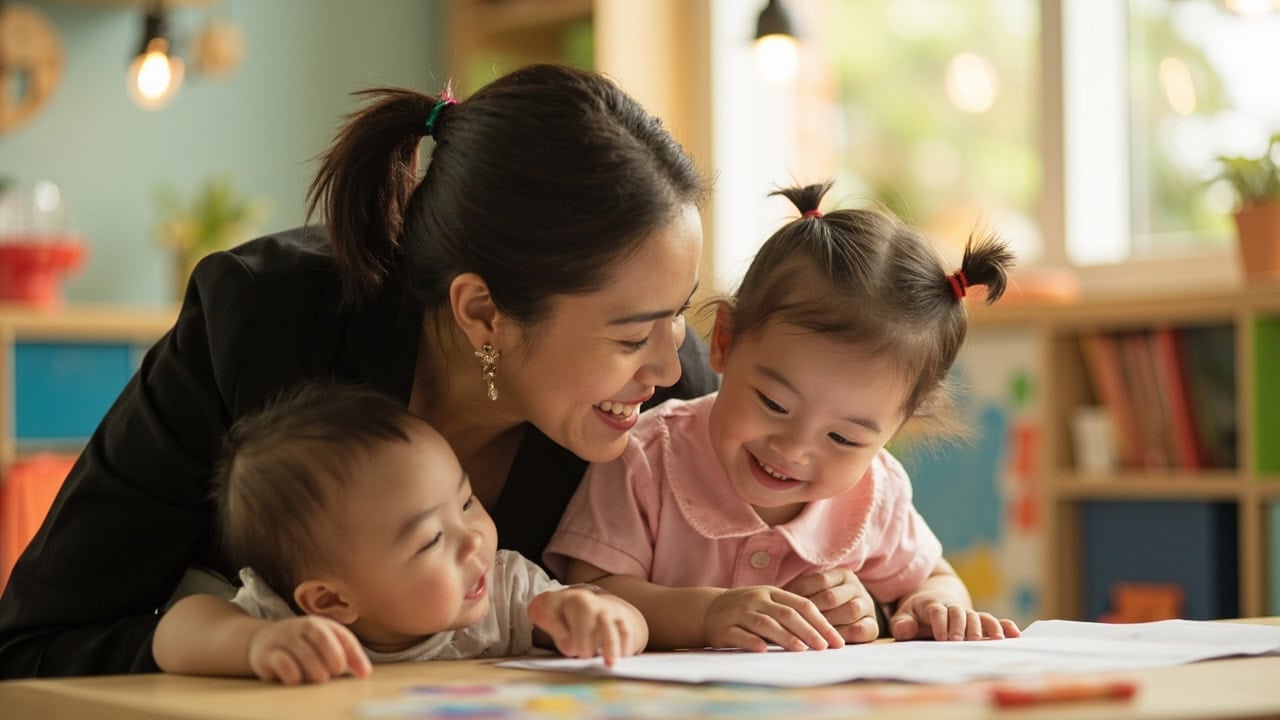
When your child is in quality care, they are learning to identify and name emotions. Not because they are given a chart on the wall, necessarily, but because their caregiver narrates the social world around them: “I see you are feeling frustrated because the tower fell. That is okay. Let us build it again.”
This is not a technique. It is a disposition. The caregiver who does this consistently is giving your child a vocabulary for the inner world, and vocabulary is the first tool of emotional regulation.
Distress Tolerance
Your child is learning distress tolerance—the capacity to experience something difficult and recover. Not to avoid difficulty. Not to be protected from every fall and every disappointment. But to discover that they can fall and get up, that they can be upset and return to joy, that the world contains both pain and play and they are equipped for both.
Peer Navigation
This is a milestone that simply cannot be replicated at home, no matter how attentive the environment. Peer interaction—learning to navigate another small person who has their own wants, their own needs, their own way of being in the world—is a distinct developmental milestone. It is not a softened version of sibling interaction or a preview of school. It is its own category, and it requires its own conditions.
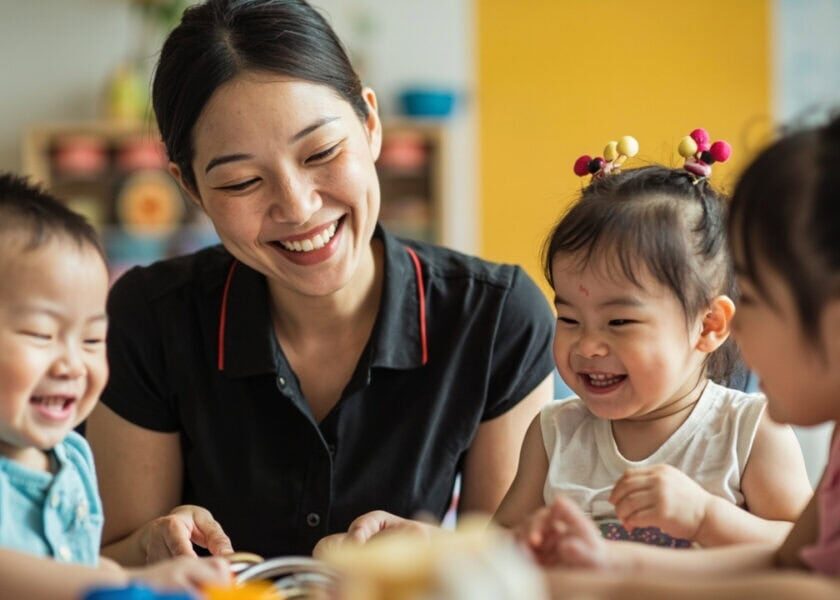
In a quality care setting, children encounter peers daily. They negotiate over toys not because they are taught to, but because the situation demands it. They experience the disappointment of a toy being taken and the relief of finding another—or discovering that the other child is willing to share after all. They learn that other children have feelings, and that those feelings matter, and that the social world operates on a set of unspoken rules that they are, slowly and imperfectly, beginning to understand.
Social Confidence
Social confidence is quieter than outgoingness. It is the child who, entering a new classroom on the first day of Primary One, can tolerate the discomfort of unfamiliar faces and unknown expectations because they have learned, in their body, that new social situations are survivable.
They have learned this not from being told it, but from living it, day after day, in the small democratic society of a quality childcare setting.
Belonging to Something Larger
Your child is also learning the experience of being part of a group, of belonging to something larger than the immediate family. This is not a diminishment of family. It is an expansion.
Your child learns that they can love you and love their caregiver. That they can miss you and be happy where they are. That the human capacity for relationship is not a fixed pie but a growing garden.
These competencies matter enormously for school readiness. A child who is socially dysregulated cannot access literacy and numeracy, no matter how many enrichment classes they attend. Social-emotional development is not a precursor to academic readiness. It is the platform on which academic readiness stands.
What Quality Childminding Actually Looks Like
For parents researching infant care in Singapore, it helps to understand what you are actually looking for. Quality childminding is not merely supervision. It is a specific set of conditions that allow development to happen.
Key Indicators of Quality
- Attuned responsiveness: Caregivers who respond to your child’s distress with calm presence, not alarm or dismissal
- Consistent relationships: Your child is not passed between multiple caregivers; they have the same people caring for them day after day
- Intentional environment: The space is designed for children’s exploration and safety, not just containment
- Narrated social world: Caregivers who help children name and understand emotions throughout the day
- Supported peer interaction: Opportunities for children to navigate social situations with gentle guidance
- Transparent communication: Regular sharing with parents about milestones, observations, and daily experiences
The Ratio Question
One of the most important structural factors in quality care is the ratio of caregivers to children. Smaller ratios mean every child receives genuine attention, not just supervision. They mean that when your child is upset, a caregiver can be fully present with them. They mean the difference between a child being watched and a child being known.
When ratios are carefully structured, the caregiver is not merely present. They are attuned. They are responsive. They are the steady presence that allows your child’s social-emotional world to expand safely.
Understanding Drop-Off Anxiety
It is worth addressing something that sits in the back of many parents’ minds, especially in those first weeks and months of care: the drop-off. The crying. The moment when your child clings to you and you feel, viscerally, that you are causing them harm by leaving.
Some crying at drop-off is not a sign that your child is unhappy in care. It is a sign that your child has a healthy attachment to you and is experiencing the normal developmental work of separation.
Children who have secure attachments to their parents are often the ones who cry more at drop-off—not because they are less adaptable, but because they trust their parent enough to protest. The crying is not a failure of the childcare setting. In many cases, it is evidence of a trusting parent-child bond.
What matters enormously is what happens after you leave. Does your child settle within minutes or a quarter hour? Does the caregiver receive them with warmth and calm? Does your child find their way back to play? Distress that persists, unsoothed, day after day is a signal worth attending to. But ordinary separation protest, followed by recovery, is the healthy work of building social-emotional capacity.
The anxiety you feel at drop-off is not evidence that care is wrong for your child. It is evidence that you are paying attention to your child’s inner world. That paying attention is exactly what quality care partners with you in doing.
Why EduNanny by BUTLER Is Different
EduNanny by BUTLER operates within the ECDA Childminding Pilot, and this is not merely an administrative detail. It is a statement of values.
The Childminding Pilot was designed to address a real gap in Singapore’s care landscape—a recognition that not every family needs centre-based care, that the needs of infants and young children are specific and demand specific attention, and that the pathway to quality care should be accessible rather than only available to those with the highest means.
The pilot creates conditions for a particular kind of care: smaller ratios, intentional pedagogy, and a model that takes the developmental needs of infants seriously rather than treating childcare as warehousing.
What This Means for Your Family
Within EduNanny’s model, the ratio of caregivers to infants is carefully structured—so that every child receives genuine attention. The caregiver is attuned, responsive, and present in the way we have been describing throughout this article.
Beyond philosophy, there are practical dimensions that matter to families:
- Care is available Monday to Friday, in care blocks that align with the realities of working family life
- Fees within the pilot structure are designed to be accessible
- Subsidies through CDA and Baby Bonus are usable—you are not forced to choose between what is right for your child and what is sustainable for your family
- Across home-based and community pathways, EduNanny offers options that reflect the diversity of how Singaporean families actually live
Communication as Partnership
Quality care cannot exist without transparency. You deserve to know what your child is doing in the hours you are apart—not because you doubt the care, but because you are their parent, and parents need information to integrate their child’s experiences with your own.
When care settings offer structured communication—regular sharing of milestones and observations, photos or notes or brief conversations that close the loop—it is not a marketing feature. It is a developmental necessity. It allows you to extend the learning. It allows you to ask questions at dinner. It allows you to see your child whole, as a person who is having a life that is not only the life you witness directly.
Where transparency measures are deployed, they serve this same purpose: not surveillance, but connection. They are a bridge between the world you cannot see and the world you need to understand.
When communication flows both ways—when your observations as a parent are received and taken seriously—you become a genuine partner in your child’s development. Not a customer at a service, but a collaborator in the most important work there is.
Choosing Quality Care in Singapore
Singapore parents have more childcare options than ever before—centre-based care, home-based childminding, enrichment programmes, and more. This is a sign of progress. But more options also mean more confusion.
When evaluating any care arrangement, the question is not just whether it is convenient or affordable. The question is whether it is building your child’s social-emotional world in the ways we have described.
Ask to observe a session. Ask about caregiver training and turnover. Ask how they handle separation and distress. Ask what a typical day looks like. Ask how they communicate with parents. Ask yourself whether you would trust the people you meet with your child’s emotional development—not just their physical safety.
The right care arrangement for your family is one where you feel genuinely partnered, where your child is known, and where the social-emotional work we have described is happening, day after day, in ways you can see and trust.
Coming Back to That Moment at Pickup
Let us return to where we began: that moment at pickup, when you notice your child seems different. Settled. More connected. More themselves.
Do you know what you are noticing? You are noticing the evidence of your child’s social-emotional growth. You are seeing, in real time, the fruit of relationships and environments that have held them well. You are seeing a child who has been building, in the hours apart, the relational foundation they will carry into school, into friendships, into their adult lives.
Time apart does not harm children with secure attachments—it expands them. The caregiver is a secondary attachment figure who expands your child’s relational world, not replaces you. And the next time you stand at the pickup door and notice that something is different in your child, see it clearly. See it not as evidence of your absence but as evidence of your alliance. See it as the visible edge of a vast, invisible architecture that your child is building with every consistent, caring hour.
You chose quality care not as a compromise. You chose it as a partnership. And your child is showing you—quietly, unmistakably—that the partnership is working.
EduNanny by BUTLER is not in the business of replacing parents. It is in the business of joining parents in the work of raising children who are not just smart or accomplished, but emotionally whole. Children who can learn because they feel safe. Children who can connect because they trust. Children who can navigate difficulty because they have experienced it, with a steady hand nearby, and discovered they could recover.
This is what we believe about children. This is what we believe about parents. And this is what we have built—through careful ratios, through intentional caregiver training, through honest communication, through accessible pathways and transparent practices—to honor.
That is the world your child is building when you are not in the room. And it is a world worth building well.
If you are researching infant care or childminding options in Singapore and want to understand how EduNanny by BUTLER approaches your child’s social-emotional development, we welcome the conversation. Reach out to learn more about our programme, schedule a visit, or simply ask the questions that matter most to you.
Because you are paying attention to your child’s inner world. And that is exactly the kind of parent we want to partner with.
EduNanny by BUTLER is a trusted, development-oriented childminding service operating within Singapore’s ECDA Childminding Pilot. We believe every child deserves consistent, emotionally intelligent care that supports their social-emotional growth from the very beginning. Learn more about our approach or read about our team.
#ChildmindingSingapore #InfantCareSG #QualityChildcare #SocialEmotionalDevelopment #EduNannySingapore