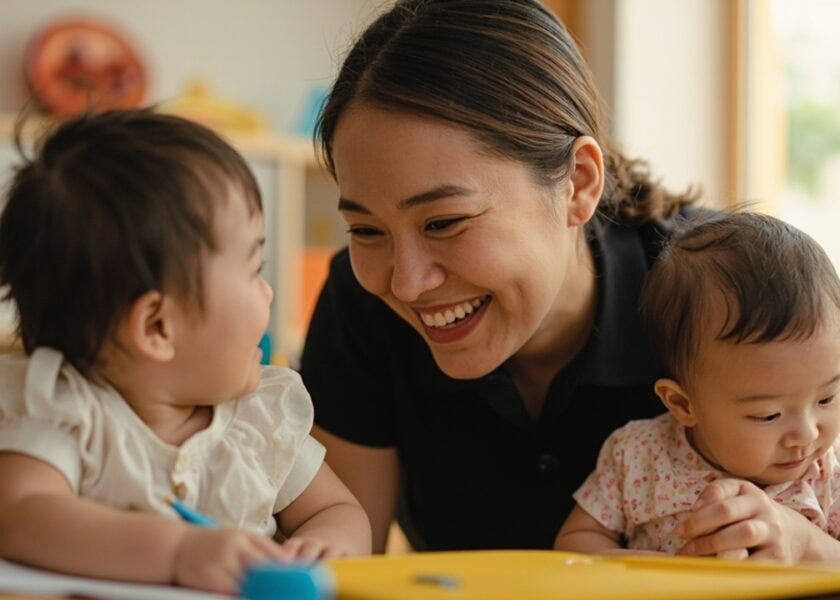
Beyond Being Minded Why Your Child Deserves to Be Known
The First Goodbye: Understanding the Weight of Choosing Childcare in Singapore
There is a moment, before you are ready for it, when you will hand your child to someone else for the first time.
You will feel the small weight leave your arms. Your child may not cry—they might even smile, distracted by a toy or a new face. And you will stand there, your hands suddenly empty, your chest tight, your mind already racing with a thousand questions you cannot answer in that moment.
Will they be okay? Will they know I came back? Will they feel, even for a second, that I abandoned them?
The first separation between a parent and child is not a logistics task. It is a threshold—one of the most profound a family will cross in the early years. In Singapore, it arrives wrapped in specific realities: the necessities of returning to work, the weight of responsibilities that do not pause for parenthood, or simply a recognition that another set of capable, loving hands might enrich a child’s world.
However it arrives, it arrives with the same companions: fear, guilt, and a quiet, desperate worry that you might miss something. That in the hours you are not present, something essential will happen—some milestone reached, some wound opened, some understanding formed—that you will never get back.
This fear is not a weakness. It is evidence of your love. It is the sound of a parent’s heart refusing to be casual about the most important work of their life. The anxiety you feel is not proof that you are making the wrong choice. It is proof that you take this choice seriously.
Children are extraordinarily adaptable, far more than we give them credit for. They form attachments with remarkable speed when those attachments are safe and consistent. They do not need a perfect caregiver. They need a present one—someone who shows up, who remains, who meets their needs with reliability.
Your child will adjust. But they will adjust best when you are also ready—not to let go entirely, but to trust the process even when trust feels premature.
The Hours Between Goodbye and Hello Again
Now let me ask you to imagine what comes after. Not the goodbye, but what happens in the hours between goodbye and hello again.
When you bring your child to quality care—a home environment or a centre where the ratios are small enough that every cry can be heard, every smile noticed, every new word caught and celebrated—you are not simply outsourcing supervision. You are entering into a relationship that will shape your child’s sense of safety, their understanding of the world, and their capacity to form trust with others throughout their entire life.
In those hours apart, your child is not simply being minded. They are being known.
Being Minded vs. Being Known
Being minded is what happens when a child is in the care of someone who sees them as a task to be managed, a schedule to be followed, a set of needs to be met efficiently and without complication. Minded children survive. They are fed, changed, kept safe from harm. But they are not seen. They do not feel, in their small bodies, that their presence matters to the person holding them.
Being known is something else entirely. It is noticing that this child reaches for comfort differently after a long sleep, that this child needs a moment of transition before moving from one activity to the next, that this child has a particular way of watching the door when a familiar face appears.
In a home-based or community-based setting with ratios of one to three infants, you can see this difference in the small moments. You can see it in the way a caregiver kneels to a child’s level before speaking. In the way they narrate what is happening, not because the child can yet understand every word, but because they know that being spoken to with respect is how language begins. In the way they hold a child during a moment of distress, saying with their presence: I know this is hard. I am here.
Your child, in those hours, is not simply in good hands. They are in hands that have taken the time to understand what makes them who they are. And that distinction—this child is known, not just minded—is the foundation on which everything else rests.
Trust: Building the Partnership That Holds Your Child
Now, let me speak directly to you about trust, because trust is the real subject of this transition. Trust between you and the person caring for your child. Trust between your child and that caregiver. Trust in yourself—that you are still, despite this separation, a good parent. Trust in your child, that they are more resilient than your fears want to believe.
Trust does not arrive all at once. It is built slowly, in the accumulation of small moments.
It is built when you send your child in the morning with a detail about how they slept, and the caregiver receives that detail not as a checkbox but as information that matters. It is built when you receive, at the end of the day, not just a report of meals eaten and naps taken, but a story—a moment your child laughed today, a new sound they made, a way they reached for a familiar toy.
It is built when you walk through a door and your child looks up with calm recognition, secure in the knowledge that you always return, and that the person they were with was safe to be with.
This trust is not built through grand gestures. It is built through consistency. Through transparency. Through the daily evidence that your child’s caregiver is not filling a role but inhabiting one—that they care about your child not because they are paid to, but because in the time they have spent together, something real has formed.
Communication as the Infrastructure of Trust
When families have access to regular updates, to transparent sharing of the day’s moments, to open channels where questions are welcomed rather than deflected, something shifts. The gap between home and care narrows. The unknown becomes known. And what was once a source of anxiety becomes a source of partnership.
Some families find comfort in practical measures—clear sightlines, documented routines, open channels of contact. These are not signs of distrust. They are signs of a healthy desire to remain connected to your child’s life, even when you cannot be in the room. They are the infrastructure of trust made visible.
The parent who asks, “How was my child today?” is not the anxious parent who cannot let go. They are the parent who is doing the work. And the caregiver who answers with specific, thoughtful detail is not just fulfilling a duty. They are honouring the weight of what has been entrusted to them.
What Quality Care Gives Back to Your Family
There is something else I want to say, because it is so rarely said in these conversations, and without it, something essential remains unspoken.
You are not choosing between your career and your child. You are not abandoning your role as a parent when you hand your child to a caregiver. You are not failing.
You are doing what millions of parents before you have done: trying to be present in more than one way at once. And here is the truth that the guilt does not want you to see: quality external care does not replace you. It restores you.
Think about what you are like at the end of a long day, after hours of focused work. Think about the attention you have left, the patience that remains, the warmth you can offer. Now think about what you are like in the morning, when you have slept, when you have had a moment to gather yourself, when you are not running on empty.
This is what quality care gives back to your family. It gives your child a consistent, attentive, loving environment in the hours when you cannot be that person—not because you do not want to be, but because you cannot be everything to your child every waking hour and still remain whole yourself.
When you pick your child up at the end of the day, you are not arriving depleted, distracted, running on guilt and exhaustion. You are arriving present. You are arriving capable of meeting them with the attention they deserve. You are arriving as the parent you want to be, not the parent fear tells you that you have failed to be.
This is not a compromise. This is wisdom. And it is time we stopped treating it as anything less.
What to Look for When Choosing Infant Care in Singapore
If you are beginning to explore your options, here are the questions that matter most—not as a checklist to exhaustively fulfil, but as a guide for where to direct your attention.
Ratios and Attention
Ask about caregiver-to-child ratios. In infant care settings, smaller numbers allow for more genuine attention. When a caregiver is responsible for fewer children, they can notice the subtle shifts in mood, the emerging preferences, the small victories of the day. This is not a luxury—it is the condition under which being known becomes possible.
Communication Practices
Ask how the arrangement shares information with families. What does a typical day look like in terms of updates? How are concerns communicated? Is there an open door policy for questions? These are not supplementary features. They are the evidence of whether the arrangement sees itself as a partnership with you.
Caregiver Consistency
Ask about caregiver consistency over time. Children build trust through familiarity. When the person caring for your child changes week by week, that continuity is disrupted. Consistent caregivers mean your child is known over weeks and months, not just in individual sessions.
Values and Philosophy
Ask about how caregivers are selected and trained. Not just whether they have certifications, but whether they are chosen for their disposition, their warmth, their capacity to see children as full human beings deserving of respect. The practical question beneath all other questions is: will the person caring for my child understand what makes them remarkable?
Practical Support for Singapore Families
For Singapore families, ask about fee structures, subsidy eligibility, and payment options including CDA funds and Baby Bonus arrangements. Quality care should not be a privilege reserved for families with significant means. Ask how the arrangement works within the practical realities of your family’s finances.
EduNanny: A Partnership Built on Understanding
EduNanny by BUTLER operates within the ECDA Childminding Pilot—a framework designed to offer families in Singapore a pathway that bridges the intimacy of home-based care with the professionalism of structured support.
We offer both home-based and community or centre-based options, because families are not all the same, and neither should their care options be.
We maintain ratios that allow for genuine attention—up to one to three infants in our infant care settings—because we believe that the number of children in a caregiver’s care directly affects the quality of noticing that occurs.
We operate Monday through Friday, in care blocks designed to support families navigating the realities of Singapore’s work environment. For families with children under twelve, we welcome the use of CDA funds and Baby Bonus payments. This is not incidental to our mission. It is part of it.
When you choose EduNanny, you are not simply choosing a service. You are entering into a partnership—a relationship that begins with your fear and your love and your hope for your child, and that grows through transparency, through communication, through the daily evidence that we take seriously what you have entrusted to us.
We know that trust is not declared. It is demonstrated, in small moments, over time. That is why we are committed to the practices that make trust visible: clear communication about your child’s day, consistent caregivers who build familiarity over weeks and months, an open door policy for questions and concerns, and daily updates for families who find it reassuring to stay close to their child’s life.
Our caregivers are not just trained. They are chosen for their disposition, their warmth, their capacity to see children as full human beings deserving of respect and attention. They understand that the work they do with your child matters not just today, but in the foundations it lays for everything that comes after.
The First Step of Trust
You may still feel the fear as you read this. I would not ask you to put it down entirely, because that fear is proof of how much you love.
But I would ask you to let it sit beside something else now—not instead of the fear, but alongside it.
Let it sit beside this: you are not abandoning your child when you leave them in quality care. You are trusting another set of capable, loving hands. You are giving your child the gift of knowing that the world contains safe people, that relationships can be trusted, that love can extend beyond the immediate family into a wider web of care.
Let the fear sit beside the knowledge that your child is being known, not just minded. That in those hours, someone is kneeling to their level, noticing their moods, learning their language, holding them with tenderness when they need comfort.
Let the fear sit beside the truth that you are doing something extraordinarily difficult with extraordinary care. That you are not a parent who has failed to measure up. That you are a parent who is trying, every day, to figure out how to love their child well in a world that does not make it easy.
And let the fear sit beside this final truth: you are not alone in this.
The first goodbye is the hardest. But it does not have to be the last moment of certainty. It can be the first step of trust—of trust in another, and ultimately, of trust in yourself.
If you are beginning to explore what this partnership might look like for your family, we invite you to take that step with us. To ask your questions. To share your concerns. To let us show you, in practice rather than promises, what it means for your child to be known.
The threshold is real. The fear is valid. And you do not have to cross it alone.
We understand. We are parents too. And we are here to walk with you toward the trust that makes everything else possible.
#ChildcareSingapore #InfantCare #ChildmindingSG #QualityChildcare #EduNannySG