The Real Transition to Two Children for Singapore Families
“`html
The Quiet Reconfiguration: When Two Children Change Your Family Architecture
Most parenting guides tell you how to choose your first childcare. They give you checklists and ratios and questions to ask on tours. These things matter.
But the deeper shift—the one that happens inside you, in your marriage, in the architecture of your days and the story you tell about your family—deserves to be named clearly today.
Because it is real, and it is significant, and it deserves to be understood before you make any decisions about infant care or childminding in Singapore.
- The grief is real. When your firstborn becomes an older sibling, something ends—and that ending deserves to be honored, not dismissed.
- One child and two children are different problems. Your childcare arrangement was designed for one. Your second child changes the equation.
- The guilt of divided attention is valid. You are not failing. You are navigating a biological and emotional reality that requires structural support, not personal criticism.
- The sibling relationship is developmental. In those early years, your children are learning, in real time, how to be in relationship with another person.
- You need a childcare architecture built for your family. The question is not whether your arrangement works for individual children, but whether it serves your entire family system.
Beginning with the Grief: What Most Guides Do Not Name
Let us begin here, because if we do not name this grief, we will not be able to move through it.
There is a form of grief that arrives when your firstborn becomes an older sibling. It is not the grief of loss in the traditional sense. Your first child is still here. You love them more than you thought possible. But something has ended.
A chapter has closed.
The chapter in which you were parents of one—the particular intimacy of those early years, the way your firstborn held your attention completely, the rituals and rhythms that were built for a family of three. That chapter is gone now. In its place is something new, and the new thing is good, but the ending of the old thing deserves to be mourned.
Many parents do not expect to feel this grief. They feel guilty for feeling it. They think: I wanted two children. I planned for this. Why am I sad?
But the grief is not a contradiction of your love for your second child. It is a measure of how much your first child meant to you in the singular form of their early years. The grief is evidence of depth, not of failure.
In conversations with families navigating this transition, this feeling takes many forms:
- One father told me he missed “the simplicity.”
- A mother said she missed “being enough for just one.”
- Another described it as “watching my toddler become a big person overnight” and grieving the baby she had just said goodbye to.
These feelings are not weakness. They are honesty. And honoring them is the first step toward building something that works for your whole family.
The Logistical Truth: Why Two Children Are a Different Problem
The second layer of this transition is logistical, and it is significant.
With one child, you built a childcare architecture that served one developmental trajectory, one set of needs, one rhythm of sleep and feeding and play. It was elegant. It was sufficient. You may have thought: we have figured this out.
Your second child does not fit into that architecture.
Not because there is anything wrong with your first arrangement, but because the requirements have changed:
- Your infant needs one ratio of care. Your toddler needs a different kind of engagement.
- Your infant’s schedule follows one pattern; your toddler’s follows another.
- Your toddler is navigating separation anxiety from you and sibling rivalry toward the new arrival.
- Your infant is simply trying to establish trust in a world that has suddenly become louder and more complex.
These are not competing demands. They are simply different demands, and they require a different design.
Was my childcare arrangement built for one child, or was it built for my family?
There is a difference. A childcare arrangement built for one child optimizes for that child’s experience. A family childcare architecture optimizes for the entire family system—including the children, but also including the parents, the relationships between siblings, the way the family moves through the world together.
When you have one child, these two things can be the same. When you have two or more, they begin to diverge, and the divergence creates tension.
Navigating Guilt, Attention, and the Sibling Bond
There is a specific guilt that arrives with a second child. It is different from the general working-parent guilt that many families navigate. It is the guilt of divided attention.
The guilt of holding your newborn while your toddler climbs on you and you cannot give either of them what they are asking for in that moment. The guilt of your toddler saying “Mama, Mama, Mama” seventeen times while you are nursing, and you cannot answer because you are feeding their sibling. The guilt of realizing that your firstborn, who was once the center of your universe, now has to share that center with someone else.
This guilt is valid. It is not a character flaw. It is a biological and emotional reality.
You are wired to attune to your children’s needs, and when you cannot meet both needs simultaneously, your nervous system registers the gap as failure. But here is what matters:
The gap is not failure. The gap is the nature of having two children.
What matters is not the existence of the gap but what you build to bridge it.
The Sibling Relationship: One of the Most Important Developmental Environments
Here is what many families discover too late: the sibling relationship is one of the most important developmental environments you will ever help create.
In those early years, your children are learning, in real time, how to be in relationship with another person. They are learning negotiation and frustration and joy. They are learning that another person has needs that matter. They are learning that they are not the only center of the universe—and neither is their sibling.
These lessons will shape them for the rest of their lives.
The question is not whether your children will have conflict. They will. The question is whether the environment around them provides the scaffolding for them to move through conflict toward connection.
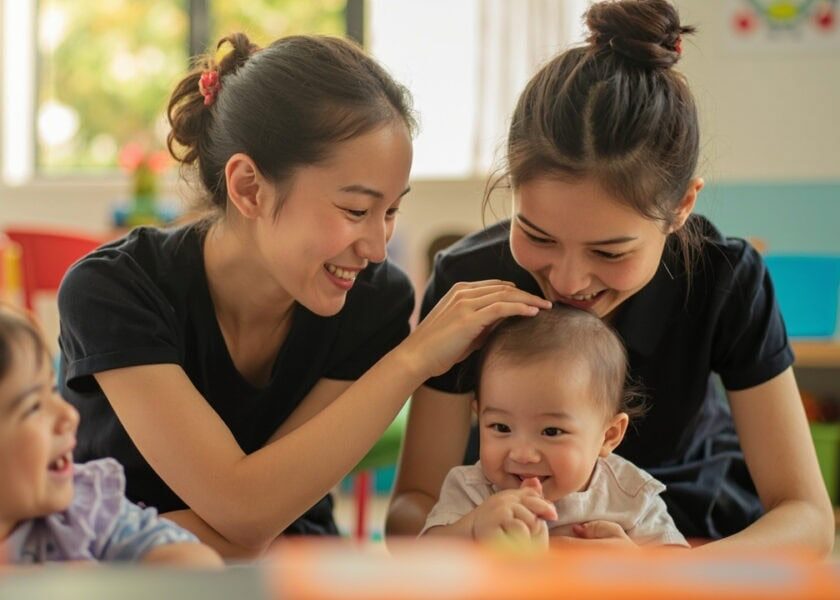
A childcare environment that understands sibling dynamics—not just managing two children in the same space but actively supporting the development of the sibling bond—makes a profound difference. It is the difference between two children who happen to share a home and two children who are becoming partners in a shared life.
Siblings will be in each other’s lives for longer than almost anyone else. They will attend each other’s weddings. Navigate each other’s crises. Share memories and conflicts and inside jokes that no one else will understand.
The sibling relationship is one of the longest relationships your children will ever have. It deserves to be supported from the beginning.
Questions Worth Asking Before You Choose Care for Two
If you are researching infant care or childminding in Singapore as a family with or anticipating two children, these are the questions that matter most:
- What is the caregiver-to-child ratio? Small ratios allow for individual attunement that larger groups cannot provide.
- How does this arrangement support sibling relationships? Not just managing siblings in the same space, but actively nurturing their bond.
- Can this arrangement evolve as my family grows? What works for an infant and toddler may need to adapt as they become preschool-age.
- How will I know what happened during the day? Daily communication, developmental updates, and transparency matter.
- Does this feel like a partner who sees my whole family? Or does it feel like a service that manages individual children?
Readiness is not a feeling—it is a design. The question is not whether you feel ready (you may never feel fully ready) but whether you have built the structural support to navigate this transition well.
Your second child did not arrive to diminish what you built for your first child. Your second child arrived to invite you to build something bigger.
Built for Growing Families
EduNanny was designed with this transition in mind—not only for the first childcare decision, but for the entire arc of a family’s growth. We understand that a family with two children is not simply a family with one child plus one more. It is a new system with its own dynamics, its own needs, its own architecture.
Our Approach to Singapore Childminding
Within the ECDA Childminding Pilot, EduNanny offers pathways that serve the complexity of growing families:
- Home-based care—where your children can be cared for in the environment where they are most comfortable, where sibling routines already exist, and where the transition between childcare and family life is seamless
- Centre-based pathways—where families benefit from community and structure
Both approaches share a common philosophy: childcare that serves the whole family system.
Ratios and Family-Centered Design
With up to one-to-three infant ratios, we ensure that each child receives the individual attunement they need, while the small group environment allows for the sibling interactions and social development that larger settings cannot provide. This is not a compromise—it is an intentional design choice that serves developmental needs that larger ratios cannot meet.
Quality childcare for growing families means:
- Maintaining ratios that allow for individual attention and sibling interaction
- Supporting each child’s developmental stage without treating them identically
- Creating opportunities for sibling bonding, not just sibling proximity
- Giving caregivers the bandwidth to notice and nurture the sibling relationship
What Singapore Families Have Told Us Matters
We know that logistics matter to Singapore families. The cost of childcare is a real consideration, and we do not pretend otherwise.
- Pilot fee structures designed to be accessible for families who need quality care
- Your Child Development Account and Baby Bonus can be used—meaning the financial architecture of your family planning already has provisions for this
- Monday to Friday care blocks give you the predictability you need to plan your working life
Communication That Bridges the Gap
What will sustain you through the Tuesday afternoon when both children are crying and you are on a work call and you cannot breathe? Knowing that you are not alone. That there is a team who understands what you are navigating. That your childcare partner sees not just your children but your family as a whole.
This is why communication and transparency are foundational to what we do:
- Where CCTV measures are deployed, they are deployed not out of distrust but out of a commitment to transparency that gives parents peace of mind
- Daily updates and developmental observations keep you informed
- Regular touchpoints ensure you know what happened, how they were, what they learned, where they struggled, where they shone
You are not guessing. You are informed. And informed parents make better decisions for their families.
A Note to Parents in This Transition
If you are in this moment right now—where your second child has arrived or is arriving and everything you thought you knew about your family needs to be redesigned—please hear this:
You are not failing. You are in a transition that is asking you to grow. And growth, even when it is difficult, is the direction of love.
The grief you feel is evidence of depth. The guilt you feel is evidence of care. The logistical complexity you are navigating is real, and you do not have to navigate it alone.
There is a childcare partner who can see not just your children but your whole family—the grief, the love, the exhaustion, the joy, the question of whether you are doing this right.
What you build now—not just for each child individually, but for the relationship between them—will shape who they become and how they move through the world together for decades to come.
The transition to two children is real. The grief is real. The logistical complexity is real. The guilt is real.
But so is the invitation. And you are ready for it.
If you are considering your options for infant care or childminding in Singapore, we would be glad to speak with you. Tell us about your family. Let us understand what you need. And let us show you what it looks like to have childcare architecture that serves your whole family—not just the children you have now, but the family you are becoming.
Explore more about who we are or return to EduNanny Singapore.
“`