The Invisible Foundation: Why Your Child’s Inner World Matters
“`html
The Inner World Is the Real Foundation
Most of the information available to parents measures what can be measured. Ratios. Qualifications. Curriculum frameworks. Meal plans. Nap schedules.
These are the right questions, and they deserve careful answers. But they describe the container, not the contents. They tell you about the structure of a place. They do not tell you about the world your child inhabits while they are there.
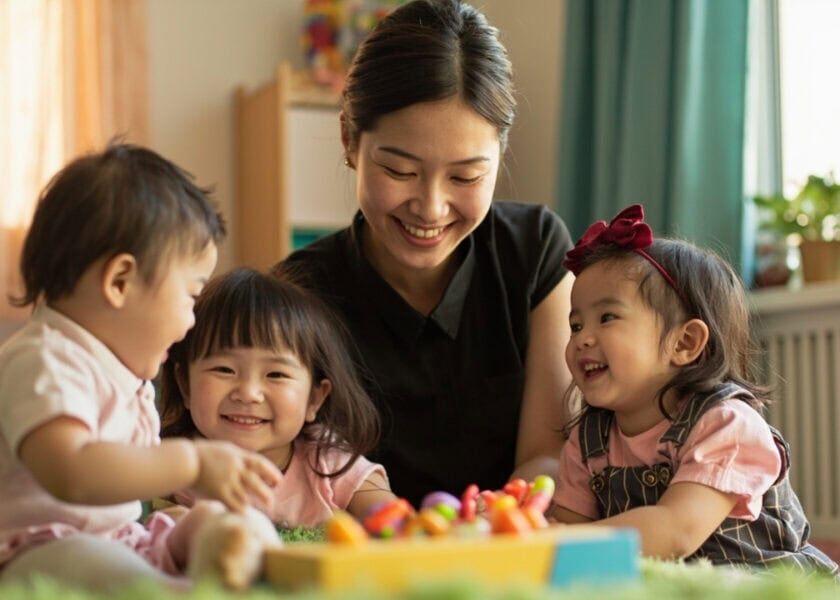
That world is made of attention. It is built in the space between your child and the person who holds them when they cry, the person who notices when they need water, the person who greets them by name each morning with genuine recognition.
The most important thing in childcare is invisible. Your child’s brain is being built right now—in the first years, billions of neural connections form based on emotional experience, not just genetics. Feeling safe, known, and valued becomes the foundation for confidence, curiosity, resilience, and the ability to learn.
This happens with you. And it happens without you. Every environment your child inhabits is constructing their sense of the world.
When we talk about quality childcare, we are talking about the quality of that space. The quality of being.
The Biology of Early Emotional Experience
In the first years of life, a child’s brain builds itself faster than it ever will again. The neural connections forming during this period number in the billions. What determines which connections strengthen and which fade is not genetics alone—it is experience. Specifically, emotional experience.
When a child feels emotionally safe, their developing brain releases hormones and chemicals that support healthy growth. Neural pathways that process trust, curiosity, and connection are activated and reinforced. When a child feels known and valued, the architecture of their social and emotional brain is being built with intention and care.
This is not sentiment. This is biology.
Attachment and the Internal Working Model
John Bowlby’s pioneering research on attachment, built upon by Mary Ainsworth and generations of developmental psychologists since, established something consistently replicated: the quality of a young child’s early relationships shapes the internal working models they carry into all future relationships.
A child who feels secure in the early years tends to expect the world to be responsive. They believe they are worthy of care. They approach new experiences with curiosity rather than fear.
This is not about intelligence or talent or potential. It is about something prior to all of those. It is about whether a child feels that the world is a place where they can thrive.
Here is the insight that gets lost in the noise: this is not something that happens only with you. It happens wherever your child spends their days—in every environment they inhabit, day and night, with you and without you. The quality of your child’s inner world is being constructed in the hands of everyone who cares for them.
What Emotional Safety Looks Like in Practice
Not safety as a checklist, but safety as a felt experience that accumulates over months. It looks like this:
It looks like a caregiver who notices that your child always gravitates toward the window when they need quiet, and gently guides them there without making a production of it.
It looks like knowing that this particular child needs three minutes of lap time before joining group play—not because they are slow, but because they process the world through connection first.
It looks like the caregiver who recognizes the difference between a child who is testing limits and a child who is overwhelmed, and responds to each with calibrated warmth.
These are not grand gestures. They are not things that appear in progress reports. They are the small recognitions that communicate, over and over, day after day:
You are known here. You are not a task to be managed. You are a person whose inner life matters.
When a child feels this consistently, something profound becomes possible. They begin to develop a sense of self rooted in being valued—not for what they achieve, but for who they are. They internalize, at a level below conscious thought, the belief that they matter, that their needs deserve response, that the world can be trusted to meet them with some measure of warmth.
This is the beginning of healthy self-regard. Not vanity. Not entitlement. The quiet, foundational sense that they are worthy of attention, worthy of care, worthy of being seen.
How This Shapes Your Child’s Future
Children who feel genuinely known and valued in their early years tend to develop stronger capacities for empathy, resilience, and authentic confidence. Not because they were taught these things directly, but because they experienced them first.
- They felt security, so they could afford to be curious.
- They felt belonging, so they could take social risks.
- They felt recognized, so they could begin to recognize others.
When researchers track children over time—through school years, into adolescence, into adulthood—they consistently find that the quality of early relational experience predicts social and emotional outcomes more reliably than early academic metrics.
This is not to say that early learning doesn’t matter. It does. But the capacity to learn, to collaborate, to recover from setbacks, to stay curious—all of this grows from the soil of early emotional security.
| Early Emotional Foundation | Builds Capacity For |
|---|---|
| Feeling safe and held | Taking intellectual risks |
| Feeling they belong | Navigating social complexity |
| Feeling truly known | Beginning to know themselves |
This is the invisible curriculum that runs beneath every visible one. And it is taught not through lesson plans but through the quality of presence your child experiences, day in and day out.
The Singapore Reality: Finding Balance in the Pressure
Singapore is a remarkable place to raise children. The opportunities available here are extraordinary—world-class schools, diverse enrichment options, a culture that values education and effort. Singapore parents are, by necessity and by disposition, deeply engaged. You research. You plan. You want the best.
But I want to name something that is easy to lose sight of in the intensity of that wanting.
The pressure toward early academic readiness is real. The sense that you must prepare your child, that you must give them every advantage, that the clock begins ticking early—this pressure is felt by every parent I have spoken to here. It can pull attention away from what matters most and toward what is most visible. It can make parents feel that they are not doing enough if their child is not already reading, already excelling, already demonstrating the markers of future success.
Here is what I want you to hear: your child’s emotional foundation is not a soft extra. It is not something you tend to after you have handled the important things. It is, in the deepest sense, the important thing.
When your child feels secure, they are not losing time. They are gaining the capacity to use every opportunity that comes after. Emotional security and future readiness are not in competition. One creates the conditions for the other.
This foundation is built precisely through your child’s early years. Every smile that is met with warmth. Every frustration that is met with patience. Every moment of exploration that is met with the quiet assurance that someone is there.
How EduNanny Is Designed to Meet These Needs
EduNanny was built on a simple but profound premise: that caring for a child in their earliest years is not incidental. It is not a service transaction. It is the work of helping a human being form their sense of the world.
This is why EduNanny was developed through the ECDA Childminding Pilot—because home-based and community-based care, with its smaller scales and stronger relationships, offers something that larger institutional settings often cannot: the conditions for genuine recognition.
With ratios that allow caregivers to know each child—not as a face in a group, but as a specific person with specific needs, preferences, and rhythms—EduNanny creates space for what actually matters.
The Caregiver as the Real Curriculum
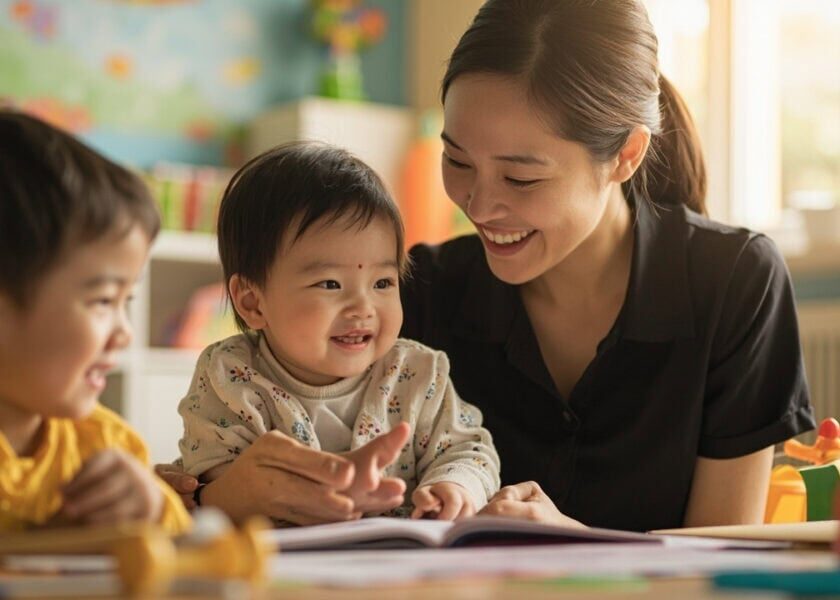
The role of the caregiver at EduNanny is treated with the dignity it deserves. These are not babysitters. They are not task managers. They are the people who are present for your child in the hours when you cannot be, and who shape the quality of those hours with their attention, their warmth, and their consistency.
Caregivers are trained not only in safety and development, but in the art of attuned care—the discipline of truly observing, genuinely responding, and consistently recognizing each child as an individual.
They are supported, too. Because we know that a burned-out caregiver cannot give a child what they need. And we know that the quality of the caregiver’s own experience flows directly into the quality of care they can offer.
For Parents: Transparency and Trust
EduNanny settings offer regular communication about your child’s day—their discoveries, their moments of frustration, their moments of delight. Some settings use CCTV, not to surveil, but to assure—to give you the confidence that you can trust what is happening when you are not there.
Practical Accessibility
EduNanny is designed to be accessible. Monday through Friday care blocks. Fees structured to be affordable. CDA and Baby Bonus usable to offset costs. These are not marketing points. They are the things that make it possible for more families to access what every family deserves: the knowledge that their child is in a place where they are building something that will last.
Questions to Ask When Choosing Childcare
You are making a decision that feels enormous, because it is enormous. When you choose childcare, you are not choosing a service. You are choosing an environment—one that will shape your child’s sense of safety, of belonging, of whether the world is a warm place or a cold one.
That is a weight to carry. I do not want to take it from you. But I want to give you a frame for it.
The question you should ask is not only:
- Is this place safe?
- Is this curriculum strong?
- Are the teachers qualified?
The question beneath all of them is:
- What is the emotional environment my child will inhabit here?
- Will they feel held?
- Will they feel known?
- Will they feel that their inner life is attended to with the same seriousness I attend to it at home?
This is the question EduNanny exists to answer well.
The Work That Matters Most
There is a quiet revolution happening in how we understand early childhood. It is the recognition that the most important things are often the most invisible.
That the smile a caregiver gives when your child enters the room in the morning is not a small thing.
That the way a child is held when they are upset may shape how they relate to their own emotions for decades.
That the sense of being known, of mattering, of belonging—these are not luxuries. They are the nutrients out of which healthy human beings grow.
If you are considering childcare—if you are carrying that quiet wondering about what is happening inside your child right now—I want you to know that your instinct is right. The invisible work matters. The inner world is real. And it deserves to be tended with the same seriousness you bring to everything else you do for your child.
At EduNanny, we tend it every day. One child at a time. One recognition at a time. One moment of feeling held and known and valued at a time.
This is not small work. This is the work that lets everything else become possible.
Ready to learn more? Speak with our team about how EduNanny can support your child’s earliest, most important years—or read more about our approach.
“`