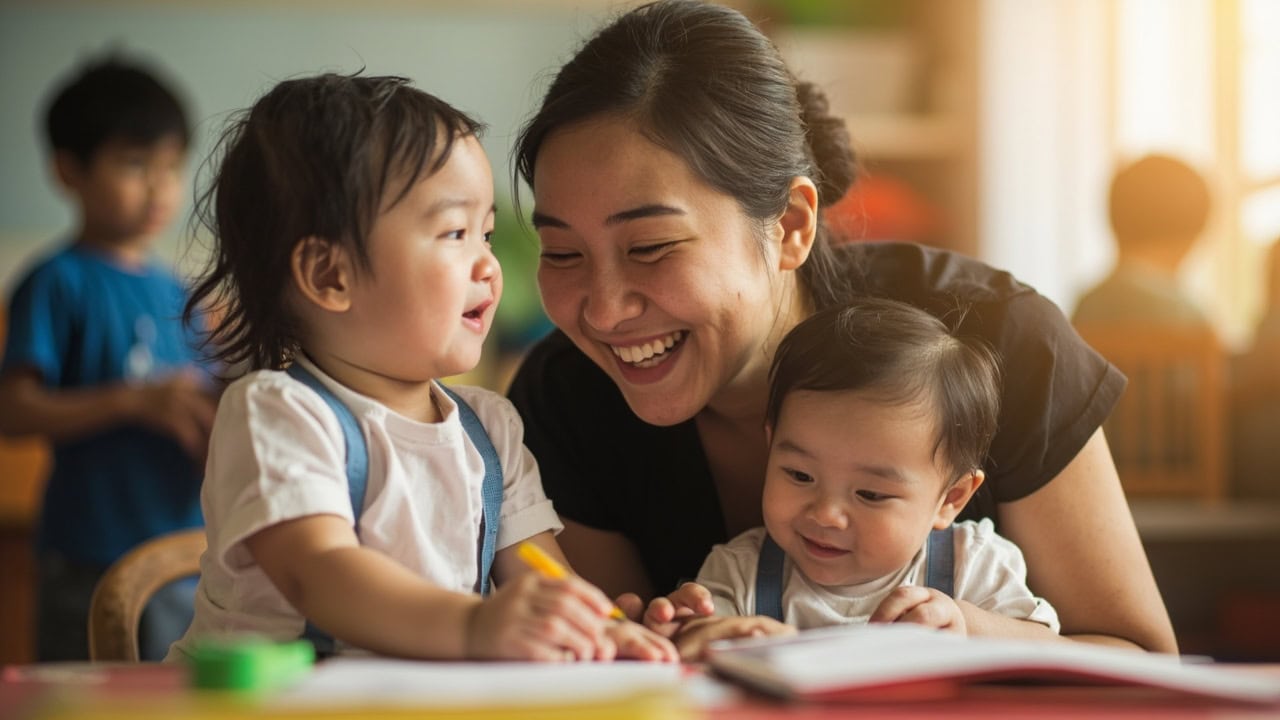
Is Your Toddler Ready for More Than Infant Care
The Developmental Reality: What Changes at 12 to 24 Months
Between twelve and twenty-four months, something extraordinary unfolds. A child who could not walk at twelve months is running by twenty. A child who communicated exclusively through cry and gesture is now attempting sentences, asking for things by name, and beginning to understand that other people have minds of their own.
They are no longer content to observe the world from a caregiver’s arms or a fixed position on a mat. They want to explore. They want to climb. They want to do things themselves, and they are developing the motor skills, the language, and the cognitive architecture to begin attempting just that.
This is the age of the toddler. And it is, in developmental terms, one of the most demanding stages a child will ever pass through — not because they are difficult, but because they are hungry. Hungry for stimulation, for challenge, for interaction that meets them where they are, rather than where they were six months ago.
Why Care Arrangements Often Fall Short at This Stage
The problem is that most infant care models were not designed with this trajectory in mind. They were designed for the first twelve months: the period of relative physical dependence, of feeding and sleeping cycles, of caregivers whose primary function is to provide safety and basic nurturing in an environment that is necessarily controlled.
And for that period, many care arrangements — whether home-based or centre-based — function perfectly well. The child is small, relatively immobile, and their world fits comfortably within the boundaries that have been set.
But then the child begins to move. Begins to think. Begins to want.
And the care arrangement does not always move with them.
This is not an indictment of caregivers, many of whom are devoted and loving and doing their best within the constraints of their model. It is simply a structural reality. When a care environment is built around the assumption of an infant, there comes a point at which the most active, curious, rapidly-developing children begin to strain against those boundaries.
The Quiet Signs Your Child Has Outgrown Their Arrangement
How do you know when your child has crossed this threshold? The signs are often subtle — which is why so many parents in Singapore find themselves sensing something is off but unable to articulate what.
- The pickup shift: Your child no longer cries when you arrive. This seems positive, but it may indicate disengagement rather than security.
- Energy mismatch: Your child comes home visibly understimulated — or conversely, unusually clingy, as if the care environment is not meeting their need for active engagement.
- Developmental leaps without response: Your child is attempting new words, new physical feats, or new social behaviours, but the caregivers do not seem to notice or build on them.
- Routine rigidity: The schedule remains identical to what it was when your child was six months younger, despite obvious changes in their sleep patterns, mobility, and social interest.
- Your own intuition: You find yourself making excuses for the arrangement. You rationalize what you see as limitations. You dismiss the quiet voice that says something is not quite right.
That last sign matters most. Not because it proves the care is inadequate — but because it proves you are paying attention.
Speaking to the Feeling You May Be Carrying
Let me address something that is rarely acknowledged in discussions about childcare transitions. There is an emotional texture to this moment that gets overlooked.
You may be in a care arrangement that was right for your child once, and may still be right for other children at a similar stage, but which no longer seems adequate for the particular child your child has become. You may have noticed yourself making excuses. You may have found yourself rationalizing what you see as limitations. You may have thought, at pickup, that something was not quite right — and then dismissed that thought because it felt disloyal, or ungrateful, or because you did not want to believe that the choice you made was no longer the right one.
I want to tell you that this feeling is not a failure of yours. It is not a lack of gratitude. It is not a sign that you chose poorly. It is, in fact, a sign that you are paying attention. That you see your child — really see them — and that what you see is no longer what your care arrangement was built to serve.
We talk about logistics, about ratios, about curriculum alignment and safety standards. These things matter. But we rarely speak about the particular ache of watching your child become someone new — someone whose needs and capacities have outpaced the world you built for them when they were smaller.
There is grief in that. Not grief for the baby — you love the toddler too, perhaps differently but no less — but grief for the simplicity of a relationship that was once a perfect fit. You knew that arrangement. You trusted it. And now your child is asking you to find something new, and that means releasing what was and stepping into uncertainty.
That is hard. And you are not wrong to feel it.
But I also want to offer you something that may help: the recognition that this is not a crisis. This is a transition. And transitions, by their nature, carry within them both loss and possibility. The same development that has created this gap in your care arrangement is also the most beautiful evidence of your child’s thriving. They are not struggling. They are growing. And growth, by definition, requires environments that can grow with them.
What Quality Care for Toddlers Actually Looks Like
So what should you be looking for when the child you see before you is no longer an infant, but not yet the older toddler or preschooler that many programmes are designed for? Here is a framework — not a rigid checklist, but a way of thinking, a lens you can apply as you observe and evaluate what is in front of you.
Responsiveness: Are They Watching, Not Just Supervising?
A care environment that can grow with your child is one in which the caregivers are watching, not just supervising. They are tracking your child’s emerging interests, noticing when they begin to attempt new physical feats, listening to the new words they try out, and adjusting what they offer accordingly.
What to ask: “What has my child been interested in lately?” “Can you tell me about a recent moment when my child did something new?” Listen to how they answer. If they cannot tell you, that is information. If they can, that is a sign.
Environment: Does It Invite Exploration?
Is the space organized in a way that invites the kind of exploration your emerging toddler craves? Is there space to move — really move — not just from one adult-controlled activity to another, but with some degree of agency?
Is there access to materials that invite manipulation, construction, pretend play, and language? A quality toddler care environment is thoughtfully arranged to support the developmental agenda of this age group, which is heavily oriented toward motor refinement, cognitive problem-solving, and social-emotional experimentation.
Ratio: The Quality of Attention Your Child Receives
In care settings where ratios are high — where one adult is responsible for many children — even the most dedicated caregiver cannot give any single child the kind of responsive, individualized interaction that the twelve-to-twenty-four-month window demands.
| Developmental Need | What High Ratios Prevent |
|---|---|
| Language scaffolding | Responding to new words and attempts at sentences |
| Motor encouragement | Safe support during climbing, running, physical discovery |
| Social facilitation | Guiding peer interactions and conflict resolution |
| Individual observation | Noticing and building on each child’s emerging interests |
Caregiver Engagement: Genuine Curiosity, Not Just Professional Duty
Notice whether the caregivers themselves seem engaged — not just professionally dutiful, but genuinely curious about the children in their care. Do they get down to the children’s level? Do they narrate what is happening? Do they wait for children’s responses and build on them?
Ask them about their training, their philosophy, their understanding of toddler development. These are not trivial details. They are indicators of a caregiving culture that takes the toddler phase seriously — that understands it as a critical window rather than a waiting room before preschool.
Forward Fit: Where Your Child Is Going
The best care arrangements for this transition are not just meeting your child where they are today. They are designed with an awareness of what comes next — laying groundwork for language, for self-regulation, for social skills, for the kind of confident curiosity that will serve your child not just in the next stage of childcare, but in school and beyond.
A Deeper Question: What Is This Arrangement Teaching My Child About Who They Are?
Think about it. Your child is at an age when their sense of self is beginning to form. They are learning, through every interaction, whether the world is a place that welcomes their curiosity or frustrates it. Whether their attempts at communication are met with engagement or dismissal. Whether their growing autonomy is celebrated or merely tolerated.
These early lessons are not abstract. They are the substrate from which a child’s earliest understanding of their own competence, their own worth, and their own place in the world is built.
A care environment that can grow with your child is one that understands this. That does not simply manage toddlers in a space designed for infants, but actively fosters the emerging capacities that define this age: the desire to do things independently, the drive to communicate, the need to test limits and discover consequences, the fascination with other children as social beings rather than mere co-occupants of space.
This is not about accelerating your child or pushing them into premature academics. It is about respecting who they are becoming, and building a relationship — and an environment — that reflects that respect.
This is what separates care from childcare. And it is what separates childcare that merely passes the time from childcare that is genuinely formative.
Questions to Ask and Concerns Addressed
Questions worth sitting with
- Can the caregivers tell me what my child has been interested in lately — not just what they ate or how they slept, but what they have been drawn to, what they have attempted, what they have discovered?
- Has the environment changed in any way since my child turned one? Activities, routines, spatial arrangements?
- Does my child seem engaged when I drop them off, or do they seem to be waiting for something more?
- Do the caregivers speak about my child’s development with specificity and warmth?
- Is my child given opportunities to move, explore, and attempt things independently — or is most of their day structured around adult-directed activities?
- Do I find myself making excuses for the arrangement when I talk about it to others?
- When I observe at pickup, do I see children who are curious and active, or children who seem passive or understimulated?
Common concerns from Singapore parents
“Is home-based care really as good as a centre?”
For children in the twelve-to-twenty-four-month window, home-based care often offers advantages that centres cannot match at this developmental stage. The scaled environment, the real-world routines, the smaller ratios — these are not compensatory features. For a toddler learning through imitation and participation, they are often ideal.
“My child seems fine. Maybe I’m overreacting.”
If your child seems fine, that may be exactly right. But “fine” is not the same as “thriving.” A child can adapt to an environment that does not quite meet their needs — but adaptation is not the same as growth. The question is not whether your child is surviving their care arrangement. It is whether their care arrangement is keeping pace with who they are becoming.
“I feel guilty even thinking about changing care.”
Guilt is understandable, but it is not useful here. You are not abandoning a care arrangement that failed. You are recognizing that your child has outgrown one that worked. That is not a criticism of anyone — least of all yourself. It is the most natural thing in the world. Children grow. Environments need to grow with them.
“How do I know if EduNanny is the right fit for my child?”
We encourage you to visit, to observe, to ask questions. Watch how the caregiver interacts with your child. Notice whether they seem genuinely interested in who your child is, not just in managing their day. Ask about their approach to the developmental needs of toddlers. Trust the quality of your own attention — it has already told you something is shifting. Now let it guide you toward whether we are the right place for what comes next.
How EduNanny Singapore Approaches This Transition
At EduNanny Singapore, this understanding shapes everything we do. Our Childminding Pilot, developed under ECDA guidelines, was built specifically to address a gap in Singapore’s care landscape — the need for high-quality, responsive care that can meet children and parents at moments of transition, and grow alongside them through the dense developmental terrain of the first years.
We are a home-based care model, and we believe this matters for the toddler transition in particular. In a home environment, the child encounters a domestic world scaled to human life — a world of real objects, real textures, real routines that they can participate in, not merely observe. The caregiver is not managing a classroom; she is running a home in which your child has a place.
Our Ratios Reflect This Philosophy
With up to one-to-three infant and toddler places, each child receives the kind of individualized attention that this stage demands. This is not an accident of our model — it is its foundation.
We designed our pilot with the recognition that at twelve to twenty-four months, a child does not benefit from a little less attention. They need more. They are absorbing everything, and the quality of what they absorb — the quality of the language they hear, the responsiveness they encounter, the opportunities they are given — will shape them in ways that we are only beginning to fully understand.
Our Caregivers Are Trained in Developmental Responsiveness
Our caregivers are not just trained in safety and basic care. They are trained in developmental responsiveness — in recognizing where each child is in their journey and meeting them there. They are equipped to support emerging language, to scaffold social interaction between toddlers, to create an environment that invites the kind of active, purposeful play that builds cognitive and motor competence.
We Partner With Parents and Offer Transparency
Our caregivers communicate regularly with parents — because we believe that the parent is the primary expert on their child, and because the transition from infant to toddler care is not a handoff but a partnership. In our settings where CCTV measures are deployed, we offer parents visibility into the daily experience of their child’s care. This is not about surveillance. It is about the recognition that trust is built through openness, and that parents navigating this particular transition deserve to see, to know, to feel confident in what is happening while they are apart from their child.
We Keep Quality Care Accessible
We know that for many Singapore families, the use of CDA and Baby Bonus funds represents a meaningful contribution to care costs. Our fees are structured within pilot parameters to remain accessible. Access to quality care should not be the privilege of the few, and our model is designed with an awareness of the real financial pressures Singapore parents face.
Trusting the Transition
There is a way of thinking about childhood transitions that I find useful, and I want to offer it to you as a gift before I close.
Every transition — every moment when the old environment can no longer contain the new capacities of the child — is not a break but a bridge. The child’s development has built the bridge. What remains is for us, as parents and as a caring ecosystem, to help them cross it.
Your child has built this bridge. They have built it with every step they took after the first uncertain wobble, with every word they attempted after the first uncertain syllable, with every time they reached for something just beyond their grasp and stretched, and stretched, and stretched until they got there.
The question now is whether the environment waiting on the other side of that bridge can meet them. Whether it can see them. Whether it can support the next chapter of who they are becoming.
Not to your child’s development, not to the framework offered, not to the checklist of what quality care looks like — but to you, and to what this transition is asking of you.
It is asking you to trust your instincts. The instinct that told you something was different when you picked up your child. The instinct that noticed your child pulling toward the door instead of crying, or walking instead of crawling, or pointing and naming something in a voice that surprised you.
That instinct is not anxiety. It is attention. It is your love for your child expressing itself in the form of perception — in the capacity to see what others may not, and to feel what the logistics of childcare decision-making usually override.
Your child is not an abstraction to you. They are a living, changing, extraordinary person who is moving through the world and growing in ways that are, frankly, breathtaking if you let yourself notice them.
And at some point in the last year or so, you began to sense that the care arrangement you chose — the one you trusted — is beginning to fit differently. Not because you chose poorly, but because you chose for a child who has become someone new.
That is not a problem to be solved. It is a transition to be honored.
And honoring it means being willing to ask the question: Is my child in an environment that sees who they are becoming? Is someone watching the way they climb, the way they talk, the way they negotiate with other children, the way they are beginning to understand the world? Is this care growing with my child, or is my child learning to shrink to fit?
You do not need to have all the answers today. You do not need to be certain that a change is necessary, or that the grass is greener elsewhere. But you do need to be willing to look — really look — at what is in front of you. To ask the questions. To notice whether the response you receive from your care environment is alive and attuned, or rote and routinized.
You have already done the hardest part. You have paid attention. You have noticed.
Now trust that noticing, and let it guide you toward what your child actually needs.
The Care That Grows
We believe EduNanny Singapore can meet your child at the place where they are, and grow alongside them as they move toward who they are becoming. Not because we have a perfect model — we do not claim that. But because we are built around an understanding of this particular transition, and because every element of our approach — from our ratios to our home-based model to our communication practices to the training of our caregivers — is designed with the awareness that at twelve to twenty-four months, your child is not a small infant and not yet a preschooler.
They are something extraordinary and specific: a toddler on the bridge, stepping into a new world with every passing day.
We would be honored to walk that bridge with you.
The transition you are sensing is real. Your child’s development is not a problem to be managed. It is the most beautiful thing happening in your life right now. And finding the care that can honor it — that is not just a logistical decision. It is an act of love.
Trust that love. Trust your instincts. And trust that the right environment for your child exists — and that when you find it, you will know it not because everything is perfect, but because your child will be met exactly where they are.
That is the care that grows. That is what your child deserves. And that is what we at EduNanny Singapore are here to offer.
Ready to explore care that grows with your child? Speak with our team about the EduNanny Childminding Pilot and whether it may be the right fit for your family at this stage of your child’s journey.