Beyond Logistics: How Trust Grows Between Parents and Caregivers Over Years
Understanding Long-Term Childcare Partnerships in Singapore
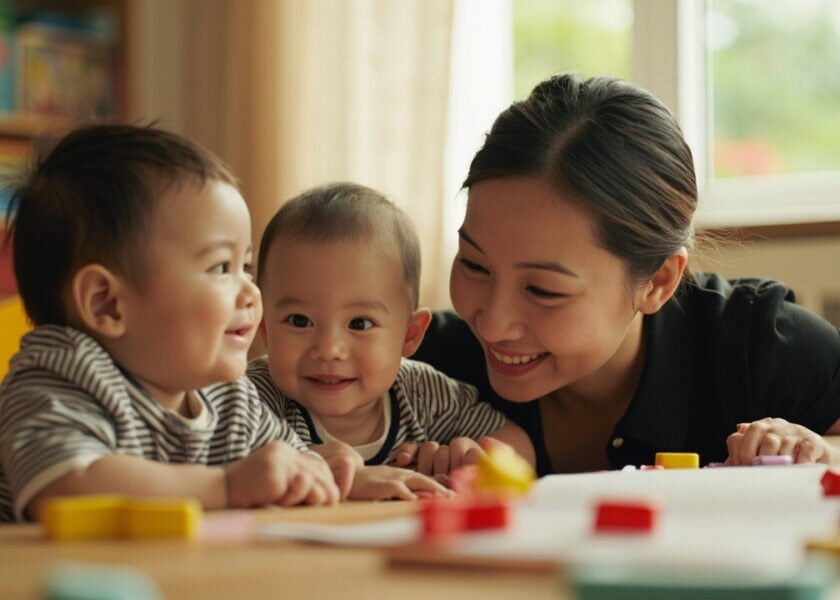
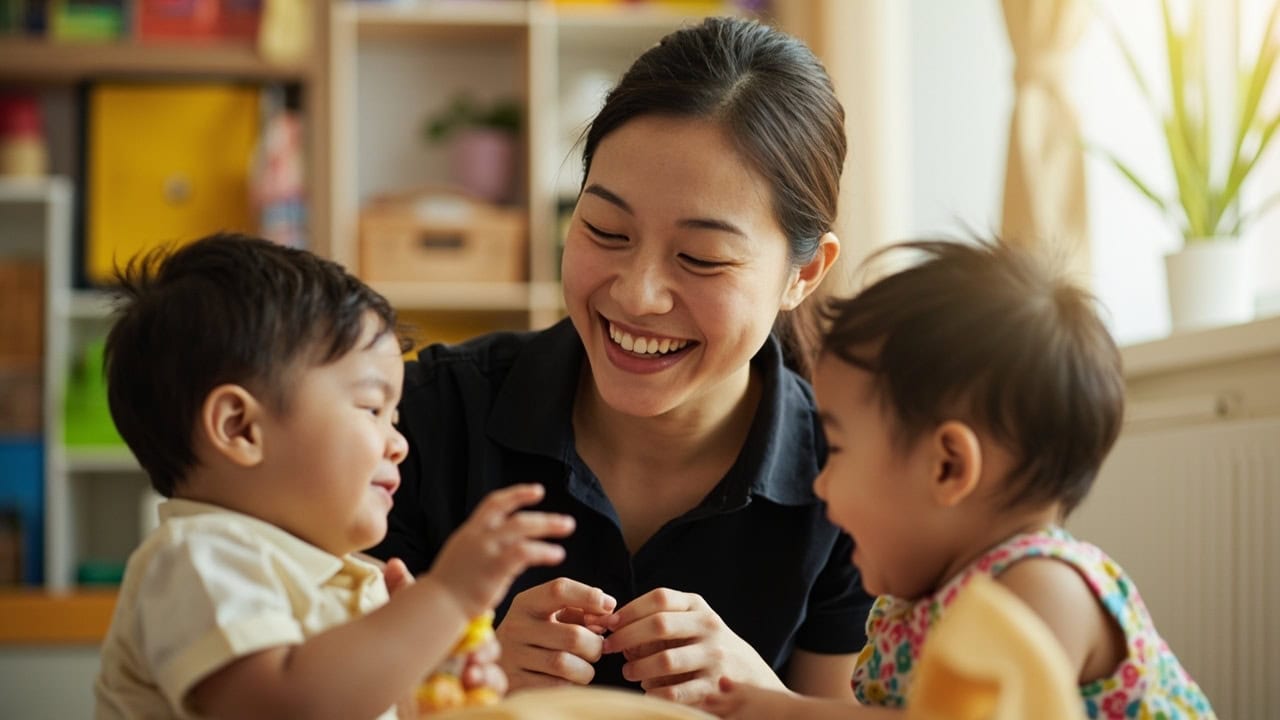
There is a moment every parent in Singapore remembers. It may happen in a playroom, in someone’s home, across a kitchen counter where someone is making tea while your child reaches for a toy on a low shelf. It may happen in a centre with soft morning light through tall windows. It is the moment you realize: this person will know your child almost as well as you do.
This person will witness the small daily miracles that no photograph captures—the first time your child stacks two blocks successfully, the particular tone they use when they are tired versus when they are hungry, the way their face changes when they hear a certain song. This person will be present for a significant chapter of your child’s life, and for yours.
That realization carries a weight that is difficult to name. It is not quite anxiety, though anxiety may live inside it. It is something closer to the feeling of handing someone a trust you did not know you were carrying until you felt its gravity. And in the days and weeks that follow, as the initial orientation settles and the routines take shape, a quieter question emerges—one that rarely gets answered in the pamphlets and parent guides and first-meeting coffees. The question is not whether you chose well. The question is what happens next. What happens over years.
We write a great deal about how to choose childcare well. We write less about how to tend what you have chosen. And we write almost nothing about what happens when both your child and your caregiver evolve—when the baby who needed constant holding becomes a toddler with opinions, when the caregiver who once felt like a stranger becomes someone who finishes your sentences because she has simply been there long enough to know.
This silence matters. It leaves parents navigating one of the most significant relationships in their child’s life without a map for the territory that stretches beyond the first year.
Trust Is Not a Feeling. It Is a Structure.
The first thing to understand is that trust, in this context, is not a feeling you arrive at. It is a structure you build. It is constructed from hundreds of small moments: the consistency of a caregiver who shows up the same way each morning, the reliability of routines that your child begins to predict and depend upon, the accumulating evidence that this person is safe and capable and genuinely invested in your child’s wellbeing.
Children are not born knowing how to trust. They learn it through repetition, through the reliable return of the same faces and the same care and the same presence. This is not a metaphor. It is the architecture of secure attachment, and it is built slowly, brick by brick, across thousands of ordinary days.
What this means practically is that the partnership you are building with the caregiver is not separate from the work of attachment. It is the same work. When you invest in consistency, you are not just making your life easier with predictable schedules. You are giving your child the foundation they need to explore the world from a base of security.
You are teaching them, through the experience of their daily life, that the people who care for them will remain, that their needs will be met, that they can venture out and come back and find things as they left them. This is the gift of continuity, and it is irreplaceable.
For Singapore parents, building trust means being intentional about the conditions that allow consistency to flourish. It means valuing the caregiver who has been with your family for eighteen months, not just the one who seemed perfect in the first week. It means building routines that your child can depend upon—same dropoff time, same greeting, same small rituals at pickup. These are not small things. They are the scaffolding that holds everything else up.
The Evolution of Communication
The relationship between you and your child’s caregiver is not only about what happens with your child. It is also about what happens between two adults who share the care of a small person across years. This relationship has its own arc, its own rhythm, its own moments of growth and friction and deepening.
Think about how your communication with your child’s caregiver evolves. In the early months, it may be primarily transactional—logistics, feeding notes, sleep updates, the basic exchange of information that allows two people to coordinate around a tiny human’s needs. This is necessary and appropriate.
But as the months become years, something changes. The transactional gives way to something more like collaboration. You begin to share observations: she noticed your child has been more clingy this week, could there be something happening at home? You have noticed it too. You begin to trade insights: she has a particular way of calming your child during tantrums that you have started to adopt at home.
The boundaries between who taught whom what begin to blur in the best possible way. You are both, slowly, becoming experts on this one particular child.
Signs that communication is deepening include when your caregiver shares observations about your child’s development unprompted, when you find yourself asking her opinion on parenting decisions, when she remembers details about your child’s preferences from months ago, when you share what’s happening at home because you trust her perspective, and when the conversations at pickup have grown beyond logistics.
When Things Shift: Adaptation Over Time
Even in the best partnerships, things shift. Children change. Caregivers change. Circumstances change. And this is perhaps the most important thing to understand about the long-term caregiver partnership: it is not static. It requires reorientation.
Consider what happens as your child moves through developmental stages. The infant who needed mostly physical care begins to need more cognitive and social scaffolding. The toddler who is discovering agency begins to test boundaries in ways that are both exhausting and exhilarating. The child who is starting to talk in full sentences begins to have opinions—strong ones—and to need a different kind of engagement.
Each of these shifts changes what your child needs from their caregiver. It changes the dynamics of their interactions. And it changes, slightly or significantly, the shape of your partnership with that caregiver.
The caregiver who has been with your family for two years does not simply know what your child likes for lunch. She knows how your child’s mood shifts when they are overtired versus under-stimulated. She knows the particular sound your child makes before a nap goes wrong. She knows which books hold your child’s attention and which ones are tolerated. She has been paying attention, week after week, year after year, and that attention has become a form of knowledge that is both practical and profound.
What allows this deepening to happen? Partly time. Partly intention. When you treat the caregiver relationship as something that requires tending—not just at pickup and dropoff, but in the quality of your presence and communication—you signal that this is a real partnership, not a service transaction.
You ask questions that go beyond the day’s logistics. You share what is happening at home that might affect your child’s mood or behavior. You listen, genuinely listen, to what she observes, because you have come to trust that her perspective is valuable. You acknowledge her expertise, not as a threat to your role as a parent but as a complement to it.
Singapore parents sometimes feel that raising concerns feels like overstepping. There is a cultural tendency to be polite, to avoid discomfort, to trust that things will work themselves out. But the caregivers who have been in this work for years will tell you that the families they respect most are the ones who engage openly. The ones who ask questions. The ones who give feedback, both positive and constructive. The ones who treat the relationship as a living thing that needs care. Because it is.
What Sustained Care Returns
Research on attachment tells us that children who experience consistent, responsive caregiving over time develop what psychologists call internal working models—internal maps of what relationships feel like, how trustworthy people are, how worthy they themselves are of care and attention. These models become the template for all future relationships.
A child who has known a long-term caregiver as a consistent, reliable, genuinely caring presence carries that experience into their friendships, their schooling, their future partnerships. The effects are not always visible in the short term. But they compound, quietly, beneath the surface, shaping the kind of person your child becomes.
This is the long view of childcare.
Signs that a long-term care relationship is deepening well include when your child talks about their caregiver with the same ease and affection they talk about family members, when transitions—dropping off, picking up—have become effortless, even joyful, when your caregiver anticipates your child’s needs before you do, when she has become genuinely fluent in the language of this particular small person, when you look forward to the brief conversations at pickup, and when you have come to value her perspective on your child’s development.
These are not small things. They are evidence of what sustained care returns to a family: a depth of relationship that enriches everyone’s lives.
But there are also harder moments. The days when something goes off track. When a miscommunication creates distance. When your child is struggling in ways that feel unexplained and you wonder whether something at care is contributing. These moments are not failures. They are part of the territory of any long-term relationship.
What matters is how they are met. A partnership that has been tended well over time has reserves of trust to draw upon in difficult moments. It has established patterns of honest communication that allow problems to be named and addressed rather than allowed to fester. It has the kind of foundation that can hold some weight without breaking. This is why the early work of tending the relationship matters so much. Not because the relationship will be without difficulty, but because the reserves you build in the good months and years are what allow you to navigate the harder ones.
How EduNanny Singapore Supports Sustained Partnership
EduNanny Singapore was built for exactly this kind of partnership. Not the quick match, not the transactional arrangement, but the sustained, evolving relationship between families and caregivers that serves children across the years.
As part of the ECDA Childminding Pilot, EduNanny’s approach to home-based care is designed around small ratios—with infant care that can maintain up to a one-to-three caregiver-to-infant relationship. This is not an accident. It is an acknowledgment that attachment needs time and attention, and that time and attention are only possible when a caregiver is not stretched across too many demands.
In a landscape where quality often feels abstract and aspirational, EduNanny has built this principle into the model itself: fewer children, deeper presence, stronger foundations.
EduNanny has invested in communication infrastructure that supports partnership—regular updates, transparent sharing of information, and in certain deployments, measures like CCTV that provide an additional layer of assurance for families. These are not replacements for trust. They are supports for it. They create the conditions in which trust can grow, because they address the small anxieties that might otherwise lurk beneath the surface of an already complex relationship. When parents feel assured, they can be more present. When caregivers feel seen and respected, they can give more freely.
EduNanny offers pathways that suit different family needs. Home-based care through the ECDA Childminding Pilot provides an intimate setting with ratios that allow for deep attention to each child. Centre-based options offer community and structured learning environments. The choice between them is not a matter of right or wrong. It is a matter of what fits your family, your child, your circumstances.
What matters is that whichever pathway you choose, the principle remains the same: continuity compounds. Consistency matters. The relationship with your child’s caregiver is not a service you purchase and forget. It is a partnership you build, and the building never stops.
EduNanny is not built for one-time matching. It is built for sustained partnership. The pilot fee structures have been designed with accessibility in mind, making quality care achievable for more families across Singapore. CDA and Baby Bonus funds can be applied, removing one layer of financial friction from a decision that already carries so much weight. Care blocks run Monday through Friday, supporting the rhythms of working families without the complexity of irregular scheduling. These are not incidental details. They are the conditions that make long-term care possible.
Begin the Conversation
Quality childminding looks like this: a caregiver who shows up consistently, day after day; routines that your child can predict and depend upon; communication that deepens from logistics to collaboration over time; a caregiver who notices the small things—mood shifts, preferences, patterns; honest conversations when something needs to change; an environment where your child feels safe to explore and return; a relationship that evolves as your child grows and develops.
For parents further along in the journey—parents who have been in this partnership for one year or two or more—there may be a different kind of recognition. The recognition that what you have built with your child’s caregiver is something real and valuable. That the relationship matters not just for your child’s development but for your own experience of parenting, for the village you have assembled around your family, for the way it feels to be truly supported in one of life’s most demanding and rewarding undertakings.
This is worth protecting. It is worth investing in. And it is worth approaching with the same care and intentionality that you bring to every other important relationship in your life.
What grows between you and your child’s caregiver when you give it time is not always easy to name. It is not a certificate or a milestone or a measurable outcome. It is something closer to a foundation. It is the knowledge, carried quietly by your child, that some relationships last. That some people can be trusted. That the world contains not just parents but other caring adults who will show up, day after day, with patience and attention and genuine affection.
This is no small thing to give a child. It is one of the most important gifts you will ever give them.
EduNanny Singapore is here for that. For all of it. For the mornings and the pickups and the conversations in between. For the years that will pass more quickly than you expect. For the child who will one day no longer need this kind of care but will carry its effects into everything that follows.
If you are considering childcare in Singapore, we invite you to start a conversation with us. Not about what we offer, but about what you need. About what you hope for in the years ahead. About what kind of partnership you want to build.
Because the relationship you are beginning is one of the most important you will ever form on behalf of your child. And we believe it deserves to be tended with the same care and intention you bring to everything else.
The long game starts with a single step. We would be honored to take it with you.
Explore EduNanny Singapore to learn more about our approach to thoughtful, development-oriented childcare and childminding. You can also read about our team or get in touch to begin a conversation about your family’s needs.