How Singapore Parents Learn to Read Their Child’s Signs
Understanding Quality Care Is an Ongoing Skill, Not a One-Time Decision
There is a widespread belief that choosing childcare is a single, decisive moment — a choice made once, filed away, and then hoped for the best. The market reinforces this. Reviews talk about open houses and first impressions. Comparisons are drawn on aesthetics, distance from home or office, waiting lists.
And all of that matters, in its way. But it is only the beginning.
Because quality — real quality, the kind that shows up in a child’s ease, in their curiosity, in the way they talk about their day — quality is not a fixed state. It is a living thing. It reveals itself over time, and it requires an attentive eye to see.
Here is the insight at the heart of everything EduNanny does: understanding your child’s care is a skill you develop. Like any skill that matters, it grows. It deepens. It sharpens with attention and reflection.
The parent who walks through the doors of a childcare centre for the first time notices things. The parent who has been observing their child for six months notices far more — and what they notice is fundamentally different. They have learned to read their child.
Most parents in Singapore are already doing this work — often without realising it. You notice when your child seems lighter after care. You notice when they mention a caregiver’s name with warmth. You notice when they don’t.
These observations are your raw data. The question is not whether you can observe — you already do. The question is whether your observations are supported by a framework, a partnership, and an environment that makes reading your child easier, not harder.
Reading Your Child: What Quality Actually Looks Like
Think about the last time your child came home from care. Perhaps they were tired. Perhaps they were energised. Perhaps they were quiet in a way that felt contemplative rather than withdrawn.
Here is a question worth sitting with: Is your child in an environment that stimulates their natural curiosity, or one that manages their schedule until you return?
These are very different things, and they reveal themselves in ways that are often subtle but always present — if you know how to look.
Key Areas Where Quality Signals Emerge
Arrival and reunion cues: Did your child look at you with warmth when you arrived? Did they move toward you eagerly, or hesitate? Did they have something to share — a drawing, a rhyme, a small story about something that happened?
Engagement quality: Is your child still curious — asking questions, exploring spontaneously? Is their energy sustained or flattened? Children who are genuinely engaged tend to have a vitality that goes beyond physical tiredness. Are they playing actively — initiating games, using imagination — or passively occupied?
Communication: Is their vocabulary growing? Are they using new phrases or concepts from care? Can they tell you about their day in their own way, even if fragmentary? How do they talk about their caregiver — warm and specific, or vague and distant?
Emotional regulation: How easily can they transition between care and home? When small frustrations arise, how do they cope? Are consistent sleep and appetite patterns emerging? These often reflect a consistent, attentive environment.
Thriving Versus Merely Occupying Space
A child who is merely occupying space may be comfortable, safe, and adequately entertained. They may not cry at drop-off. They may appear calm. But over time, you may notice a flattening — a quietness that feels more like withdrawal than contentment.
A child who is thriving may be tired — because they have been active and engaged. They may have moments of frustration, because they are being challenged. But their vitality remains. They are not merely passing time. They are growing into themselves.
The parent who learns to read their child’s signs with growing confidence is the most important quality indicator in any care arrangement.
No single signal is definitive. What matters is the pattern over time — and that pattern begins to form when you pay attention consistently, when you give yourself permission to notice, to wonder, to ask.
The Parent-Caregiver Partnership: Your Most Powerful Quality Tool
Observation is not meant to happen in isolation. The most powerful quality indicator in any care arrangement is the relationship between parent and caregiver — and the communication that flows between them.
Research in early childhood development consistently shows that the strength of parent-caregiver communication is among the most reliable predictors of positive developmental outcomes. Not because the communication itself changes the child, but because it creates the conditions for responsiveness. When caregivers and parents are truly talking, the child cannot fall through the cracks.
What Deep Communication Looks Like
It is not the perfunctory daily report. It is not a polished summary that asks nothing of you. It is:
- Specific observations: “Your child spent twenty minutes building a tower today and then knocked it down on purpose — she was testing gravity. It was fascinating to watch.”
- Open dialogue: Caregivers who welcome your questions, who don’t deflect, who treat your curiosity as important.
- Shared noticing: Both of you contributing pieces to the same picture of your child’s development.
- Honest conversations: When something isn’t working, both parties can name it and problem-solve together.
This kind of partnership requires confidence — from the parent and from the caregiver. It requires the parent to trust that they have something valuable to contribute to the observation of their own child, even without formal training in early childhood education.
It requires the caregiver to welcome scrutiny, to share honestly, and to treat the parent’s questions as the important things they are.
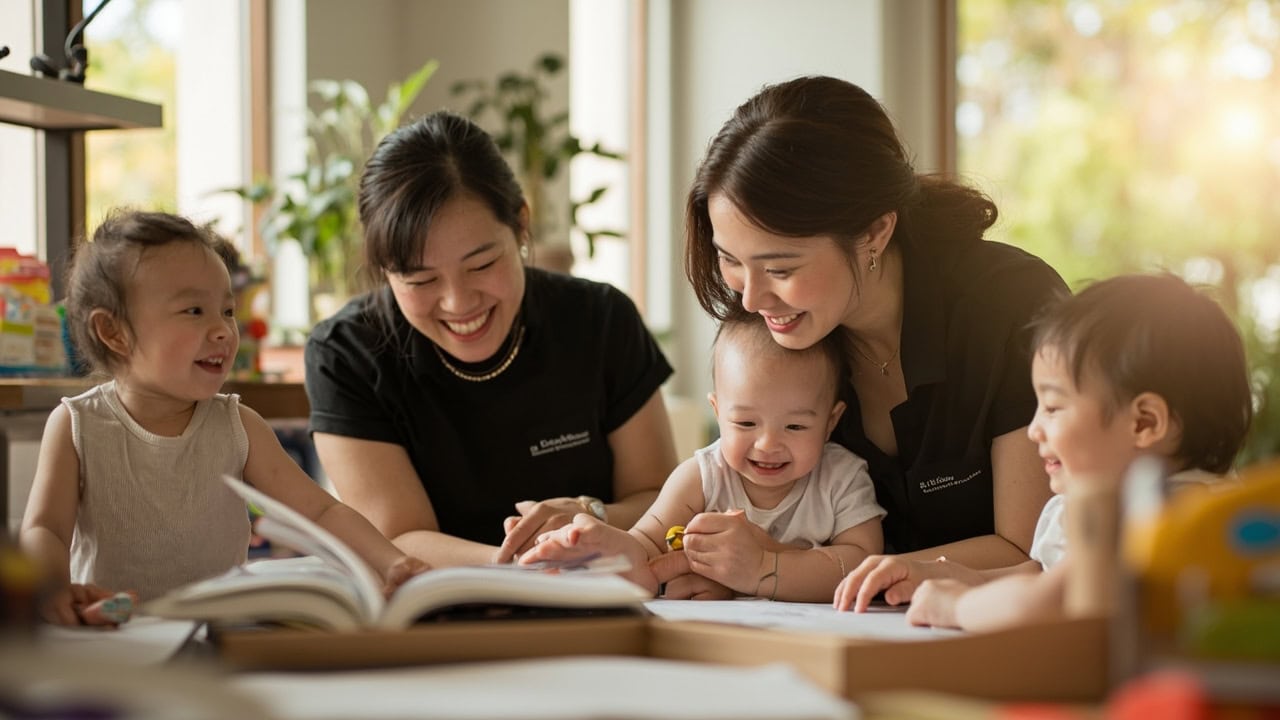
When a caregiver knows that the parent is an active, observant partner — not someone who drops off and picks up without engagement — the relationship deepens. The caregiver begins to share observations with specificity. The parent begins to ask questions with precision. Over time, this creates a feedback loop that is one of the most powerful quality indicators we know of.
What Quality Childminding Looks Like in Singapore
In Singapore, childminding has historically occupied an ambiguous space — less formalised than centre-based care, often understood as a private arrangement rather than a recognised profession. But this is changing.
EduNanny Singapore operates under the ECDA Childminding Pilot — a framework that brings intentionality and oversight to childminding. This means families access home-based care held to standards of quality, with ECDA’s guidance ensuring that care is not only safe but developmentally meaningful.
Why Ratio Matters
One of the most significant quality indicators in infant care is ratio. The difference between a ratio of one to three and a ratio of one to six or higher is not merely a number.
It is the difference between a caregiver who can attune to your child’s signals in real time — who notices when curiosity is being engaged and who notices when it is flagging — and one who is necessarily focused on managing a larger group.
EduNanny’s up to one-to-three infant ratio means each child is seen. Each child is known. Each child’s cues are read and responded to. For infants, whose communication is primarily behavioural and emotional, this attentiveness is not a luxury. It is the architecture of good care.
Accessibility and Affordability
High-quality care should not be reserved for those with significant resources. EduNanny’s pilot fee structures have been designed with accessibility in mind:
- CDA and Baby Bonus funds can be used
- Monday to Friday care blocks provide the regularity working parents need
- Coverage across Singapore means quality is not limited by geography
Addressing the Concerns You May Be Carrying
Singapore parents often carry guilt about needing childcare. This guilt is not helpful, and it is not deserved. Singapore has one of the highest rates of dual-income households in the world. The reasons families need support are as varied and valid as the families themselves.
You are not meant to feel guilty for needing childcare. What you are meant to do is seek quality — for your child and for your own peace of mind. That is not a failing. It is good parenting.
“Am I Overthinking This?”
You notice your child seems withdrawn after care. You wonder: am I overthinking it? Is this just tiredness?
Your instincts are more reliable than you think — but they become more reliable when they are supported by a framework, sharpened by observation, and met with transparency from the people caring for your child.
If something feels off, it is worth paying attention to. Not to spiral into anxiety, but to investigate with curiosity. To ask questions. To seek the information that helps you understand what is really happening.
“I Want to Trust, But How?”
The question many parents carry is not really about trust in a general sense. It is: how do I trust? How do I move from anxiety to confidence?
The answer is not to suppress the uncertainty or pretend it away. It is to build your observation skills over time, and to find a care arrangement that invites you in rather than pushing you out.
EduNanny’s Approach: Built Around You as the Quality Observer
When BUTLER, the organisation behind EduNanny, conceived of this service, they started not with logistics but with a question of philosophy: what does it actually take for a child in Singapore to receive care that is worthy of their full personhood?
The answer was not simply ratios or facilities or curriculum frameworks — though all of those matter. The answer was about relationship. About the quality of attention a child receives. About whether the environment is designed for the child to be truly known, not just adequately managed.
EduNanny’s approach is built on a kind of radical confidence — the confidence to invite parents in, to share what is really happening in their child’s day, to say: here, look at this. Your child did something remarkable today. And here is why that matters.
What EduNanny Offers Parents
- Trained caregivers who observe, document, and communicate — who treat every child’s day as a meaningful narrative worth sharing
- Transparent communication that goes beyond the perfunctory daily report, inviting parents into genuine partnership
- Openness measures where CCTV is deployed, giving parents documented assurance of transparency
- Continuous dialogue — understanding your child’s day is not a courtesy extended; it is a core part of what EduNanny does
- Thomas AI Chatbot — a thinking partner who answers your questions and helps you process your observations, available when you need it
The questions do not only come during office hours, and neither should the support.
EduNanny’s parents are not treated as consumers making a purchase. They are treated as partners — the adults who know their child best, who bring irreplaceable context to every interaction. When these two forms of knowledge — the caregiver’s professional observation and the parent’s intimate familiarity — come together, the result is genuinely greater than the sum of its parts.
Practical Guidance for Choosing Infant Care in Singapore
Whether you are at the beginning of this journey or have been navigating it for some time, here is what matters most:
- Ask about ratio. For infant care, the caregiver-to-child ratio is one of the clearest quality indicators. Ask specifically. Understand what it means for your child’s daily experience.
- Observe the first conversation. When you meet a caregiver or programme, notice how they respond to your questions. Do they welcome scrutiny or deflect it? Do they speak about your child as an individual or as part of a group?
- Look for transparency. What does communication look like in practice? Is there a system for daily updates? Are caregivers accessible for conversations beyond the transactional?
Questions Worth Asking
- How do you communicate a typical day’s experience to parents?
- What does your training cover, and how do you continue developing?
- How do you handle it when something isn’t working well for a child?
- What does a typical day look like for infants in your care?
- How do you individualise care for each child’s needs and temperament?
Remember: choosing childcare is not a single decision you make and then forget. It is an ongoing relationship that you build over time. You are not looking for a perfect programme — you are looking for a partner who will grow alongside you as you develop your own observation skills.
You Are That Most Important Quality Observer
Let me close by returning to where we began — with that quiet question you may have asked yourself in the car, at your desk, in the small hours.
How do I know if my child is okay?
You know because you are paying attention. Because you are learning to read the signals — the way your child moves, speaks, creates, rests, reaches for you.
Because you have found a caregiver who pays attention too, and who trusts you enough to tell you what they see.
Because you have given yourself permission to keep asking, to keep observing, to refuse the easy answer when the honest answer requires more patience.
This is not a skill that arrives fully formed. It develops. It deepens. And the environment you place your child in can either support that development or make it harder.
At EduNanny, we want it to be easier. We want to be the kind of partner that makes you a more confident, more knowledgeable, more attuned parent.
Not because we have all the answers. But because we believe the best care is built on honest, ongoing conversation between the people who love a child most and the people trained to support them.
You are that most important quality observer. You always have been.
What EduNanny offers is a place that knows that — and is built around it.
To learn more about EduNanny Singapore’s approach to infant care and childminding, or to speak with our team, we would be glad to hear from you.