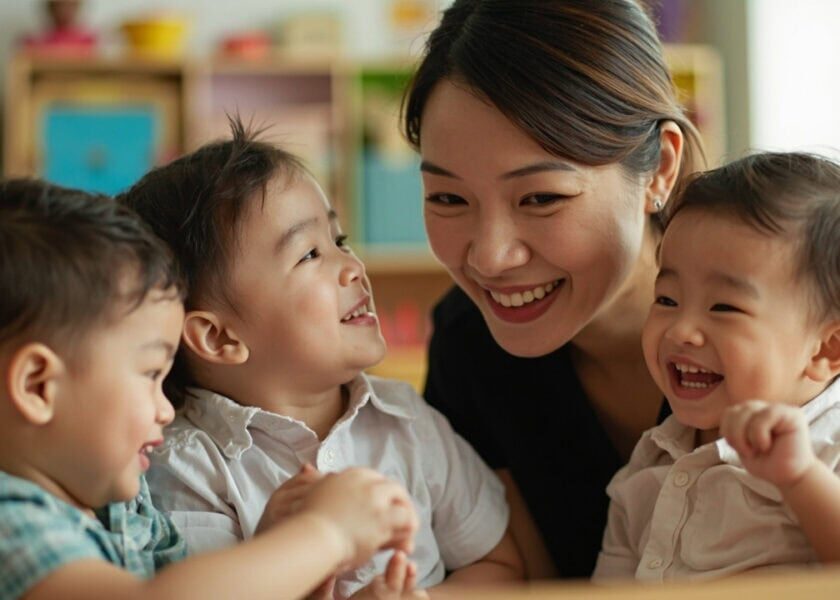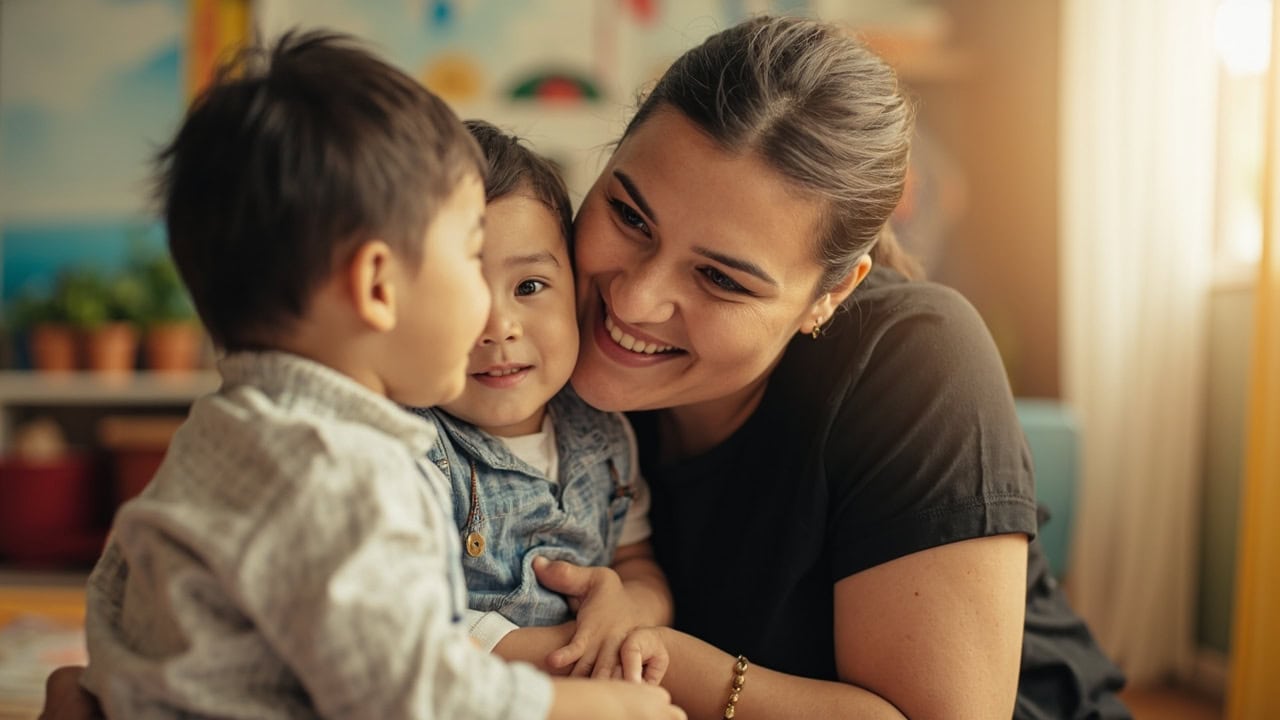
Your Child Is More Okay Than You Fear: Understanding Separation and Trust in Singapore Childcare
Is My Child Okay Right Now? Understanding Separation, Adaptation, and Trust
There is a moment that happens every morning in car parks across Singapore. A moment that looks ordinary from the outside—a parent unbuckling a child from a car seat, adjusting a tiny backpack, smoothing down hair that refuses to stay flat. But on the inside, something quieter and more complicated is unfolding.
The parent adjusts the straps of the bag one last time, even though they are already perfect. They kneel down to say goodbye. They promise to come back. And then they walk away.
And in that walking away, a question forms. Not a question they would say out loud, because saying it out loud would give it too much power. But it is there, in the space between the car seat and the classroom door, in the pause before the ignition turns over.
The question is this: is my child okay right now?
That question is not really about logistics. It is not about whether the nappy is dry or the bottle is warm or the sun hat is in the bag. It is something deeper and more tender than that. It is the question of whether the child feels all right in a world where the parent is not present. Whether separation is harm. Whether absence is abandonment. Whether the child is building something healthy in this absence or something fragile and frightened.
This is the question we want to speak to today. Not because we have a formula that eliminates it—parenting has never been about eliminating the hard questions—but because we believe that when we understand what is actually happening inside our children during these hours apart, we make different choices. We feel different. And our children deserve parents who feel different: not free of worry, but held by understanding.
The Secure Base: What Your Child Carries Into the World
When a young child—say eighteen months old, newly walking, still held together by the gravitational pull of a few trusted faces—arrives at a care setting, something profound is already in motion.
John Bowlby, whose work on attachment has shaped how we understand the first relationships of childhood, described something he called the secure base. This is the invisible foundation from which a child learns to explore the world. The secure base is not a place. It is a person. A warm, consistent, available presence that the child knows will be there when they turn around.
When that presence—usually a parent—is suddenly across town, running errands or sitting in meetings, the secure base does not simply vanish. The child’s internal world reorganizes itself. It has to. And this reorganization is not, as many parents fear, a trauma or a crisis. It is an adaptation. It is the beginning of something that will serve your child for the rest of their life: the capacity to feel safe with more than one person. The capacity to attach, and attach again.
Breaking the Myth of Exclusive Attachment
There is a myth that children can only form one true attachment, that this primary bond is sacred and exclusive, and that any other relationship dilutes it or threatens it. This is not what the research tells us.
What the research tells us is that children are remarkably adaptive creatures. They are built to form multiple attachments. When a caregiver consistently meets their needs, responds to their signals, provides comfort when they are upset and celebrates when they are curious, a new attachment forms. A secondary attachment. And this is not a consolation prize. It is a developmental achievement.
What this means is that when your child looks to a caregiver not as a stranger but as a familiar face—as someone who smells right and sounds right and responds in the way they have come to expect comfort to respond—something significant is happening. Your child is learning that the world contains more than one safe person. They are learning that love is not a finite resource that gets divided when shared. They are learning that they can leave the shore of home and sail out into new waters, and the harbor will still be there when they return.
What Adaptation Actually Looks Like
When we imagine our child adjusting to care, we might picture tears at drop-off—loud, dramatic, heart-wrenching tears—and then, once we are gone, a gradual settling. And sometimes that is exactly what happens.
But sometimes, the picture is different. Sometimes a child arrives and barely cries at all. They accept the handoff. They turn away. They play. And the parent in the car feels a complicated mix of relief and something that might be unease. Because if the child is not protesting, does that mean they have already learned not to expect comfort? Does that mean they have given up?
We want to speak directly to that parent, because we know that fear is real.
The child who does not cry is not a child who has given up. They may be a child whose previous experiences have taught them that crying does not reliably bring the response they need. They may be a child who is watching, carefully, taking in every detail of this new environment before committing to any reaction at all. They may be a child whose temperament is simply more reserved, more watchful, more cautious.
The absence of visible distress is not the presence of internal distress. We cannot assume that silence means suffering. We have to look deeper.
The Emotional Rhythm of a Care Day
Seen from the inside, a day in quality childcare has a rhythm to it. It is not a flat line of neutral feeling. It is more like the tide—moving in and out, rising and falling.
There is the arrival, which carries whatever residue of the morning was already in the child’s body: were they rushed, were they still half-asleep, did they have breakfast, were they already tired from a restless night? The way a child enters care is shaped by everything that came before. A caregiver who understands this does not meet a crying child with frustration. They meet them with patience, recognizing that the tears are not about the caregiver at all.
There is the mid-morning, when cortisol levels often even out and a child who seemed distressed begins to engage, begins to play, begins to discover that this place has toys and other children and interesting things to do. This is the pivot from survival to exploration. The child has assessed the environment, decided it is safe enough, and is beginning to venture out emotionally.
There is the midday, when hunger and tiredness converge and emotions run closer to the surface. This is when a caregiver’s patient presence is not just nice to have but essential. A child who is overtired and hungry needs someone who can hold that discomfort without trying to fix it or rush it away.
And then there is the afternoon, when the child’s nervous system begins to prepare for reunion. There is a quiet hum of anticipation beneath the play, a reaching toward home. The child may become more clingy, more focused on the door, more attuned to sounds in the hallway. This is not anxiety. This is healthy attachment in motion—your child is looking forward to seeing you.
The Reunion: What Your Child Is Telling You
And then there is the reunion. We think it is one of the most misunderstood moments in the childcare experience. Parents often worry about what happens during the day. But the reunion is where the child processes everything that happened before you arrived. What it looks like can be confusing, if you do not know what you are seeing.
There is the child who bursts into tears the moment they see you. Parents sometimes interpret this as proof that the day was terrible, that the child was miserable and waiting in anguish for rescue.
But often, what that child is doing is expressing relief. The tears are not distress at being at childcare. They are the release of having held it together. Your child waited. They adapted. They were brave. And now you are here, and they can stop being brave. The tears are a compliment. They mean your child trusts you enough to fall apart in front of you.
Then there is the child who barely looks up when you arrive. Who continues playing as if you are just another visitor. Parents sometimes read this as rejection, as evidence that the caregiver has replaced them. But this child is showing you something different. They are showing you that they felt safe enough to stay fully engaged in their world. They were not anxiously scanning the room for your arrival because they did not need to. They were not afraid you would not come. This, too, is a sign of secure attachment.
And there is the child who reaches and pulls away, who seems to want to be held but also seems angry about something, who demands a snack with an intensity that feels disproportionate to their hunger.
This child is telling you that they have feelings about the day—strong feelings—and they are not sure how to organize them yet. This is normal. This is the work of integration: learning that you can love your parent and also feel frustrated by them, that you can miss someone and also be glad to be away from them, that the world contains contradictions and your heart holds all of them at once.
The attuned parent does not panic at this. They make space for it. They say, in a hundred small ways: you can feel this. All of it.
What You Can Trust When You Cannot Be There
Every one of these reunion patterns is a message from your child’s inner world. Your child is not just surviving the hours you are apart. They are living them, feeling them, processing them, growing in them. What you are seeing at the reunion is the tip of an enormous iceberg of experience that happens during the hours you cannot see.
So what can you trust, when you cannot be there? How do you know whether your child is not just supervised but genuinely secure, connected, and growing emotionally in your absence?
You can trust the signs that emerge over time, not the moments in isolation. You can trust the trajectory.
- You can trust the way your child settles into the morning routine after a few weeks, the way the goodbye kiss becomes quicker and more confident.
- You can trust the way your child mentions the caregiver’s name in the bathtub with the same easy familiarity they mention your own.
- You can trust the way your child comes home not depleted but energized, not withdrawn but curious about what you did all day and eager to share what they did.
You can trust communication that tells you not just what your child ate and slept, but how they seemed. You can trust a caregiver who notices when something is off, who tells you not just that your child had a good day but what made it good. You can trust a setting where your child’s emotional experience is treated as the center of everything, not an afterthought.
How to Evaluate Quality Caregiving
When evaluating childcare options, look for markers that align with what we have discussed about children’s emotional needs:
- Ratios that allow for attunement: Fewer children per caregiver means more time to notice the small things. Ask about group sizes and caregiver-to-child ratios.
- Communication that goes beyond logs: Quality care means you hear about not just what happened but how it felt. Ask how caregivers share updates with parents.
- A focus on emotional safety: The environment should feel warm and predictable. Children should have space to explore and space to retreat.
- Trained and consistent caregivers: Attachment requires consistency. Ask about staff turnover and what training caregivers receive in child development and emotional attunement.
- Transparency: You should feel welcome to ask questions, visit, and know what is happening. Quality providers welcome this involvement.
EduNanny by BUTLER: Where Understanding Meets Practice
Where communication and transparency are prioritized, parents receive insight into their child’s day—not just a log of activities, but a sense of how the day felt. This closes the loop. It means the reunion is not a mystery. It means you are part of the story, even when you were not in the room.
EduNanny is part of the ECDA Childminding Pilot, which means it operates within a framework designed to ensure that the ratios, the training, the oversight, and the structure of care are held to standards that put the child’s experience at the center.
What the Structure Means for Your Child
With up to one to three infants in care, the environment is intimate enough that your child is not a face in a crowd. They are known. They are seen. The caregiver-to-child ratio means that there is time—not just in an emergency, but throughout the day—to notice the small things, the micro-adjustments, the moments when a child is beginning to feel unsteady and needs a presence to re-stabilize them.
For families in Singapore, the pilot fee structures are designed to make quality care accessible. Families can use the Child Development Account and Baby Bonus, which means the conversation about affordability does not have to be separate from the conversation about quality. Because every child deserves to be in an environment where their inner world matters.
A Philosophy, Not Just a Service
What EduNanny offers, beyond the logistics, is a philosophy. It is the belief that caring for a child in their parent’s absence is not babysitting. It is not supervision. It is the profound responsibility of holding someone’s heart while they are not there to hold it themselves.
The caregivers who are part of EduNanny are trained not just in the practical skills of infant care—they are trained to read the emotional cues that children send, to understand the difference between a child who is adapting and a child who is struggling, to create an environment where a child feels safe enough to explore and held enough to return.
Coming Back to That Car Park
Now, let us come back to where we started. That car park. That walk away.
You are driving now, or you are on the MRT, or you are sitting in a meeting room trying to focus on something on a screen. And somewhere across the city, your child is in the middle of their day.
They are not wondering whether you love them. They know you love them. They carried that knowledge into this new place like a seed in their pocket, and it is growing. They are forming new connections, making discoveries, learning that the world is larger and more interesting than they imagined. They are having feelings about all of this—big feelings, small feelings, feelings they do not yet have words for—and there is a caregiver nearby who is helping them hold those feelings.
And when you come back, they will show you something. A drawing, maybe, or a new word, or just a look in their eyes that tells you something has shifted inside them. They will not be the same child who left this morning. They will be a child who grew a little, while you were not there to see it.
That is not a failure. That is the whole point.
What we are doing, when we build systems of care that honor the child’s inner world, when we train caregivers to be attuned and present, when we create environments where a child can safely venture out and safely return—we are not replacing the family. We are extending it. We are saying: this child’s heart is big enough. It can hold more than one safe person. It can navigate absence and return, separation and reunion, the whole rhythm of modern life without losing its center.
And the parent—your parent, that parent in the car park who walked away this morning with a question lodged beneath their ribs—they are also growing. They are learning to trust. Not blindly, not without evidence, but trust nonetheless. Trust that their child is resilient. Trust that the caregiver is capable. Trust that love travels, even across the city, even across the hours.
This is not a small thing. This is one of the most profound acts of faith in modern life: to leave your child in someone else’s hands and believe that they will be held well.
So the next time you are driving away from that gate, and the question forms—is my child okay right now?—let us offer you an answer that is not a guarantee, because there are no guarantees in parenting, but is something better:
There is a caregiver who knows your child’s name. There is a ratio that means your child is not overlooked. There are principles that say your child’s inner world matters, that separation is not harm, that adaptation is not surrender, that love is not diminished by sharing.
Your child is more okay than you fear. And you are more trusted than you know.
If you are ready to explore what a childcare arrangement built on understanding, attunement, and genuine care for your child’s inner world could look like for your family, we invite you to speak with our team or learn more about EduNanny by BUTLER. Visit a care setting. Ask the questions that matter to you.
Because you deserve to walk away from that car park not with a question lodged beneath your ribs, but with quiet, grounded confidence that your child is in hands that will hold them well.
Learn more about EduNanny’s approach to quality childminding in Singapore.