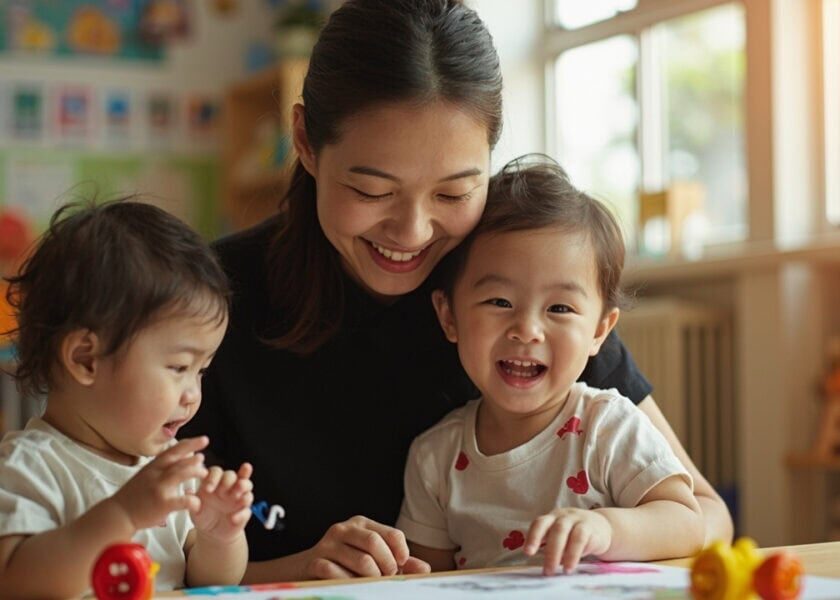
The Hidden Dimension of Sibling Childcare Decisions
“`html
The Question Nobody Asks
Singapore parents talk endlessly about finding the right infant care, the right preschool, the right balance between family and professional support. We seek recommendations in parenting forums, compare curricula at school open houses, and have long conversations with other parents at playgrounds and birthday parties.
But when we have more than one child, we tend to make these decisions one child at a time. We ask, “Is this the right environment for Ethan?” or “Will Mei Ling thrive here?” We rarely ask the larger question that sits beneath these decisions:
What does this choice do to the system of relationships that includes both of them?
That question matters more than we realise. Siblings are not just sharing a home. They are sharing a developmental journey. And the quality of the childcare environment you choose does not simply affect the child who attends it—it ripples outward, reshaping the emotional landscape that every child in your family navigates daily.
What Siblings Learn From Each Other
When your children are young, their brains are building the architecture for how they will understand relationships for the rest of their lives. Neuroscientists have shown us that early social experiences literally wire the neural pathways that govern empathy, cooperation, conflict resolution, and emotional regulation.
The question is not whether your children will develop these capacities—their brains are building them regardless. The question is what raw material these developing systems will be constructed from.
In a high-quality childcare environment, your children have access to developmental experiences that your home alone may not be able to provide—not because you are failing, but because siblings in quality care are something more than roommates. They are, in ways we are only beginning to fully understand, each other’s quiet teachers.
The Older Child Watching
Think about what happens when your three-year-old watches her infant brother being comforted by a caregiver. She is not merely observing. She is internalising a model of what emotional attunement looks like.
She is learning, quietly, that distress has an answer, that needs can be met, that another person can respond to your pain with care rather than frustration. This is not something you can lecture into existence. It is absorbed through witnessing.
The Younger Child Reaching
Consider what happens in the other direction. When your toddler is struggling with a puzzle and his older sister—noticing his frustration—wanders over not to fix it, but simply to sit beside him, he is learning something invaluable.
He is learning that struggle does not mean abandonment. He is learning that competence is not threatened by the presence of someone more capable. He is learning that help can come without condescension.
These lessons are not taught. They are caught.
Why the Environment Matters
These lessons happen most powerfully when the environment itself understands the sibling dynamic—when caregivers are attuned not just to individual children but to the web of relationships between them. When the rhythm of the day creates space for spontaneous cooperation, for the older child to feel pride in demonstrating, for the younger one to feel safe reaching toward a sibling for connection rather than competition.
Quality care is not just about what happens to your child. It is about what happens between your children.
The Paradox of “Fairness”
Choosing care for siblings is genuinely complex. It is not simply a matter of finding one good environment and replicating it. Your children are not the same. They may share your blood, your home, your surname, but they arrived with different temperaments, different sensitivities, different rhythms of development.
What soothes your infant son may not calm your toddler daughter. What engages your four-year-old may frustrate your two-year-old. What they need from a caregiver, from a routine, from the physical space around them—these needs are as individual as they are.
And yet, here is the paradox that many parents quietly wrestle with: when you have two or three children needing care, there is enormous pressure to treat them the same. To find one solution that serves both. To make a decision that feels fair by making it identical.
Fairness in childcare is not sameness. Fairness is responsiveness.
Your children do not need the same thing. They need the thing that is right for them—and the best childcare decision is one that sees each child clearly, understands their individual needs, and provides an environment where those needs can be met without one child having to shrink to make room for another.
This requires you to resist the pull toward simplicity, toward the clean logic of “they should be together, so they should be in the same place.” It requires you to ask harder questions:
- Does my older child need more cognitive challenge than my younger one can tolerate in the same space?
- Does my anxious child need a quieter, smaller environment that my more social child would find stifling?
- Does the gap in their ages mean that what serves one is actually limiting the other?
These are not questions with easy answers. But they are the right questions. The parents who make the best childcare decisions for their families are often the ones who have stopped asking “where should my children go” and started asking “what does each of my children actually need—and how can I design a system that honors those differences?”
The Quiet Guilt and the Bonds That Hold
There is a quiet guilt that lives in parents with multiple children. It is not the dramatic guilt of feeling like a failure. It is subtler than that.
It is the feeling that surfaces when you cannot remember the last time you gave one child your complete, undivided attention. When you catch yourself apologising to your three-year-old for the third time that week because the baby needed something. When you wonder whether your children are getting enough of you—not because you are neglecting them, but because there are simply more of them and the same limited bandwidth you have.
You are not failing. You are navigating a system that is inherently more complex than single-child parenting, with the same amount of love and considerably less sleep.
That guilt is often pointing you toward something true. Your children’s need for individual attention is real. Each of them deserves to be seen, known, and responded to as the particular person they are.
But here is what is equally true: the bond between siblings is one of the most powerful resilience builders available to any child. Not because sibling relationships are naturally harmonious—they are not, and anyone who has watched two children fight over a cardboard box knows this. But because siblings are the first peers we ever have. They are our first context for learning how to navigate difference, how to negotiate, how to compete and cooperate, how to love someone who is not our parent and not our friend but something entirely more complicated and ultimately more enduring.
In the best childcare environments, these sibling bonds are not left to chance. They are actively supported. Caregivers who understand the sibling dynamic know how to set up situations where cooperation is more rewarding than competition. They know how to acknowledge each child’s unique contribution so that neither feels overshadowed. They know how to create moments of shared joy—songs sung together, stories told side by side, the simple pleasure of a caregiver who takes a genuine interest in the whole family, not just one child.
This is what distinguishes care that happens to include siblings from care that is genuinely designed for the sibling unit.
EduNanny Singapore: Built for This Reality
When you are evaluating childcare options for your family, it helps to know what genuine sibling-aware care looks like—and where to find it.
EduNanny by BUTLER is part of the ECDA Childminding Pilot, and that matters. The Childminding Pilot exists because Singapore recognised that the childcare needs of families with multiple children, infants, and complex schedules could not be met by a one-size-fits-all approach.
It exists because parents needed flexibility—real flexibility, the kind that acknowledges that Monday looks different from Wednesday, that your infant’s nap schedule and your toddler’s activity preferences are not the same thing, that “affordable” and “high quality” cannot be kept in separate boxes when you are making real decisions with a real household budget.
What sets sibling-aware care apart:
- Caregivers who observe and respond to the relationships between your children, not just individual behaviours
- Attention to each child’s individual temperament, needs, and developmental stage—recognition that what works for one child may not work for their sibling
- Environments and daily rhythms that create opportunities for spontaneous cooperation—where the older child can feel proud of demonstrating, not threatened by comparison
- Caregiver-to-infant ratios that allow for genuine individual responsiveness, not just room management
- Transparent communication about what your children are experiencing throughout the day, with honest conversations about what is and isn’t working
EduNanny offers multiple pathways designed for the reality of siblings with different temperaments and complex schedules:
| Feature | What It Means for Your Family |
|---|---|
| Home-based, community, and centre-based pathways | Different children within the same family may thrive in different settings—we help you design the right combination |
| Infant ratios of up to 1:3 | Caregivers who can genuinely attune to your child’s individual needs |
| Monday–Friday care blocks | Reliability designed for working families who need consistency, not just occasional support |
| CDA and Baby Bonus accepted | Quality care that works within the resources your government has made available to support your family |
| CCTV measures and open communication | Trust honoured with visibility—you should not have to wonder what your children experienced today |
We have built EduNanny for the reality you are living: the reality of siblings with different temperaments, the reality of finite parental attention, the reality of needing childcare that sees each child as an individual while also understanding that your children are connected in ways that matter to their development.
Addressing Your Concerns
“Will putting my children in different care settings damage their bond?”
The research on sibling bonds tells us that proximity does not create connection. What creates connection is the quality of interaction, the presence of adults who facilitate positive sibling engagement, and the emotional safety to relate to each other as individuals rather than as competitors for parental attention.
In many cases, siblings who spend time in environments tailored to their individual needs come together with more patience and generosity than siblings who are constantly managing the stress of mismatched expectations in a shared space.
“I feel guilty for even considering separate care arrangements.”
That guilt is understandable, but it may be pointing you toward responsiveness rather than away from it. The question is not whether your children will grow up close—that depends on many factors beyond any single childcare decision. The question is whether your children are each getting what they need to thrive as individuals. When they do, they bring more to each other.
“How do I even begin to figure out what each child needs?”
This is hard. It requires observation, honesty, and a willingness to accept that what you thought would work may not be what’s working. It also requires a childcare partner who can help you see your children clearly—without the emotional blind spots that come from loving them so much.
That is one of the things we do at EduNanny. We sit with you in the complexity rather than offering false simplicity.
Trust What You Know
You are not just choosing a service. You are designing a system. You are the architect of the environment in which your children’s sibling bonds will take root and grow.
And that is a profound responsibility—but it is also a profound gift. Because it means that you have more agency than you may have been giving yourself credit for.
When you are making this decision, try asking yourself these questions—not to find a perfect answer, but to clarify what matters most to your family:
- When I imagine each child thriving, what does that actually look like? Get specific. Not “happy” but what does happiness look like for this particular child with this particular temperament?
- What am I assuming about “fairness” that might not be true? If both children were in the same room, would they each be getting what they need?
- What do I observe about how my children interact when they are at their best with each other? What conditions seem to support that?
- What do I observe about how my children interact when they are at their most frustrated with each other? What triggers that?
- If I could design one ideal element of their childcare experience, what would it be? Sometimes starting with what you want rather than what you fear opens up better thinking.
You do not need to make this decision perfectly. There is no perfect. There is only thoughtful, informed, responsive choosing.
That moment—the quiet revelation when you notice one child’s behaviour changing because of what a sibling is experiencing—is not a coincidence. It is evidence. Evidence that your children are connected in ways that matter deeply to their development. Evidence that the childcare decision you make is never just about one child—it is about the whole web of relationships your children are building with each other, with caregivers, with the world beyond your home.
Your children are watching each other grow. They are learning from each other, shaping each other, becoming who they are partly because of who their sibling is becoming.
That is not a burden. That is a gift. And the childcare decision you make is one of the most important gifts you can give to the relationship between them.
Trust what you know. Trust what you have observed. Trust that quiet guilt, that nudge toward responsiveness over sameness, that sense that your children deserve to be seen not as a unit but as individuals who happen to share your home and, increasingly, your world.
That is the question worth sitting with.
EduNanny Singapore offers flexible, sibling-aware childcare through the ECDA Childminding Pilot. Our services include home-based, community, and centre-based pathways designed for families with multiple children, different temperaments, and complex schedules.
Learn more about who we are or get in touch to explore how we can help you design a childcare system that serves every child in your family.
“`