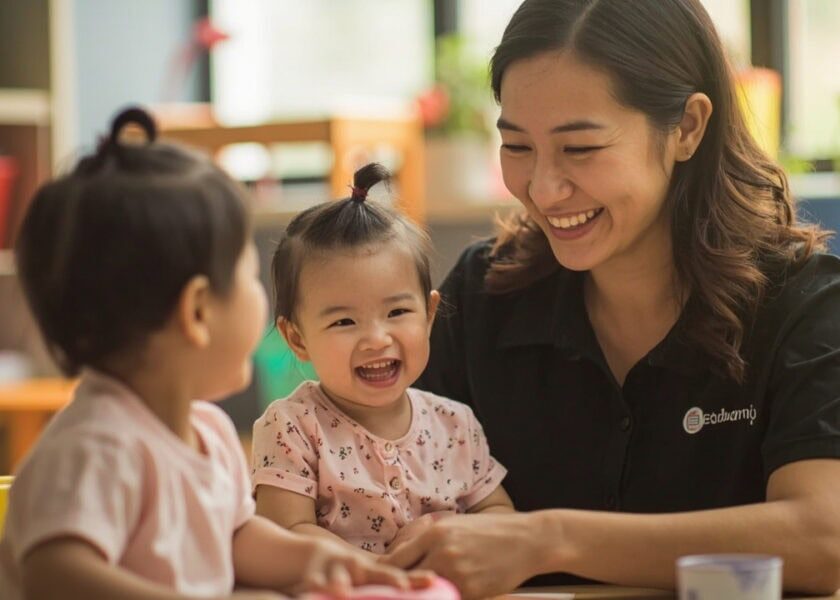
The Gentle Transition: Professional Childcare for Singapore’s Growing Families
The Extraordinary Gift of Grandparent Care
There is a particular kind of silence that falls over a Singapore home in the evening, after the grandparent has gently closed the gate behind them and the child has been bathed, fed, and put to bed. It is in that silence that many parents find themselves sitting with a thought they have been avoiding all day, perhaps all week, perhaps longer. A thought that begins as a flicker and grows into something they can no longer pretend they have not seen.
The thought goes something like this: something has shifted. The care that once felt not just sufficient but perfect is no longer enough. And worse than knowing this, worse than having to acknowledge it to themselves, is the question that follows in the dark.
What kind of person does this make me?
Let me tell you what kind of person it makes you. It makes you a parent who is paying attention. It makes you a parent who is beginning to understand that love, while essential, is not always the same as readiness. And it makes you a parent standing at one of the most quietly significant thresholds in modern family life—one that millions of Singapore families will face in the coming years, and one that our culture has not yet given us the language to navigate with grace.
If you’re reading this between meetings or after the kids are asleep, here is the essence of what this article offers:
- Recognizing that grandparent care has reached its natural limit is not a failure—it is evidence of attentive, evolved parenting
- The guilt you feel is not a warning sign; it is proof that you take family seriously
- Professional care does not replace the grandparent bond—it creates space for it to flourish differently
- Quality childminding provides developmental experiences that complement and extend what family care has built
- There is a way through this transition that honors everyone, including your child
The Shift That Is Already Happening
Grandparent care in Singapore is extraordinary. It is woven into the fabric of how families here have functioned for generations. When both parents work—and in Singapore, both parents almost always work—the multigenerational family becomes the architecture of survival. Grandparents step in with an intimacy that no stranger can replicate. They know the child’s rhythms before the parents do. They remember which songs calmed colic, which blanket smells like home, which embrace turns a meltdown into a laugh. They bring a language, a cultural continuity, a weight of history that grounds a child in who they are and where they come from.
For infants in their first year, grandparent care provides something genuinely irreplaceable: consistent, emotionally invested presence. Your child’s grandparent has been an essential part of their early formation, holding your baby through the fragile, demanding months when the brain is building connections at a speed that will never be replicated. Every moment of secure attachment during this time has mattered enormously.
And yet—there comes a point, and it is rarely dramatic, which is perhaps why it is so easy to miss, where the child begins to need something more. Not more love. Never more love. But more: more stimulation, more social exposure, more age-appropriate challenge. More peers to navigate conflict with. More environments designed not just for safety but for growth. More hands that are rested enough to be patient, present enough to respond with intention rather than reflex.
This is not a failure of the grandparent. It is not a failure of the parent. It is simply the nature of development itself.
Reframing the Question
In Singapore, where family is not just a unit but a value system, where filial piety is not merely a courtesy but a cultural architecture, the decision to seek professional care can feel like a kind of ungrateful arithmetic—as if you are weighing the reliability of grandparent love against the convenience of a schedule, and finding the scale tilting toward convenience.
But that is not the scale you are standing at. That is a false scale, and it will not tell you the truth.
The truth is that you are not choosing between family and childcare. You are choosing between a care arrangement that served a particular season and one that can serve the season now arriving. The guilt you feel is not a sign that you are doing something wrong. It is a sign that you understand the weight of what you are doing. It is evidence of a heart that takes family seriously.
The question is not whether you feel it. The question is whether you will let it paralyze you, or whether you will move through it toward a decision that serves your child’s evolving needs while honoring the bond that has already been built. There is a way through this that does not require you to abandon anyone. But it does require you to be honest, and honesty is sometimes the bravest form of love.
What Your Child Needs Now
In the first thousand days of life—a window of development that Singapore’s own research and global pediatric consensus has confirmed as foundational—your child’s brain is building connections at extraordinary speed. Every sensory experience, every social interaction, every moment of secure attachment forms a neural pathway that will influence not just intelligence but emotional regulation, resilience, and the capacity for relationship. What happens in these early years echoes across a lifetime.
Safety Alone Is Not Development
Grandparent care, in its warmth and familiarity, provides a kind of safety that is genuinely irreplaceable. But safety alone is not development. Safety is the foundation, but development requires more than foundation. It requires:
- Stimulation calibrated to where the child is now, not where they were
- Peer interaction, which grandparents alone cannot provide
- Caregivers whose energy matches the relentless curiosity of a toddler
- Strategies for managing developmental leaps and emotional storms
What Quality Professional Care Provides
| Element of Quality Care | What It Means for Your Child |
|---|---|
| Small group ratios | Fewer children per caregiver, so attention is concentrated and unhurried |
| Structured routines | Balance of activity with rest, independence with support |
| Language-rich environments | Every interaction becomes an opportunity for vocabulary and connection |
| Outdoor exposure | Physical growth alongside cognitive and social development |
| Peer interaction | Social cognition learned through navigating relationships with other children |
Your child is not simply being minded. Your child is being formed. And the grandparent who has loved them through the earliest, most fragile months has been an essential part of that formation. They do not stop mattering because professional care begins. They matter differently.
Navigating the Conversation with Your Family
How you frame this change, both to yourself and to your family, will determine whether it becomes a wound or a bridge. The conversation with your child’s grandparent is one of the most important conversations you will have as a parent—not because it is difficult, though it may be, but because how you approach it will set the tone for their relationship with you going forward, and for their relationship with your child.
What to Carry Into That Conversation
You are not asking your child’s grandparent to step aside because they are inadequate. You are asking them to step into a new role—one that is not less important but differently important.
The grandparent who has been the primary daytime presence can become something equally vital: the grandparent who is present for what they do best. The bedtime stories. The weekend visits. The cultural rituals, the family recipes, the accumulated wisdom that no curriculum can teach. The grandparent who is not exhausted from being the sole caregiver but who arrives fresh, energized, genuinely present because they are not also responsible for every meal and every diaper and every crisis of the day.
How to Speak to Your Child’s Grandparent
When you speak to your child’s grandparent, speak from that place. Acknowledge what they have done. Name it specifically.
Say: You gave my child their first sense of what home feels like. You gave me peace of mind when I could not be here. You loved them in a way that shaped who they are.
And then say: Because I love you, and because I want that bond to only grow stronger, I need us to find a new balance—one that lets you be grandparents in the fullest sense, not exhausted caregivers in the technical sense.
That is not rejection. That is invitation. An invitation into a relationship that has room for joy again.
Handling Family Pressure
You cannot control your parents’ or in-laws’ reactions, but you can control how you approach the conversation. Lead with gratitude. Acknowledge the sacrifice. Be specific about what they have provided. And then, gently but firmly, explain that this decision is about your child’s development—not about replacing them. If they love your child as much as you know they do, they will eventually understand.
Your Child Through the Transition
Children are exquisitely attuned to the emotional frequencies of the adults around them. If you approach this change with anxiety, they will feel that anxiety. If you approach it with quiet, grounded confidence that says everything is still safe, they will absorb that too. Your child does not need you to pretend this is easy. They need you to be present, consistent, and trusting that they are more resilient than we sometimes give them credit for.
What Adjustment Looks Like
In the early days of a new care arrangement, your child may experience some disorientation. A new environment. New faces. New rhythms. This is normal—the normal discomfort of growth, the same discomfort every child feels when they take their first steps or start their first day of school.
It passes. What replaces it, when the transition is handled with care, is expansion. A wider world that feels safe because the adults in their life have made it feel safe. New friends. New skills. A growing confidence that says: I can explore because someone is watching over me.
Children adjust. It is what they are wired to do. The key is your own emotional steadiness. If you project calm confidence, your child will follow. If you are visibly anxious, they will absorb that anxiety. You do not need to pretend it is easy—but you do need to believe it will be okay. Because it will be.
What Your Child Is Learning
Your child is not choosing between you and their grandparent and their new caregiver. Your child is learning that love comes from many directions, and that this is not abandonment but abundance. The more people who love your child well, the more secure your child becomes. Not less.
Underneath those surface struggles, something healthy is happening. Your child is learning that change does not mean loss. That new does not mean replacement. That family is not a fixed number of people in a fixed arrangement, but a living thing that grows, adapts, and finds new ways to protect what matters most.
What Quality Professional Care Looks Like
In Singapore, the Early Childhood Development Agency (ECDA) has been working to expand and professionalize the childcare landscape, recognizing that the early years are not a soft luxury but a foundational infrastructure. For families transitioning from grandparent care, understanding your options can make the decision feel less daunting.
Home-Based Childminding: A Worthy Consideration
Among the developments in Singapore’s childcare landscape is a model that may be less familiar but deserves serious consideration: home-based childminding. Rather than a child being brought to a centre, a trained, vetted childminder provides care in an environment that is already the child’s most familiar, most secure space.
- Smaller ratios: Often no more than one to three infants under care at a time, which means attention is personal, unhurried, calibrated to each child’s specific rhythms and needs
- Gentler transition: For families moving from grandparent care, the child is not thrust into an unfamiliar environment on top of adjusting to new people
- Grandparent proximity: Care happens within or near the home, which may offer comfort to grandparents who want to remain connected
- Family oversight: The arrangement is visible and verifiable, which can ease concerns about trust
What to Look For in Any Care Arrangement
- Regular updates—not just that their child is safe, but that they are engaged, that milestones are being observed, that the day’s small moments are being noticed and shared
- Communication that is genuine partnership, not performance
- A caregiver-to-parent relationship built on mutual respect and openness
- Consistency—a caregiver who returns, who knows their child, who builds the kind of relationship that allows a child to feel secure enough to grow
Practical Support for Singapore Families
Care arrangements within recognized programs have been structured with affordability in mind. Many families find that:
- Their child’s Child Development Account (CDA) or Baby Bonus funds can be applied
- Care blocks are structured around the working week—Monday through Friday
- Financial navigation support is available to help families plan this transition
These are not peripheral details. They are the practical architecture of a decision that is already emotionally complex. Knowing that the numbers can work, that the logistics are navigable, that there is support available in concrete ways—this allows parents to focus on what matters most: the wellbeing of their child and the health of their family.
Common Questions, Answered Honestly
Will this damage the relationship between my child and their grandparent?
Not if the transition is handled thoughtfully. In fact, when grandparents are released from the exhausting role of primary daytime caregiver, they often find their relationship with the child deepens. They show up as grandparents again—joyful, patient, fully present—instead of stretched thin as surrogate parents.
Can we afford this?
Singapore has made genuine progress in making quality early care more accessible. Explore your CDA and Baby Bonus options. Look into subsidies for which your family may be eligible. And consider that the cost of quality care is an investment in your child’s foundational years—one that echoes across their entire life.
At the Threshold
If you are sitting in that silence tonight, or if you know you will be sitting in it soon, I want you to know something.
The fact that you are thinking carefully about this decision is itself evidence of the parent you are. You are not taking the easy way out. You are not choosing convenience over family. You are standing at a threshold—a threshold that is genuinely difficult because it involves people you love, loyalties that run deep, and a child’s future that you carry in your hands with a weight that never quite leaves you.
The transition from grandparent care to professional care is not a failure. It is a milestone. It is the moment when you acknowledge that your family is evolving, that your child is growing, that the next phase of their development requires something new—and that having the courage to provide that something is one of the most loving things you can do.
The grandparent who has cared for your child has given them a gift that cannot be measured. That bond will continue. That love will persist. And one day, perhaps soon, it will exist in a cleaner, more joyful form—not because you replaced them, but because you created the conditions for them to show up as grandparents again, in the way they were always meant to.
Your child will not remember the logistics of this transition. They will remember that home felt safe. They will remember being loved, by many hands, in many places. They will carry that multiplicity of care into their own lives, and it will make them more capable of receiving and giving love in ways we cannot fully predict but can confidently trust.
For families navigating this transition, there are professionals who understand the weight of what you are carrying—and who are ready to walk alongside you with care, transparency, and genuine commitment to your child’s development. EduNanny was built for this season of parenting: to offer the support and trust that allows you to breathe a little easier, to parent with confidence, and to honor both your family’s past and your child’s future.
If you are ready to explore what this transition could look like for your family, begin a conversation with us. There is no obligation—only the recognition that you have already taken the hardest step, which is being willing to see clearly and act thoughtfully on behalf of your child.
You are not alone in this. The village may look different now, but it is still there. And when you are ready, it is ready for you.