Quality Infant Care That Truly Noticed Your Child
What Quality Infant Care Looks Like in Singapore
For parents researching childcare options, understanding what genuinely matters can feel overwhelming. Here is what the research on early childhood development consistently points to:
- Observation over supervision. The best caregivers do not just watch children — they notice them. They track emerging interests, learning styles, and developmental patterns over time.
- Responsive attunement. Genuine enrichment is not a schedule of impressive activities. It is the caregiver’s ability to respond to each child as an individual, building on what genuinely interests them.
- The hours between matter deeply. When you are not there, your child is still becoming. The right care environment becomes a developmental partner in those unseen hours.
- Communication transforms everything. Specific, child-centred observations shared with parents create a richer picture of who your child is becoming.
- Developmental depth is accessible. Quality care with trained observers and small ratios should not be a privilege available only to families with significant means.
The Question Every Parent Holds
You drop your child at childcare in the morning. You leave them in the capable, loving hands of someone you have chosen to trust. And then — if you are like most parents — you spend the rest of the day thinking about them. Wondering what they are doing. Hoping they are happy. Hoping they are safe.
And hoping, perhaps, that they are not just being watched, but being seen.
This is not a small hope. It is the most important question a parent can hold when choosing care for their infant or toddler: not merely, will my child be safe here, but will my child be noticed here? Will someone pay attention to who they are becoming?
And this is where the conversation about childcare so often stops short. We talk about safety. We talk about ratios. We talk about routines and nutrition and the comfort of knowing our children are in clean, warm, stimulating environments. All of this matters enormously. But there is something deeper that separates genuine enrichment care from the kind of care that merely keeps children occupied and content.
It is the difference between supervision and observation. Between watching and noticing. Between a place where children are kept and a place where children are seen.
Supervision vs Observation: The Difference That Changes Everything
A caregiver who is simply providing supervision is managing a group of children. She is ensuring safety, maintaining routines, keeping the peace. This is not without value — it is the baseline of responsible care. But it is not the same thing as what a trained developmental observer does, and the difference lives in the smallest details.
Consider two children at play with the same set of wooden blocks.
One child is building a tower — tall, precarious, focused. She places each block with care, pauses, evaluates, adjusts. She does not look up when another child approaches. Her attention is entirely held.
The other child is building something low and wide, testing the weight of each block, watching how they stack. She looks up often. She smiles when another child sits near her, not to collaborate, but to share the experience of being near someone else.
A supervisor notices that both children are playing with blocks.
A developmental observer notices two entirely different children expressing two entirely different learning styles — one moving toward deep focus, the other toward social attunement — and she files this observation away not as a label, but as a map. A map of who this child is becoming, of what this child needs next, of how to respond to her in a way that honours her emerging way of being in the world.
What Developmental Observation Actually Tracks
- The quality of a child’s attention — sustained focus versus wide, scanning curiosity
- How they approach new textures, sounds, people, and challenges
- Whether they seek independence early or need more scaffolding before trying
- The shape of their emerging social instincts — connecting, observing, or processing alone
- Physical confidence and persistence — the willingness to fall, try again, reach higher
- Early interests that return again and again — patterns, movement, sounds, faces
These are not random preferences. They are the earliest signals of who this particular child is. They are the first sparks of emerging talents, emerging interests, emerging ways of being in the world that will, if tended with skill and patience, grow into confidence, into passion, into a sense of self.
The First Thousand Days: Why the Early Years Are Different
The early years of a child’s life — what developmental researchers often call the first thousand days — are a period of extraordinary neurological and emotional architecture. The brain is building itself at a speed it will never match again. Connections are forming. Pathways are being laid.
In these thousand days, a child does not just absorb information. They reveal themselves. They show you who they are — not through words, because words come later, but through the quality of their attention, the shape of their curiosity, the way they approach a problem or a person or a new texture under their fingers.
- A child who notices patterns early will show you through their persistent interest in sorting, categorizing, predicting
- A child with strong social instincts will show you through their constant monitoring of faces, their responsiveness to tone, their need for connection
- A child with physical confidence will show you through their persistent attempts at mastery — pulling themselves up, letting go, falling, trying again
What Genuine Enrichment Care Looks Like
Quality developmental care does not look like a performance. You will not walk into a great infant care environment and immediately see a production. There are no rows of children completing worksheets or reciting facts.
What it looks like is unhurried:
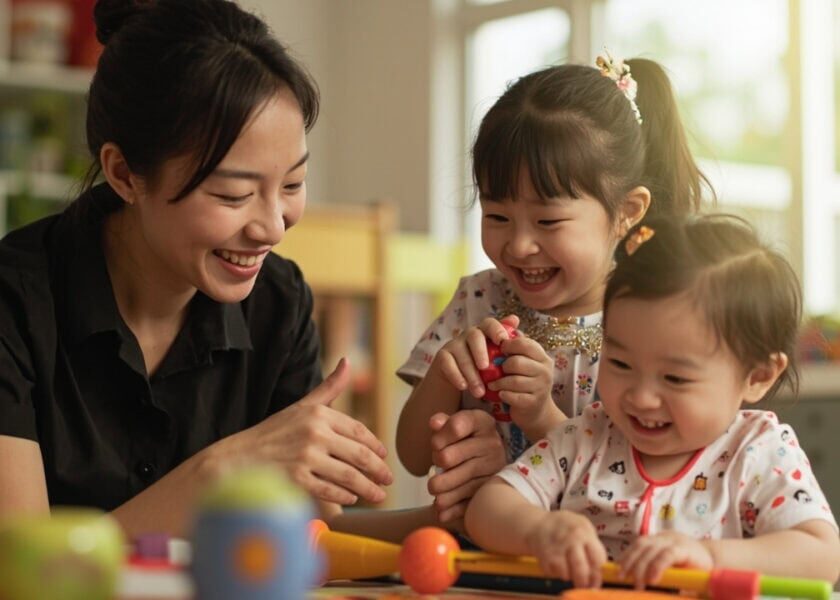
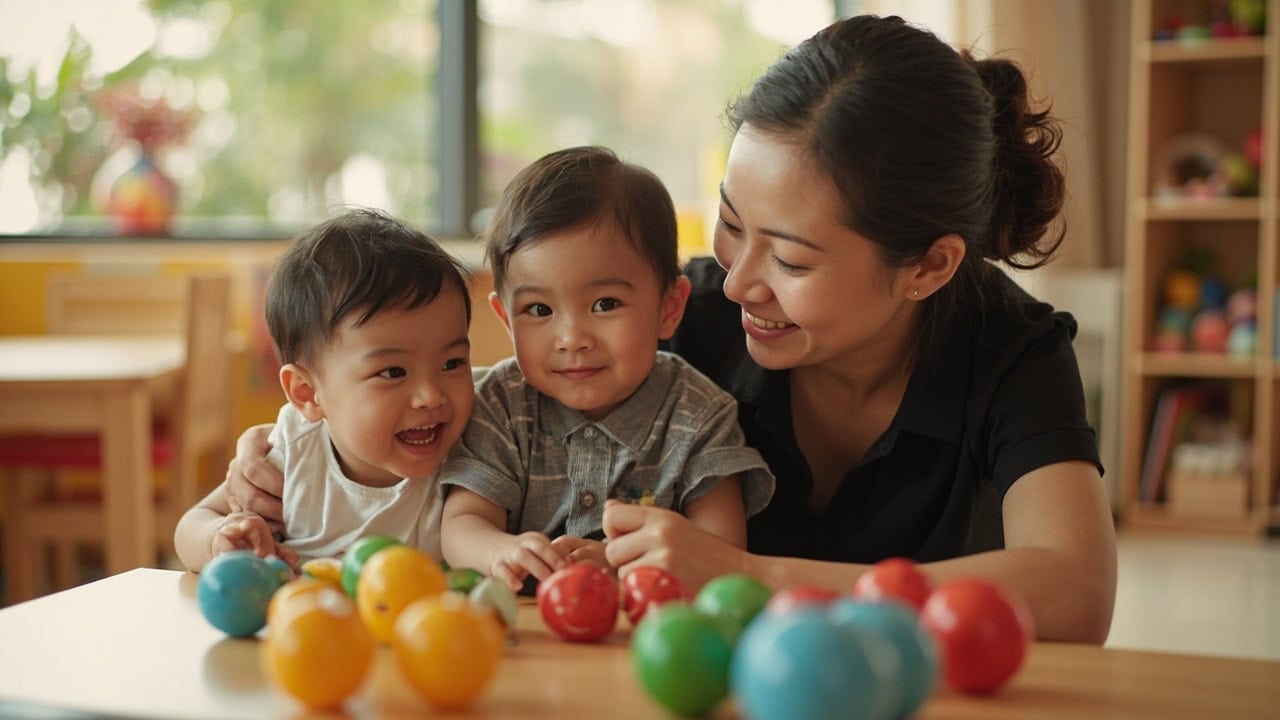
- A caregiver sitting on the floor, following a child’s lead rather than directing it
- A caregiver noticing that one child has been drawn to the wooden puzzle for three days running and quietly introducing a slightly more complex version
- A caregiver observing that another child seems overwhelmed by noise and large groups and beginning, gently, to offer more contained spaces where that child’s emerging social confidence can grow without overstimulation
- A caregiver noticing, over weeks and months of observation, that a child’s vocabulary is expanding in a particular direction — lots of words for movement, for action, for things that go — and beginning to narrate the world back to that child using precisely the language that resonates with their emerging interests
This is enrichment. But it is not enrichment theatre. It is not enrichment designed to impress parents with its visibility. It is enrichment that is invisible to the untrained eye precisely because it is so thoroughly attuned to each individual child.
It is the opposite of one-size-fits-all programming. It is, in the deepest sense, a form of love that pays attention.
Activity Theatre vs Developmentally Attentive Care
| Activity-Based Enrichment | Developmentally Attentive Care |
|---|---|
| Scheduled activities happen regardless of individual child interest | Activities and environment respond to each child’s emerging interests |
| Same materials offered to all children | Materials adjusted based on observation of individual readiness and preference |
| Progress measured by activity completion | Progress understood through patterns of attention, persistence, and curiosity |
| Child adapted to the program | Caregiver and environment adapt to the child |
| Parents receive reports of activities completed | Parents receive observations of who their child is becoming |
The Hours Between: Singapore’s Unseen Developmental Laboratory
Singapore parents work some of the longest hours in the world. For many families, the hours between morning drop-off and evening homecoming make up the majority of a child’s waking time during the week.
These are not lost hours. They are not merely the gap between your presence and your child’s needs. These are the hours in which your child is constructing their sense of self. Learning whether the world is a place where their efforts are met with response. Discovering whether their interests matter to anyone. Testing whether they are capable of mastery. Building the foundations of confidence that will carry them through school, relationships, and the larger work of their life.
In these hours, the caregiver you have chosen is not just keeping your child safe. They are answering, on your behalf, the most fundamental questions a child asks in their earliest years:
- Am I competent?
- Am I worthy of attention?
- Does my curiosity matter?
- Is the world a place where my efforts are seen?
The answers to these questions are not given by the child alone. They are given by the environment the child lives in. And for the hours when you are not there, the answer is given by the caregiver you have chosen.
What You Receive When Observation Is Part of the Care
There is a moment — and every parent who has chosen quality care eventually has this moment — when you receive something unexpected from your caregiver. It might be a note, or a conversation at pickup, or a quiet observation shared over a message. These observations — small, specific, child-centred — are gifts. They are the windows into the life your child is living in your absence.
Consider what a genuine observation sounds like:
- “Today, Aiden spent forty-five minutes working on the shape sorter, and I noticed he was trying the triangle in every shape hole before he found the right one. He didn’t give up. He kept adjusting his approach. When he finally got it, his whole face changed.”
- “Mei has started noticing when other children are upset. She goes to them and pats their arm. She doesn’t say much, but she knows how to be present.”
- “We saw something interesting today — whenever we introduce a new book, Ethan turns it upside down first. He’s testing how books work. That’s exactly what we call ‘book handling,’ and it’s a real developmental milestone.”
These observations do more than inform you. They transform how you understand your own child. Because when a caregiver notices that your child has a persistent, methodical approach to problem-solving, you can see that same quality at home and understand it as part of who they are becoming.
When a caregiver tells you that your child is showing early signs of social confidence, you can nurture that at home in ways that feel purposeful rather than accidental.
When a caregiver observes that your child is moving toward language at a particular pace and in a particular style, you can respond with books and songs and conversations that meet them exactly where they are.
This is the partnership that quality developmental care makes possible — not the partnership of equals managing logistics, but the partnership of two attentive eyes on the same child, sharing observations, building a richer picture of who this small person is becoming.
EduNanny Singapore: Developmental Observation as Daily Practice
EduNanny Singapore has built its approach around developmental observation — not as an abstract philosophy, but as a daily practice woven into every interaction.
EduNanny caregivers are trained in developmental observation. They are not just caring for children; they are learning to read them. To notice the differences between children who approach new textures with caution versus curiosity. To observe which children seek independence early and which need more scaffolding before they are ready to try. To track, over time, the emergence of language, of social reciprocity, of physical confidence, of the kind of sustained attention that is the foundation of later learning.
Within the ECDA Childminding Pilot, EduNanny offers both home-based and centre-based pathways, giving Singapore families options that suit their circumstances while maintaining the developmental standards that make quality care possible.
What This Approach Means in Practice
- Trained observers. Caregivers learn to notice not just what children are doing, but what they are reaching toward — emerging interests, learning styles, social instincts
- Small ratios. With infant ratios of up to one to three, caregivers have the time and space to observe, to notice, to respond rather than simply manage
- Responsive environment. The caregiving environment adapts based on what caregivers observe — materials introduced, spaces adjusted, interactions shaped by individual needs
- Parent communication. Regular updates and specific observations shared with parents, creating a partnership of attentive eyes on the same child
- Accessible depth. Within pilot fee structures, this level of attention is genuinely accessible — because developmental care should not be a privilege
Addressing Your Real Concerns
How can I know what is actually happening when I am not there?
The communication structures at EduNanny are designed to create transparency — regular updates, caregiver observations, developmental notes that are specific and meaningful rather than generic reports that could apply to any child. Where CCTV measures are deployed, they offer an additional layer of reassurance. The goal is not surveillance. The goal is partnership.
Is quality care actually affordable for working families?
Within the ECDA Childminder Pilot fee structures, the kind of attention described here — small ratios, trained caregivers, developmental observation — is genuinely accessible to families across Singapore. CDA and Baby Bonus funds are usable within the pilot. Monday to Friday care blocks support the rhythms of working families.
What if my child has special needs or emerging concerns?
Developmental observation is not about labeling children. It is about noticing patterns over time — which is precisely what allows trained caregivers to identify when a child may benefit from additional support. Early identification means early response. The more closely a caregiver observes, the earlier they can flag concerns and partner with parents on next steps.
Is this just for infants? What about toddlers?
The first thousand days and the years immediately following are when the foundations are laid. But developmental observation continues to matter as children grow. The questions a toddler asks, the way they negotiate, the emerging complexity of their play — all of these are worth noticing and responding to. EduNanny’s approach extends through the early childhood years.
A Practical Guide for Choosing Infant Care in Singapore
When you begin comparing childcare options, here are the questions that matter most:
Questions to Ask Any Potential Caregiver or Centre
- How do you observe and track each child’s individual development over time?
- How do you adapt your care and environment based on what you observe?
- How do you communicate with parents about their child’s development — not just what they ate or slept, but who they are becoming?
- What is the caregiver-to-child ratio, and how does that allow for individual attention?
- How are caregivers trained in child development and observation?
- What does a typical day look like — and how much of it is responsive versus rigidly scheduled?
What to Look For on a Visit
- Do the caregivers seem attentive or primarily focused on logistics and schedules?
- Are children responding to the environment or is the environment primarily directing them?
- Do you see caregivers getting down to children’s level and following their lead?
- Is there evidence of individual materials or spaces — or does everything look the same for every child?
- Do the caregivers seem to genuinely enjoy being with the children?
The Partnership You Deserve
Every child is becoming someone. That is not a metaphor. It is a description of what childhood actually is. In the first years of life, the self is not fixed. It is in formation.
When you choose care that is developmentally attentive, you are not just choosing a safe place for your child. You are choosing an environment that will notice your child’s emerging strengths and help them grow. You are choosing a place that will see your child’s struggles and respond with patience. You are choosing a caregiver who will watch for the first sparks of interest and curiosity and persistence and wonder, and tend them with skill.
You are choosing, in the truest sense, to give your child more eyes on everything they are becoming.
Here is what I know about parents in Singapore, because I have spoken with so many of you — at playdates and at coffee mornings, in forums and in quiet conversations after bedtime. You are not looking for the minimum. You are not looking for adequate. You are looking for something that meets the full weight of what your child deserves.
You want to know that the hours of separation are not empty. You want to know that your child is not just being minded but being seen. You want to know that when they reach toward something — a new skill, a new word, a new way of relating — there will be someone there to notice, to celebrate, to build on.
Not just: will my child be safe here?
But: will my child be noticed here? Will someone pay attention to who they are becoming?
If the answer to the second question is yes, everything else tends to follow.
Your child is becoming someone. That is the quiet truth that every parent knows and holds close.
Let us help you discover who that is. Let us be the second pair of eyes on everything your child is reaching toward.
EduNanny Singapore offers developmental infant care grounded in observation, attention, and the belief that every child deserves to be seen. To learn more about our approach and the options available through the ECDA Childminding Pilot, we invite you to connect with our care team or explore our ECDA Childminding Pilot programme.