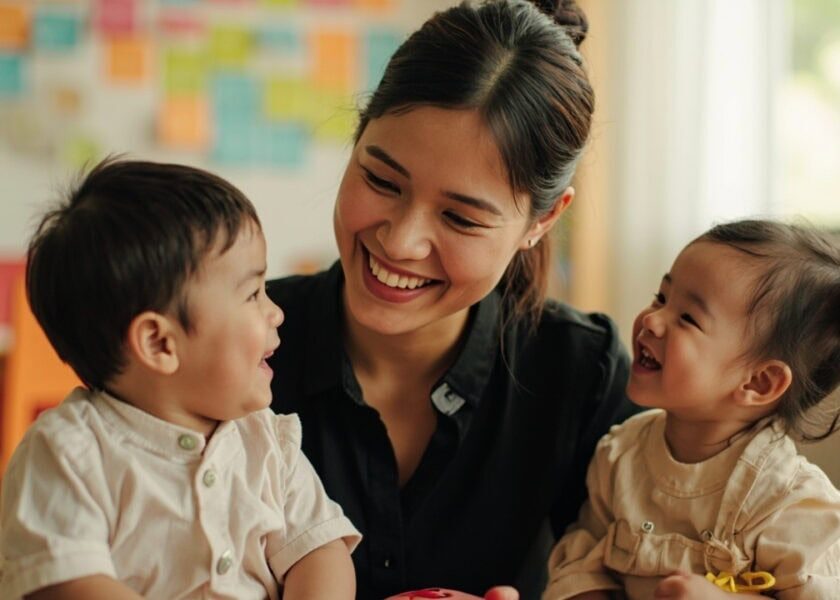
What Quality Childcare Actually Does for Your Child’s Development
What Quality Childcare Actually Is: A Developmental Platform, Not a Waiting Room
The pressure you feel to justify your childcare decision intellectually is not vanity. It is not overthinking. It is a completely reasonable response to living in a society where early childhood has become both intensely important and intensely competitive.
The guilt is real because the love is real. And the need for understanding is real because the stakes feel high.
So let us talk about what is actually happening—specifically, concretely, in ways that you can take home and recognise.
Here is what quality childcare is not: it is not a waiting room. It is not a place where children are simply kept safe and entertained until a parent returns. It is not a series of activities arranged for appearances. It is not the opposite of what happens at home.
Quality childcare is a developmental platform. It is a carefully designed environment where trained adults use relationships, observation, and intentional interaction to support your child’s growth across multiple domains that researchers and early childhood educators have spent decades understanding.
When I say developmental platform, I mean something specific. The environment itself is engineered for learning. The rhythm of the day is not arbitrary but responsive to children’s need for security, exploration, and rest. The interactions your child has with caregivers are not random kindness but skilled responses that build neural pathways, language acquisition, emotional regulation, and social competence.
This is the hidden curriculum. And it is not hidden because it is secret. It is hidden because most parents have never been given a map for reading it. So let me give you one.
The Five Core Developmental Domains Inside Quality Childcare
There are five core developmental domains that quality childcare intentionally supports. Most early childhood frameworks internationally recognise variations of these. Understanding them changes how you see your child’s day.
1. Language and Communication
You might imagine that language development happens through flashcards, vocabulary drills, or screens. But the research here is unambiguous: language grows fastest in the context of responsive human interaction.
When a caregiver narrates what a child is doing, mirrors the child’s sounds back with meaning, reads a book and pauses for the child to fill in a word, asks open-ended questions about what happened during play—these moments are not filler. They are language architecture.
In a quality childcare setting with a high adult-to-infant ratio, your child is not just hearing words. They are being heard. They are having their attempts at communication responded to, expanded, and valued. This is why language development in quality childcare often outpaces what happens in isolation at home, even with attentive parents—because the ratio allows for more individual responsive interaction throughout the day.
2. Motor Development
Movement is not just physical. The development of motor control is deeply connected to cognitive development, to the brain’s understanding of space, cause and effect, and the relationship between intention and action.
A child who spends the morning climbing, carrying, pouring, and manipulating objects is not just burning energy. They are building the neural infrastructure for mathematical thinking, for spatial reasoning, for the hand control that will later enable writing.
Quality childcare environments are designed to offer what developmental scientists call “just-right challenges”—activities that are neither too easy nor too frustrating, that invite sustained physical engagement.
3. Cognitive Development
When your child stacks blocks, watches what happens, knocks them down, and stacks them again—that is not random play. That is the scientific method, in its earliest and most pure form. When they figure out how to open a container, when they persist in fitting shapes into the right holes, when they solve the social problem of how to play alongside another child—these are cognitive achievements.
Quality childcare environments are rich with what educators call “open-ended materials”—things that can be used in multiple ways, that invite experimentation, that do not come with a predetermined correct outcome. A set of wooden blocks, a basket of fabric scraps, a water table with cups of different sizes. These are not primitive or cheap substitutes for educational toys. They are, in many ways, more educationally valuable because they require the child to generate their own learning.
4. Social-Emotional Development
This is perhaps the domain most invisible to parents, because it happens so gradually and in such small moments. But consider what your child is learning when they play alongside another child, when a caregiver names their frustration and helps them find words, when they experience a conflict and have a trusted adult help them navigate it.
Social-emotional development in early childhood is not about politeness or compliance. It is about the capacity to feel, to express, to understand that others have feelings too, and to eventually regulate one’s own emotional states. These are not soft skills. They are the foundations of every meaningful relationship your child will have for the rest of their life.
In quality childcare, peer interaction is not incidental. It is intentional. Caregivers create opportunities for cooperative play, model conflict resolution, and provide what researchers call “co-regulation”—helping children manage big emotions until they develop the internal capacity to do so themselves.
5. Self-Regulation
Self-regulation is what allows a child to wait, to focus, to inhibit an immediate impulse in service of a longer-term goal. It is predictive of academic success, of relationship quality, of physical health outcomes. And it develops not through teaching, but through repeated experience of being regulated by a calm, responsive adult.
When a caregiver helps a frustrated child take deep breaths, when they create predictable routines that allow a child to anticipate what comes next, when they provide consistent responses to distress—they are not just comforting a child. They are building the child’s capacity for self-regulation, one interaction at a time.
This is why consistent relational care matters so profoundly. The child who has a single trusted caregiver, or a very small team of caregivers, over many months develops something different from the child who experiences a rotating cast of different faces every week. The attachment system settles. The brain redirects energy from vigilance to exploration. And the developmental possibilities expand.
What Singapore Parents Can Observe at Home
You cannot see the inside of the classroom. But you can read the evidence that emerges.
- Language is perhaps the most legible signal. After a few months in quality care, many parents notice what educators call a “vocabulary explosion”—a sudden doubling or tripling of words, and more importantly, the emergence of two-word combinations, of sentences, of narrative. If your child is beginning to describe what happened, to ask “why” questions, to engage you in back-and-forth conversation—that is language development in action.
- Motor confidence shows up in how your child moves through space at home. In a quality environment with adequate physical challenge, children develop better balance, coordination, and body awareness. If your child is climbing more confidently, carrying things with purpose, showing greater physical daring—not reckless, but appropriately exploratory—that is motor development.
- Problem-solving appears in the way your child approaches challenges. Does your child persist when something is difficult? Does your child experiment, try different approaches, show signs of thinking rather than immediately giving up or seeking help? Quality childcare builds persistence. It teaches children that effort leads to success.
- Social interest is a powerful signal. Does your child show curiosity about other children? Does your child reference friends from school, want to play alongside peers, show early forms of sharing and turn-taking? Social development happens in peer environments that are difficult to replicate at home. If your child is developing social interest, that is a sign that the peer environment is doing its work.
- Emotional vocabulary is something parents often miss, because it develops gradually. But if your child is beginning to name feelings—not just crying, but saying “I’m sad” or “I’m frustrated” or “I feel scared”—that is the work of adults who have been naming emotions and helping children understand their inner lives.
These are not guarantees. Children develop at their own rhythms, and there is enormous variation in what is normal. But these are positive signals, and their presence should reassure you that meaningful development is occurring.
The Enrichment Question: Does Quality Childcare Reduce the Need for External Programmes?
Let me address something that may surprise you, given how much enrichment marketing you are exposed to in Singapore.
Quality childcare, delivered consistently and with skill, can reduce the need for external enrichment programmes.
This is not a claim against enrichment—many enrichment programmes are excellent. But there is a phenomenon in early childhood development that researchers call “the tyranny of the optimal environment”—the idea that more is not always better, that children’s brains need downtime, repetition, and the consolidation that comes from having the same experiences deepened rather than constantly expanded.
When a child attends a quality childcare programme that genuinely supports their development across all five domains, the developmental return on that investment is substantial. Adding a music class and a swimming class and a sensory programme on top of that is not always additive. Sometimes it is dilutive.
It fragments attention. It reduces the unstructured time that is essential for imagination and autonomous problem-solving. It can, paradoxically, reduce the very development parents are trying to accelerate.
This does not mean your child should do nothing. It means that the quality of the primary care environment matters more than the quantity of additional activities. And it means that when you are evaluating childcare, you should be asking: is this environment doing the developmental work, or is it expecting enrichment to compensate for a hollow foundation?
What to Look For: Signs of Genuinely Developmentally-Oriented Care
Not all childcare is created equal. And in Singapore’s diverse care landscape, it can be difficult to distinguish between environments that are genuinely designed for development and those that prioritise appearance over substance.
Look for these markers of quality:
- Consistent, familiar caregivers who know your child as an individual—not a rotating cast of strangers
- Child-initiated play alongside adult-facilitated interaction, not a rigid schedule of instructor-led activities
- Responsive interactions—caregivers who tune in to what your child is doing and build language and engagement around it
- Physical environment designed for movement, exploration, and safe risk-taking—not primarily for adult supervision
- Open-ended materials—blocks, fabrics, natural objects, water, sand—that invite creative problem-solving
- Peer interaction intentionally facilitated, not left to chance
- Routines that provide predictability and security, not just time-filling structure
- Transparent communication about your child’s day that goes beyond a list of activities
Questions worth asking:
- How do you support language development in everyday interactions?
- What does a typical day actually look like for an infant versus a toddler?
- How do you handle transitions and emotional moments?
- What training do your caregivers have in early childhood development?
- How do you communicate with parents about their child’s development?
- What is your adult-to-child ratio, and how consistent is the caregiver team?
Asking better questions at pickup
When you pick up your child and speak to the caregiver, you do not need to ask “what did you do today?” because that question generates a list of activities that may or may not reflect the real developmental work.
Instead, try asking:
- How was my child’s language engagement today?
- Who did my child play with?
- How does my child respond when frustrated?
- What did my child seem most interested in?
- How did my child handle transitions?
These questions signal something important to the caregiver. They signal that you understand development, that you are paying attention to the real work, and that you see childcare as a developmental partnership rather than a service transaction. A quality childcare provider will not just tell you what happened. They will help you understand what it means.
EduNanny: Home-Based Care Within Singapore’s Childminding Framework
For families in Singapore, the ECDA Childminding Pilot reflects a thoughtful national recognition that families need more than one model of quality care. The pilot offers a home-based pathway alongside centre-based options, and for infants specifically, it maintains a ratio of up to one caregiver to three children.
That ratio is not arbitrary. It is designed to allow for the kind of individual responsive interaction that drives language development, emotional regulation, and secure attachment.
EduNanny operates within this framework, bringing together the intimacy of home-based care with professional developmental oversight. The care runs Monday through Friday, with fee structures that aim to be accessible to families across Singapore. Many families find that their child’s development account and Baby Bonus can be applied meaningfully within these structures, reducing the financial weight of quality care.
EduNanny’s approach to transparency—through regular communication, through documented observation of your child’s development, and through measures such as CCTV where deployed—is not about surveillance. It is about partnership. It is about giving you the information you need to see the hidden curriculum, to understand what is happening in the hours you are not there, and to integrate that understanding with what you observe at home.
Trust is not built on faith alone. Trust is built on transparency. When you can see the framework, when you can ask the right questions and receive thoughtful answers, when you understand the developmental logic behind the environment—then the decision you made stops feeling like a leap and starts feeling like an informed choice.
Addressing the Concerns You Carry
“Am I failing my child by choosing childcare?”
You are not failing your child by choosing quality childcare. You are not choosing between love and development. You are not sending your child somewhere that subtracts from their growth—you are placing them in an environment designed to add to it, in ways that complement and extend what you are already doing at home.
“How do I know if it’s worth the cost?”
The hours your child spends in quality care are not empty hours. They are hours of language acquisition, of motor challenge, of problem-solving, of social learning, of emotional scaffolding. They are hours in which your child’s brain is building the architecture for everything that comes later—the school readiness, the relationship skills, the capacity for sustained attention, the resilience that will carry them through a world you cannot control.
“Should I add enrichment programmes too?”
Quality childcare that genuinely supports all five developmental domains delivers substantial developmental return. Before adding external programmes, observe whether your current care environment is doing the foundational work. If it is, additional enrichment may be less necessary than you think—and the unstructured time it takes away might be more valuable than the structured input it adds.
“How do I know what’s really happening?”
You cannot see every moment. But you can look for the signs of healthy development at home. You can ask the right questions. You can insist on transparent communication. And you can trust that the hidden curriculum is real, even when you cannot see it directly.
A Final Word on What You Have Chosen
Every morning in Singapore, thousands of parents drop their children at childcare and leave carrying some version of the same weight. The worry that they are not doing enough. The guilt that they cannot be there. The doubt that the money they spend is buying something real.
Here is what I want you to know.
You are not a passive participant in your child’s development. Your understanding matters. Your questions matter. Your integration of what happens at childcare with what happens at home creates a continuity of developmental experience that is more powerful than either environment alone.
So the next time you stand at that threshold, and the quiet question surfaces—what are they doing right now? What are they learning?—you will have an answer.
They are building themselves. They are growing in ways that you chose, that you invested in, that you now understand. They are in an environment designed for their development, run by people trained for their care, observed and supported in their individual journey.
That is not just childcare. That is a developmental foundation, laid carefully and with intention, for the child you love more than you know how to say.
You made a good choice. And now, you know why.
If you would like to explore what quality home-based infant care looks like in practice, EduNanny welcomes the conversation. We are happy to answer your questions, share more about our approach, and help you understand whether our care model is the right fit for your family.
You can also learn more about EduNanny and our commitment to thoughtful, development-oriented childminding in Singapore.