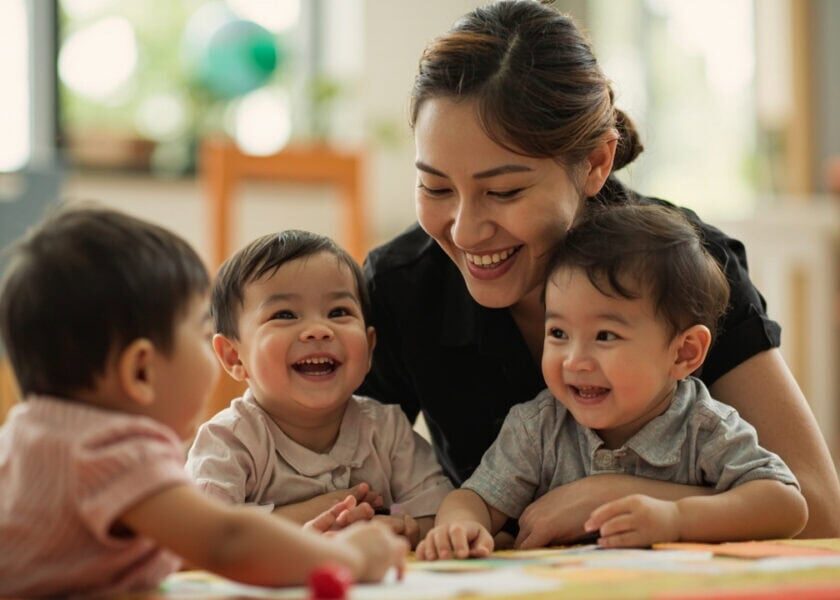
The Hidden Hours: What Your Child Is Really Learning in Quality Childcare
The Hours You Cannot See: What Your Child Is Really Learning in Quality Childcare
There is a moment, familiar to every parent who has left a child in someone else’s care, that arrives the instant you walk out the door. The handoff is done. The bag is over your shoulder. You are in the car or on the train or already thinking about the meeting that waits for you.
And somewhere in the back of your mind, a quiet question lingers — one you may not even say aloud because it feels too hard to answer.
What is my child doing right now?
You trust the place. You chose it carefully. But trust and knowledge are not the same thing. And the distance between them is where a parent’s imagination lives — sometimes with comfort, sometimes with worry, and often with something in between that is hard to name.
You picture your child. You hope they are happy. You hope they are safe. And underneath all of that, in the place where your deepest hopes for them live, you hope they are growing.
That hope — that unspoken, persistent hope that your child is becoming someone capable, curious, and confident even when you are not beside them — is where this conversation begins.
Because quality childcare, when it is done with intention and expertise, is not a pause in your child’s life. It is not a holding pattern until you return. It is one of the most consequential environments your child will ever inhabit.
We want to talk about those hours. Not to replace what you feel as a parent, but to open the door on what is happening on the other side of it.
Quick Summary: What Children Learn in Quality Childcare
- Self-regulation and emotional resilience — learning to manage big feelings in a supportive environment
- Independence and agency — discovering “I can do things myself” through everyday moments like self-feeding
- Social confidence — navigating sharing, conflict, and collaboration with peers
- Language development — building linguistic architecture through rich, responsive conversation
- Curiosity and a love of learning — developing the internal motivation to explore and discover
These are not skills that appear on report cards. They are the foundations upon which every future skill — academic and otherwise — is built. And they grow not in structured lessons, but in the ordinary, unremarkable hours of a childcare day.
What Developmental Care Actually Means
Every morning in Singapore, children arrive at childcare with their bags and their sleep sacks and their small, cautious eyes taking in a room that is not home. In those first minutes, something important is already happening.
A child who has been held almost constantly for the first year or more of life is encountering, perhaps for the first time with real regularity, a world that does not rearrange itself around their every need. There are other children. There are routines that have a shape. There is a caregiver who is warm but who is also, necessarily, attending to more than one person.
And in that encounter — that first, gentle friction between a child’s need and the rhythm of a group — learning begins.
The Difference Between Being Watched and Being Nurtured
Not the kind of learning that can be measured in worksheets or test scores. Not yet. But the kind of learning that shapes a human being at the level of their nervous system, their social instincts, and their growing sense of who they are in relation to other people.
We call this developmental care, and we mean something specific by it: the practice of designing every interaction, every routine, every moment of the day around what a child is biologically and emotionally ready to learn next.
It is not a curriculum printed in a folder. It is a living, responsive understanding of each child as an individual — their temperament, their current skills, their vulnerabilities, their spark.
In quality infant and toddler care, there is no passive watching. There is no default. There is a caregiver who is reading the child constantly, gently adjusting the environment, the pace, and the challenge level so that the child is always operating in that productive zone — stretched just enough to grow, but never so much that they feel overwhelmed.
A watcher keeps a child safe and comfortable. A nurturer helps a child discover what they are capable of.
What That Looks Like in Practice
Let us talk about what that actually means in real moments, because this is where the abstract becomes real.
The Moment a Child Feeds Herself
When a one-year-old learns to feed herself with a spoon, she is not just acquiring a motor skill. She is experiencing, for perhaps the first time in a significant way, the profound satisfaction of doing something for herself.
She is building the neurological pathway that connects intention to action to outcome. She is feeling capable.
If a caregiver is present — not intervening, not correcting, not taking over, but simply nearby with gentle encouragement and the readiness to help only if needed — that child is learning something far larger than how to hold a spoon.
She is learning: I can do things. I am a person who does things. The world responds when I act.
This is the beginning of independence. Not the independence of a teenager refusing help, but the quiet, joyful independence of a young child discovering her own agency.
The Moment Two Toddlers Disagree
Consider a different scene. Two toddlers are playing with the same set of blocks. One takes the other’s block. There is a moment of tension — a cry, a protest, a small face crumpling with injustice.
In a childcare environment guided by developmental principles, a caregiver does not rush to resolve the conflict. She stays close. She observes. She may offer language to the child who took the block — “I see you wanted that one. It is hers right now” — giving the child words for an emotion that is bigger than her vocabulary.
She does not lecture. She does not punish. She uses the moment as a teaching opportunity, because moments like these — when real emotions meet a real social situation — are the moments where children learn what it means to be part of a community.
They learn:
- Empathy — other people have feelings too
- Negotiation — there are ways to ask for what we want
- Causality — our actions have consequences
- Collaboration — being with others can work
This is social confidence. It is built brick by brick, conflict by conflict, shared toy by shared toy, in the hours you are not there.
The Conversation That Builds a Brain
Language development in the early years deserves its own attention, because the science here is robust and the implications are significant.
In the first three years of life, a child’s brain is more receptive to language acquisition than it will ever be again. The infant who hears rich, responsive language — who is spoken to, sung to, read to, and engaged with as a thinking being with real thoughts — builds a linguistic architecture that will support every future subject, every future conversation, every future opportunity.
The neurons that fire together in early childhood become the highways of thought for the rest of a person’s life.
Quality childcare understands this. It is not background noise and television. It is intentional, responsive conversation.
It is a caregiver narrating what a child is doing — “You are stacking the red block on top of the blue one. Look, it fell! You tried again” — not because the child needs the commentary, but because that child is building language from the inside out, connecting sound to meaning to experience.
Research in early childhood development has consistently shown that the quality of language interaction in the early years — not the quantity of words thrown into a room, but the quality of responsive, back-and-forth communication — is one of the strongest predictors of later academic success.
What Quality Childcare Is Not
Here is something that parents in Singapore often carry quietly: the worry that choosing childcare means choosing a trade-off. That they are sacrificing closeness for convenience. That their child is somehow diminished by time away from them.
We want to be direct about this, because parents deserve honesty.
The evidence does not support that fear.
What the research shows — consistently, across cultures and contexts — is that quality childcare supports healthy attachment when it is part of a broader ecosystem of responsive, loving care. The child who has a secure base at home and a nurturing environment at childcare is not divided between two worlds. She is building the capacity to attach to more than one trusted adult.
This is, in fact, a developmental milestone. It is a sign of health, not a sign of compromise.
What you are doing, by choosing quality care, is not leaving your child. You are expanding the world they are safe in.
Primary School Readiness: The Real Indicators
Now let us talk about Primary One, because this is where a different kind of anxiety often surfaces. Parents frequently ask: Is my child ready? Will they cope? Will they sit still, follow instructions, get along with others, manage a full day of structure?
The honest answer is that primary school readiness is not primarily about literacy and numeracy.
A child who can recite the alphabet but cannot regulate their emotions, share a toy, or sustain attention for more than a few minutes will struggle in a classroom.
A child who is curious, socially confident, emotionally regulated, and secure in their ability to ask for help will not.
This is the deeper preparation that quality childcare provides — not the cramming of academic content, which research tells us yields diminishing returns when introduced too early, but the building of the foundational capacities that make academic learning possible and sustainable.
The Child Who Is Truly Ready
The child who has spent her toddler years in an environment that challenged her appropriately, that gave her language for her feelings, that placed her in social situations and supported her through them, who was read to and spoken to and listened to with genuine attention —
That child walks into Primary One not with a head full of facts, but with a mind that is ready to learn and a heart that is ready to belong.
These are the real readiness indicators. And they are built in the hours you cannot see.
EduNanny: Transparency, Standards, and Partnership
We understand that for parents in Singapore, the philosophy of quality care is inseparable from its practical realities. The cost matters. The accessibility matters. The peace of mind that comes from knowing your child is in a licensed, regulated, trustworthy environment matters enormously.
EduNanny by BUTLER operates as part of the ECDA Childminding Pilot, which means we are embedded in a framework designed to make quality childminding both accessible and accountable.
We offer home-based care, where your child is nurtured in familiar surroundings with a dedicated caregiver, and community and centre-based pathways where children benefit from peer interaction in thoughtfully designed environments.
Our Commitment to Quality
Our infant ratios — up to one caregiver to three children — mean that every child receives the attentive, responsive care that their developmental stage demands. This is not an accident of staffing. It is a deliberate commitment to the kind of attention that quality development requires.
Our fee structures are designed to be affordable within the pilot framework, and we actively support the use of the Child Development Account and Baby Bonus schemes, so that financial considerations do not become a barrier to quality.
Transparency as Standard
We know that transparency is not a nicety but a necessity for parents who are trusting someone else with their most precious responsibility.
When CCTV measures are deployed, they are deployed not as surveillance of caregivers, but as a window for parents — a way of saying, you can see what is happening, because you have every right to know.
Daily updates, developmental observations, photographs, and narrative notes are part of how we keep you connected to your child’s day — not because we are obligated to, but because we believe you deserve to know what your child is learning even when you cannot witness it yourself.
Signs of Quality You Can Look For
- Your child seems happy to go — not necessarily without hesitation (adjustment is normal), but with a growing sense of comfort and trust over time
- The caregiver knows your child — not just their schedule, but their temperament, their preferences, their current challenges
- You receive regular updates — not just “they had a good day,” but specific observations about what they were exploring, learning, and discovering
- The environment is calm but engaged — children are not merely occupied, they are absorbed in purposeful activity
- Your child is developing new skills — not just academic ones, but the quieter skills: independence, language, social navigation, emotional vocabulary
- The caregiver talks about your child as an individual — with warmth, with attention, with genuine investment in their development
These are the signs that the hours you cannot see are hours well spent.
What We Believe
We want to close by speaking not to what we offer, but to what we believe.
We believe that the early years are not a prologue to the real story of a child’s life. They are the story. Every interaction, every discovery, every moment of security or uncertainty, every time a caregiver responds to a child’s cry with warmth and presence rather than haste — is writing something permanent into that child’s architecture.
The brain that is being built in the first thousand days is the brain that will carry a person through school, through relationships, through challenge and joy and all the ordinary extraordinary moments of a full life.
We believe that parents in Singapore carry more than their share of worry about getting this right. The pressure to be present, to be perfect, to somehow shield a child from every difficulty while also preparing them to face the world is enormous, and it falls disproportionately on mothers and primary caregivers.
We do not think that is fair, and we do not think it is necessary.
What children need is not parents who are everywhere. They need parents who love them, and environments that nurture them, and the freedom to grow in the care of people who take that responsibility with the seriousness it deserves.
Quality childcare does not replace your role. It extends it. When families and caregivers are aligned — when there is trust on both sides and a common understanding of what matters most — children thrive. They move between home and care with security rather than confusion. They receive consistent messages about their worth, their capabilities, and their place in the world.
This is what EduNanny stands for. Not a replacement for your role. An extension of your love, backed by expertise, delivered with intention, and made visible so that you never have to wonder what is happening on the other side of the door.
The next time you drop your child off and walk away, we hope that instead of the old quiet question — what is my child doing right now? — you might feel something different.
Not certainty, because parenting never offers that. But confidence.
The hours you cannot see are full of learning. Full of growth. Full of small, quiet miracles that will, over time, add up to something extraordinary.
You chose this. And it was the right choice.
To learn more about how EduNanny by BUTLER supports your child’s development — and your peace of mind — we invite you to speak with our team.
Explore EduNanny · About Us · ECDA Childminding Pilot