Beyond the Village: How Singapore Families Can Design Better Childcare Together
What Singapore Families Already Know
In Singapore, multigenerational living is not merely a cultural tradition — it is an economic reality and an emotional inheritance. Nearly half of all Singaporean children are cared for by their grandparents at some point in their early years. This is not a failure of modern parenting. This is not a sign that parents lack commitment or capability. This is a feature of how Singapore has always worked, passed down through generations as naturally as recipes and dialects.
The village raises the child. That is what we believe. That is what we do.
And there is so much to celebrate in this. Grandparents bring a kind of love that is different from parental love — less urgent, more patient, more willing to simply be present without agenda. They bring continuity of language, of cultural practice, of family story. They bring meals cooked with intention. They bring the weight of experience that says, “I have done this before. You will survive.”
Children do not remember what you fed them or what you bought them. They remember how you made them feel. The warmth of a grandparent’s presence leaves an imprint on a child’s nervous system that no curriculum can replicate, no screen can substitute.
The Quiet Tension You May Have Felt
Which brings me to the tension that many Singapore parents carry but rarely speak aloud.
It begins as a small feeling. Perhaps when your child is nine months old and you notice they have learned a new word from their grandmother — a word you have been saying for months without response — and you feel a strange mixture of joy and something that feels uncomfortably like inadequacy.
Perhaps when your mother-in-law tells you, gently but firmly, that she raised four children without any of these “new-fangled ideas” about developmental milestones, and you find yourself nodding while quietly wondering whether your child is meeting theirs.
Perhaps when your child cries differently with you than with their grandmother, and you wonder what that means about the attachment you have worked so hard to build.
This is the quiet tension. It is not dramatic. It does not announce itself in arguments or confrontations. It lives in the space between what you know about child development and what you see happening in the day-to-day. It lives in the guilt you feel when you are grateful for grandparent care but also anxious about its limitations.
I want to tell you that this tension is not a sign that you are doing something wrong. It is a sign that you are paying attention. It is a sign that you care deeply about your child’s development and that you are trying to hold multiple truths at once: that your child is loved, that your parents are generous, that your child also needs something more.
The problem is that Singapore families rarely have language for this middle space. We have language for full-time working parents. We have language for full-time stay-at-home parents. We have language for centre-based care and domestic helper care.
But we do not have language for what happens when grandparents are part of the care team — when the person who babysat you as a child is now babysitting your child, and you are navigating a relationship with them that has suddenly become professional as well as personal.
Children Between Two Care Worlds
Children are extraordinarily adaptive creatures. They learn early to read the room, to modulate their behavior based on who is watching, to perform different versions of themselves in different contexts. If you have ever noticed that your child behaves differently with their grandfather than with you — more demanding perhaps, or more 撒娇, or more compliant — this is not a sign that you are failing as a parent. It is a sign that your child is learning to navigate social complexity, which is actually a sophisticated developmental skill.
But here is what the research also tells us: children need consistency in the quality of responsiveness they receive, even if the person providing that responsiveness changes. The secure base that attachment theory describes does not have to come from a single caregiver. It can be distributed across multiple consistent, warm, responsive adults who provide predictable care.
What matters is not the number of caregivers but the reliability and emotional attunement of each relationship.
This is deeply reassuring for families who rely on grandparent care. Your child can be securely attached to you and also to their grandmother, provided that both relationships offer consistent warmth and responsiveness. The attachment system is not a zero-sum game. It does not drain from one relationship to fill another.
However — and this is the important caveat — the way care is structured matters for development. When children experience significant inconsistency in expectations, disciplinary approaches, and daily routines across caregivers, it can create a low-grade background stress that manifests as increased tantrums, sleep disruption, and difficulty with emotional regulation.
This is not because grandparents are doing anything wrong. It is simply because a child’s developing brain benefits from predictable patterns and coherent expectations.
So the question for your family is not whether grandparent care is “good enough.” It is whether the coordination between your care philosophy and your parents’ care philosophy creates the consistency your child needs to feel secure and regulated.
The Invisible Burden on Grandparents
Now let me speak directly to the experience of grandparents themselves, because they are often invisible in these conversations.
When we talk about childcare in Singapore, we talk about parents and children and teachers. We rarely pause to consider what it means to be a grandparent in the twenty-first century, raising a child in a world that is different from the one in which you raised your own.
Many grandparents who provide regular childcare do so out of love, yes, but also out of obligation. They feel that it is their duty — culturally, familially, perhaps spiritually. They want to help their children. They want to be useful. They want to be close to their grandchildren.
And they would never admit, especially not to their own children, that they are tired. That their knees ache when they kneel on the floor. That the sixteen-hour days are beginning to wear on them. That they, too, have dreams of retirement that look different from this.
Grandparent burnout is real, and it is under-recognized. In Singapore, where the sandwich generation is a statistical reality — where many adults in their forties and fifties are simultaneously caring for aging parents and young children — the burden on grandparents can ripple outward into the whole family system.
When grandparents are exhausted, the quality of care they provide inevitably declines, even if their love remains constant. And yet there is so little space for them to say this out loud.
I think of a grandfather I once spoke with — a retired civil servant in his late sixties who was caring for his granddaughter three days a week while his daughter worked. He told me he loved those days more than anything in his retirement. He also told me that by Thursday afternoon, he was counting the hours until his daughter came home. He told me that he sometimes felt guilty for feeling this way, as if his love for his granddaughter should make him immune to fatigue.
This is the quiet burden that many grandparents carry. And it is one of the reasons why integrating professional childcare into your family system is not a rejection of grandparent care — it is, in many cases, a way of protecting it.
When grandparents are stretched thin, when they are the primary or sole caregivers for too many hours across too many years, the very relationship they treasure most becomes a source of strain. But when professional care is introduced as a complementary layer — not a replacement, but a supplement — it can actually preserve and enhance the grandparent-grandchild relationship.
Grandparents become weekend visitors, holiday caregivers, the special people who do arts and crafts and read stories without the pressure of being the daily framework. That is a different and, I would argue, better role for many grandparents.
Meeting Your Child’s Evolving Needs
There comes a point in many families when the question surfaces: when does a child need more than grandparent care can provide?
The answer is not about age, though certain developmental windows do have specific needs. The answer is about the child’s emerging requirements and the family’s evolving capacity to meet them.
There are signals worth watching. When your child begins to approach significant developmental milestones — when language explosion begins, when social interaction with peers becomes important, when fine motor skills require intentional practice — the care environment needs to be responsive to these shifts. This does not mean grandparent care cannot be part of that environment. But it does mean that the adults providing care need access to current understanding of child development, not the understanding from thirty years ago.
There is also the question of structure. Unstructured grandparent care — the kind that happens naturally, that follows the rhythm of a grandparent’s day rather than a developmentally designed curriculum — is not inherently inferior. But it has different strengths and different limitations. Free play, exploration, and the organic unfolding of a child’s interests are valuable. So are the targeted activities that professional caregivers provide to support specific domains of development: language acquisition, cognitive scaffolding, social-emotional skill building, physical coordination.
Neither approach is complete on its own. The goal is not to choose between grandparent care and professional care. The goal is to design a care architecture that draws on the strengths of both while compensating for the limitations of each.
A well-designed multigenerational care arrangement begins with honest conversation. Not the kind of conversation where you tell your parents what they are doing wrong, but the kind of conversation where you share what you are learning about child development and invite them to learn alongside you.
Grandparents are not resistant to new information. They are resistant to feeling criticized. When you approach them as partners who are both invested in your child’s wellbeing, the conversation shifts.
I encourage families to hold what I think of as a care mapping session — a time to sit together and actually map out what the week looks like:
- Who is doing what?
- When does care transition?
- What are the non-negotiables on each side?
- What are the things that matter enough to discuss but not enough to conflict over?
- When is the child at their best, and who is best positioned to be with them during those hours?
This kind of deliberate mapping does not diminish the organic quality of family care. It creates the conditions for family care to thrive without the friction of unspoken expectations.
Communication frameworks matter too. Many families find that a simple shared document — a daily log, a weekly summary — creates alignment without requiring constant conversation. When grandparents know what the child ate for lunch and when they napped, they can extend that pattern rather than inadvertently disrupting it. When parents know what the child did with their grandmother yesterday, they can build on it rather than starting from scratch.
This is not micromanagement. It is collaborative care design.
Adding professional care is not an admission of grandparent failure. It is an acknowledgment that your child has needs that are expanding and that your family system is evolving. It is a choice made in service of your child’s development and, increasingly, in service of your parents’ wellbeing as they age.
There is no universal right time. But the decision becomes easier when framed correctly: you are not replacing your parents. You are building a complementary system that allows everyone to contribute what they do best.
EduNanny: A Professional Layer for Singapore Families
EduNanny operates as part of the ECDA Childminding Pilot, designed with the recognition that many Singapore families need care options that fit their lives, not care options that require their lives to fit them.
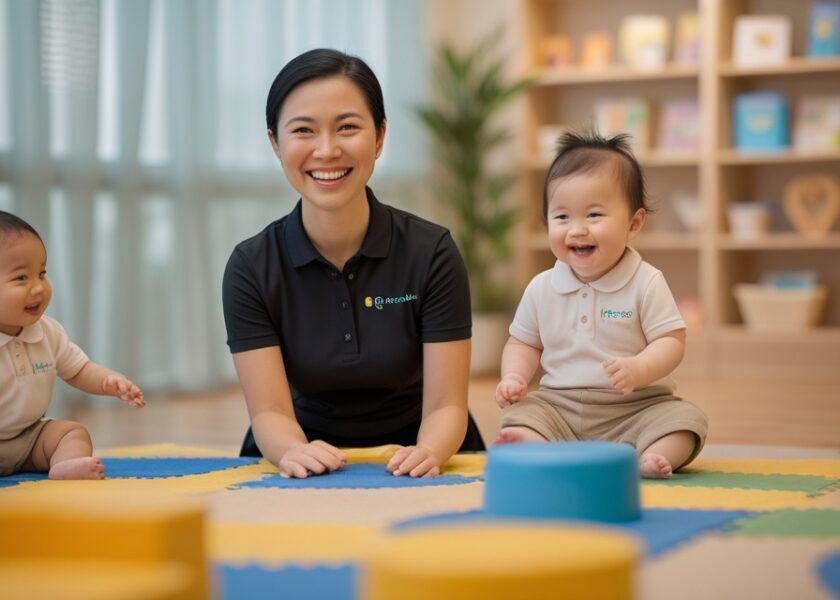
The pilot offers both home-based and community-based pathways. In home-based care, a trained childminder comes to you — which can be especially valuable for infants and toddlers whose world should not always have to expand outward to meet adult schedules. In community-based settings, children benefit from peer interaction in a structured, professionally supervised environment.
The ratios matter. In the EduNanny programme, the infant ratio is maintained at up to one to three, which means each child receives genuine individual attention rather than being lost in a group. This is not a regulatory checkbox. This is the difference between care that watches and care that nurtures.
Professional caregivers are trained. They understand the science of child development — not in the abstract, but in the specific, practical ways that translate into daily interactions. They know how to scaffold a child’s language during play. They know how to design environments that invite exploration while maintaining safety. They know the difference between a child who is typically developing and a child who might benefit from early intervention.
Professional care also follows your child. It is designed around developmental progressions, not around a grandparent’s availability or energy level on any given day. It maintains the structure and rhythm that children need to feel secure. It provides peer interaction that grandparents, however beloved, cannot fully substitute. It creates a record — a documented understanding of where your child is, what they are working on, what is emerging — that gives you as a parent a clearer picture of your child’s trajectory.
The programme operates Monday to Friday in care blocks that align with working family schedules. Families can access their child’s Development Scroll and CDA funds to support costs. The Baby Bonus is usable. These are not incidental details. They are the practical architecture that makes professional care accessible and sustainable for the families who need it.
Addressing Your Concerns
“Will introducing professional care hurt my relationship with my parents?”
When framed and communicated thoughtfully, professional care can actually protect and enhance the grandparent-grandchild relationship. Many grandparents find that having breaks during the week allows them to engage with their grandchildren with more patience and presence. The shift from primary caregiver to special-time grandparent can be a relief — and a gift.
“My parents will feel rejected.”
This concern is valid, and how you introduce the conversation matters. Focus not on what grandparent care lacks, but on what professional care adds. Frame it as giving your parents permission to be grandparents rather than full-time caregivers — to enjoy their grandchildren without the weight of daily responsibility.
“Is my child’s development actually at risk if we only use grandparent care?”
Every child is different. The research suggests that significant inconsistency in care quality and expectations can create background stress for children. What matters is not the label of who provides care, but whether your child’s developmental needs — for language scaffolding, social-emotional support, physical exploration, and consistent responsiveness — are being met across all care environments.
“Can children really be securely attached to multiple caregivers?”
Yes. Attachment is not a limited resource. Children can form multiple secure attachments. What matters is that each relationship provides consistent warmth and emotional attunement. Your child can love you deeply and also love their grandmother deeply. These relationships coexist and complement each other.
A Vision for Intentional Care
Let me paint a picture of what coherent family childcare looks like when it works well.
Imagine a Tuesday morning. Your child wakes up and goes to their grandmother, who has already prepared breakfast and is ready for the first few hours of the day. There is unhurried time. There are stories. There is the particular warmth that a grandmother brings to a morning — the patience, the indulgence, the sense that nothing urgent exists outside this small room.
Then, mid-morning, the EduNanny childminder arrives. Or perhaps you take your child to the community-based centre. Either way, the transition is warm. Your mother waves goodbye, and there is no guilt in that wave because she knows — because you have told her and she has come to believe — that this next part of the day is not a rejection of her. It is a complement to her.
Your child enters a professionally designed environment where their language is being scaffolded, where their social-emotional skills are being supported, where trained eyes are watching for the subtle developmental signals that might otherwise go unnoticed.
At the end of the day, you collect your child. You hear from the childminder about what they did, what they said, how they played. You bring them home to your mother’s arms for the evening. There is dinner, and bath time, and the bedtime routine that only you can provide.
The day has been full, but it has not been fragmented. It has been layered — each layer contributing something distinct and valuable, all of them fitting together like the parts of a whole.
This is not a fantasy. This is what intentional care design makes possible.
The Village, Redesigned
The guilt that many Singapore parents carry about grandparent care is not trivial. It is rooted in genuine complexity. You love your parents. You are grateful for what they do. You also know things they may not know — about how children’s brains develop, about the importance of early intervention, about the long-term benefits of professional educational care. And you feel caught between loyalty to your family of origin and commitment to your child.
You do not have to resolve this guilt by choosing one thing over another. You can resolve it by designing a system that honors both. You can resolve it by having conversations with your parents that are honest, loving, and forward-looking. You can resolve it by recognizing that asking your parents to be grandparents rather than primary caregivers is not diminishing their role — it is protecting the relationship that matters most to them.
And you can resolve it by trusting yourself. You are paying attention. You are learning. You are trying. That is enough.
Singapore families have always understood something that the rest of the world is only beginning to rediscover: it takes a village. But we are also living in a moment that requires us to be more intentional about our villages than ever before.
The world is more complex. Developmental science has given us knowledge that our parents did not have. The demands on working parents have intensified. The expectations on grandparents have quietly expanded even as their energy for meeting them has not.
In this moment, the families who will raise children best are not the ones who pretend that love is enough, nor the ones who outsource care to systems that feel clinical. The families who will raise children best are the ones who bring everything together — the love of grandparents, the dedication of parents, the expertise of professional caregivers — and who design a system that serves the child at the center.
EduNanny exists to be part of that system. Not the whole of it. Part of it. A professional, warm, expertly designed layer that integrates with your family’s unique architecture and helps it hold together as your child grows.
If you are a parent navigating this complexity — who loves your parents, who is grateful for their help, who also knows that your child needs more than one care world can provide — I want you to know that you are not failing. You are paying attention. You are doing the difficult work of holding multiple truths at once.
The photograph in the hallway will still have three generations in it. But the story behind that photograph — the daily, deliberate, loving work of raising a child across generations — will be richer, more intentional, and more coherent than ever before.
If you are ready to explore how professional childminding can complement your family’s care arrangement, we would be glad to hear from you.
To learn more about who we are, visit our About Us page.