Why Every Childcare Choice Is Really a Sibling Choice
Quick Summary: Why Your Childcare Choice Is Always a Sibling Choice
- The care environment is not neutral. It actively shapes how your children relate to each other, for better or worse.
- Every childcare decision is a family decision. When you choose care for one child, you are choosing it for the relationship between them.
- Age gaps matter. Siblings with closer gaps develop different dynamics than those with wider gaps, and each requires different conditions to flourish.
- Separation is not inherently harmful, but it changes the conditions. When children are in different care settings, parents become the bridge between two worlds.
- The sibling bond is worth planning for. It is one of the most enduring relationships your children will have, and it begins in the conditions you create today.
The Question Most Parents Never Think to Ask
In Singapore, we have become extraordinarily thoughtful about childcare. We research centres, compare curricula, visit open houses with notebooks, ask friends about ratios and routines. We agonise over the first child with an intensity that feels, in retrospect, almost like preparation for something we did not anticipate.
Because when the second child arrives, and the questions multiply, we discover that the real complexity was never about finding good care for one child. It was about understanding that every childcare decision is a family decision. And the family you are designing, quietly, through your choices, has more than one heart in it.
There is something happening in our community that we do not yet have good language for. When we cannot name something, we cannot plan for it. We can only react to it. This article is an attempt to give you that language.
What Siblings Actually Do Together (And Why the Care Environment Matters)
We know, in the abstract, that siblings matter. We grew up with siblings, or we did not, and we carry the weight or the lightness of those bonds into our own parenting. Siblings are witnesses. They are co-authors of a shared history. They are the people who knew us before we learned to perform.
But here is what we have not yet fully integrated into our thinking about childcare: the care environment is not a neutral backdrop to sibling relationships. It is an active ingredient. It either nurtures the bond or complicates it. It either gives siblings the time and conditions to learn each other, or it adds friction to a relationship that is already one of the most demanding and rewarding a person will navigate.
Think about what siblings actually do together in the early years, when their brains are building the architecture for empathy, for conflict, for repair, for joy:
- They negotiate who gets the red toy first.
- They witness each other’s frustrations and triumphs.
- They learn, through observation and imitation and gentle correction, how to be a person in relationship with another person.
- They practice. They fail. They try again.
Developmental researchers call this building social-emotional competence. Children do not develop it through lessons or worksheets. They develop it through the messy, daily, real-time work of being siblings.
Now ask yourself: what happens to that practice when the children are in separate care environments? When one is in childcare and one is at home with a grandparent? When they are together in a setting that is overcrowded or stressed or simply not designed to hold sibling relationships as a developmental priority?
The practice still happens. Siblings always find ways to be siblings. But the conditions change. The scaffolding shifts. And the outcomes shift with it.
This is not a moral point. It is not about blame. It is about recognition. Once you see it, you cannot unsee it. And that seeing changes what you look for when you make your next childcare decision.
Age Gaps: Why the Question Is Not “Better or Worse” But “Different”
Here is where it gets complicated, because Singapore families are not navigating a simple binary. Many parents have children with significant age gaps. Your five-year-old and your one-year-old have different needs, different developmental windows, different rhythms.
The centre that is perfect for your older child may not feel right for your younger one. You may have one child in community care and one at home, managing two different systems, two different relationships with care, two different sets of friends and caregivers and routines. You may be wondering whether keeping them together serves them or constrains them.
These are not anxieties. They are legitimate questions, and they deserve honest thinking rather than easy reassurance.
The research on age gaps and sibling relationships is rich and sometimes contradictory. Siblings are not variables in an equation. They are people, and the relationship between them is alive. What we do know is this:
| Age Gap | Typical Dynamic | What It Needs |
|---|---|---|
| Closer gaps (under 3 years) | More frequent, more intense interaction. Likely playmates and co-conspirators. | Shared environment where they can practise being together daily. Activities that require cooperation. |
| Wider gaps (3+ years) | Mentorship dynamic. Older child may take on caretaking roles; younger child looks up. | Space for both roles to coexist. Attention to ensuring the older child is also seen as an individual, not just a helper. |
Both are valuable. Neither is superior. But they are different, and they require different conditions to flourish.
What does this mean for childcare? The question is not “what is the best childcare arrangement for my children individually?” It is “what arrangement allows my children to develop the sibling relationship that is right for them, given who they are and who they are becoming?”
That is a harder question. But it is the right question.
When Children Are in Different Care Environments
Most childcare frameworks are built around the individual child. You have one child in front of you. You assess whether the environment meets that child’s needs. You make a decision.
But the moment you add a second child, you are no longer making individual decisions. You are designing a system. And systems have dynamics that individuals do not.
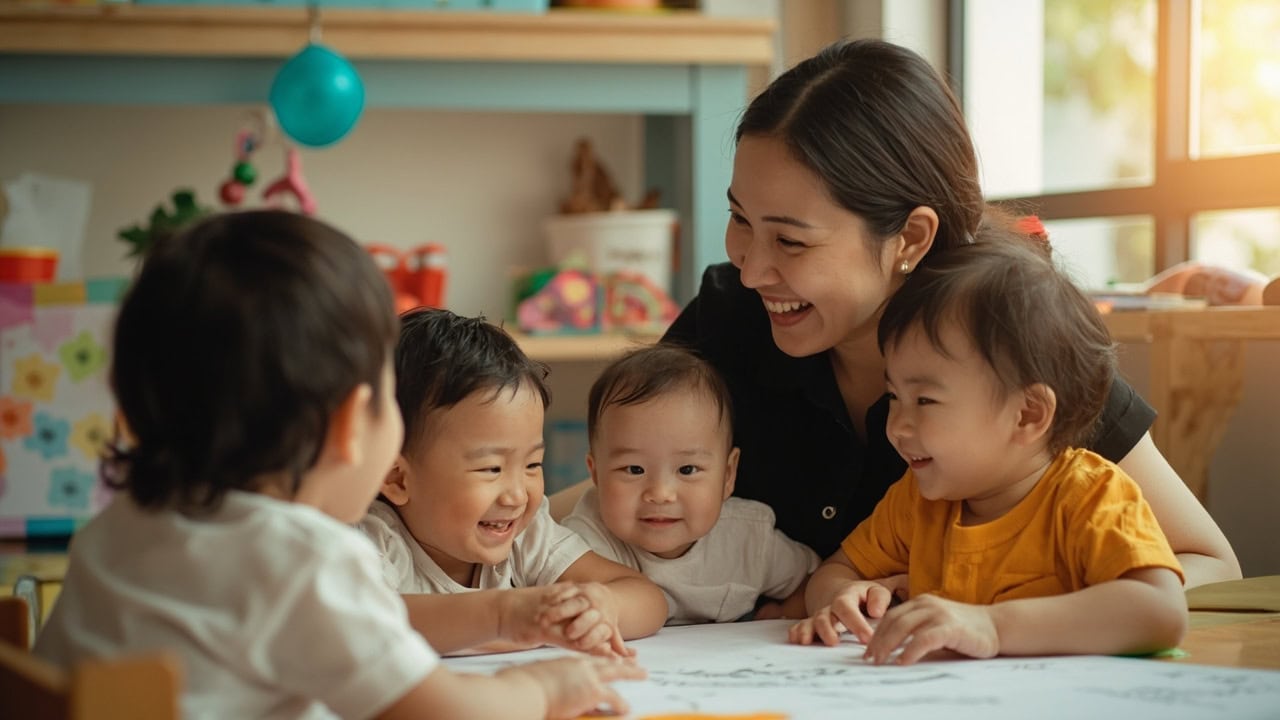
When two siblings are in the same childcare environment, they are learning something that siblings in separate environments do not learn as easily. They are learning that the world can hold them together. That there is a place where they belong to each other, not just alongside each other. That their bond has a home, a context, a community of witnesses who understand that these two children are not just two children in a room. They are siblings. And that matters.
In a well-designed care environment, this manifests in small, daily moments:
- The caregiver who notices that your daughter calms your son in ways that she cannot replicate and does not need to.
- The teacher who deliberately pairs your children for an activity because she understands that cooperation between them is a skill worth practising.
- The moment your children walk into their childcare and greet it like a shared language, a place that belongs to both of them because it holds both of them.
When siblings are in different care environments, the dynamics shift. You become the bridge. You carry news from one world to the other. “Your sister did this today,” you say, and in the telling, you are stitching together two experiences that would otherwise remain separate.
This is not a lesser thing. Many families navigate this successfully, and their children develop deep sibling bonds. But it requires something different from you as a parent: intentionality and deliberate effort to create the shared experiences that a common care environment provides organically.
There is a question that many Singapore families are quietly navigating: what happens when one child is in formal childcare and another is not, perhaps with a grandparent or a domestic helper? Children in quality childcare environments are often developing certain skills at a pace that reflects the richness of that environment. They are learning to navigate peer relationships, to share attention, to adapt to routines and transitions, to find security in multiple attachments. When a sibling comes from a different care context, there can be a dissonance in their social-emotional rhythms.
Not a problem. Just a difference. And differences require accommodation.
The question is not which arrangement is superior. The question is what you are doing, as the parent holding this family together, to ensure that the sibling bond remains strong across whatever differences the care arrangements create.
What Makes a Care Environment Trustworthy
The decisions I am describing require something that Singapore parents are not always given the conditions to exercise: trust in the care environment. Trust that when your children are not with you, they are not merely being supervised but being known. That the people caring for them understand that these are siblings. That the environment has the capacity, the attention, the ratio to see each child as an individual and as a member of a duo, a trio, a family.
In Singapore, we have an emerging landscape of care options, and this matters enormously. The ECDA Childminding Pilot, for instance, is creating pathways specifically designed for the conditions of home-based care. In a home-based setting, with a ratio that allows genuine attention, siblings can be cared for in their own environment, with their own routines, with a caregiver who is not managing ten other children at the same time.
What makes a care environment trustworthy in this deeper sense is not CCTV cameras or communication apps, though these have their place in creating transparency. What makes it trustworthy is relational depth:
- It is the caregiver who knows that your older child is working through a frustration with sharing, and who gently creates the conditions for that frustration to be felt and processed rather than simply managed.
- It is the teacher who understands that your younger child looks to the older one for cues about safety, and who works with that dynamic rather than against it.
- It is the environment that sees the sibling relationship as part of its developmental mandate, not as an add-on or a coincidence.
Because you can believe, in the abstract, that sibling bonds matter. But if your care environment does not share that belief, if it is too large, too under-resourced, too focused on compliance and curriculum to notice the moment your son reaches over to fix your daughter’s hair at snack time, then the belief remains abstract. The care does not catch up to it.
Questions Real Parents Ask (And What We Have Learned)
“Should my children be in the same childcare environment?”
There is no universal answer. The question to ask is not “same or separate?” but “what will allow my particular children, with their particular temperaments and age gap, to develop the sibling relationship they need?” Sometimes that is together. Sometimes it is apart. The key is making the choice consciously, with the sibling relationship as part of your criteria.
“One of my children is with a grandparent. How do I maintain the sibling bond?”
You become more intentional about creating shared experiences. This might mean regular sibling time in a common environment, shared activities that bring them together, and communication that explicitly names their bond. You are doing the work that a shared care environment would do organically. It requires effort, but it can be deeply successful.
“My children have a wide age gap. Can they really benefit from being in care together?”
Yes, but the benefits look different. For wider age gaps, being together in care can give the younger child a sense of security from the older sibling’s presence, and it can give the older child meaningful responsibility. The care environment needs to be able to honour both dynamics simultaneously, which is why ratios and caregiver attention matter so much.
“How do I know if a care environment really sees my children as siblings?”
Ask specific questions. How do the caregivers respond when siblings have conflict? How do they facilitate joint activities? Do they notice when one child calms another? Do they communicate about both children, not just the one who is more challenging? If the answer is that they treat each child independently with no attention to their relationship, the environment may not yet have the language or capacity to support sibling bonds as a developmental priority.
The Long View: Why You Are Building Something That Lasts
We talk so much about the immediate in childcare conversations. About readiness for school. About developmental milestones. About making it through the day. These things matter. But they are not the whole story.
The whole story is about what you are building for decades, not semesters.
The sibling bond, when it is nurtured well in the early years, becomes something extraordinary in adolescence. It becomes a refuge. A sibling who knows you before your performance, who has seen you in your most unedited moments, who shares the context of your childhood and your parents and your cultural inheritance, that sibling becomes an anchor.
And that anchor is not automatic. It is built. It is built in the moments I described earlier. The reaching over to fix the hair. The announcement about the green cup. The quiet observation in the carpark when you look in the rearview mirror and understand what you have made.
In a city like Singapore, where families are nuclear, where grandparents may live far away, where the pace of life can leave children in separate orbits even within the same household, the sibling bond may be the most reliable constant a child has. It is constant not because it is forced, but because it is chosen. Siblings choose each other, day after day, across differences and disappointments and the ordinary friction of shared space.
The quality of that choosing, the depth of that bond, is shaped in childhood. By the experiences they have together. By the environments that hold them. By the adults who see what they are becoming and tend to it with care.
That Moment Is Available to You
Not just once, but every day. The moment when you see your children together and you understand that this is what you made, not through grand gestures, but through ten thousand small decisions, each of them ordinary, many of them made in exhaustion and uncertainty.
The decision to keep them together in care. The decision to find a caregiver who sees them both. The decision to ask the question that most parents never think to ask: how will this choice shape the relationship between my children?
You are asking that question. You are here, because something in you already knows the answer. The relationship matters. It is worth planning for. It is worth building the conditions for.
EduNanny stands with families who understand this. Who bring their whole selves, their whole families, and trust that the care they find will be worthy of what they are entrusting.
That is not a small thing to ask, and it is not a small thing to offer. But it is what childminding has always been, at its best. Not just care. Partnership. Not just supervision. Knowing. Not just a service. A shared commitment to what matters most: that these children, your children, grow up knowing each other. Growing together. Becoming, for each other, a home they can always return to.
If you are ready to explore what relational childcare looks like for your family, we welcome the conversation.
EduNanny is a trusted, development-oriented childminding service for families in Singapore. Learn more about our approach · About the ECDA Childminding Pilot · Get in touch