The Invisible Curriculum of Sibling Relationships in Singapore Childcare
The Quiet Question Every Parent With Multiple Children Carries
There is a moment familiar to every parent with multiple children. You pick them up from childcare, and one runs toward you bubbling with stories about the morning. The other walks slowly, content in their own thoughts, and offers only a quiet smile when you ask how the day was.
You feel grateful for both responses. You also feel, somewhere beneath the surface, a quiet question you have learned not to voice: Are they both okay? Is each of them getting what they need?
This is not anxiety. This is parenting. And it is worth taking seriously because it points to something real.
When siblings share the same childcare environment, parents face a particular kind of worry that single-child families do not carry. It is not about whether childcare is safe or clean or well-staffed. It is about something deeper. It is about whether your children can be themselves in the same space, or whether one of them will always be defined by proximity to the other. Whether the child who speaks more easily will set the bar. Whether the child who observes before engaging will be seen, or only noticed.
If you have felt this, you are not overthinking it. You are thinking about your children with the precision love requires.
Beyond Logistics: What Siblings Teach Each Other
For too long, the conversation around childcare for multiple children has focused on logistics. Who gets picked up when. Whether the older child will disrupt the younger one’s nap. Whether to keep siblings together or separate them for different activities.
These are practical questions, and they deserve practical answers. But they miss the point.
The real question is not whether childcare can manage two children in the same room. It is whether childcare can see two children who are learning from each other every single day.
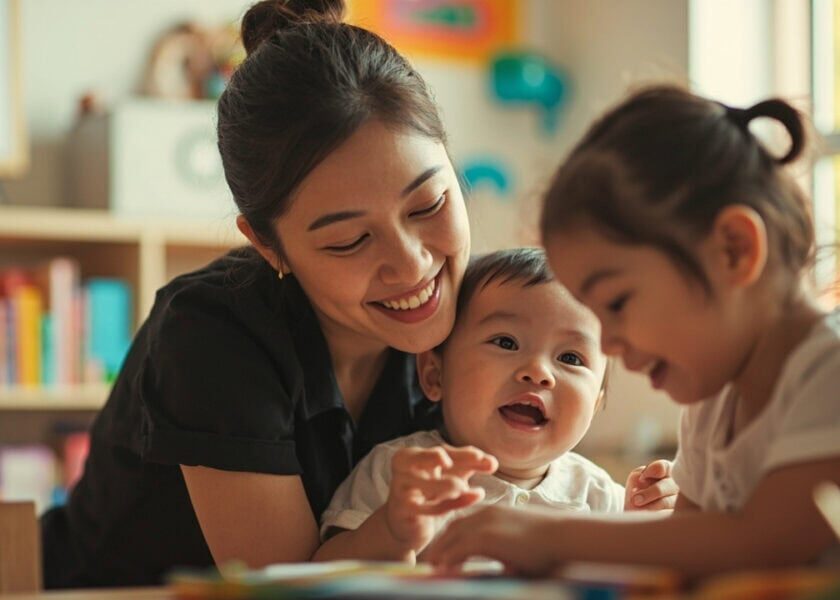
When siblings are together in a high-quality childcare environment, something quietly extraordinary happens. The younger child watches the older one navigate social situations, solve problems, ask questions, and receive responses. And something shifts inside them—not because anyone is teaching, but because proximity and care create conditions for learning that instruction alone cannot replicate.
The reserved child absorbs confidence. They see that words and actions have power, and that the people around them respond with interest and warmth. They begin, in small ways, to believe that their voice matters too.
Simultaneously, the older child encounters something equally valuable. They learn patience. They learn that someone smaller needs different things, and that different does not mean less. They experience the quiet pride of being looked up to, and also the opportunity to step back and let someone else lead.
These are not lessons any curriculum assigns. They emerge naturally from sibling proximity, shaped by the invisible presence of caregivers who understand what is happening and honor it.
The Invisible Curriculum: How Sibling Dynamics Become Developmental Strength
When caregivers understand sibling dynamics at this level, they do something powerful. They begin to create conditions for the sibling relationship itself to become a source of developmental strength rather than a complication to be managed.
Think about what siblings teach each other, given the right environment:
- They teach each other patience.
- They teach each other how to read another person’s emotions from a position of genuine investment.
- They teach each other negotiation, compromise, the delicate art of standing your ground while also yielding.
- They teach each other what it feels like to be protected, and what it feels like to be the protector.
These are not small lessons. They are, in many ways, the foundational skills for every significant relationship these children will ever have.
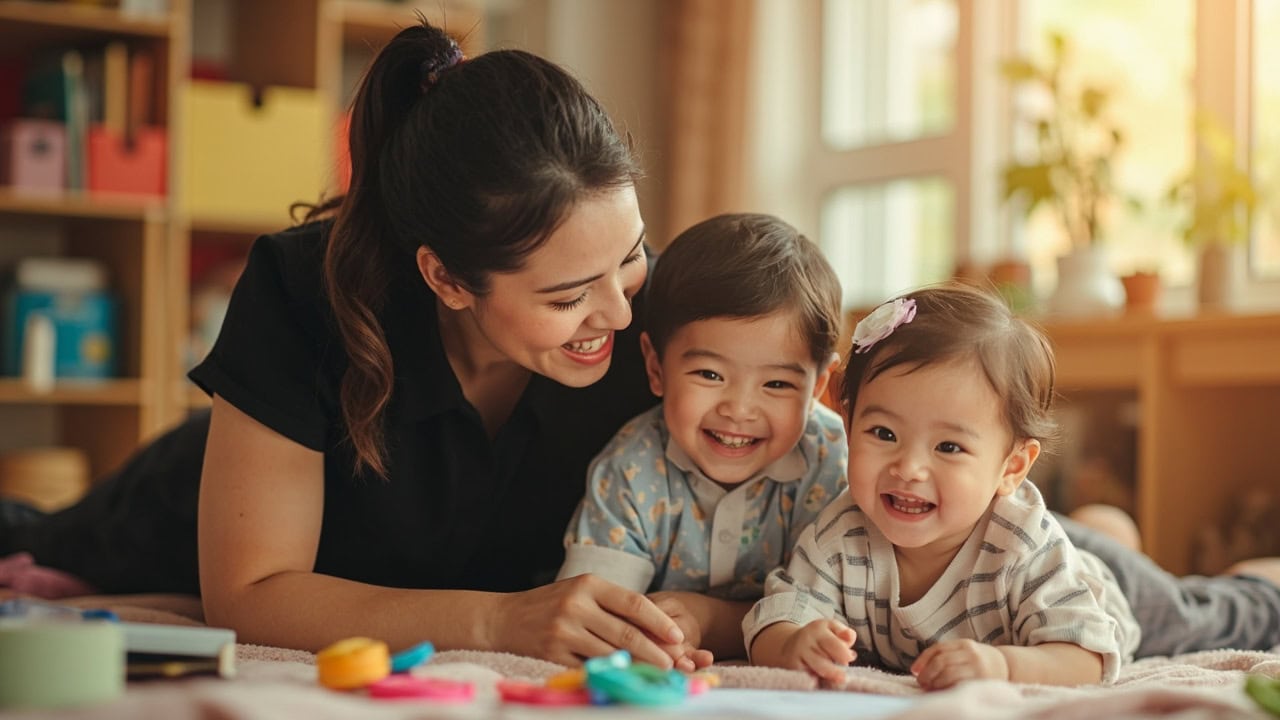
In quality childcare, this learning is not left to chance. It is supported by caregivers who understand that the sibling dynamic is an invisible curriculum, as important as any structured activity. They create moments where siblings can work together and moments where they play apart. They allow small conflicts to surface naturally, because conflict between siblings handled well is where children learn to repair, to apologize, to understand another perspective.
They do not rush to resolve every friction. They stay close, they observe, and they step in only when safety or real distress requires it.
What this means, practically, is that when siblings argue over a toy, the caregiver does not simply hand them two toys and move on. They watch. They note how each child responds. They notice whether one child always yields and what that teaches them about their place in the world. They notice whether one child always claims and what that teaches them about others. And they find quiet, natural moments to model what it looks like to share, to wait, to see the other person’s need without losing your own.
This is sophisticated work. It requires caregivers who understand child development, but more than that, it requires caregivers who are genuinely interested in children as people—who find them fascinating rather than simply adorable, and who see the long game, not just the immediate moment.
Individual Attention Within Sibling Groupings
Every child has their own rhythms, preferences, and ways of engaging with the world.
One child processes aloud, narrating their play and thinking in real time. Another processes internally, building and observing before they speak. One gravitates toward sensory materials and physical exploration. Another prefers to watch from the edge of a group before joining in.
None of these tendencies are better or worse. They are simply different, and they matter equally.
What quality caregivers develop, over time and through consistent attention, is the ability to hold both children in mind simultaneously. They notice that the child deeply engaged in her puzzle needs that focus preserved, not redirected toward group activity. They notice that the quieter child is beginning to withdraw and move closer—not to pull them out of their solitude, but to signal that solitude and support are not opposites. They notice when one child gravitates toward their sibling, and when they need space from them. They notice what each child learns in each mode.
This kind of observation is not a checklist. It is a way of being present that allows the caregiver to respond to each child as a distinct person, even when they are together. It is the difference between seeing siblings as a pair to be managed and seeing them as individuals whose relationship with each other is worthy of careful, intelligent attention.
Why Equality Is Not Sameness
The sibling relationship is never equal by default. One child is older. One is more verbal. One navigates social situations with ease while another processes more carefully. One has more stamina for physical play. One needs more reassurance.
These differences are not problems. But they create dynamics, and dynamics require attention.
The parent worry about fairness is real. You have probably caught yourself wondering whether your more reserved child feels overshadowed. Whether your more vocal child is taking up too much space. Whether the gap between them is widening in ways that will calcify over time.
These are not irrational fears. They are the concerns of parents who understand that sibling relationships, left unattended, can develop asymmetries that become harder to address as children grow.
Quality childcare addresses this not by treating siblings identically, but by treating each child with the precision their individual needs require.
When caregivers understand developmental differences, they do not assume siblings should always do the same activities at the same level. They notice that the older child needs more complex challenges, and they create space for that. They notice that the younger child benefits from caregiver interaction at their own level, and they provide that.
The goal is not equal activity. The goal is that each child feels equally attended to, equally interesting, equally valued for who they are.
When that happens, the sibling dynamic shifts. Competition decreases because each child has their own territory. Comparison decreases because each child is seen for themselves. And something else becomes possible: genuine sibling connection, rooted in security rather than rivalry.
What to Look For: A Practical Guide for Singapore Parents
When you visit a childcare setting with multiple children, there is a simple question that cuts through all the rest: Does the caregiver seem interested in your children as individuals?
Do they ask about each child’s specific preferences, rhythms, and concerns? Or do they speak about your children as a pair, a unit, a set?
Neither approach is wrong by itself, but you are looking for someone who can hold both levels at once—who can tell you something specific about each child, and who also understands how your children are together. Who notices the older one’s need to lead and the younger one’s growing confidence to try new things. Who notices when they collaborate and when they need space. Who sees the whole picture, not just pieces of it.
Questions to Ask During Your Visit
- How do you support children who have different engagement styles in the same group?
- Can you share how you would approach a situation where one sibling needs individual attention while the other is present?
- How do you communicate updates about each child specifically, not just the pair?
- What does a typical day look like for siblings who are at different developmental stages?
What to Observe
- Watch how the caregiver interacts with your children together and separately.
- Watch what happens when one child needs help and the other is nearby. Does the caregiver assume the older child will help, or do they give the same attention to both?
- Does the caregiver speak to each child in a way that recognizes their distinct personality?
- Can the quieter child have moments of leadership? Can the more expressive child have moments of simply being present without commentary?
These details will tell you more than any brochure or tour can.
EduNanny Singapore: Built Around the Whole Family
EduNanny by BUTLER was built with this understanding at its centre. As part of the ECDA Childminding Pilot, EduNanny offers pathways designed for families who need more than a one-size-fits-all solution.
With small ratios of up to one caregiver to three infants in home-based settings, and flexible centre-based options, the structure allows for exactly the kind of individualized attention that siblings need. Care operates Monday through Friday, with fee structures that make quality care accessible within the pilot framework. CDA and Baby Bonus funds can be applied, so the practical realities of Singapore family life are built into the design rather than treated as afterthoughts.
But the real design principle is not structural. It is relational.
It is the commitment to knowing each child deeply, to understanding sibling dynamics with the same seriousness parents bring to them at home, and to creating an environment where children can grow individually while also growing together.
Communication is central to this. Parents need to know what is happening in the day—not in a checklist format, but in a way that conveys the texture and quality of their children’s experience. EduNanny maintains transparency as a core practice, with communication protocols that keep parents informed and CCTV measures where deployed to support trust and accountability. This is not surveillance. It is partnership. You are entrusting someone with your children, and you deserve to understand what that looks like in practice.
Addressing the Concerns You Actually Have
“Will my quieter child be overshadowed?”
This concern reflects exactly the kind of attention your children deserve. In quality care, the quieter child’s introversion is not seen as something to fix. It is recognized as a valid way of engaging with the world. Caregivers create space for this child to lead in ways that suit them—perhaps through careful observation, through creating something quietly, through being the one others turn to for steadiness. The child who speaks less is still being heard.
“Will my more vocal child take up too much space?”
Children who are verbally expressive often do command attention, and that is not inherently problematic. The question is whether they are also learning that other styles of engagement have value. Whether they have moments of being the observer, the follower, the one who waits. Whether their confidence is expanding their world rather than crowding out someone else’s.
“Will siblings become too dependent on each other, or too competitive?”
Both can happen in environments that do not thoughtfully support sibling dynamics. In quality care, siblings have moments together and moments apart. They learn that their relationship with each other is one important part of their life, not the entirety of it. They develop their own friendships, their own interests, their own sense of self—separate and together.
“Is it better to keep siblings together or separate them?”
There is no universal answer. Some siblings thrive in shared environments; others benefit from brief separations that allow them to develop independently before coming back together. What matters is that the choice is made based on what each child actually needs, not based on what is most convenient. Quality caregivers observe enough to know which arrangement serves each child best.
The Long Game: Why This Matters for Decades
What you are choosing, when you choose a childcare partner who understands sibling dynamics, is the long game.
The relationship between your children will outlast your guidance as their parent. It will evolve through school, adolescence, adulthood, and into their own families. What they learn about each other in these early years—the security they build, the patterns they establish, the ways they learn to see each other as individuals—will shape that trajectory in ways that are difficult to undo later.
The child who learns in these early years that they are seen and valued on their own terms will carry that security into the sibling relationship. The child who learns that their place in the family is understood will offer that same understanding to their sibling, not out of obligation, but out of genuine connection.
This is why childcare matters. Not because it replaces what parents do, but because it extends what parents intend.
When you choose a childcare partner who sees your whole family, you are choosing to reinforce at home what is being nurtured during the day. You are choosing consistency, attention, and respect for the complexity of raising multiple children who are also learning to be together.
If you are a parent in Singapore exploring childcare options for multiple children, we invite you to learn more about how EduNanny Singapore supports sibling dynamics as a core part of what we do.
For families who would like to understand more about EduNanny’s approach, our team is available to answer your questions and help you find the right fit for your family.