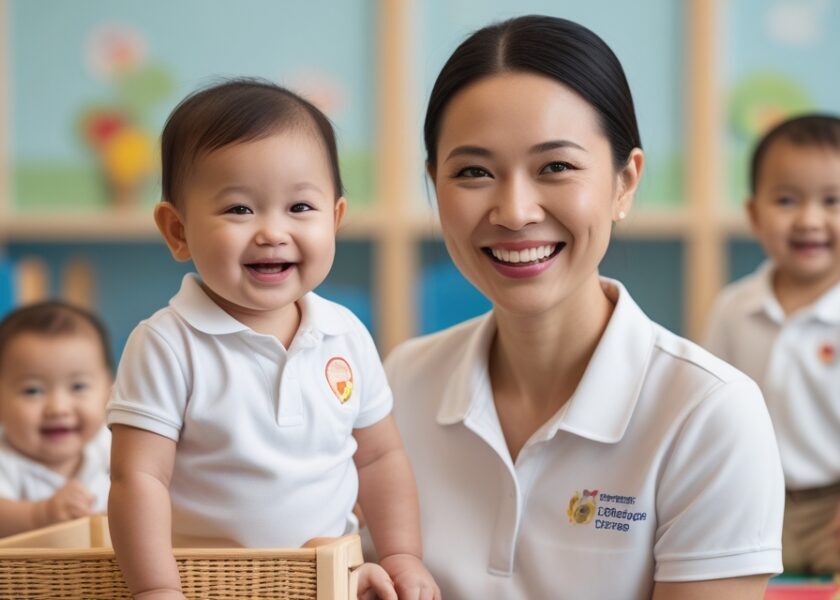
How Professional Childcare Reveals Your Child to Singapore Parents
The Quiet Truth About Professional Childcare
Here is what Singapore parents rarely hear: choosing professional childcare is not a surrender of your influence over your child. It is, if you find the right partner, the beginning of a deepening of it.
This is not a comfortable thing to say, and it is not a comfortable thing to hear. We live in a culture that oscillates between celebrating parents who do everything themselves and quietly shaming those who cannot. The language we use around childcare — outsourcing, delegating, entrusting — frames professional care as a transfer of responsibility, a loss of proximity.
And yet, for thousands of Singapore families, the reality has been something else entirely. Something quieter. Something more profound.
Quick Summary
- Why the fear of losing connection through professional childcare is often the opposite of what happens
- What exhaustion does to your ability to observe and understand your child
- The transformation from anxious watching to confident reading of your child’s signals
- How quality caregivers become mirrors that help you see your child more clearly
- What to look for when choosing infant care in Singapore
- Why this transformation continues long beyond the early years
What Exhaustion Does to Observation
To understand this transformation, you must first understand what exhaustion does to observation.
There is a well-documented phenomenon in psychology that researchers sometimes call “tunnel vision under stress.” When the demands on our cognitive and emotional resources exceed our capacity, we become highly efficient at processing the most urgent information — the cry that means hunger, the cry that means discomfort — while losing the ability to perceive the subtler signals that sit just outside that narrow band.
We become expert at crisis response and beginners again at attunement.
Most parents are not walking around in crisis mode. But many are operating at a level of sustained fatigue and cognitive load that produces a milder version of this phenomenon — a kind of constant low-level overwhelm that narrows perception without our awareness.
We are so busy doing that we forget how to notice. We are so tangled in the logistics of feeding, sleeping, soothing, working, and managing households that the quieter signals — the way your baby’s hand reaches differently now, the new quality of their eye contact, the emerging preferences they are beginning to show — can pass right by us like ships in the night.
This is not a failure of love. It is a feature of being human under load.
And here is the quiet truth that changes everything: when professional childcare takes some of that load off, it does not just give you back time. It gives you back yourself. It gives you back the cognitive and emotional space to do what you signed up for as a parent, which is not merely to feed and protect your child, but to know them.
The irony is profound. The thing that parents fear most about returning to work or sharing caregiving — the fear of missing out, of being less present, of losing the intimate knowledge that comes from round-the-clock proximity — turns out to be, for many families, the doorway to a deeper and more reliable understanding of their own child.
The Observation Arc: From Watching to Reading
At EduNanny, we have seen this pattern in hundreds of families across Singapore, and we have come to understand it as something we call the observation arc — the journey that parents take from anxious watching to confident reading.
The Report Phase
In the early weeks and months of any new childcare arrangement, parents are often in what we think of as the report phase. You come home at the end of the day, and your child’s caregiver tells you what happened. What they ate. How they slept. Whether they were fussy or content.
You are receiving information, but you are not yet generating understanding. Your child’s day is a story someone else is narrating to you, and you are a listener.
This phase is necessary, and it is not without its own quiet gifts. The reports keep you connected. They tell you that your child is safe, that they are cared for, that their days have shape and meaning even when you are not there to witness them. The caregiver becomes a bridge — a way of carrying knowledge from your child’s world to yours.
The Reader Phase
But at some point, something shifts. The reports become the raw material for a new kind of seeing.
You begin to notice patterns across the days. You see connections between what the caregiver describes and what you observe at home. The fussy afternoon that the caregiver mentions starts to make sense in light of the teething you noticed that morning. The new game your child is playing with blocks at the centre begins to show up in their play at home, and you realize with a small shock that you would have missed this entirely if you had not been listening carefully to the daily accounts.
This is the beginning of the reader phase. You are no longer just receiving information about your child. You are beginning to read them — to see patterns, to anticipate, to understand the logic behind the behavior.
And this is where the transformation becomes genuinely exciting, because the capacity to read your own child is not a skill that maxes out. It deepens over years. The parent who has spent five years in this kind of attentive partnership with a caregiver is not the same parent who started. They have developed what we think of as observation intelligence — a quiet, practical wisdom that allows them to perceive their child with increasing nuance and accuracy.
This is the parent your child needs you to become. And professional childcare, chosen and partnered with wisely, can help you get there faster and more surely than you might have arrived on your own.
The Caregiver as Mirror and Partner
What makes this possible is not simply the relief from exhaustion, though that matters enormously. What makes it possible is the caregiver.
The relationship between a professional caregiver and a parent is often discussed in transactional terms — you hire someone to look after your child, they provide a service, you pay for it. But this framing misses something essential about what happens when a caregiver truly knows a child.
When a trained, attentive caregiver spends hundreds of hours with your infant or toddler, they accumulate knowledge about your child that is qualitatively different from what you can observe in the fragmented hours of your own day. They see how your child handles frustration. They notice the way your child interacts with other children, or the particular texture of comfort they seek when they are overtired. They develop a picture of your child’s whole self — not just the self they show you at home, but the self they are becoming in the world.
This is enormously valuable to you as a parent. Not because the caregiver knows your child better than you do, but because the caregiver’s knowledge becomes a mirror for your own.
When your EduNanny caregiver tells you that your child has been reaching for books during free play with a particular intensity this week, and you know that you have been reading to them every night before bed, you see the connection. You see your influence taking shape in a new way. You see your child as a whole person whose development is not happening in isolation, but in a web of relationships, environments, and choices that include you, the caregiver, and the quality of the childcare you have chosen together.
The caregiver does not replace your intuition. They refine it.
They give you more material to work with, more data to interpret, more of your child’s voice to listen to. And in doing so, they give you permission to trust yourself more deeply.
There is a kind of parental confidence that comes from this — not the brash confidence of someone who has all the answers, but the quiet confidence of someone who has learned to read their child with skill and care. This is the confidence that says: I know this person. I understand what they need. I can respond to them with accuracy and warmth.
What Quality Childcare Looks Like in Practice
If the observation arc is the goal, what does the childcare arrangement that supports it actually look like in practice? Singapore parents deserve clear answers here, because not all professional care is created equal.
Small Ratios Matter
When an EduNanny caregiver is caring for up to three infants, they have the space to notice. They have the capacity to see your child as an individual, not as one of a crowd. They can tell you that your child’s cry when they are frustrated sounds different from their cry when they are hurt — and that kind of granular knowledge is the foundation of the observation intelligence we are describing.
Larger group settings have their place, but they inevitably compress the opportunity for this depth of observation. When ratios are high, even the most dedicated caregiver is pulled toward management rather than attunement.
Communication Rituals
Quality childcare includes daily communication rituals that keep parents connected to their child’s world. The quiet ritual of handover — those few minutes at the beginning and end of each day when a caregiver walks you through what happened — is not bureaucratic box-ticking. It is the infrastructure of observation.
Ask prospective providers how they structure daily updates. What do they document? How do they communicate? The answers will tell you whether they understand observation as part of their role, or whether they see it as optional extras.
Training and Professionalism
Professional caregivers are not just people who enjoy spending time with children. They are developmental partners in your family’s life, trained to observe, to document, to communicate, and to collaborate with you in the ongoing project of understanding your child.
Ask about training requirements. Ask about ongoing professional development. At EduNanny, our caregivers are part of the ECDA Childminding Pilot, which means we operate within a framework that takes the professionalization of childminding seriously — that treats it as a vocation deserving of training, support, and respect.
Transparency and Trust
Where EduNanny deploys CCTV measures, it is not because we doubt our caregivers. It is because we believe that visibility builds trust, and trust builds partnership. When parents can relax into the knowledge that their child is safe, they can begin to notice. They can step into the reader phase rather than remaining stuck in anxious watching.
Common Concerns Singapore Parents Ask About
“Will my child form attachments to the caregiver instead of me?”
This is one of the most common fears, and it deserves a direct answer. Attachment research consistently shows that infants and toddlers are capable of forming multiple healthy attachments. What matters is the quality of the primary attachment — and that remains with you. The caregiver becomes a secondary attachment figure, not a replacement. Your child learns that there are trustworthy adults in the world who care for them, and this actually supports their broader emotional development.
“I’m worried about separation anxiety and how my child will cope.”
Separation anxiety is a sign of healthy attachment, not a problem to be avoided. Quality caregivers understand this and help children navigate it with patience and consistency. The goal is not to prevent the child from feeling the difficulty of separation, but to help them learn that departures and returns are predictable and that you always come back. This is developmental work, not damage control.
“How do I know if a caregiver is really observing my child well?”
Ask specific questions. Instead of “How is my baby today?”, try “What was she drawn to during free play?” or “Did you notice anything new in how she communicates frustration?” Caregivers who are genuinely observing will have answers that reveal pattern recognition and developmental awareness. Those who are simply managing will give you surface-level summaries.
“Will I feel like a visitor in my own child’s life?”
The opposite tends to be true. Most parents who engage quality childcare report that the hours they do spend with their child become richer, more focused, and more attuned. You are not a visitor. You are the person your child has been waiting to return to — and you return with a clearer lens than you had before.
The Long Game: Observation Intelligence That Grows
There is one more thing worth understanding: the observation intelligence you develop through quality childcare is not a tool for the infant and toddler years alone. It is a capability that grows with your child and with you.
The parent who has learned to read their infant’s signals with patience and accuracy is the parent who will be better equipped to navigate the complexities of the preschool years — the social conflicts, the emotional intensity, the beginning of identity formation. The parent who has learned to partner with caregivers in the early years is the parent who will build stronger relationships with teachers, coaches, extended family, and ultimately with the young adult their child becomes.
This is a long game. The transformation we are describing does not end when your child starts primary school. It continues. The observation skills deepen. The partnership capacity expands. The confidence that comes from truly knowing your child becomes a quiet foundation for everything that follows.
What you are building, with the support of quality childcare and a trusted caregiver, is not just a safer, more enriching early environment for your child. You are building yourself as a parent. You are becoming the kind of reader your child deserves — someone who can see them clearly, respond to them accurately, and walk alongside them as they grow into whoever they are meant to become.
The EduNanny Approach
EduNanny was built with this transformation in mind. We are part of the ECDA Childminding Pilot, and we have designed our service around the understanding that what Singapore parents need is not just someone to watch their child while they work, but a partner in the longer, deeper project of becoming the parent their child needs.
We offer home-based childminding as well as centre-based care, because we know that different families have different needs, and because the quality of the relationship matters more than the location of the service. Whether your child is cared for in the familiar surroundings of your home or in one of our community spaces, the principles are the same: attentive observation, respectful communication, and a genuine commitment to helping you know your child more fully.
These are the conditions that make the observation arc possible. When childcare is affordable, reliable, and structured around the real demands of Singapore work and family life, parents can relax into the partnership. They can trust that their child is safe. And when they can trust that, they can begin to notice.
The observation arc does not announce itself. It does not arrive with fanfare. It works quietly, in the margins of your ordinary days, until one evening you realize that you are no longer anxiously collecting reports about your child — you are reading them.
You notice the pattern in the fussiness. You anticipate the hunger before the cry. You see the new gesture and understand what it means. You are present in a way that feels different — clearer, calmer, more connected.
And somewhere in that noticing, you understand what you have actually been given. Not just a break from the weight of sole caregiving. Not just a safer environment for your child while you work. But a mirror. A partner. A way back to yourself.
You are not losing proximity to your child’s development. You are gaining clarity about it. You are not surrendering influence. You are deepening it. And the parent who returns from this partnership is not the same parent who left — they are returning changed. More observant. More confident. More connected. More themselves.
That is the quiet intelligence that quality childcare builds. That is the parent your child is already choosing you to become.
If you are exploring infant care or childminding options in Singapore and would like to understand how EduNanny can support your family’s observation arc, we welcome the conversation. Every family’s journey is different, and we are here to listen before we offer anything else.
You can reach us at WhatsApp +65 1234 5678 or [email protected]
To learn more about who we are and what we stand for, visit our about us page.