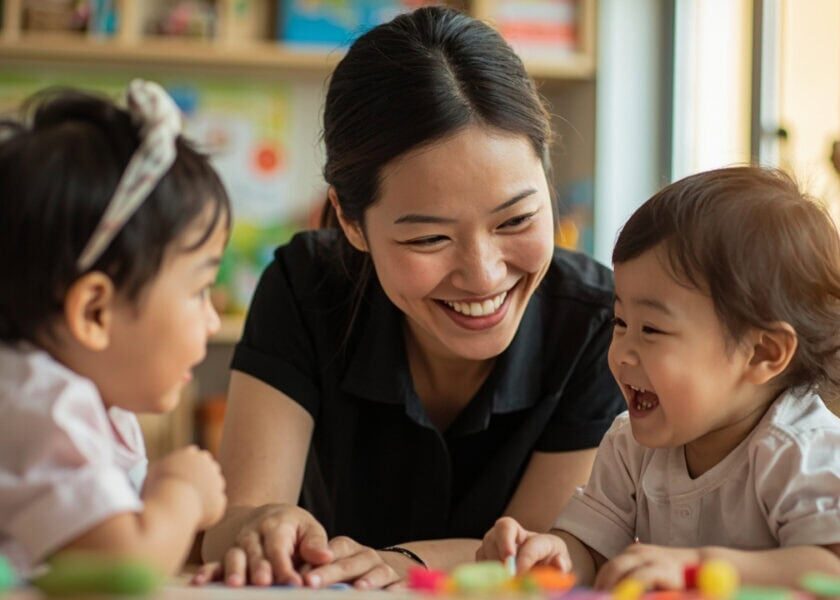
Be Your Child’s Most Important Care Partner Every Single Day
The Shift That Changes Everything
Here is what most parenting content tells you after you have enrolled your child in care: trust the process. Trust the caregivers. Trust the system you have chosen.
And there is wisdom in that. But there is also something missing.
Because trust, real trust, is not a passive act. It is not something that happens to you while you are waiting. Trust is built. And the person who builds it most consistently, most powerfully, most influentially, is you.
You are not the anxious outsider looking in through the window of your child’s day. I want you to hear that clearly, because somewhere in the anxiety of modern parenting, we have convinced ourselves that once our child walks through that door, we become passengers. We hand over the most important work of our lives and we hope for the best.
But that is not the arrangement that serves your child best. And that is not the relationship that makes the daily separation bearable for you.
You are the leader of your child’s care story. You were before enrollment, and you remain after enrollment. The caregiver you have chosen is not a replacement for you. She is an extension of you—someone you have selected, shaped through your communication, and empowered through your trust.
From Worried Parent to Confident Partner
The shift is this: the move from being a worried parent who hopes the right things are happening, to being a confident partner who knows how to ensure they do.
I want to be clear about what I mean by confident. I do not mean certain. I do not mean having all the answers. I mean something simpler and more powerful: knowing what questions to ask, and asking them without apology.
The parent who leads the partnership is not the parent who never worries. It is the parent who has learned to transform worry into observation, observation into communication, and communication into collaborative care.
This is the work. This is what daily parenting in Singapore actually looks like, whether you are a dual-income family navigating the demands of two careers, or a parent piecing together care arrangements that must somehow account for the cost of living in one of the most expensive cities in the world.
The Caregiver on the Other Side of the Door
When we talk about parents as leaders of the partnership, we are not diminishing the role of the caregiver. We are elevating it.
The childminder, the infant care educator, the professional who has chosen to do this work, deserves to be treated as an expert in the room. She has training. She has experience. She has seen hundreds of children move through these developmental stages, and she knows things about your child that you, in your loving parental blindness, may not yet see.
She is not a service provider performing a task. She is a professional, and she is your colleague in the most important work either of you will ever do.
When you treat her as an equal, when you communicate with her as a partner, when you value her observations as much as your own, you do something that does not always come naturally in a culture that sometimes positions professional caregivers as being in competition with parents.
You make her better at her job. You make her more attentive, more invested, more willing to share the small insights that make all the difference—because she knows that you will hear them without judgment. Because she knows that you are both on the same side.
Reading Behavioral Signals and Building Partnership
Let me give you something specific. A real scenario that plays out in Singapore homes every single evening.
Your child comes home from a day in care, and she is clingier than usual. She melts down at dinner. She does not want you to leave the room. You feel a flicker of alarm. Is something wrong? Did something happen? Did the caregiver handle a moment poorly? Is my child unhappy?
Here is what the anxious parent does: she sits with the worry, turns it over, checks her phone for messages that do not come, and eventually decides to mention it at drop-off the next day, tentatively, carefully, afraid of seeming like a difficult parent.
And the opportunity passes. Because the moment has passed, and the caregiver is now trying to reconstruct what Tuesday afternoon might have been like, and the insight that could have come from real-time communication is lost.
Here is what the leader parent does: she names what she sees. She picks up the phone or sends a message in the evening, and she says, simply, “Mia seemed a bit off this evening. Was Tuesday afternoon different for her? I am not worried, I just want to make sure we are reading her signals well.”
She does not accuse. She does not apologize. She collaborates. She treats the caregiver as an equal partner in understanding the child, because that is exactly what the caregiver is.
She doubles the amount of attention her child receives. Because now there are two adults who are looking for the same things, in the same way, with the same language.
What Partnership Looks Like in Practice
Partnership is not a feeling. It is a daily practice of communication. It is the deliberate act of asking your child’s caregiver what her morning was like, and genuinely wanting to know. It is sharing the small update at pick-up, the thing you noticed at home that might matter at school.
- At morning drop-off: A brief exchange beyond “she slept well” or “here’s her milk.” Sharing context: “She’s been really attached to her stuffed rabbit, I wonder if she’ll want it during the day.”
- During the day: A message when something significant happens at home. “Dad had to travel for work this week, she might be looking for extra comfort.”
- At evening pick-up: A conversation that goes deeper than eating and sleeping. “How was she? How are we reading her today? What should we be paying attention to?”
- When something feels off: Naming it directly, without apology. “She was really clingy tonight. Did today feel different to you?”
This is not about being the perfect parent. It is about being the present parent. The parent who shows up at the door with calm energy, not rushing, not distracted, making eye contact with the caregiver and the child and saying, with their whole body: I am here. You are safe. We are connected.
The First Thousand Days: Why This Work Matters
The brain is building faster in the first thousand days than it ever will again. The stress response systems are calibrating. The attachment patterns that will shape relationships for a lifetime are forming. Every responsive interaction, every moment of being seen and known and soothed, is laying down neural pathways that will later support emotional regulation, social connection, and cognitive flexibility.
You are not just getting through the day. You are building your child’s brain. And so is the caregiver you have chosen.
That is an extraordinary responsibility. And it is also, I think, an extraordinary gift, because it means that the invisible work you do—the quiet attention you pay, the questions you ask, the partnership you build—all of it matters in ways that go beyond what you can see.
You are not just a parent managing logistics. You are a leader shaping the conditions in which your child will grow.
Your Child’s Language
Your child speaks to you constantly through behavior. The question is whether you have built the conditions to act on what you read.
- The diaper rash that flares when she is teething
- The food refusal that signals a developmental leap
- The sudden reattachment to a comfort toy that means something has shifted in her daily world
You are already learning this language. Every parent is. The question is not whether you can read your child. The question is whether you have built the conditions to act on what you read.
What Quality Childminding Looks Like in Singapore
In Singapore, families have real choices: home-based care, community-based care, and centre-based care, each with its own strengths, each designed to meet families where they are.
When you are evaluating these options, here are the questions that matter most:
- What are the caregiver-to-child ratios? In the early months, when your baby is building the neurological architecture that will support everything that comes after, ratios matter enormously. One of three is different from one of eight or ten. It means your child is seen. She is held. She is known.
- What are the communication systems? Are there regular updates? Is there a way to share what you observe at home? Are conversations at drop-off and pick-up welcomed and substantive?
- What are the fee structures and subsidies? Can CDA and Baby Bonus be used? Are there pilot fee arrangements that make quality care sustainable for your family?
- What is the transparency? Where CCTV measures are deployed, they are deployed not because families do not trust caregivers, but because trust and transparency are partners, not competitors.
- What is the caregiver’s training and experience? This is a professional doing important work. She deserves to be treated as an expert in the room.
These are not checklist items. They are the conditions that allow partnership to happen. Because when you are not spending your energy worrying about whether you can sustain the arrangement, you can spend your energy on what actually matters: being present in it.
Being Present, Even From a Distance
Children do not experience the separation the way we do. They do not think, “my parent has left me with someone else.” They think, “where is my person?”
And when your person has built a strong partnership with their other person, when there is alignment, when there is communication, when there is shared language, your child feels the coherence of it.
She feels that the adults in her life are talking to each other. She feels that her world is not fragmented but held.
That feeling—that sense of a safe and predictable world—is not a luxury. It is the foundation on which everything else is built.
You may not be in the room with your child during the day. But presence is something you can cultivate:
- It is the text you send in the morning asking how the night was
- It is the conversation at pick-up that goes beyond “did she eat and sleep” to something deeper
- It is showing up at the door with your attention clear, your questions ready, your partnership open
Trust is not built by surveillance. It is built by relationship. The parent who shows up consistently, who communicates openly, who treats the caregiver as a partner, will know when something is wrong—because she will have built the kind of relationship where that conversation can happen.
How to Know If the Arrangement Is Working
You watch. You observe. You notice. Does your child seem settled in the mornings? Does she have a relationship with her caregiver that looks comfortable, not anxious? Does she come home and seem like herself? Does she regress briefly after weekends and holidays, and then settle again?
These are the signals that tell you the partnership is working. When both of you are looking in the same direction, at the same child, with the same intention, the small things get caught before they become big things.
How EduNanny Singapore Approaches This Work
EduNanny Singapore is part of the ECDA Childminding Pilot, building a structured, supported, quality-assured pathway for infant and childminding in Singapore.
Here is what that means for you:
- Ratios that make quality possible: Up to one-to-three infant ratio in home-based settings. In the early months, your baby is not one of eight or ten. She is one of three, held and known.
- Fee structures designed for real families: Pilot arrangements that make quality care sustainable. CDA and Baby Bonus are usable across our services.
- Coverage that works: Monday through Friday care blocks structured to give working parents the coverage they actually need.
- Communication systems that create visibility: Regular updates, meaningful exchange, and the transparency that allows distance to become something other than anxiety.
- Technology as a support, not a replacement: The Thomas AI Chatbot is available for parents in our community, because we know that the questions do not stop when you leave the centre. Thomas is there for those midnight questions about bottle refusal or sleep regressions. He is not a caregiver. He is not a replacement for professional advice. But he is a resource when you need answers. He is part of the ecosystem we are building around you, because supported parents make better partners.
But let me be clear about what we are not. We are not the answer to the question I opened with. The answer to that question is you. It has always been you.
EduNanny Singapore is here to walk this road with you. Not as a replacement for what you bring, but as a support for it. Because the village it takes to raise a child is not a given in this city, but it is being built, piece by piece, by parents and caregivers and educators who refuse to settle for less.
Go Show Up at That Door Tomorrow
So let me come back to that moment. The moment after drop-off. The walk to the car. The day ahead.
I want you to feel something different the next time that moment comes.
I want you to feel what it feels like to be the kind of parent who shows up in that partnership with everything you have. Who asks the questions. Who shares the observations. Who trusts not blindly but intelligently, because you have built the conditions for trust.
Who knows that your child is not alone on the other side of that door, because you have made sure of it.
Who feels, even in the distance, the steadiness of the presence you bring.
That steadiness is your gift to your child. It is not perfect. It is not constant. There will be hard days, and uncertain days, and days when you wonder if you are getting any of this right.
But the steadiness is not about being perfect. It is about being present. It is about showing up, again and again, as the architect of the conditions in which your child will grow.
You are the author. You are the leader. And you are, already, more capable than you know.
You have always been the heart of it.
Now go show up at that door tomorrow with your questions ready, your attention clear, and your partnership open. Ask what you need to ask. Share what you need to share. Be the steady presence your child needs, and trust that it is enough.
It is more than enough. It is everything.
EduNanny Singapore is here to walk this road with you. If you are exploring infant care or childminding options in Singapore, we invite you to learn more about our approach and how we support parents as partners in their child’s care story. Reach out to us to start a conversation.