Beyond the Lunchbox: Understanding Childcare Nutrition in Singapore
Why Early Childhood Nutrition Matters More Than You Think
We know that early childhood is a period of rapid physical growth, of brain architecture being built, of preferences and habits taking root in ways that can persist for decades. A toddler’s nutritional needs are not simply smaller versions of adult needs. They are specific, evolving, and demanding.
A child’s body during these formative years needs calcium for bones that are lengthening. Iron for a brain making connections at a speed it will never match again. Fats for a nervous system still under construction. Protein for muscles learning to run and climb and dance.
And beyond the nutrients themselves, there is the act of eating. The social experience of the table. The way a child learns to trust food, to explore new flavours, to sit with hunger and satisfaction, to understand that eating is not just fuel but a shared human ritual.
In Singapore, where both parents often work, childcare is not a luxury but a logistical necessity for most families. We have normalised leaving our children in someone else’s care during the most formative hours of their day. We have built systems, frameworks, regulations, and ratios to ensure safety and quality.
But there is one dimension that remains difficult to see: what happens at the lunch table when we are not in the room.
The Trust Gap: What Parents Cannot See
You cannot be in two places at once. You cannot see through the eyes of your child’s caregiver on a Tuesday afternoon when she is navigating your daughter’s fear of mushrooms or your son’s sudden refusal of anything white after a week of loving rice.
You trust, because you must. You hope, because you have no other choice. But the not-knowing is a weight, and it deserves to be named.
When parents choose childcare, they are asking a question that cannot be fully answered by a tour or a brochure: Does this place see my child? Not just as a body to be fed, not just as a slot to be filled, but as a whole person with preferences and fears and cultural roots and individual needs?
This is the trust gap. It is the space between what parents imagine happening in a childcare setting and what is actually occurring when the door closes. Parents imagine someone kind, attentive, patient. They imagine their child being coaxed gently toward the carrot, not force-fed until they gag. They imagine their child’s dietary restrictions being taken seriously, not treated as inconvenient requests.
But imagination is not certainty. And certainty is what parents crave.
What Quality Childcare Nutrition Actually Looks Like
In quality infant and toddler care, mealtimes are not simply about delivering calories to small bodies. They are developmental moments, carefully structured and attentively supported.
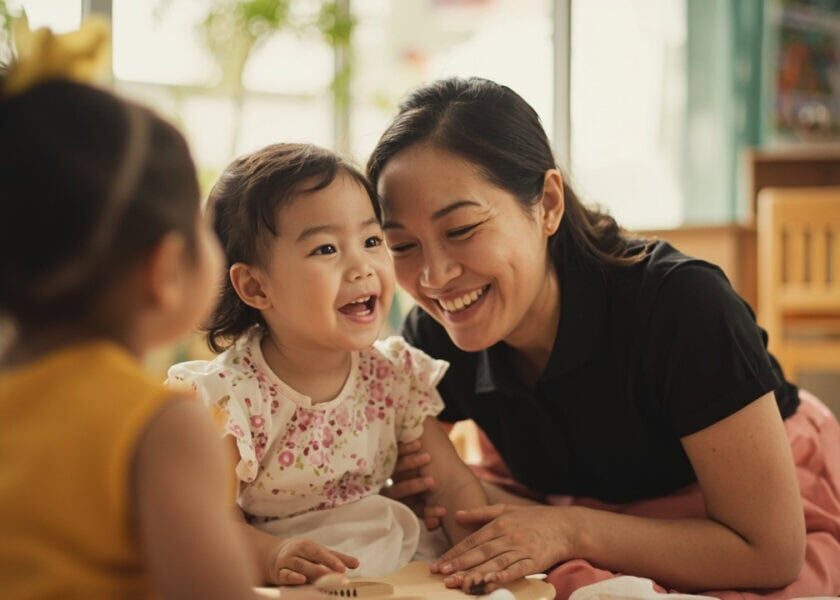
A skilled childminder understands that a twelve-month-old learning to self-feed does not need efficiency. She needs patience. She needs the freedom to explore food with her fingers, to squish avocado between her palms, to experience texture before she experiences taste. She needs an adult nearby who will not rush her, who will narrate what is happening on the plate, who will model eating with genuine enjoyment rather than mechanical obligation.
For older toddlers, the table becomes a social space. This is where language accelerates, where children learn words for food and sensation and preference. “Yucky,” they say. “More,” they demand. “Mine,” they declare with tomato sauce on their cheek.
A quality food environment allows for these expressions, treats them as normal rather than problematic, and gently expands a child’s repertoire without coercion. There is a difference between a child being encouraged to try one bite and a child being forced to finish everything on their plate. One builds trust. The other damages it.
The Small Details That Signal Quality
When a caregiver is responsible for fewer children, there is time to notice. Time to see that one child is picking around the onions but eating everything else. Time to gently encourage a second bite without making it a battle. Time to recognise when a child’s lack of appetite signals something more—a coming fever perhaps, a stomach ache that has not yet announced itself.
Time to sit with a child who is struggling with self-feeding and guide their hands rather than simply taking over.
Time is the luxury that makes quality care possible, and ratios are the mechanism that creates that time.
Understanding Picky Eating and Singapore’s Food Diversity
Picky eating deserves its own honest conversation, because how it is handled shapes a child’s relationship with food for years to come. It is not a character flaw in a child. It is a developmental stage, a protective mechanism, a normal expression of a toddler’s emerging sense of autonomy and their body’s innate wisdom about what feels safe to consume.
Research tells us that children may need to be exposed to a new food anywhere from seven to fifteen times before accepting it. They may refuse a food today that they will devour tomorrow. Their appetites fluctuate wildly from day to day, influenced by growth spurts, teething, illness, sleep, and mood.
A childcare environment that understands this will not panic when a child pushes away the dal or rejects the steamed fish. They will offer the food again without pressure. They will pair new foods with familiar ones so the child has security on the plate. They will not bribe, or reward with dessert, or make mealtimes a battlefield.
Honouring Cultural and Religious Dietary Needs
Singapore’s cultural diversity adds another layer that cannot be ignored. In a single childcare class, children may come from Chinese, Malay, Indian, Eurasian, and international families. Dietary needs are shaped by religion, by culture, by family tradition, by medical requirement. Halal, vegetarian, no beef, no pork, no shellfish, no peanuts. Food allergies that are not preferences but life-threatening realities.
A child’s body cannot be negotiated with. An anaphylactic reaction to a peanut does not care about cultural context. It requires precision, protocol, and absolute clarity.
Quality childcare nutrition must hold all of this. It must honour cultural food traditions while ensuring that no child feels othered by what is on their plate. It must prepare separate meals when needed, not as an afterthought but as a thoughtful act of inclusion.
It must document, communicate, and verify. When a parent says their child cannot have dairy, that information must travel from enrollment form to kitchen to caregiver to the actual bowl placed in front of the child. There is no room for error. There is only room for care.
Questions to Ask Your Childcare Provider
When researching childcare options, the questions worth asking go beyond the menu itself:
- How do caregivers respond when a child refuses food? Is there pressure or patience?
- What is the child-to-caregiver ratio during mealtimes?
- How are dietary restrictions and allergies documented and communicated?
- Can you receive regular updates about what your child actually ate?
- How are cultural and religious dietary requirements handled?
- What does a typical mealtime look like? Is it rushed or paced?
- How do caregivers support self-feeding development in infants and toddlers?
These questions will tell you far more than a menu ever can. They reveal whether mealtimes are treated as a checkbox or as a genuine developmental opportunity.
How EduNanny Approaches Childcare Nutrition
EduNanny by BUTLER, operating as part of the ECDA Childminding Pilot, approaches childcare nutrition as inseparable from child development. This means starting with ratios that allow for real attention.
With a one-to-three infant ratio in our home-based pathway, our childminders have the capacity to truly observe, to adapt, to respond. They are not rushing through lunch to get to the next task. They are present at the table, engaged with the children, building the kind of mealtime environment that supports healthy eating patterns for life.
We work across both home-based and centre-based pathways, because Singapore families are not a monolith. Some children thrive in the intimate, home-like setting where meals feel familial, where there may only be three or four children at the table, where the childminder knows every family’s food preferences as well as she knows her own. Others benefit from the structure and peer modelling of a centre environment where children watch each other eat, where a confident eater inspires a hesitant one, where the rhythm of the day is shaped by group routine.
Both pathways have value. Both can be done with excellence.
Our care runs Monday to Friday, in structured blocks that give parents predictability and children routine. Children thrive on knowing what comes next. When lunch is at the same time each day, when snack follows the same sequence, children arrive at the table with their bodies and appetites prepared. There is comfort in rhythm. There is security in knowing that when the song is sung or the bell is rung, it is time to eat.
Communication That Closes the Gap
We believe that parents should not have to guess. Our systems include regular updates, and where CCTV measures are deployed, we offer transparency to parents who want it. We document what children eat, how much they eat, and any notable moments at mealtime.
We ask parents about food preferences, about cultural requirements, about medical needs, and we treat that information as sacred. We do not assume. We ask. We listen. We adapt.
Where applicable, our fee structures are designed with accessibility in mind, keeping care affordable within the pilot framework. Singapore parents already carry enough financial weight. Childcare should not add to that burden in ways that force families to compromise on quality.
For families eligible for the Child Development Account and Baby Bonus schemes, we help navigate the application and usage of those resources. Bureaucratic complexity should not stand between a child and good care.
The Bigger Picture: Nourishment Beyond the Plate
When we talk about childcare nutrition, we are not just talking about lunchboxes and menu plans. We are talking about the first relationships a child forms with nourishment, with their own body’s signals, with the people who tend to them.
We are talking about trust. About whether the world is a place where your needs are met, where someone notices when you are hungry, where food is a source of comfort rather than conflict.
Singapore parents carry so much. They carry the weight of work deadlines and daycare pickups, of career ambition and parental presence, of wanting to give their children everything while knowing that time is the one resource that cannot be stretched or multiplied.
They make impossible choices every day and do so with love and worry in equal measure. The anxiety about what happens at lunch is not small. It is a proxy for a larger question: Am I doing enough? Is my child okay when I am not there?
No childcare provider can answer every question. But we can answer this one: Is my child being fed with intention? Are their needs being met? Is anyone paying attention?
At EduNanny, the answer is yes.
And that answer, that simple certainty, changes everything. It allows a parent to breathe at work. To focus. To trust that when the day ends and the pickup comes, their child will be there, fed, settled, and thriving. Not perfect. Children are never perfect. But seen. Supported. Nourished in body and in spirit.
The children in quality childcare will grow up. They will carry with them the memories of how they were fed, how they were held, how they were seen. They will become adults who either trust or distrust their own bodies, who either enjoy food or feel anxious around it, who either know that someone was paying attention or feel that they had to tend to themselves alone.
Let us be the ones who paid attention. Let us be the ones who saw. Let us be the ones who honoured the sacred, ordinary, daily act of feeding a child.
EduNanny was created for this moment in Singapore’s story. For parents who need more than a checklist of safety features. For children who deserve more than a warm body in a room. For a city that is beginning to understand that early childhood care is not a support service but a foundational pillar of a healthy society.
If you are ready to explore what this looks like in practice, we welcome the conversation.
Quick Summary
- Early childhood nutrition shapes development in ways that can last a lifetime
- Picky eating is a normal developmental stage, not a problem to be solved with pressure
- Quality childcare treats mealtimes as developmental moments, not just calorie delivery
- Singapore’s cultural diversity calls for thoughtful, individualised food care
- The right provider will close the trust gap and keep you informed about what your child actually eats
For families looking for a trusted, development-focused approach to childcare in Singapore, EduNanny is here to answer your questions and explore the possibilities with you.