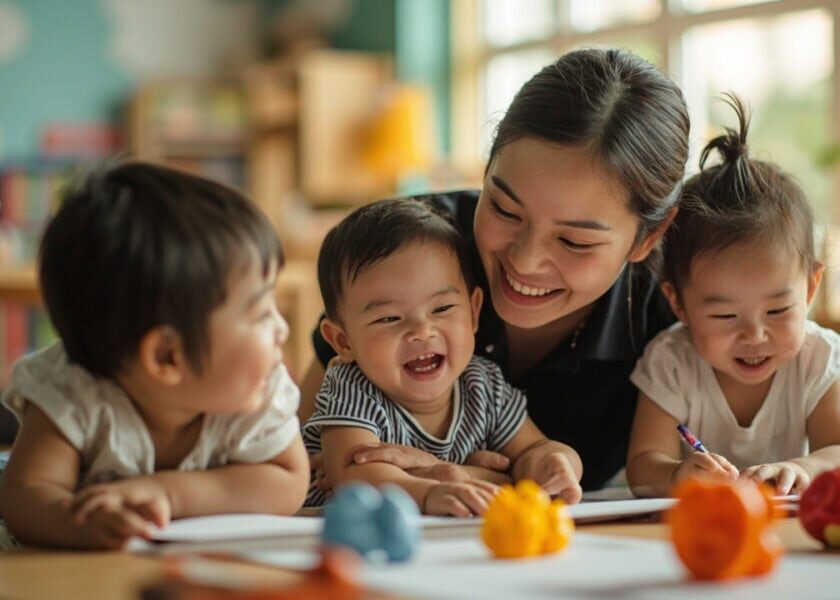
What Your Child Becomes When You Are Not There
The Hidden Social-Emotional Intelligence Your Child Is Building When You Are Not There
There is a moment — and every parent knows it — when you hand your child to someone else and walk away. The corridor stretches ahead of you. The door closes behind you. And in that silence, between the last thing you said and the first thing you will ask at pickup, something profound is happening. Something you cannot see, cannot hear, and can only, in time, begin to understand.
You are not alone in carrying that quiet weight. Singapore parents navigate work demands, logistics, and the weight of cultural expectations every single day. At the center of it all sits a question you cannot fully answer from the outside: what is my child actually experiencing when I am not there?
You want to trust. You do trust — at least enough to leave your child each morning. But trust and understanding are not the same thing, and the gap between them can feel enormous.
What research and experience consistently show: When you choose quality childcare, you are choosing a setting where your child is practising emotional regulation, conflict navigation, peer friendship skills, social confidence, and trust in capable adults. These skills determine not just school readiness, but life readiness. And they are built, day by day, in the hours you are not there.
This article is designed to close that gap — not with reassurances alone, but with a shift in perspective. Once you see what is actually happening in those hidden hours, you become a more intentional partner in your child’s social and emotional development.
The Hidden Social Curriculum: What Is Actually Happening
We spend so much of the early years thinking about what we are doing when we are with our children. The books read aloud. The meals shared. The scraped knees tended, the night terrors calmed, the small hand held in the dark. These moments are sacred, and they matter enormously.
But today I want to talk about the other hours — because that is precisely where a different kind of learning is unfolding. Quiet, unscripted, and extraordinarily important.
Think of the ordinary morning at a well-run childcare setting. A two-year-old reaches for the same red truck another child is holding. There is no parent to mediate, no referee waiting on the sidelines to intervene. What happens next — the negotiation, the wait, the attempt at sharing, the disappointment if it does not work, the recovery from that disappointment, the return to play — is not a minor event. It is, in miniature, the entire architecture of social life.
And it is happening multiple times a day, across every room, in ways that rarely make it into the daily update or the photo sent to parents’ phones.
What Your Child Is Building in Quality Childcare
Consider what your child is actually practising in a quality childcare setting — often for the first time, and with a regularity that home simply cannot replicate.
Emotional regulation — A trusted caregiver helps them name what they are feeling and offers a way through it. A spill becomes an opportunity. A conflict becomes a story. The child who pushes back in frustration is not shamed; they are guided. In that guidance, something is actually wiring itself — the capacity to manage intensity, to bounce back, to know that a bad moment does not end the day.
Conflict navigation — The child who learns, over months in a quality setting, that sharing does not mean losing. That waiting does not mean giving up. That another child having a turn does not mean they will never have one again. These are not intuitive lessons. They require repetition, scaffolded difficulty, and patient adult guidance in the messy reality of peer interaction.
Peer friendships — Your child is learning to be a friend. They are learning that another child has needs, preferences, and feelings that matter alongside their own. They are learning the geography of a small social world — who is kind, who is bold, who is shy, who shares, who includes — and where they themselves fit in that geography.
These peer bonds scaffold social confidence in a way that no amount of adult-directed interaction can replicate. Your child is not just playing next to other children. They are beginning to understand what it means to be with others.
What Growth Actually Looks Like at Pickup
What you cannot see is not what you cannot know. Once you know what to look for, the hidden curriculum stops being hidden.
Signs of Social-Emotional Development
- Settled behaviour — Your child is calm upon reunion, not because they did not miss you, but because they trust the rhythm of your return
- Spontaneous storytelling — “Milo took my ball and I was sad, but then Teacher said we could take turns and I played with the blocks”
- Social references — Naming friends, sharing who they played with, mentioning caregivers by name
- Resilience after conflict — Not the absence of conflict, but the ability to move through it and return to play
- Curiosity about returning — Asking about tomorrow, mentioning what they want to do next
The Evening Conversation: Your Window Into the Hidden Curriculum
The evening conversation at the dinner table is more important than you might realise. Not the interrogation — “What did you do today?” “Nothing.” — but the open, curious, patient invitation.
Try asking instead:
- “Who did you play with today?”
- “What was the best part?”
- “Was there anything that was hard?”
- “What did Teacher help you with?”
- “Did anyone need help today?”
These are not small talk questions. They are your window into the hidden curriculum. When you listen to the answers — really listen, without immediately solving or redirecting — you are teaching your child that their social world matters to you.
When your child begins to narrate their day spontaneously — sharing both the frustration and the resolution, the sadness and the recovery — that is social learning in action. “I was upset and it got better.” That capacity to hold two truths at once, to move through a social difficulty and come out the other side with the story intact, is one of the markers of emotional intelligence that quality childcare cultivates with extraordinary steadiness.
What to Look For When Choosing Infant Care in Singapore
Choosing childcare is one of the most emotionally weighted decisions a parent makes. Here is a practical framework for evaluating whether a setting is truly building the hidden curriculum, or simply managing the hours.
| Factor | Why It Matters for Social-Emotional Development |
|---|---|
| Caregiver consistency | Your child needs the same warm faces, day after day, to build trust. Inconsistency disrupts the secure base that enables exploration. |
| Child-to-caregiver ratios | Lower ratios mean more observation, more responsiveness, more individual attention. A caregiver who truly knows your child can read early signals of distress or frustration. |
| Caregiver training | Trained caregivers understand child development. They know how to respond to big feelings in ways that build rather than shame. |
| Communication practices | Look for settings that give you real windows into the day — meaningful updates about social moments, friendships, and emotional milestones. |
| Transition practices | How does the setting handle drop-off? Quality care understands that this transition matters — for both child and parent. |
You are the expert on your child. If your child resists going to a setting, if they seem consistently distressed at pickup, if they do not mention any friends or caregivers — these are signals worth taking seriously. At the same time, some adjustment period is normal. What you are looking for is forward momentum: gradual settling, increasing engagement, growing ease.
Reinforcing the Hidden Curriculum at Home
The bridge between childcare and home is where real social-emotional growth accelerates. Here is how to build it:
- Name the social world — Ask about friends by name. Ask who they played with, who they sat next to, who they missed.
- Validate difficult moments — “It sounds like that was really hard when someone took your toy. How did you feel? What did you do?”
- Celebrate growth — Notice when they share, when they recover from disappointment, when they show kindness. Name it explicitly.
- Read together — Books about friendship, sharing, and big feelings open doors for conversation you might not otherwise have.
The Power of Naming Emotions
One of the most powerful things you can do is help your child build a vocabulary for what they feel. “I can see you are frustrated.” “You seem really disappointed.” “That made you feel sad, didn’t it?”
When children have words for their emotions, they are better able to manage them — and better able to ask for help when they need it. This is the same work that trained caregivers are doing in quality childcare settings. When you reinforce it at home, you create continuity that accelerates growth.
Where the Hidden Curriculum Happens with Intentionality
There are choices available to you in Singapore that are built with exactly this kind of intentionality. EduNanny by BUTLER, operating under the ECDA Childminding Pilot, offers pathways that recognise the diversity of family needs — home-based care with a dedicated childminder, and community or centre-based settings where your child benefits from small group interaction, structured emotional environments, and consistent caregiver relationships.
What Makes This Different
EduNanny understands that childcare is not about finding someone to watch your child while you work. It is about finding a place where your child’s inner life is being tended with the same care and intention you bring at home — where the hours apart are not a gap to be managed but a dimension of your child’s growth to be trusted.
The pilot structure makes quality care more accessible through practical fee arrangements, with CDA and Baby Bonus benefits applicable — considerations that matter when you are planning for the long term. Monday to Friday care blocks provide the regularity that children thrive on.
Communication measures — including transparency tools and, where deployed, CCTV — are designed not as surveillance but as trust-builders, giving you real windows into your child’s day. These are not just features. They are the conditions that make the hidden curriculum possible.
The Professional Intentionality Behind the Scenes
What sets quality care apart is not visible in a brochure. It is in the deliberate way caregivers are trained to observe, to respond, to narrate, to create space for emotional expression within safe boundaries. It is in the ratios that allow for genuine relationship-building. It is in the environment designed not just for safety, but for the kind of quiet, unscripted social learning that shapes who a child becomes.
Here, in a setting built on these principles, your child’s future is being shaped with patience, skill, warmth, and genuine care for the work. Because the work of raising a child is never done alone — it takes a village.
Your Child Is Becoming Someone
Here is what I want you to carry with you when you leave this article.
Your child is not simply waiting for you to return. In the hours you are apart, they are becoming someone — a person who can share and wait and negotiate and recover, a person who knows how to make a friend, a person who trusts that the world can be kind and that adults can be relied upon.
That is not hidden. That is extraordinary. And it is happening, right now, in the place you chose with such care.
The hidden social curriculum is not a mystery to be feared. It is a foundation to be trusted. And when you understand what is happening in those quiet hours, you do not just feel better about your childcare decision — you see your child more clearly. You see their growing capacity, their emerging strengths, their beautiful unfolding into a social being who is learning, every single day, how to be human among other humans.
That is the most important curriculum of all.
If you are exploring infant care and childminding options in Singapore and would like to understand how EduNanny by BUTLER creates the conditions for this hidden curriculum to flourish — with trained caregivers, consistent relationships, small group environments, and transparent communication — we would be glad to hear from you.