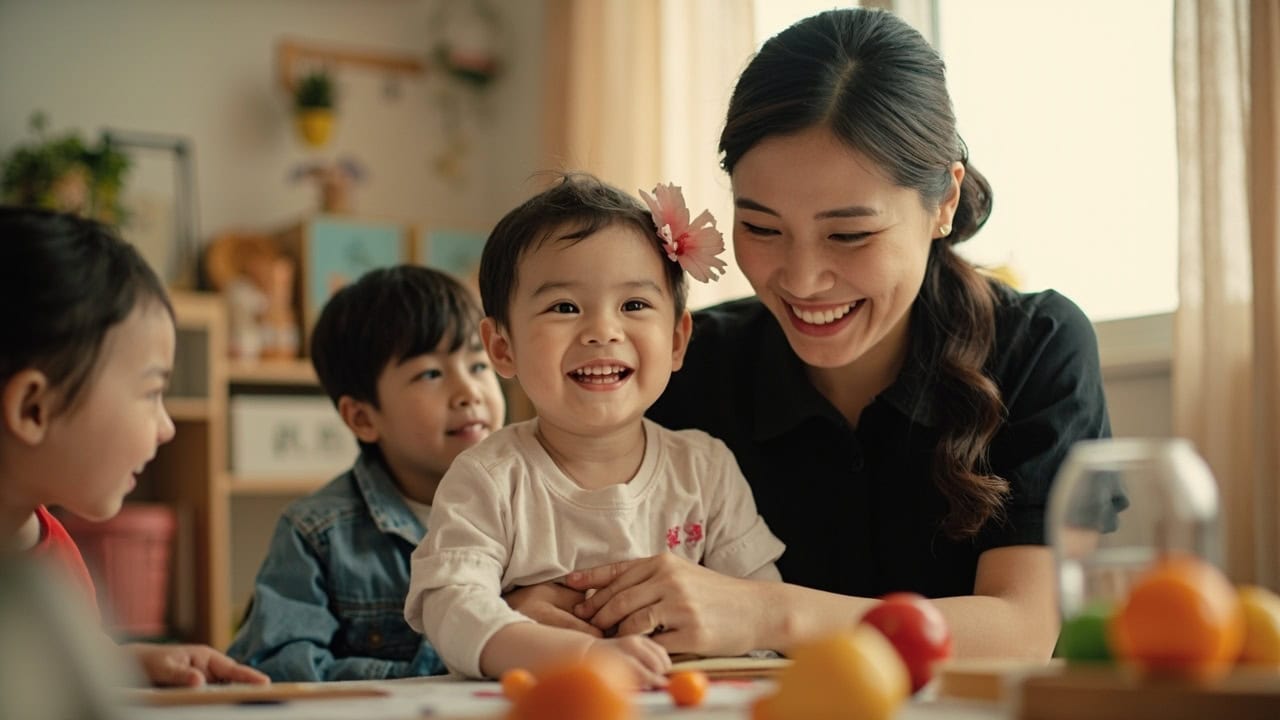
Beyond the Smile: What Attentive Parents Notice in Every Childcare Visit
That Feeling When You Walk Out of a Childcare Centre and Still Do Not Know
There is a moment every Singapore parent knows. You walk into a childcare centre. The walls are clean. The toys are arranged. A staff member greets you with a smile and a brochure.
You are shown the sleeping room, the nappy change station, the activity corner with colourful charts on the wall. Everything looks fine. Everything looks acceptable.
And yet you leave with a quiet feeling you cannot name — not alarm exactly, not comfort either. Just a vague, persistent sense that something in that room did not quite add up.
You replay the visit during the drive home. The children looked calm. The teachers seemed pleasant. But you cannot say with any real certainty what the afternoon was actually like when no visitor was watching.
You do not know what you saw.
That uncertainty is not a weakness. It is the most honest thing about the entire experience. Because here is what most parenting advice fails to acknowledge: when you visit a childcare centre, you are not simply evaluating a programme. You are participating in a performance — one that every centre, to varying degrees, has prepared for.
The staff know the route. They know which rooms to show you. They know how to answer the standard questions.
And so the real question for any parent is not what to ask. It is what to look at. It is how to read a room the way someone who works inside it would read it.
What to Look For: Five Domains of Genuine Quality
Before we get into what to look for, let us be clear about something: a childcare visit is a two-way assessment, not a one-way inspection.
The centre is showing you what it wants you to see. But you are also — whether you realise it or not — trying to answer a deeper question. Not just “Is this centre good?” but “Does this place know children? Does this place understand what my child needs?”
These are not questions a tour checklist can answer. They require you to watch, to listen, and to trust what you actually observe — not what you are being shown.
The Caregiver’s Hands
Walk in a few minutes early if you can, or linger near the entrance when a session is underway. Watch the room before anyone knows you are watching it.
In those first unguarded moments, you will see something no centre can rehearse — the quality of the room when it is just functioning, without a visitor to perform for.
Now notice the caregiver’s hands. Not whether she waves at you, but what her hands are doing with a child right now, in this ordinary moment.
Is she adjusting a bib with her free hand while holding a feeding bottle at the correct angle? Is she wiping a child’s face with a cloth she has already reached for — before the child started crying, before the mess became a problem?
Those small anticipatory movements are not accidents. They are the signature of someone who has learned to read a child’s signals before the child has to shout them out.
In infant care, the whole of quality lives in a very small gap — between the need arising and the response arriving. A child who is hungry makes a small sound. A caregiver who is attuned hears it. A child who is about to tumble reaches out instinctively. A caregiver who is attuned is already there.
A caregiver who closes that gap consistently is not just competent. She is attuned. And you cannot fake attunement for eight hours a day across an entire term. You either see it, or you do not.
The Children’s Bodies
Watch the children themselves. Not whether they are sitting quietly — young children are not meant to sit quietly for long stretches. But notice their bodies.
Are they loose? Are their faces expressive? Watch how a child moves through the room when a caregiver is nearby.
A child who feels safe in a room will lean into a caregiver without looking first to check if it is allowed. A child who is merely compliant will wait for permission even for small physical closeness.
That difference is enormous. It tells you whether the emotional environment is one of genuine warmth or one of managed behaviour.
Watch also for language — not just the words children use, but how they use them. Do children talk to each other, or only repeat phrases back to an adult? Do they narrate their own play — I am building a tower, it fell, I will build it again — or does all language in the room flow only from the caregiver to the child?
Children who are allowed to develop expressive language freely are children who feel ownership of the space. They are children who know their voice matters. That is not a curriculum item. That is a cultural result of how the room is run.
What the Room Believes About Children
Open your eyes in the room and ask: what does this space believe about children?
You can tell by what is at their eye level, by what they can reach without help, by whether there are mirrors at the height of a crawling infant or a newly walking toddler.
Mirrors are not decoration in an infant room. They are developmental tools. A child who can see his own reflection learns something fundamental about himself — I am separate, I exist, my face is my own. That is the beginning of identity. A centre that has thought carefully about infant development will have placed them intentionally. A centre that has not will have mirrors for the aesthetic of the room, at adult height, where they do not serve the child at all.
This is a small detail. But small details reveal big philosophies.
Look at the materials on the shelves. Are they open — meaning a child can take them, carry them, explore them? Or are they locked away, brought out only when an activity is led?
In the first thousand days especially, a child’s primary work is discovery through free exploration. An environment that restricts that — that controls access, keeps materials out of reach, funnels every interaction through adult-directed activity — is an environment that does not yet understand what the child needs.
You can read the difference between intentionality and cost-saving, and you do not need to be an expert to do it. Natural materials like wood and natural fabrics serve developmental purposes that plastic alone cannot replace. A room that prioritises sensory richness over durability reveals something about its philosophy.
What does this place believe children deserve?
The Staff in Unguarded Moments
This is where most parents focus their attention, and it is also where it is hardest to see clearly. Because what you are greeted with — the warm smile, the enthusiastic introduction, the scripted explanation of the curriculum — is almost never the full picture of what the afternoon will actually be.
So go deeper. Listen to how the staff speak to the children when they do not know you are listening.
Do they speak to infants as though the infants are already people with something to say? Or do they speak at children, over children, around children?
A professional who has been well-trained will speak with warmth that is firm, with gentleness that is consistent. There is no cracking under pressure, no sharp word in the hallway, no abruptness that disappears the moment a parent walks in.
That kind of professional steadiness is not performed. It is the result of supervision, reflection, continued development, and a culture inside the centre that takes its own work seriously.
Here is a practical test: ask a staff member a question about a specific child’s behaviour or need. Not a general question about the programme, but something particular.
- How does she handle teething discomfort during a group activity?
- What does she do when a child refuses the afternoon bottle?
- What is her approach when a child is going through a clingy phase?
A rehearsed answer will be broad and reassuring — we follow ECDA guidelines, we are all trained and certified, we have proper protocols in place. Those answers are not wrong. But they are not the answer to your question.
A caregiver who genuinely knows her work will answer specifically. She will describe a moment. She will explain her reasoning. She will tell you what she has tried, what worked, what she would do differently.
That specificity is not something you can script for a tour. It comes from actual experience, actual reflection, and actual professional development.
The Moments No Centre Can Rehearse
Watch what happens when a child is frustrated. Not when a parent is watching — when no one is watching. Does the caregiver get down to the child’s level? Does she name the feeling? Does she offer comfort without rushing to fix the problem?
Watch what happens during transitions — from play to meal, from indoor to outdoor, from one activity to the next. Does the transition feel rushed? Are children being managed from station to station? Or is there space for the natural rhythm of a young child’s time?
Watch what happens when a child makes a sound — not a cry, just a sound. A vocalisation. An experiment with their own voice. Does anyone notice? Does anyone respond?
In those moments, you are seeing the actual culture of the room. You are seeing what happens when no one is performing. And that is the care your child will receive on an ordinary Tuesday afternoon, when the brochure is closed and the tour is over.
What Quality Childminding Actually Looks Like
All of this leads to a deeper question: what does quality actually look like in infant care? Not in a brochure, not in a curriculum framework, but in the room, in the moment, in the daily reality of a child’s first years?
Quality in infant care is not primarily about programmes or activities or learning outcomes. It is about the quality of attention your child receives. It is about whether there is someone present who knows your child’s temperament, your child’s signals, your child’s particular way of reaching for comfort.
Quality in infant care is about ratios — not as a number on a wall, but as a lived reality. When a caregiver is responsible for three children instead of fifteen, every cry is heard. Every need is met in real time. Every developmental moment is noticed by someone who knows your child by name.
Quality in infant care is about the environment — a space designed around the needs of a very young child, not around the logistics of a large programme. The way the morning unfolds, the way a caregiver responds to a child’s distress, the way a transition happens without rushing, without force, without a child being managed.
And quality in infant care is about consistency — the same care that happens when a parent is watching is the same care that happens when no one is watching. Because the people who work in this field chose it not for the performance, but because they care about children.
EduNanny by BUTLER: A Different Answer to the Question
This is the moment to be direct about what EduNanny by BUTLER offers — because it speaks directly to what you are looking for.
EduNanny is an ECDA-licensed Childminding Pilot service operating across both home-based and centre-based pathways. Care is built around ratios of up to one to three infants.
What that means in plain language: your child is not one of fifteen in a room. Your child is one of three, and the person beside your child chose this work, is trained for it, and is present because the model of care demands presence, not just supervision.
In the ECDA Childminding Pilot, care is built around small ratios precisely because the research is unambiguous — infant care quality is inseparable from the degree of individualised attention a child receives.
Up to one to three infants means every cry is heard. Every need is met in real time. Every developmental milestone is tracked by someone who knows your child by name, by temperament, by the particular way she reaches for comfort.
The pilot fee structures are designed to keep this accessible. CDA and Baby Bonus funds can be used, which means the financial logistics of securing quality care are one less thing for parents to navigate alone.
Monday to Friday care blocks are structured around the rhythms of a working week, with communication and transparency built into the model — parents receive regular updates not because it is a policy requirement but because when your child is one of three, you simply know your child better, and that knowledge belongs to you as much as it belongs to the caregiver.
Where CCTV measures are deployed, they are deployed not as surveillance but as trust infrastructure — for parents who want that assurance, and for the team who are proud of the care they provide.
Addressing Common Concerns
How do I know what I am seeing is real?
You cannot know for certain. No visit can give you complete certainty, and any service that promises that is not being honest with you.
But you can watch more carefully. You can notice what happens in unguarded moments. You can ask specific questions and listen for specific answers. You can read the environment for its philosophy, not just its aesthetics. And you can trust your instinct — that vague unease you feel after some visits is not confusion. It is your mind telling you that something did not add up.
What if I ask the wrong questions?
There are no wrong questions. But there are questions that reveal more than others. Ask about specific situations — teething, feeding resistance, clinginess, frustration, transitions. Listen for answers that are specific, experience-based, and grounded in actual practice rather than policy frameworks.
A good caregiver will not be put off by specific questions. She will be relieved. Because specific questions are the questions of a parent who cares, and that is exactly the kind of parent she wants to partner with.
Is it realistic to expect small ratios and high quality?
The ECDA Childminding Pilot makes this accessible. Fee structures, CDA and Baby Bonus funding eligibility, and Monday-to-Friday care blocks are designed to bring this level of care within reach for more families.
Quality infant care has historically been associated with high costs. The Childminding Pilot is part of a broader effort to change that — to make the kind of care that was once only available to some the standard for all.
The Real Question
What EduNanny offers, ultimately, is not a solution to the childcare problem. It is a different answer to the question itself.
Because the question is not where can I put my child while I work.
The question is where will my child be known.
Where will someone notice the way she favourited her left hand this week, the new sound she made at pickup yesterday, the slight change in her sleep pattern that might mean something or might mean nothing but is worth watching?
The question is whether the place you leave your child in the morning is a place where your child is the point — not the logistics, not the ratios on paper, not the activity schedule on the wall.
Your child.
A Quick Reference for Your Next Visit
- Watch before you are watched. Arrive early or linger at the entrance. The first unguarded moments reveal more than any guided tour.
- Notice the caregiver’s hands. Anticipatory movements — adjusting a bib before the mess, reaching for a cloth before the child cries — signal attunement that cannot be performed.
- Read the children’s bodies. Loose limbs, expressive faces, leaning into caregivers without asking permission — these are signs of genuine safety, not managed compliance.
- Read the environment. Mirrors at infant height, open shelves, natural materials — these reveal whether the space was designed for children or for aesthetics.
- Ask specific questions. A rehearsed answer reassures. A specific, experience-based answer tells you a caregiver actually knows your child.
- Trust your instinct. That vague unease you feel is clarity still finding its form. Bring the same attention to every visit.
An Invitation
If you have walked out of a childcare visit wondering what you missed, trust that instinct. It is not uncertainty. It is clarity, still finding its form.
Bring that same quiet attention to an EduNanny setting. Walk through the door the way you have learned to walk through any room — with open eyes, with your child in your heart, with the questions that matter.
And notice what is different.
Not because we prepared for you to notice it. But because this is simply what it looks like when care is practiced the way it was always meant to be practiced — for the child, in the room, in the moment, every moment.
That kind of parent does not need to be convinced.
And EduNanny does not need to perform for a parent who is watching closely — because the care that happens in an EduNanny room when no visitor is present is the same care that happens when a parent is standing right there.
That consistency is not a feature. It is the foundation. It is the way the programme is built, the way the caregivers are trained, the way the environment is designed, the way every single day begins.
Ready to see what quality infant care looks like when your child is truly known?
Explore EduNanny by BUTLER — ECDA-licensed Childminding Pilot services across Singapore, built around ratios of up to one to three infants, designed for the way children grow and the way families work.
Learn more about our approach or connect with our team to begin a conversation about what care looks like when your child is known.