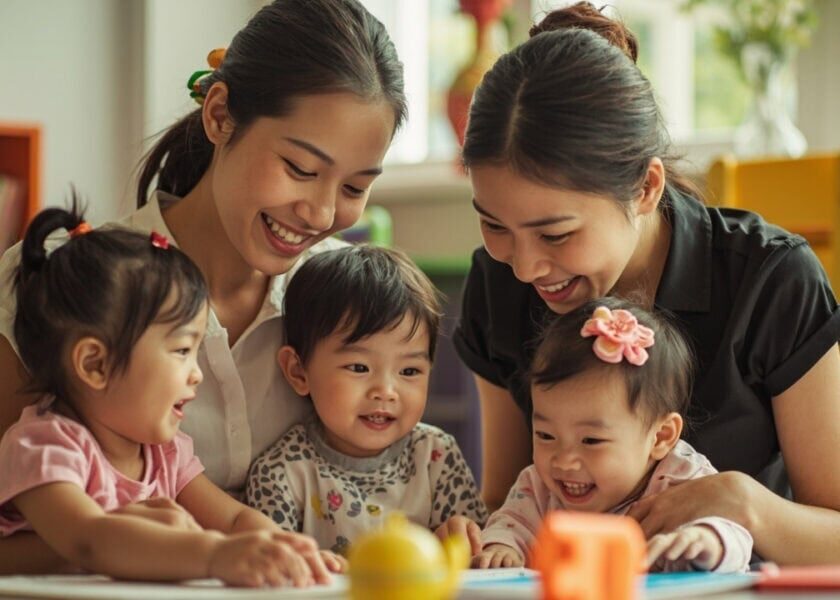
The Social-Emotional Curriculum Your Child Is Learning in Childcare
The Social-Emotional Curriculum: What Your Child Is Actually Learning
In Singapore, parents navigate a landscape of caregiving that includes centre-based care, helper care, grandparent support, and professional childminding services. Academic expectations loom even before primary school. Developmental milestones are tracked and compared. And in the middle of all this, parents ask themselves: is my child in the right place?
Most parents, when evaluating a childcare option, know to ask about safety. They look at ratios, check certifications, observe cleanliness and organisation. These are reasonable, necessary concerns.
But there is a deeper question that sits beneath these practical ones, a question that nags at parents even when they cannot quite name it: beyond keeping my child safe and fed, is something important happening? Is my child being formed in ways that will matter for who they become? And if so, how would I even know?
This is where the social-emotional curriculum of quality childcare enters the picture. I use the word curriculum deliberately, because that is what it is. It is a course of learning, though not one measured by tests or progress cards. It is the learning that happens before children can articulate what they are learning, and it is the learning that shapes everything that comes after.
Developmental science confirms that the first thousand days of life lay the foundations of emotional and social functioning with extraordinary speed and sensitivity. Neural pathways are forming that will govern stress response, emotional regulation, and the capacity for connection. Behavioural patterns are being established that will repeat, refine, and consolidate into the relational styles children carry into adulthood.
In these early years, we are talking about the most consequential learning your child will ever do. Not because academic learning is unimportant, but because the social-emotional foundations being built right now determine whether academic learning can happen at all.
The Five Foundations of Social-Emotional Development
Quality childcare constructs five essential foundations in the early years. These are not soft outcomes. They are the foundations that determine whether academic learning can happen at all. A child who is anxious cannot concentrate. A child who does not trust cannot explore. A child who cannot manage their own emotional storms cannot sit still, raise their hand, ask for help, or collaborate with peers.
Secure Attachment
When a child has consistent, responsive, warm care in the early years, something profound happens at the neurobiological level. The child develops what developmental psychologists call an internal working model of relationships. This is an unspoken understanding, learned through thousands of experiences, that says: other people can be trusted, I am worthy of care, and the world is a place where my needs matter.
This sounds abstract, but its effects are anything but. A securely attached child enters a room with confidence. They can tolerate the normal anxiety of separation because they have learned, through experience, that parting is temporary and reunion is sure. They approach other children with curiosity rather than wariness. They try new things because they trust that if they falter, someone will be there.
An insecurely attached child, by contrast, spends emotional energy managing anxiety that could otherwise be directed toward growth. They may appear fine on the surface, even cheerful and independent, but underneath they are carrying a weight that limits exploration and connection.
Emotional Regulation
This is the ability to recognise, tolerate, and manage one’s own emotional states. Here is something that may surprise you: children are not born with this ability. They feel everything intensely, immediately, completely. A toddler does not experience mild frustration. They experience overwhelming fury. They do not feel a small sadness. They feel devastation.
What they need, and what quality care provides, is co-regulation. When a child is in the grip of a big emotion, a skilled caregiver does not simply wait it out or impose compliance. They stay with the child. They name the emotion, because naming it is the first step toward mastering it. They offer comfort without judgment, and they model what it looks like to come back to calm.
Over time, this external regulation becomes internal. The child begins to carry within them the voice of the attuned caregiver, the one who said, “I know you are so angry right now. That is okay. You are safe. We can handle this together.” One day, when the child is four or five, an adult will watch them manage a disappointment with unexpected grace and wonder where they learned that. The answer is: in those hundreds of earlier moments when they were not yet able to manage it alone, and someone stayed close.
Peer Navigation
In group care settings, peer interaction emerges with particular power. From the moment children begin playing alongside one another, they are learning how to be social beings. They encounter difference, conflict, desire, and disappointment in their most raw and honest forms. They want the same toy. They want the same attention. They are fascinated by each other and frustrated by each other in equal measure.
This is precisely why peer interaction is so formative. It cannot be replicated by adult-structured activities. It cannot be taught through explanation alone. It must be lived, and it must be scaffolded.
When a caregiver in a quality setting watches two toddlers negotiate over a toy, they are present but not intrusive. They allow the children to stretch their social muscles, to practice the delicate art of getting along, while staying close enough to prevent harm. They intervene not to resolve but to support, modelling language, offering gentle suggestions, and ensuring that the emotional temperature remains safe.
Empathy
Empathy is not a lesson that can be taught in a single moment. It is cultivated through countless small experiences of being seen, understood, and cared for.
When a caregiver says to a child, “I can see that Jamie is sad. She looks like she might need a gentle voice right now,” that caregiver is doing something extraordinary. They are teaching the child to look beyond themselves, to recognise that other people have inner lives, and that those inner lives matter.
Children raised in environments where empathy is modelled and valued begin to show it themselves. They offer comfort to a crying peer. They notice when someone is left out. They share not because they have been scolded into it, but because they genuinely care about the wellbeing of others.
Supported Independence
In the name of safety and efficiency, adults can do far too much for young children. We zip up their jackets, cut their food, clear away their struggles before they even ask for help. We do this from a place of love, but the effect can be the opposite of what we intend.
A child who is never allowed to struggle never learns that they can succeed. A child who is always rescued never builds the internal conviction that they are competent.
Quality care finds the balance. It offers what caregivers call scaffolding: the kind of support that allows a child to stretch toward a challenge while knowing that help is nearby if needed. When a toddler is trying to climb and the caregiver stands close, ready to catch but not rushing to lift, that child is learning something vital: “I can do hard things. I can try. I might fail, but I will be okay.”
That is the foundation of confidence, and it cannot be given through praise alone. It must be earned through real, effortful, successful experience.
How to Recognise Quality Childminding
One of the things parents tell me is that they want to know what to look for. They want observable indicators, real evidence that this invisible curriculum is being delivered. Here are the markers of social-emotional growth visible to any parent who knows what to look for.
- How children respond when upset — not whether they ever get upset, because they will, but how caregivers and the environment respond. Is distress met with patience and presence, or with speed to compliance?
- How children talk about feelings — do they have words for emotions beyond happy and sad? Can they name frustration, disappointment, or surprise?
- How children play together — is there evidence of attempted cooperation, of shared attention, of the beginning of real social engagement?
- How children talk about their caregivers — do they mention them with warmth, with a sense of being known?
The question is not whether your child is attending activities. The question is how your child is being formed.
Supervision Versus Developmental Care
I want to distinguish clearly between two kinds of care, because this is where the conversation must be honest.
There is care that supervises. And there is care that develops.
Supervision keeps children safe, fed, and occupied. Developmental care does all of that and also attends to the invisible architecture I have been describing. It is intentional about how children learn to manage emotions. It creates conditions for secure attachment. It scaffolds peer interaction and empathy. It supports independence with wisdom and restraint.
Not all childcare does this. Not because caregivers are unkind, but because understanding the social-emotional curriculum of early childhood requires training, intention, and the conditions that make such work possible.
This is why frameworks like the ECDA Childminding Pilot matter. They create standards and structures that make quality possible. They offer training that builds caregiver competence. They maintain ratios that allow for genuine attention to each child’s social-emotional development. They hold caregivers accountable to developmental goals, not just logistics.
EduNanny’s Approach to the Social-Emotional Curriculum
EduNanny by BUTLER is built on the understanding that attachment cannot be left to chance. The ECDA Childminding Pilot framework creates conditions where secure attachment is possible: low ratios that allow caregivers to truly know each child, consistent schedules that create predictability, and trained caregivers who understand attachment dynamics and can respond to each child’s individual needs.
When you place your child in an EduNanny setting, you are not placing them in a rotation. You are placing them in a relationship.
EduNanny operates across home-based and community pathways, providing flexibility for families across Singapore. With Monday to Friday care options, CDA and Baby Bonus usability, and fee structures designed with affordability in mind, the programme makes quality care accessible to families who need it.
What EduNanny offers is a programme where the social-emotional curriculum is not an afterthought but the foundation. Where caregivers understand that when a child is crying, they are not just being difficult, they are communicating, and that communication deserves a thoughtful response. Where the goal is not a quiet room of compliant children, but a warm environment of emotionally intelligent, socially confident, empathetically connected human beings.
Transparent communication and careful observation practices ensure that parents are partners in their child’s development, not just receivers of daily reports.
Questions to Ask When Choosing Infant Care
Here is what you should look for. Ask about attachment. Ask how the programme handles emotions. Ask how children are supported in peer interaction. Ask how independence is encouraged. Ask what happens when a child struggles.
These are not intrusive questions. They are the right questions. Any programme that takes its developmental mission seriously will welcome them.
| Question to Ask | What It Reveals |
|---|---|
| How do caregivers respond when a child is upset? | Whether co-regulation is understood and practiced |
| What happens during transitions (arrival, departure)? | Whether attachment and separation are handled thoughtfully |
| How are conflicts between children managed? | Whether peer interaction is scaffolded rather than avoided |
| What does a typical day look like? | Whether there is time for free play, which builds social skills |
| How do caregivers support children doing difficult tasks? | Whether independence is genuinely encouraged |
For Parents in Singapore
Let me speak to the reality of Singapore family life. I know the pressures. I know that both parents often work. I know that extended family is not always available. I know that the cost of living is real and that childcare is a significant line item in any family budget. These are not abstractions. They are the lived conditions of raising children in this city.
But within those real constraints, parents still want more than logistics. They want to believe, and rightly so, that their child is not just being watched but being shaped. They want to know that the hours apart are not just hours filled but hours that matter.
And this is not an unreasonable desire. It is the most reasonable desire a parent can have.
The truth is that early childhood is brief. It is approximately a thousand days from birth to the start of formal schooling, and then it is over. The foundations built in those days are not easily rebuilt later. The emotional architecture that forms in secure, responsive, developmentally rich care becomes the substrate on which all future learning and relationships are built.
This is not sentimental. This is developmental science. And it means that the choice of childcare is, in a very real sense, one of the most consequential choices a parent makes.
A Place That Tends to What Matters Most
If you find yourself at EduNanny, know that you have found a place that takes these questions seriously. A place where caregivers do not just supervise but tend. Where each child is known and responded to as an individual. Where the social-emotional curriculum is present in every interaction, every routine, every moment of the day.
Where your child is not just cared for but being formed.
There is a version of this that would end with urgency, a reminder of slots available. But what EduNanny offers deserves the slow consideration that a decision of this magnitude warrants.
If this vision of quality childminding resonates with you, speak with our team about your child’s needs and what a thoughtful, relationship-based caregiving arrangement could look like for your household.
Because the invisible architecture matters. And it deserves to be tended by people who understand why.
Learn more about who we are and how our ECDA-registered childminding programme works.