Why Singapore Families Are Redefining What a Village Means
“`html
Singapore’s Multigenerational Reality
Singapore has always been a city built on family. We talk about the kampung spirit, the multigenerational household, the way grandparents have always been central to raising children here. And this is not nostalgia. This is real.
Grandparents in Singapore bring something irreplaceable to a child’s life. They carry history and language. They offer unconditional presence. They know things about your child that no schedule can capture.
A grandmother who sings the same lullaby her mother sang to her. A grandfather who sits with a toddler and says nothing, and somehow that silence is exactly what the child needed. These are not luxuries. These are the things that root a child in identity and belonging.
But Singapore is changing. Families are more geographically distributed than before, even when they live in the same city. Both parents often work in careers that demand flexibility and energy that full-time childcare at home simply cannot provide. The expectations on grandparents have shifted too—sometimes without anyone explicitly agreeing that they have shifted.
Many grandparents are still working. Or caring for aging parents of their own. Or simply navigating their own aging bodies and changed capacities. And the children themselves are growing up in a world that asks more of them earlier, in ways that feel unfamiliar to the generation that raised their parents.
This is not a failure of family. This is the reality of family in a modern city. And the parents living inside this reality are not looking for permission to abandon their village. They are looking for help building one that works.
The Conversation Nobody’s Having
When EduNanny was conceived, it began with a simple observation: Singapore parents were caught in a false choice. The narrative around them—whether from family or from the broader culture—tended to frame childcare as a competition.
Family care was positioned as loving but outdated. Professional care was positioned as quality but impersonal. Parents were told, implicitly and sometimes explicitly, that choosing one meant rejecting the other.
If you valued your child’s development, you had to feel guilty about wanting your parents’ rest. If you honored your parents’ desire to be involved, you had to accept care that might not be designed for what your child actually needs.
This framing hurts everyone. It asks grandparents to be something they were never trained or resourced to be. It asks parents to choose between honoring their family and trusting their instincts. And it asks children to grow up inside arrangements designed to manage adult emotions rather than child development.
The parents who navigate this well do something deceptively simple but emotionally demanding: they separate the decision about childcare from the relationship with their parents. They make it clear—in words and in practice—that choosing professional care is not a judgment on their parents. That it is not a reflection of distrust or ingratitude. That it is, in fact, an act of love directed at everyone in the family, including the grandparents.
One mother described her approach this way. She told her mother that she needed her to be a grandmother, not a teacher. That her children needed the woman who could spend an entire afternoon building a castle out of cardboard, without checking whether it was educational, without worrying about whether it met some developmental milestone.
Her mother was surprised at first. But when she saw what it meant for her relationship with her grandchildren, the surprise became relief.
This is the reframing that matters. Not the apology. Not the justification. The invitation.
What Professional Care Actually Offers
There is a version of this conversation that stays entirely in the emotional realm and never lands on what children actually need. Let me speak plainly about what trained caregivers bring to a child’s life and why it matters.
Children in their first thousand days are not simply waiting to be fed and entertained. They are building neural architecture at a rate that will not be repeated. They are learning what safety feels like, how relationships work, what their own bodies can do, how to trust, and how to communicate.
Every interaction in these early years is teaching them something—whether we intend it or not. The question is not whether they are learning. They always are. The question is what they are learning, and whether the people around them are equipped to shape those lessons well.
This is not a criticism of grandparents. It is a recognition that childcare has evolved as a profession for a reason.
Trained caregivers understand developmental stages. They can recognize when a child is approaching a language explosion and create the environment for it. They can identify when a child’s frustration is actually a sign of cognitive growth and respond in ways that support rather than suppress it. They are trained to observe without projecting, to respond without reacting, to create consistency and predictability even when everything else in a child’s day is changing.
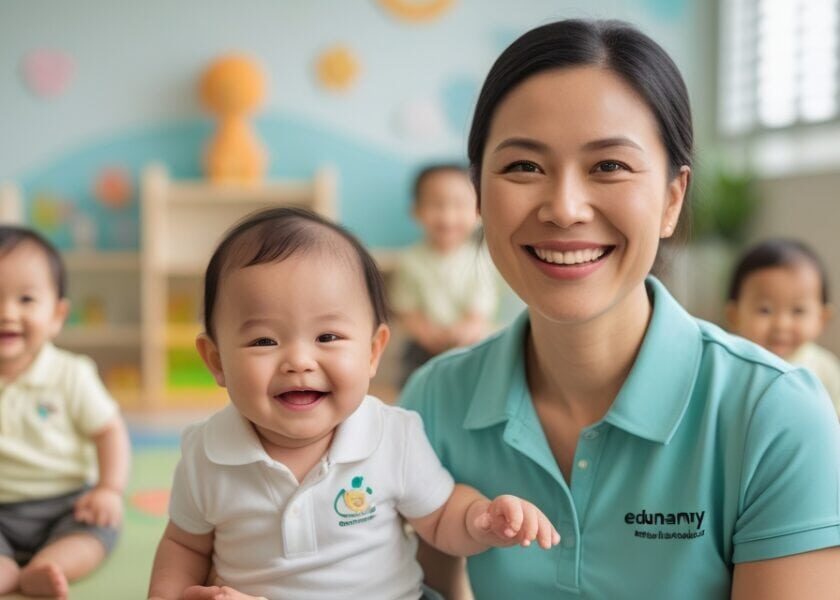
At EduNanny, our caregivers operate within ratios that allow them to truly know each child in their care. When a caregiver is responsible for a small group of infants, she knows that Joshua is working on his pincer grip today, that Aisha is about to start pulling herself up, that the slight irritability Liam has been showing for two days is actually the sign of a tooth coming in.
This is not surveillance. This is attention. And attention is what early childhood is made of.
The communication structures reflect this. Parents receive updates that are not just logistical but developmental. They hear about what their child explored today, what captured their attention, what challenged them, what made them laugh. This transforms the workday from a separation into a partnership.
Designing Your Family Village
Intentional design begins with honesty about what you need and what you have. Start by asking yourself:
- What does our child actually need from their weekday care?
- What do our grandparents actually want from their relationship with our child?
- What are the non-negotiables, and where is there flexibility?
A Framework That Works
For many families, the answer looks something like this:
| Day Type | Care Arrangement | What This Offers |
|---|---|---|
| Working Week (Mon–Fri) | Professional, structured, developmental care | Consistency, trained attention, developmental support |
| Weekends | Grandparent presence and involvement | Unstructured time, cultural continuity, multigenerational bonding |
| Holidays | Spontaneous family involvement | Adventures, family traditions, relationship depth |
| Emergencies | Grandparent backup | Reliability when unexpected situations arise |
This is not a compromise. This is a design. And designs work better than accidents.
What Grandparents Bring That Professionals Cannot
Part of intentional design is recognizing what each part of your village does best. Professional care is designed for developmental support, structured learning, and consistency. But there are things that only grandparents can offer:
- Family history and cultural continuity passed down through stories and presence
- The particular kind of unconditional love that comes from a lifetime of relationship
- Patience that is not tied to a schedule or professional obligation
- The family’s own rhythms, traditions, and ways of being
- A child’s sense of belonging to something larger than themselves
When professional care handles what it does best, grandparents are freed to bring what only they can bring.
Addressing Common Concerns
Will choosing professional care make my parents feel rejected?
Only if the choice is framed that way. The parents who navigate this successfully are explicit that professional care is an addition to the village, not a replacement of grandparent involvement.
I feel guilty even considering this.
Guilt is often a sign that you are taking a responsibility seriously. But guilt can also come from a false framework—one that says you must choose between honoring your parents and trusting your instincts about your child’s needs. If you believe both can be true, and you design accordingly, the guilt often transforms into clarity.
What if my child’s development needs more than grandparents can provide?
This is not a failure of love. It is a recognition that love, however powerful, is not always enough. Children need stimulation, structure, consistency, and attention that is trained and resourced for their development.
How do I handle different childcare philosophies?
Different generations have different perspectives on childrearing, and that is normal. When grandparents are not responsible for day-to-day developmental decisions, there is less friction about philosophy. They can enjoy being grandparents without feeling like every choice is a statement about their parenting of you.
The EduNanny Approach
EduNanny is structured to make intentional family village design possible.
Our home-based pathways mean that care can happen in your own space—which matters for infants particularly, where familiarity and routine are not luxuries but necessities. Our community and centre-based options mean that families who prefer a different environment have access to one.
The ECDA Childminding Pilot reflects our belief that quality infant care should be accessible, not just aspirational. The pilot fee structures are designed with real families in mind, not just families who can afford premium pricing.
We know that Singapore families use CDA and Baby Bonus funds for good reason. These tools exist because the government understands that childcare costs are real, and we do not pretend otherwise. We structure our services to work within the frameworks that Singapore families already rely on, so that choosing quality care does not require choosing financial strain.
Where CCTV measures are deployed, they are there not to monitor but to create transparency. Parents can see what is happening. Caregivers know that they are seen. This is not surveillance culture. This is mutual respect made operational.
What we offer is not the cheapest option, because cheap and excellent rarely share a sentence. But we offer something more valuable than low cost: we offer clarity. You know what you are getting. You know who is caring for your child. You know how they are trained, how they are supported, and how they are connected to the larger ecosystem of your child’s development.
This is the kind of childcare that allows parents to go to work and not spend their entire meeting wondering if their baby is okay. This is the kind of childcare that allows grandparents to visit on a Saturday and hear—from a parent who actually slept last night—about the new word their grandchild said today. This is the kind of childcare that makes the village bigger without making anyone feel replaced.
What We Owe Our Families
This article is ultimately about something simple. It is about what we owe our children and what we owe the people we love.
We owe our children the best possible start, and that means acknowledging that love alone—however powerful—is not always enough. Children need stimulation, structure, consistency, and attention that is trained and resourced for their development. This is not a judgment on family care. It is a recognition that different kinds of care serve different purposes, and that our job as parents is to put our children in the path of as much goodness as we can possibly gather.
We owe our grandparents honesty, and gratitude, and something more: we owe them relief. We owe them the chance to be the people their grandchildren will remember as the ones who showed up with presence and joy—not as the ones who were pressed into service because there was no other option. We owe them the dignity of a role that they chose, not a role that was assigned.
And we owe ourselves, as parents, the grace to make decisions that are right for our families without waiting for permission from anyone else.
You are not abandoning your village by choosing professional care. You are building a village that is more than any one person or generation could provide alone.
The modern Singapore family is not weaker than the families that came before it. It is more complex, and it is asking for tools that match that complexity.
EduNanny is one of those tools. We are here not to replace the people you love but to stand beside them—to carry what they cannot or should not be expected to carry—so that what remains is exactly what should remain: the joy of family, the privilege of grandparenthood, and the promise of a child who is growing up surrounded by more love than any single arrangement could ever provide.
This is childcare designed for Singapore. For our multigenerational realities. For our working parents and our aging grandparents and our children who deserve both the village they were born into and the village we are building around them.
EduNanny is honored to be part of that building. And we are honored to walk this path alongside families like yours.
If you are considering your childcare options and would like to explore how EduNanny can complement your family village, we welcome the conversation. Every family’s situation is unique, and we believe the right care design starts with listening.
Speak with our team to learn more about how we can support your family.
“`