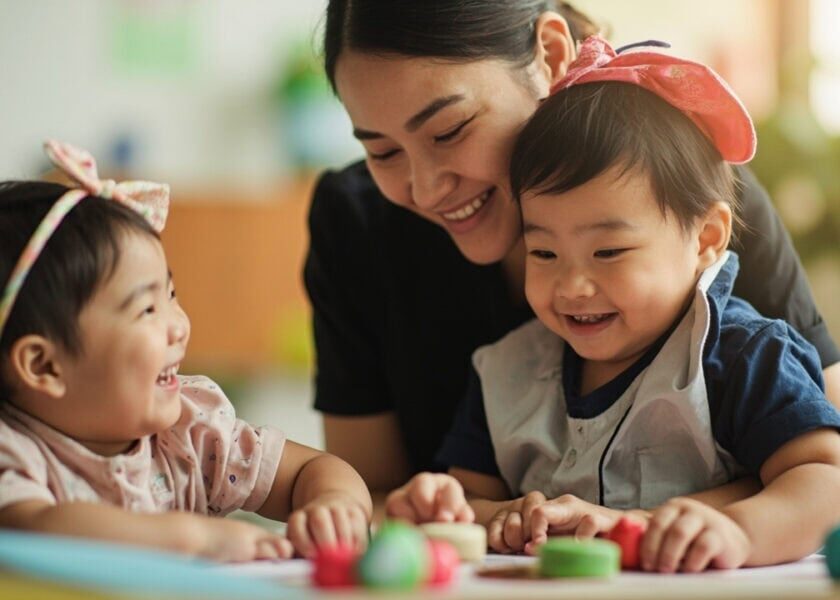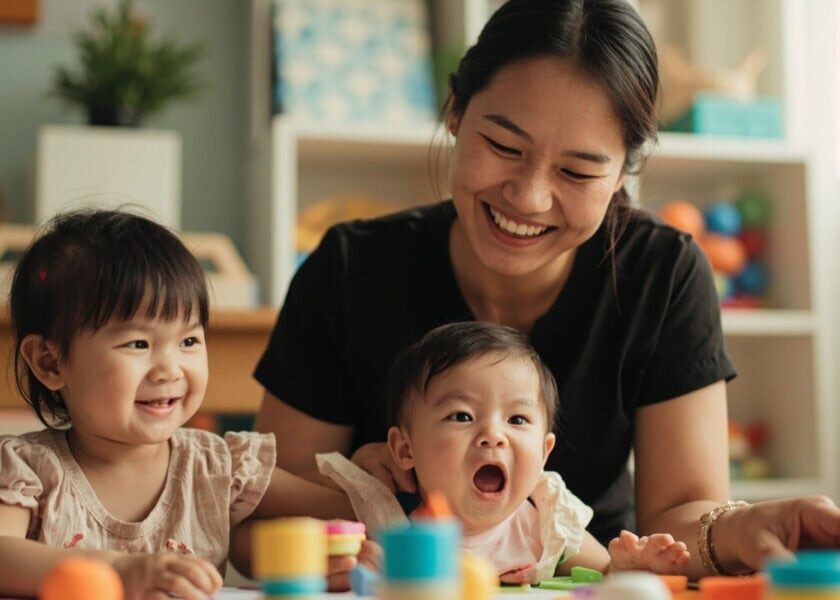
The Intelligent Care Ecosystem Singapore Families Are Building
The Question Most Singapore Parents Never Ask — Until It Quietly Shapes Everything
There is a question most Singapore parents never consciously ask themselves, and yet it shapes their days more than almost any other decision they will make. It is not the question they bring to parenting forums or raise over coffee with other mothers and fathers. It does not appear on any checklist they received during pregnancy.
But it lives in the background of every morning rush, every handover, every negotiation between grandparents and helpers and the quiet ache of wondering whether they are doing this right.
The question is this: not which childcare should I choose, but how does all of this hold together?
You are already running a care ecosystem. You may not have called it that. You may not have designed it with intention. But if you are like most families in Singapore, your child’s day moves through multiple hands, multiple rhythms, multiple relationships — sometimes seamlessly, often with friction, always with a quiet complexity that no single label adequately captures.
There is your child’s grandmother who watches the little one two mornings a week because she insists, because she wants to, because it matters to her. There is your domestic helper who has become part of the family, who knows your child’s moods and sleep cues and favourite songs in a way that no résumé could capture. Perhaps there is a childcare centre in the neighbourhood, or a relative who steps in during school holidays, or a neighbour you trust enough to leave the baby with for an hour when a meeting runs long.
You did not set out to build this. It grew. It accumulated. It became the texture of your daily life.
And somewhere in the middle of all that accumulation, there is a question that deserves to be asked with honesty and without guilt: Is this patchwork helping my child thrive, or is it simply helping us survive?
That question is not a criticism of any family arrangement. It is an invitation to look more clearly at something you have already built — and to consider what it might look like if you built it with more awareness.
Understanding Your Care Ecosystem
Most parents think in terms of choices: centre-based versus home-based, grandparent care versus hired help, one arrangement versus another. But the ecosystem lens reveals something different. It reveals that your family is not choosing between options. Your family is already managing a system of relationships, and the quality of that system — its coherence, its communication, its capacity to hold your child consistently even as different people step in and out of the daily rhythm — matters as much as any single choice within it.
Think about what actually happens in your home. In the morning, your child wakes in one emotional register and transitions through several others before lunch. That shift from you to your helper, from your helper to their grandmother, from grandmother back to you in the evening — each of these transitions carries its own emotional freight.
The child is not simply being passed between caregivers. They are calibrating, adapting, learning what to expect and what safety feels like across different environments and different faces. The adults in that system are also calibrating — managing expectations from parents, adjusting discipline approaches, communicating (or not) about what worked and what did not. Most of this happens without discussion. Most of it happens in the cracks between obligations.
Why the Patchwork Feels Heavy — And Why It Does Not Have To
The patchwork that most families manage is not born of poor choices. It is born of love, of necessity, of the realistic understanding that raising children in Singapore requires a village, and that the village must often be constructed rather than inherited.
But patchwork, however lovingly stitched, has its own weight. It requires parents to manage multiple relationships with different expectations, different communication styles, different ideas about what the child should be learning and eating and feeling. It requires constant translation between systems — explaining to one caregiver what another did, adjusting expectations when one arrangement falls through, carrying the cognitive load of an orchestra that has no conductor.
Beneath the logistical load is something deeper: the emotional weight of uncertainty. The late-night wondering whether the child is getting what they need. The guilt that surfaces when a grandparent asks to help but you are not sure how to integrate their care with the rest of the system. The anxiety of not knowing what happens in the hours when you are not present.
Singapore parents carry this weight quietly, partly because voicing it feels like ingratitude. After all, grandparents are offering their time. Helpers are showing up daily. Family is being family. To admit that it sometimes feels like too much feels like betrayal.
But naming the weight is not ingratitude. It is the first step toward designing something that works better for everyone — including the child at the centre.
What Families Rarely Have: A Framework for Seeing Clearly
Families rarely have a language for understanding that the relationships surrounding your child are not separate obligations to manage one at a time, but a system to design and tend. The moment you begin to see your family’s care arrangements as an ecosystem — interconnected, mutually influential, capable of thriving or fragmenting — everything shifts.
You stop asking whether grandparents should watch the baby instead of a professional. You start asking how every element of your care system can strengthen every other element.
You stop feeling guilty about needing help and start feeling intentional about building support.
What Quality Infant Care Actually Looks Like
Before exploring how to coordinate care, it helps to be clear about what good care actually provides — because the difference matters enormously, and it is the difference that makes professional care valuable not as a replacement for family but as a complement to it.
The Three Pillars of Quality Care
- Responsive attunement: The caregiver notices the subtle shift in mood that precedes a meltdown, responds to coos and cries with timely engagement, and adapts their approach to what the child needs in that moment — not a general routine, but a specific relationship.
- Developmental intentionality: Love is present in most homes. But structured learning — narrating the world in ways that build language long before words arrive, offering age-appropriate sensory experiences, supporting motor development through play — requires training and focus that is not always possible when a caregiver is also managing household tasks.
- Consistent communication: Updates that flow naturally, not just reports filed at the end of the day, but an ongoing conversation about how your child is growing, what they are exploring, where they might need more support.
Why Ratio Matters
For infants in their first thousand days, responsive care is not a luxury. It is architecture — not the building kind, but the neurological kind. The kind that shapes how a brain learns to manage stress and form relationships for the rest of their life.
This is why caregiver-to-child ratio matters. At a ratio of up to three infants per caregiver, a caregiver can provide the kind of attunement that infants need. They can be present for each child, not spread thin across five or six. They can notice what one child needs without losing track of what another is experiencing.
Quality is not about finding someone who loves children. It is about finding a system designed to make responsive, intentional, developmentally supportive care possible — at scale, consistently, every day.
How Professional Care Elevates Your Whole Village
When families consider professional childcare, a common fear surfaces: that involving a professional caregiver means they will be less present in their child’s life, or that their child’s grandmother is somehow less valued, or that they are admitting that family is not enough.
These are not unreasonable fears. They are the quiet concerns that many Singapore parents carry but rarely voice, because voicing them feels like betrayal.
But the ecosystem lens makes something important possible. It makes it possible to add without replacing. To strengthen without displacing. To bring in professional structure that raises the quality standard for everyone — not because anyone is failing, but because children deserve more than the average of what their caregivers can provide on any given day.
What Professional Care Actually Does in a Well-Designed Ecosystem
- It introduces consistency where inconsistency lives.
- It introduces developmental intentionality where love is present but structured learning is not always the focus.
- It introduces communication — not the awkward kind that comes from managing different expectations, but the kind that flows naturally from a professional relationship where updates, observations, and collaborative thinking are part of the service.
And when a professional caregiver operates at the right ratio, something else happens too. The standard in the home rises.
Grandparents who visit notice a different quality of interaction. Helpers who work alongside a professional caregiver absorb techniques, rhythms, ways of speaking to a child that they might not have learned elsewhere. The professional becomes a quiet teacher not just for the children but for everyone in the care ecosystem. This is not a diminishment of the family’s role. It is an elevation of it.
Addressing Common Concerns
You might wonder whether your child will form attachments elsewhere instead of with you. The research on attachment is more nuanced than the anxiety it often generates. Children form multiple attachments. What they need is not one caregiver exclusively, but a network of caregivers who are responsive, consistent, and emotionally attuned.
You might worry that involving a professional means your child’s grandmother is less valued. But grandparents offer history, intimacy, a connection to family culture and lineage that no professional can replicate. The ecosystem lens does not compete with these contributions — it elevates them. When professional care raises the overall quality standard in the home, grandparents often find that their time with the child is more enjoyable, not less. They are part of a system that is working well, not holding things together alone.
You might also wonder about your helper. Helpers offer daily constancy, a familiarity with the rhythms of the home that creates deep comfort for the child. Professional care works with helpers rather than around them, often supporting their development as caregivers through shared presence and modelling. A helper who feels supported and trained by a professional caregiver is not being sidelined — they are becoming more effective at the work they already do with love.
EduNanny Singapore: Your Professional Anchor
EduNanny Singapore operates within the ECDA Childminding Pilot framework, developed under the BUTLER banner. It occupies a specific and intentional position in your care ecosystem: not as another piece to manage, but as the professional centre of gravity that brings coherence to everything else.
What This Means in Practice
- Home-based care that fits into the rhythms families already have rather than demanding that families restructure around it. A caregiver who comes to your environment, works within your home’s patterns, and integrates with the arrangements you already have in place.
- Low infant-to-caregiver ratio (up to three infants per caregiver) because responsive attunement cannot be delivered at scale. Your child is not a number in a centre — they are a person who deserves a caregiver who can truly see them.
- Transparent communication that flows naturally — not just end-of-day reports, but an ongoing conversation about your child’s growth, discoveries, and needs. Where deployed, technology measures such as CCTV offer parents additional reassurance, not because trust is absent, but because transparency is a value. Professional care should not require parents to simply hope for the best.
- Accessibility through the ECDA Childminding Pilot framework. Quality infant care is not only available to families with significant financial resources. Pilot fee structures, alongside the usability of the Child Development Account and Baby Bonus schemes, mean that more families can access the kind of care that was once reserved for those who could pay premium rates privately.
The Difference Between Surviving and Thriving
When professional care operates at its best, it gives parents their lives back without taking their children away from them. It provides the structure within which parents can work, rest, recover, and show up more fully for the moments that matter.
It is not a trade-off. It is an integration.
And it works best when it is designed intentionally — when parents understand what they are building and why, when grandparents feel honoured rather than replaced, when helpers feel supported rather than superseded, when professional caregivers are seen not as staff but as partners in the most important work a family does.
Designing Your Care Ecosystem with Intention
A designed care ecosystem is built with awareness. It starts with the honest recognition of what your family already has and what it still needs.
Step 1: Map What You Already Have
Take a moment to name everyone currently involved in your child’s care. Not just the formal arrangements — the grandmother who comes Tuesday mornings, the neighbour who watches your toddler occasionally, the helper who is with your child every day.
Write them down. You may be surprised by how many people are already part of your village.
Step 2: Notice Where the Gaps Are
For each arrangement, ask: Is this providing developmental intentionality, or primarily logistical support? Is there consistent communication about how my child is growing? Where do I feel uncertainty or anxiety about what happens in the hours I am not present?
The gaps are not failures. They are information about what your ecosystem needs.
Step 3: Position Professional Care as an Anchor
Professional care does not replace your village. It gives your village a centre of gravity — a point of consistency and communication that makes every other relationship work better.
When professional caregivers provide updates, model techniques, and maintain developmental focus, everyone in the ecosystem benefits. Grandparents enjoy their time more when they are part of a system that is working. Helpers feel supported rather than isolated. Parents experience less cognitive load and more confidence.
Step 4: Design Transitions, Do Not Just Manage Them
Every handoff — from parent to helper, from helper to grandparent, from grandparent back to parent — is a moment that matters. Transitions carry emotional freight for children and adults alike.
Intentional ecosystems design these transitions: brief communications about the child’s mood and recent experiences, consistent routines that help the child feel secure across changes, and respect for the emotional work that each transition involves.
You Are Already Building This
Every handover, every conversation with your child’s caregiver, every adjustment you make when one arrangement does not quite work — you are already tending an ecosystem that matters enormously.
The question is not whether you can do this. You are already doing it.
The question is whether you want to design it — with intention, with support, with the professional centre of gravity that makes everything else work better.
Not a family choosing between competing options, but a family designing a system where every element serves the child’s development and every relationship is honoured for what it uniquely offers:
- Grandparents offer history, intimacy, a connection to family culture and lineage that no professional can replicate.
- Helpers offer daily constancy, a familiarity with the rhythms of the home that creates deep comfort for the child.
- Parents offer the primary bond that shapes a child’s sense of their own worth and belonging.
- Professional caregivers — specifically trained, intentionally ratioed, developmentally focused — offer structured warmth, developmental scaffolding, and a coordination that benefits every other relationship in the system.
The best care ecosystems are not accidental. They are designed. They require honesty about what is working and what is not, humility about what can be improved, and the willingness to bring in professional support not as a confession of inadequacy but as an act of love — love for the child whose first thousand days deserve intention, and love for the family that deserves to feel less burdened and more coherent in how they raise their children.
Singapore families are already building this foundation. They are doing it with love and sacrifice and exhaustion and often very little support beyond what they can piece together themselves.
There is something profound about designing a care ecosystem with awareness rather than letting it accumulate by default. It requires honesty about what is working. It requires the courage to ask for help. It requires trusting that professional care can honour family love rather than compete with it.
But the families who make this shift — who see their arrangements not as obligations to manage one by one but as a system to tend — report something consistent: less guilt, more coherence, children who are secure across multiple relationships, and parents who feel, perhaps for the first time, that they are not just surviving but building something.
The first thousand days of your child’s life are not a phase to be survived. They are a foundation to be built with intention. Every interaction, every transition, every relationship in those days is shaping something permanent — a brain architecture, an emotional template, a sense of security or its absence that will echo across decades.
EduNanny is here to stand alongside you. Not as staff. Not as a service. As a partner in the most important work your family will ever do.
If you would like to explore what your care ecosystem could look like with professional support, reach out for a conversation. We are happy to talk through what your family already has, what it might still need, and how the right kind of professional care can become the centre of gravity that makes everything else work better.
Learn more about EduNanny Singapore and our approach to thoughtful, development-oriented childminding.