The Hidden Sensory World Every Singapore Childcare Should Support
Sensory Development: The Invisible Foundation Beneath Every Milestone
When we think about child development, most of us have a mental checklist. Language milestones. Social sharing. Emotional vocabulary. Readiness for school. We watch for the things that are easy to name, easy to photograph, easy to report at paediatric checkups. And these things matter—enormously.
But beneath them, running underneath every interaction, every lesson, every moment of calm or chaos in your child’s day, there is a foundation that most of us have never been taught to see. It is not visible on growth charts. It does not appear in milestone apps. But without it, everything built on top of it wobbles.
This foundation is sensory development—the way a child’s nervous system learns to take in information from the world around them and from their own body, and to make sense of it, respond to it, and eventually, regulate it.
Long before your child learns to read, to share, to wait their turn, their body is already learning to process the sound of a door slamming, the weight of their own body in a chair, the sticky feeling of mango on their fingers, the rush of cold air conditioning after a humid walk outside. In those early years, when the brain is forming more than a million new neural connections every single second, the way those sensations are experienced and responded to shapes everything that comes after.
Here is what makes sensory processing easy to miss: it happens beneath conscious awareness. Your child is not thinking about how their shoes feel or whether the light is too bright. Their body is simply reacting—pulling away, crying, refusing, seeking, needing more, needing less—in a language that is completely honest and completely invisible unless you know what you are looking at.
Most people know five sensory channels: sight, sound, touch, taste, and smell. But there are two more that are equally important and far less understood.
- Sight — visual input including brightness, colour, contrast, and movement in the environment
- Sound — auditory input including volume, pitch, background noise, and sudden changes
- Touch — tactile input including textures, temperature, pressure, and sensation on the skin
- Taste — gustatory input including flavours, temperatures, and food textures
- Smell — olfactory input including scents in the environment and food
- Movement (Vestibular) — tells your child’s brain where their body is in space and whether they are still or moving, balanced or tipping, safe or falling
- Body Awareness (Proprioceptive) — tells your child where their limbs are without looking at them, how much force they are using, whether they are being held firmly or lightly, whether they are cramped or stretched out
Together, these seven channels create your child’s moment-to-moment experience of being alive in their body. When these channels are working well, a child can sit still, focus on a story, tolerate the unexpected sound of a construction site outside the window, adjust to the transition from outdoor heat to indoor air conditioning, and recover quickly from a small tumble.
When these channels are overwhelmed or understimulated—when a child has had too much noise, too little movement, a scratchy shirt they cannot stop feeling, or an inner ear that is still learning to process rapid direction changes—the entire system shifts. They may appear stubborn, clingy, distracted, or explosive. But what you are actually watching is a child whose sensory system is asking for help in the only way it knows how.
This is the invisible layer beneath behaviour. And once you see it, you cannot unsee it.
Why Singapore Changes the Equation
Every child grows up within an environment, and that environment shapes their sensory experience in ways that are specific and real. Singapore is a city of extraordinary density, relentless stimulation, and a climate that is, by global standards, extreme.
The humidity is not just uncomfortable. For a small body that has not yet learned to regulate its temperature efficiently, it is an additional sensory load—something the nervous system is processing alongside everything else. The indoor air conditioning that feels like blessed relief to adults creates a sharp thermal shift that a child’s body must constantly adapt to. The MRT, the malls, the sounds of multiple languages overlapping in a childcare centre—these are not neutral environments. They are sensory environments, and they are training your child’s nervous system whether anyone is paying attention or not.
Consider, too, what Singapore takes away. Limited outdoor space means children in childcare spend more time indoors than their counterparts in suburban or rural settings. Less natural texture variation—the same smooth flooring, the same plastic toys, the same manufactured surfaces—means fewer opportunities to build the tactile discrimination that supports fine motor development. Dense urban living means proximity to noise, to crowds, to constant visual and auditory input.
And yet, paradoxically, it also means children can be overstimulated in some sensory channels while being understimulated in others. Too much noise and not enough messy play. Too much visual input and not enough running, jumping, rolling, climbing that would give their bodies the movement their nervous systems actually need.
This is not a criticism of Singapore. It is a recognition that context matters. A child growing up in temperate suburbia has a different sensory diet than a child growing up in a tropical high-rise. Neither is better or worse. But they require different kinds of awareness, different kinds of care.
And this is precisely why the quality of your child’s childcare matters so deeply in this environment. Because while your child cannot change their sensory context, their caregiver can.
What Genuinely Supportive Childcare Looks Like
A supervised child is a child who is safe, fed, changed, and accounted for. This matters. It is the baseline.
But a supported child is something more.
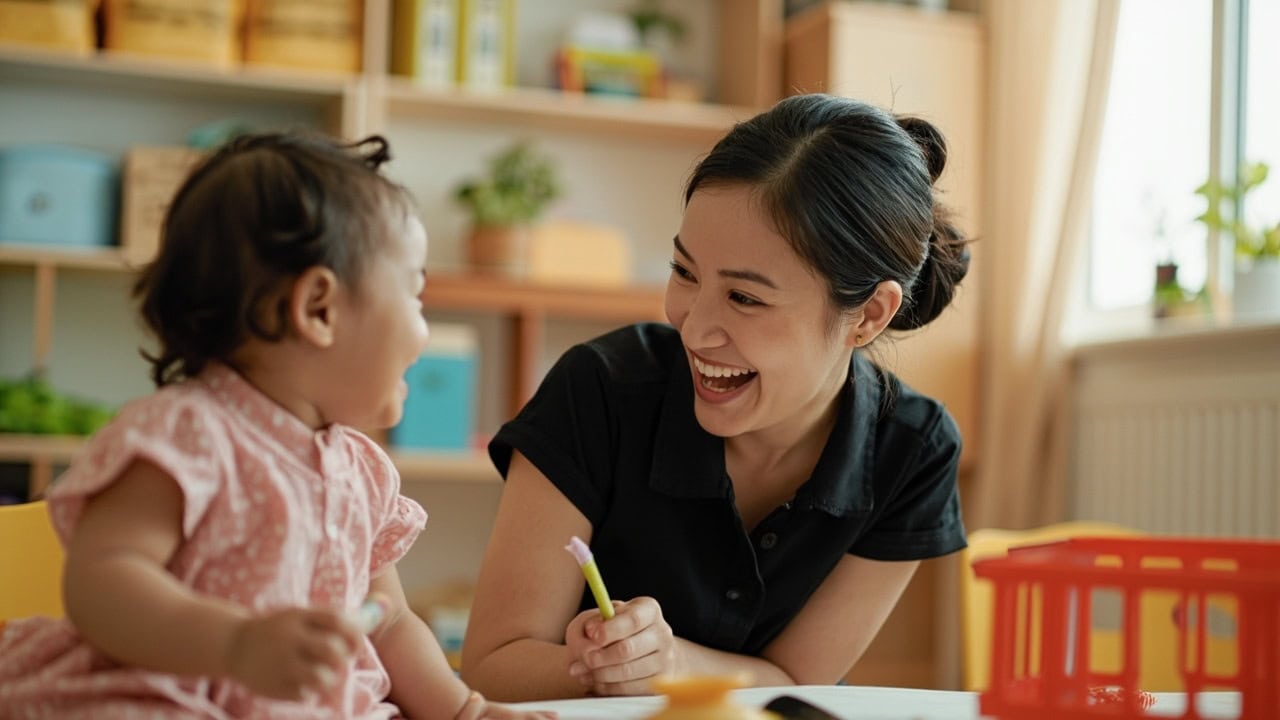
A supported child is one whose caregiver has noticed that they flap their hands when the environment gets loud and quietly offers them a weighted lap pad to ground their body. A supported child is one whose caregiver recognises that the child who is always crashing into furniture is not being reckless—they are seeking the deep pressure input their proprioceptive system craves, and so the caregiver builds crashing into soft cushions into the child’s routine deliberately. A supported child is one whose caregiver notices that they refuse to touch wet paint not because they are being difficult but because their tactile system needs more time to process unfamiliar textures, and gently offers them a brush to use at a distance while they gradually build tolerance.
These are not guesses. These are observations. And they are the observations that trained caregivers learn to make when they understand sensory development as the foundation it is.
A caregiver who understands sensory signals can catch struggles before they become behavioural problems—supporting sleep, transitions, social ease, and learning readiness naturally. When sensory foundations are solid, the outcomes that parents care about most begin to emerge naturally—not because children are drilled or pressured, but because regulation makes everything else possible.
Sleep improves
A regulated sensory system can transition into rest. Children who are not fighting sensory battles inside their bodies all day can actually relax into sleep at night. You may have been attributing poor sleep to temperament, to teething, to separation anxiety. And sometimes those are factors. But often, a child who cannot sleep is a child whose sensory system has not been given what it needs during the day to feel safe enough to power down.
Social ease improves
Regulation is the prerequisite for connection. You cannot share, take turns, read social cues, or manage the frustration of not getting what you want when your sensory system is in overdrive. This is why the child who receives quality sensory support in their early years tends to be the child who navigates friendships more smoothly in preschool and beyond. Not because they were taught to be social, but because their body learned that the world is manageable and that they have resources within themselves to handle it.
Learning readiness improves
Attention requires a calm nervous system. A child who is sensory-seeking or sensory-avoiding is a child whose attention is hijacked by their body’s needs. Once those needs are met—through intentional, trained care—their attention becomes available for learning. They can sit in circle time. They can follow instructions. They can focus on a teacher.
Confidence grows
A child who feels regulated in their body feels capable in the world. They know they can handle the tag on their shirt by asking to take it off. They know they can ask for quiet when the noise is too much. They know their body, and they trust that their body will tell them what they need, and that the people around them will listen. That is not a small thing. That is the beginning of self-advocacy. That is the beginning of resilience.
What You Can Start Seeing at Home
You can begin to notice sensory signals in your child’s daily life with confidence and curiosity rather than worry. What you observe at pickup is often the last visible chapter of a day’s worth of sensory processing your child has been managing silently.
- Texture sensitivities — the child who refuses certain fabrics, who will only wear the softest socks, who hates having their face wiped
- Sound sensitivities — the child who covers their ears at a birthday party, who is distressed by the vacuum cleaner, who cannot tolerate the hand dryer in public bathrooms
- Movement needs — the child who cannot sit still at the dinner table, who always needs to be climbing, jumping, spinning, who seems driven to move in ways that frustrate you but that are actually their body’s way of seeking input it genuinely needs
- Transition patterns — the child who falls apart at certain times of day, the child who seems fine all day and then completely undone the moment you pick them up
- Environmental responses — inexplicable distress that resolves as soon as you change something—a cooler room, a quieter space, a different shirt, a moment of swinging or jumping before you need them to sit still
Sensory sensitivities exist on a spectrum, and they are part of normal development. What matters is not the sensitivity itself but whether it significantly interferes with your child’s daily functioning, sleep, or wellbeing. A child who falls apart at pickup is often showing you the accumulated weight of a full day of sensory processing in a stimulating environment. This is not a diagnosis. It is a signal that their nervous system has been working hard and has used up its reserves.
When you learn to read these signals, something shifts in your relationship with your child. You stop asking what’s wrong with them and start asking what they need. You stop interpreting their behaviour as defiance and start interpreting it as communication. You become a partner in their sensory development rather than a bystander to it.
Choosing Infant Care in Singapore: What to Look For
If you are weighing up childcare options, here are the questions worth asking beyond safety ratios and operating hours:
- Do the caregivers observe and talk about how children respond to their environment—not just what they do, but how they seem to feel in their bodies?
- Is the environment predictable enough for a young child to feel grounded, but varied enough to offer different sensory experiences?
- Are transitions between activities handled calmly and consistently, with time built in for children to regulate between activities?
- Do caregivers describe children in terms of who they are as individuals, or only in terms of what they have done?
- Is there a genuine partnership between caregivers and parents—where the observations made in care are shared, discussed, and used to support the whole child?
The answers to these questions will tell you far more about the quality of sensory support your child will receive than any brochure ever could.
What EduNanny Brings to Sensory Development
At EduNanny, caregivers are trained to understand sensory development as a framework—not as a clinical label, but as a lens through which to see what every child is communicating through their body, their movements, their reactions, and their needs. They learn to recognise the signals that indicate a child’s sensory system is working well: the child who transitions smoothly between activities, who sleeps well and wakes rested, who engages with curiosity rather than avoidance, who recovers from frustration within a reasonable window.
And they learn to recognise the signals that indicate the sensory system is struggling: the child who is always on the move, driven by their body’s need for input; the child who collapses at the smallest provocation; the child who resists being touched unexpectedly or who seeks only roughhousing; the child who cannot tolerate certain clothing textures; the child who startles at small sounds; the child who seems perpetually unsettled without clear cause.
These are not behavioural problems to be disciplined. They are sensory signals to be understood.
EduNanny is part of the BUTLER family, operating under the ECDA Childminding Pilot. This means the programme meets the standards set by Singapore’s Early Childhood Development Agency for quality home-based and centre-based childcare. With up to three infants per caregiver in the home-based pathway, every child receives the attentive, individualised observation that sensory development requires.
Caregivers share what they observe with parents—not as reports, but as conversations. The work done in care should inform and enrich what you are seeing at home, creating a consistent, informed approach to your child’s development rather than a fragmented one.
The Foundation of Everything
Every child is building a nervous system. They are building it right now, today, in every moment of their waking lives. The sounds they hear, the textures they touch, the movements they make, the temperatures they adapt to, the way their bodies are held and handled and supported—this is not incidental to their development. This is the development. This is the raw material from which their capacity to learn, to regulate, to connect, to trust, and to grow is being constructed.
You cannot be present in every moment of your child’s childcare day. But you can be present in your understanding of what is happening during those hours. You can be an informed, observant, trusting partner in your child’s development. You can stop wondering if something is wrong with your child when they come home undone, and start recognising that their body is telling a story—a story that can be understood, supported, and honoured.
At EduNanny, we believe in doing this invisible work carefully. In training caregivers to notice sensory signals before they become struggles. In tending to your child’s development with the attention and care that every young nervous system deserves. Because children are not just watched here. They are seen.
To learn more about how EduNanny supports sensory development from day one, we invite you to connect with our team or read about our approach.