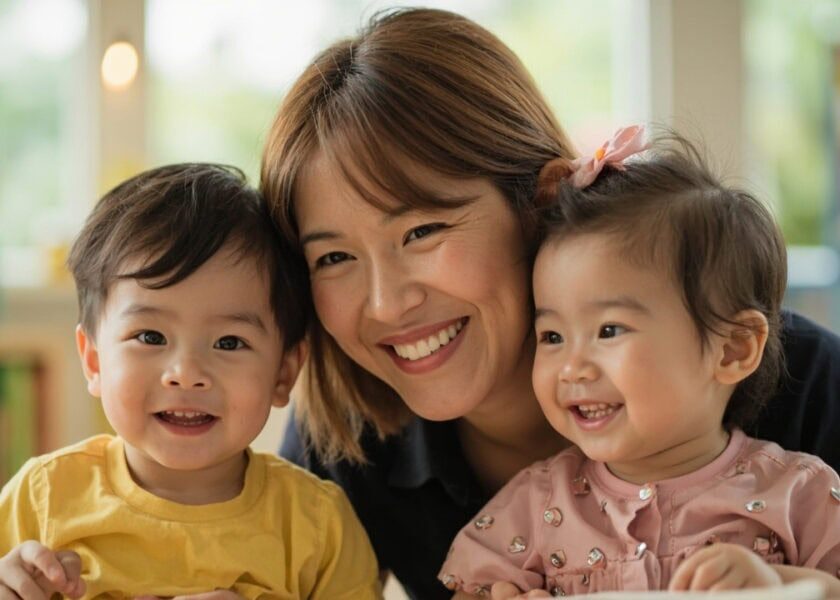
Beyond Service to Genuine Partnership in Care
The Moment Every Parent Knows
There is a moment, and every parent listening knows it, when you hand your child to someone else and walk away. It happens in the morning, often before the light has fully come.
Your child may be crying or may be calm. You may be calm or may be anything but.
You walk to the MRT, or to the car, or to your desk, and a small part of you stays behind in that room with your child and the person you have just trusted with the most important thing in your life.
That moment is not dramatic. It happens thousands of times every morning across Singapore. But it carries within it a quiet, enormous hope: that the person now caring for your child will know them. Not just their name, not just their schedule, not just whether they have finished their milk. But them. Who they are. What makes them light up. What makes them retreat. What they are trying to learn right now, without words.
That hope is not naive. It is the most human thing a parent can carry.
And yet, here is what we rarely say aloud: most parents do not know how to tell whether that hope will be answered. They can evaluate a centre’s operating hours, their proximity to the MRT, the cleanliness of the play area. But the thing they actually long for — that sense of being genuinely partnered in their child’s care — is invisible. It cannot be Googled. It cannot be toured. It can only be felt, over time, in the texture of daily interactions.
This is the gap. And at EduNanny Singapore, we believe it should not exist.
The Question Beneath the Question
When Singapore parents begin their search for infant care, they approach it practically. They compare licensing and certifications. They check ratios and operating hours. They visit spaces and assess cleanliness. They ask about curriculum frameworks and meal plans.
These are reasonable things to evaluate. They matter. But parents who have been through the search process often describe a particular experience: they did all the research, checked all the boxes, and still felt uncertain. Not about the logistics, but about something harder to name.
What they were actually asking, beneath all the practical questions, was this: Will my child be seen? Will anyone truly know them? Will my voice as a parent matter in how my child is cared for?
These questions do not appear on enrollment forms. They cannot be answered by a facility tour. But they are the questions that determine whether a childcare arrangement feels right — or whether it leaves parents with a quiet, persistent unease that no amount of research quite resolves.
Service Versus Partnership
There is a difference — and it is not subtle — between childcare as service and childcare as partnership.
Most of what the industry offers operates on the logic of service. You contract for a set of tasks: feeding, napping, diaper changes, developmental activities. The caregiver performs these tasks. You pay for them. The transaction is complete.
This is not wrong. It is simply incomplete.
Parents who have only experienced this model often describe a particular loneliness. They receive updates that feel like reports. Milestones that feel like checkboxes. Questions at pickup that feel like a caregiver is giving a summary rather than sharing something they genuinely observed.
Partnership operates differently. In a partnership, the caregiver is not simply executing tasks in your absence. They are holding a thread of relationship with your child that runs alongside your own — distinct, but connected. They notice things you would notice if you were there. They ask questions that matter. They make space for your knowledge of your child to inform how they care, and they make space for their observations to inform how you parent.
You can feel the difference even before your child is enrolled. It is in the questions asked during consultation: whether the caregiver wants to know your child’s temperament, your family’s rhythms, what your child is working on right now, what you are hoping for.
It is in the language used. Not “our programme” versus “your child,” but “we” and “us” and “what we are noticing together.”
It is in the way concerns are received — not as complaints to be managed, but as information to be honoured.
What Genuine Knowing Looks Like
Beyond routine reporting, genuine knowing shows up in specific, attentive observations.
It looks like a caregiver who can tell you not just that your child ate well today, but that they have been working on a particular fine motor skill — turning pages, say, or stacking rings — and that today they managed three in a row before losing interest.
It looks like a caregiver who notices that your usually easygoing child has been a bit more clingy in the mornings and asks, gently, whether anything has changed at home.
It looks like a caregiver who remembers your family’s cultural practices, your child’s comfort objects, the songs that settle them, the texture of food they prefer.
None of this is extraordinary. It is simply attentive. And it is what becomes possible when a caregiver has the time, the ratios, and the relational culture to actually know the children in their care.
Why Ratios Matter for Relationship Quality
At EduNanny, our infant ratios of up to one to three ensure that this kind of knowing is possible in practice. When a caregiver is responsible for three infants instead of six or eight, every child can be truly seen. Every observation is not a task to be logged but a relationship to be tended.
This is not a small thing. It is the difference between infant care that functions and infant care that nurtures.
Questions to Ask Before Enrollment
Not in a suspicious way, but in a curious way — because the answers will tell you a great deal.
- How does the caregiver learn about your child before enrollment begins? Is there a settling process designed to transfer information, not just to ease anxiety?
- How does daily communication work? Not just whether updates are sent, but what kind of updates. Are they formulaic or specific? Do they reflect genuine observation or just routine compliance?
- What happens when there is a concern? About development, behaviour, health, or wellbeing. How is that concern raised, and how are parents involved in responding?
- Is the caregiver open to your input about your child? Not just as a courtesy but as an expectation of how the relationship works?
- What does continuity look like? Will your child have a primary caregiver over time, or will they be passed between multiple people?
- Does the environment feel designed around the child or around operational efficiency?
These are not trick questions. They are revealing ones. The way they are answered — whether with warmth and specificity or with vague reassurances — will tell you a great deal about the relational depth you can expect.
The Concerns Parents Carry But Do Not Voice
Beneath every enrollment decision lives a concern that shapes how parents experience the early days of childcare — even when it is never spoken aloud.
The concern sounds like this:
- Will my child be more than a name on a roll?
- Will anyone tell me what they actually observe?
- Will my input matter?
- Will this feel like family or facility?
- Will I leave my child each morning with quiet confidence that they are known, or with lingering doubt that they are simply being managed?
These are not unreasonable fears. They are reasonable fears. And they deserve honest answers — not because parents are being difficult or demanding, but because the stakes are real.
The first years of life are not a waiting period. They are a building period. And the quality of relationships that surround a child during this time shapes the architecture of their social, emotional, and cognitive development in ways that researchers are still mapping with care.
What we know with confidence is this: children thrive when the adults around them are attuned. When a caregiver can read a child’s cues, respond with sensitivity, and adapt to what that child needs in that moment, something profound is happening in the child’s developing sense of the world as a trustworthy, responsive place.
This is not abstract. It shows up in the child’s willingness to explore, to connect, to regulate their emotions. It shows up over months and years in the confidence they carry.
The Developmental Value of Relational Trust
When parents and caregivers are genuinely partnered, that partnership extends to the child — who experiences, across their day, a coherent web of attentive adults who communicate with each other, who share observations, who coordinate their responses.
The child does not experience a fragmented series of disconnected interactions. They experience continuity of care. From that continuity comes security. From security comes the freedom to grow.
What EduNanny Is Built For
At EduNanny, partnership is not a philosophy we arrived at by accident. It is encoded in the model itself — in the choices we have made about how care is structured and delivered.
EduNanny is part of the ECDA Childminding Pilot, established to explore how home-based and community-based childcare pathways can complement centre-based care in Singapore. For parents, this means access to a care model designed with intention, supported by frameworks that prioritise the child’s safety, development, and wellbeing — and delivered at fee structures that reflect our commitment to making quality care accessible.
Within this model, EduNanny brings specific commitments:
- Caregiver training that addresses not just technical competencies of infant care — though those matter — but the relational competencies that distinguish a caregiver who watches from a caregiver who knows
- Communication rhythms that treat sharing, listening, and adapting as an ongoing practice, not a task to be completed at the end of the day
- Continuity of care through Monday to Friday care blocks — because fragmented arrangements make the kind of knowing we have described genuinely difficult to develop
- Financial clarity through CDA and Baby Bonus usability, removing unnecessary administrative friction from a season that is already full
- Transparency measures including open communication channels and, where deployed, CCTV — because trust is not built on blind faith but on the accumulation of evidence, over time, that the partnership is real
Finding Partnership in Childcare
In conversations with hundreds of Singapore families, parents who find genuine partnership in their childcare relationship describe something that sounds almost like relief.
Not the relief of finding someone competent — though that matters. But the deeper relief of finding someone they do not have to explain themselves to.
Someone who already knows their child. Someone who anticipates rather than reacts. Someone who asks questions and listens to the answers and lets what they learn shape how they care.
This is what becomes possible when parents are treated as partners, not customers. When the relationship is understood as a collaboration rather than a contract. When the caregiver’s expertise and the parent’s knowledge are recognised as complementary rather than competing.
Parents who experience this often describe a shift — not just in how they feel about their childcare arrangement, but in how they feel about themselves as parents. When you are genuinely partnered, you do not feel like you are handing your child off each morning to an unknown. You feel like you are entrusting your child to someone who shares, in some meaningful way, in your investment in their growth.
That changes the quality of your attention when you pick them up in the evening. It changes the quality of your conversations with the caregiver. It changes the experience of parenthood itself — which is often lonely in ways that surprise us, for a season that asks us to carry enormous love and responsibility with limited scaffolding.
Partnership provides that scaffolding. Not because the caregiver replaces the parent — they never do — but because the relationship between parent and caregiver creates a structure that holds the child more securely than either could hold alone.
If you are navigating the search for infant care in Singapore, your hope is not naive. The quiet hope you carry each morning — that the person caring for your child will truly see them — is the right hope. It deserves to be answered.
When evaluating your options, look beyond the checklists. Ask the questions that matter to you. Notice whether the conversation feels like a transaction or a beginning. Trust the instincts you have as a parent — they are more reliable than you might think.
The decision about who will care for your child is not simply a logistical decision. It is an act of trust — one of the most significant acts of trust you will make in the early years of your child’s life.
And that trust, when it is well-placed, does not simply make your life easier. It makes your child’s world bigger. It makes your child’s sense of security deeper. It makes the transition between home and care a passage between two connected places rather than a rupture between two disconnected ones.
At EduNanny Singapore, we have built our model around the belief that the relationship between parent and caregiver is not a peripheral feature of quality childcare but its central achievement.
Everything else — the ratios, the training, the communication systems, the continuity of care — exists in service of that relationship. It is what we are working toward each day, with each family, with the full awareness of how much it matters.
We would be glad to walk this path alongside you. Not as a service provider you hire, but as a partner you trust.
Ready to explore what genuine partnership in childcare looks like? We welcome conversations with parents who are beginning their search or seeking to understand more about the EduNanny approach. Reach out to us — we would be glad to hear from you.
EduNanny Singapore offers development-focused infant care and childminding for families across Singapore. Learn more about our approach or read our story.