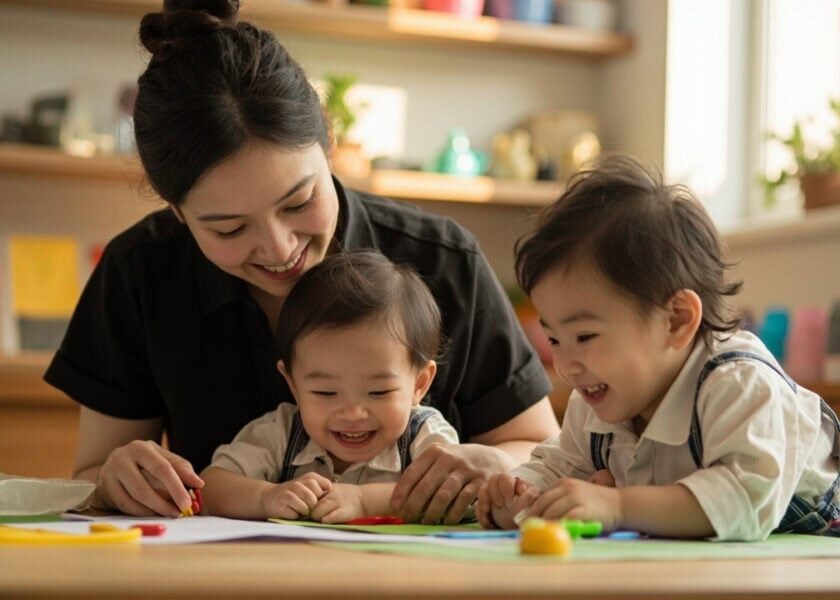
The First Year That Changes Everything: What Singapore Parents Need to Know About Infant Care
Why Infant Care in Singapore Is Different: A Parent’s Guide to the First Year
There is a moment that every parent returning to work after having a baby knows. It happens early in the morning, in the blue-grey half-light before the city has fully woken, when the house is still quiet and your infant is sleeping in your arms. You know you need to leave soon. You know someone else will be caring for your child in a matter of hours.
And in that moment, something inside you tightens in a way that is unlike anything you have felt before. Not because you doubt your decision to return to work. Not because you lack faith in who will be caring for your child. But because you are acutely aware that your baby cannot yet tell you where it hurts, what they need, or whether they felt safe when you were gone.
That moment of first separation is not simply logistics. It is a kind of grief, small but real, and it deserves to be named as such before we move on to anything else.
Here is what too many Singapore parents are told when they reach this moment: that it gets easier, that the settling period is temporary, that babies are resilient. Those things are true. But they are not the whole truth.
The whole truth is that the first year of life operates by different rules than every year that follows, and the parents who understand this—not to paralyze themselves with worry, but to choose with clarity and conviction—are the ones who emerge from this season with their confidence intact and their child’s foundation secure.
The Quick Summary: What Every Parent Should Know
- The first year is architecturally distinct. Neural pathways form faster than they ever will again. Your baby’s brain is building the templates for every future relationship.
- Infants cannot self-advocate. They cannot tell you they were frightened, that something felt wrong, or that their needs were not met. This changes everything about how care must be delivered.
- Attachment patterns form in the first year. Consistent, attuned care builds internal working models of trust that your child carries into every relationship they will ever have.
- The caregiver-to-infant ratio matters more now than at any other time. A caregiver managing three infants is not doing the same work as one managing three toddlers. Individual observation is not optional—it is the baseline.
- Choosing quality infant care is not a compromise. It is an extension of your love into the foundation-building year.
The Science of the First Year: Why It Cannot Be Treated Like Any Other
Let us begin in the territory that most childcare conversations skip past entirely: the science of the first year, and why it is categorically, fundamentally different from what comes after.
The Difference Between Leaving a Toddler and Leaving an Infant
When a toddler goes to childcare, they can run to the door when a parent returns. They can say “Mama” or “Daddy” or “I missed you.” They can express their distress in words, negotiate their needs, and tell you if something frightened them.
An infant cannot do any of this. And that is not a small thing. It is the entire thing.
In the first twelve months, a baby is constructing the architecture of trust from materials they cannot see or name. Neural pathways are forming at a speed that will never be replicated again. Synaptic connections are being pruned or reinforced based on whether the world feels consistent, whether their cries bring response, whether the people who care for them feel reliable in the most primal sense of the word.
Internal Working Models: The Invisible Foundation
Developmental researchers call this the formation of internal working models—the templates, written in the language of feeling rather than words, that a child carries forward into every future relationship. When an infant experiences consistent, attuned care, they are building a foundation that says: the world is reliable, people can be trusted, my needs matter.
This is not metaphor. This is the measurable outcome of responsive caregiving in the first year. And it is why the question of who cares for your infant during this period is not simply a question of logistics or convenience. It is a question about what kind of relational template you are helping your child to build.
Why Ratios Matter More in the First Year
This is also why the infant-to-caregiver ratio matters more in this period than at any other point in childhood. Consider what infant care actually requires:
- Reading cues through movement, skin tone, and cry quality
- Noticing whether an infant turns toward a voice or away from it
- Distinguishing between hunger, overstimulation, and the need to be held
- Responding before distress escalates into dysregulation
A trained infant caregiver learns to read these signals with the same precision that a doctor reads vitals. They can only do that if their attention is not fragmented across too many children at once. This is not a luxury. This is the basic condition for safety.
What Quality Infant Care Actually Requires
Beyond warm hands and a clean environment, quality infant care requires three things that are easy to overlook when you are caught up in centre tours and enrollment forms.
Caregivers Who Understand Development as a Practiced Skill
Not general knowledge, but practiced skill. Caregivers who know that a certain quality of crying at three months means something different than at seven months. Who can distinguish between hunger and overstimulation and the simple need to be held. Who have been trained to observe and document non-verbal cues in ways that create a reliable record of your baby’s unique communication style.
In Singapore’s childcare landscape, this distinction matters. Not every centre or childminder has made the investment in specialized infant development training. Asking about it is not being difficult—it is being attentive to what your baby needs.
Sensory-Appropriate Environments
Quality infant care requires environments designed for a developing nervous system. Not too much stimulation, not too little, but the calibrated middle ground where an infant can explore safely and settle easily. This means gentle lighting rather than harsh fluorescent, noise levels that allow an infant to rest without constant interruption, positioning that allows for eye contact and physical responsiveness, and routines that respond to infant cues rather than rigid clock-based schedules.
Communication That Keeps You Connected
Parents are still the primary experts on their child. Quality infant care works in partnership with that expertise rather than replacing it. This means communication protocols that keep parents informed not just of what their baby ate and slept, but of subtle shifts in mood, in responsiveness, in the texture of their day.
Questions Every Singapore Parent Should Ask Before Enrolling Their Infant
The questions you ask before enrolling your infant matter. Not just the logistics questions—hours, fees, proximity to work—but the questions that reveal whether a care environment has been designed with the infant’s developmental reality in mind.
The Essential Questions
- What is the infant-to-caregiver ratio? You want to understand exactly how many infants each caregiver is responsible for.
- How are caregivers trained specifically in infant development and observation? General childcare experience is valuable, but infant care requires specialized knowledge.
- How do you communicate with parents about their baby’s day, and how often? You should expect more than a daily log. Ask about how they share subtle shifts in mood and responsiveness.
- What does a typical day look like for an infant in your care? How do you balance stimulation and rest, individual attention and group time?
- How do you handle feeding, sleeping, and soothing? How do you adapt your approach to each infant’s individual temperament and cues?
- Can I observe during a settling period? How do you support both the infant and the parent during transition?
These are not anxious parent questions to be politely deflected. They are the right questions. And the caregivers and programmes that are truly qualified to care for infants will welcome them.
Red Flags That Are Easy to Miss
- A caregiver who becomes defensive when asked about their training or approach
- A room that looks clean but feels off—the lighting too harsh, the noise level too high, the infants positioned in a way that limits eye contact and physical responsiveness
- Routines that are rigid rather than responsive, where feeding and sleeping happen on a schedule rather than in response to the infant’s actual needs
- A general culture of not wanting parents to observe, to ask questions, or to be present
- Inconsistent caregivers or high turnover that means your infant cannot build familiarity with the same faces
None of these alone is definitive, but together they paint a picture, and that picture deserves your attention.
The Reframe That Changes Everything
Choosing quality infant care is not a compromise of your love. It is an extension of it.
The parent who researches, asks difficult questions, chooses a caregiver with trained expertise and thoughtful ratios, and invests in a care environment that takes infant development seriously—that parent is not failing their child. They are doing the hard, unglamorous, financially and emotionally demanding work of building a foundation.
The infant who experiences consistent, quality care in the first year is not being shortchanged. They are being given the gift of a reliable world.
And the parent who can walk out the door each morning knowing that their baby is in hands that are trained, attentive, and trustworthy is a parent who can be more present when they are home—not because they have abandoned their role, but because they have extended it deliberately.
The weight you feel when you leave your infant each morning is not a sign that you are doing something wrong. It is a sign that you understand what is at stake.
EduNanny: Designed Around the Reality of the First Year
EduNanny by BUTLER was built around a single conviction: that the decision of who cares for your infant during this foundational year deserves to be made with real information, real support, and real options designed around the actual needs of infants—and the actual realities of Singapore family life.
A Framework Built for Infants
EduNanny operates within the ECDA Childminding Pilot, a framework designed to reflect what developmental science tells us infants require. Training standards, ratios, and communication expectations are shaped by this evidence base—not by convention alone.
Care Pathways Designed for Infant Development
Home-based care pathways offer the intimacy and individualized attention that infants need, with caregivers trained in infant observation and attuned responsiveness. Where available, community and centre-based options provide structured environments built with infant sensory needs in mind.
The Ratios That Make Everything Else Possible
When an infant caregiver is responsible for one to three infants—rather than the higher ratios common in less specialized settings—that is not an administrative detail. That is the condition that makes everything else possible: the observation, the attunement, the responsiveness, the individual knowledge of each child’s cues and rhythms. That is where safety lives.
Making Quality Care Financially Sustainable
The practical dimensions matter too. Monday to Friday care blocks that align with the reality of working parents. The usability of CDA funds and Baby Bonus for eligible families—because the financial weight of quality infant care should not be invisible in how we talk about it. These are not secondary concerns. They are the conditions that make quality care sustainable for ordinary Singapore families.
Making This Decision With Confidence
If you are reading this and you are in the thick of that first-year decision, I want you to know something:
You are not overthinking it. You are thinking about it exactly as much as it deserves to be thought about.
You deserve to be heard. You deserve to have your questions answered by people who understand why you are asking them. You deserve to visit a care environment and feel, in your body, whether it is the right place for your baby.
You deserve to know not just what your child ate today, but how they seemed, who held them, and whether they settled easily. You deserve to walk out the door each morning and trust that the people caring for your infant are trained, attentive, and committed to the same reliable world you are trying to build at home.
The science is on your side. The options are there. And the people who have dedicated their professional lives to walking this path alongside you—trained, experienced, and committed to the kind of care that shapes a child’s capacity to trust—are ready to answer your questions, to show you their work, and to be the trusted extension of your love in the year when your baby cannot yet say your name but is already learning what your love feels like.
That year matters. You are right to treat it that way.
And you do not have to navigate it alone.
Ready to explore what quality infant care looks like for your family? Connect with EduNanny to learn about trained caregivers, low infant ratios, and the communication partnership that keeps you informed and confident every step of the way.
To learn more about EduNanny and our approach to infant care in Singapore, visit our homepage or read about our story and values.