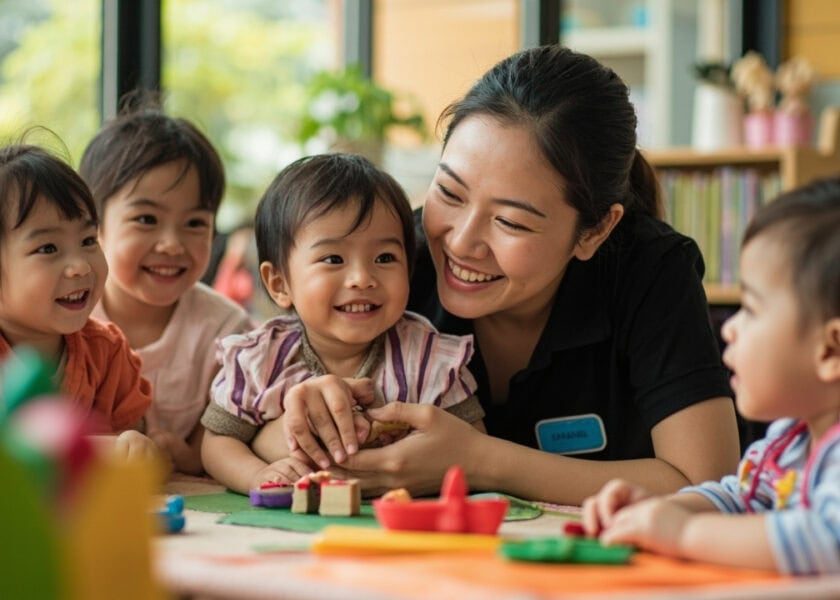
The Hidden Education Your Child Receives Before School
The Quiet Question Every Working Parent Carries
There is a question that most parents in Singapore carry quietly. Perhaps in the car on the way to work. Perhaps in the brief moment before a meeting begins. Perhaps at night when the house is finally still.
It is not a dramatic question. It does not arrive with panic or urgency. But it is there, persistent, sometimes unnameable:
Is this time well spent?
You drop your child at childcare. You kiss their forehead, say you’ll be back soon, and leave. And in that leaving, a small and honest worry takes root. Is my child simply being watched today, or are they truly learning? Are these hours building something, or are they simply passing?
If you have felt this, you are not alone. And you are not wrong to ask. The question deserves a real answer.
Quality childcare does not just supervise children. It builds the invisible foundation — the social, emotional, and cognitive skills that predict long-term success better than early academic training. It teaches through experience, not instruction. Children learn to share, wait, negotiate, and recover from disappointment through daily interactions with trained caregivers and peers. In the early years, warmth is educational. Responsiveness is educational. A well-designed environment is educational.
School readiness — concentration, curiosity, self-regulation, resilience — comes from within. These are built through years of accumulated experience, not weeks of worksheets.
The Invisible Curriculum: What Quality Childcare Actually Builds
Before a child can learn to read, they must learn to listen. Before they can solve problems on a page, they must learn to sit with a problem and persist. Before they can work alongside others in a classroom, they must learn how to be part of a group — how to share, how to wait, how to feel frustration, and find a way through it without falling apart.
These are not soft skills. These are the load-bearing walls of everything that comes after.
And here is what most parents do not realize: these capacities are not taught. They are caught. Absorbed slowly through daily experience in environments deliberately designed to offer them.
Consider a typical morning in a well-designed infant or toddler care setting. A child wakes from rest and is greeted by a familiar face — someone who knows their rhythms, their preferences, the particular way they like to be held.
That greeting is not incidental. It is a lesson in belonging. It teaches a child that they are expected, that their presence matters, that the world can be a place where people know your name and are glad to see you.
Now watch what happens when a two-year-old reaches for a toy that another child is holding. In a supervised, reactive environment, an adult might step in quickly, separate the children, resolve the moment for them. But in a designed learning environment, something different occurs.
The caregiver is present, warm, and watchful. She does not rush. She gives the children a moment to negotiate. She is ready to support, but she trusts the process.
Over days and weeks and months, those children learn something extraordinary: how to navigate desire, how to read another person’s feelings, how to use words instead of force, how to wait, how to be disappointed and recover.
This is social intelligence being built, brick by brick, in the most ordinary moments of daily life:
- The way a caregiver speaks to a child when they are frustrated, modeling calm
- The rhythm of the day — the predictability that helps a young mind feel secure enough to explore
- Learning that actions have consequences, that words have power, that presence affects others
- Experiencing conflict in the context of warm, supportive adults who help make sense of big feelings
This is what quality childcare offers. This is the invisible curriculum.
Care and Education Are the Same Thing
Parents in Singapore often feel torn about this. We have been taught to treat care and education as different paths. There is the educational path, which we trust. And there is the care path, which we hope for but are not quite sure about.
We worry that we are making a trade-off. That we are choosing convenience over quality. That somewhere, someone else is giving our child the stimulation and attention they truly need.
This assumption is costing parents something important: confidence. And children feel our confidence. They read our hesitations. They sense when we believe the arrangements for their care are less than ideal — and this can shape their own experience of belonging.
The truth is that in the first thousand days of life, care and education are not two different things. They are one and the same.
- The warmth of a responsive caregiver is educational. It teaches a child about safety, about trust, about the reliability of human connection.
- The richness of a prepared environment is educational. It invites curiosity, supports concentration, rewards persistence.
- The daily negotiations of peer interaction are educational. They build the emotional vocabulary and social fluency that no worksheet can provide.
Why Conflict Is an Opportunity, Not a Problem
When children play together, they disagree. They want the same toy. They have different ideas about what to build. Someone’s tower falls. Someone’s feelings are hurt.
These moments are not problems to be eliminated. They are opportunities.
When children experience conflict in the context of a warm, supportive environment, they learn something that cannot be taught through instruction alone. They learn that conflict is survivable. That relationships can weather disappointment. That they have the capacity to repair what has been broken.
They learn resilience, not as an abstract concept but as a felt experience. And they learn it in the company of skilled adults who help them make sense of what they are feeling, who offer them words for their emotions, who show them that big feelings do not make bad people.
This is why emotional vocabulary develops so powerfully in quality childcare settings. A child who can say “I am angry because she took my toy” has transformed an overwhelming sensation into a communicable experience. They have taken a step toward self-regulation. They have opened a door to resolution.
And this capacity, born in the everyday moments of childcare, will accompany them into primary school, into friendships, into marriage, into the boardroom. It is one of the most enduring gifts we can give a child.
The Skills That Actually Matter for School Readiness
Let us speak to the anxiety that often concentrates here. You want your child to be ready for primary school. You want them to have the tools they need to succeed in an educational system that can feel demanding and competitive.
So you wonder: is spending these early years in childcare helping or hurting that readiness?
Here is what matters most. The skills that predict long-term academic success and personal wellbeing are not the ones we tend to test for at school entry. They are not letter recognition or number counting, though these have their place.
The skills that predict enduring success are:
- Concentration and the ability to sustain attention
- Curiosity — the drive to explore and understand
- Self-regulation — managing impulses and emotions
- The ability to persist when something is difficult
- The ability to ask for help
- The ability to work with others
- The ability to recover from setbacks
These are the skills that quality childcare builds, quietly and systematically, every single day.
When a child in a quality childcare setting spends a morning choosing an activity, persisting with it even when it is challenging, transitioning to the next part of the routine with minimal distress, sharing space and materials with peers, and being gently supported through moments of frustration — they are not just having a pleasant day. They are rehearsing the fundamental capacities they will need for formal education. They are building the internal architecture of a learner.
Academic skills can be taught later, and they can be taught quickly when the foundation is strong. But concentration, curiosity, emotional resilience, and social fluency cannot be drilled into a child in the weeks before school. They are the product of years of accumulated experience in environments that honor child development.
Quality childcare is not a detour on the way to real education. It is the place where the most important education begins.
What Sets Quality Childcare Apart
There is a meaningful difference between a supervised environment and a designed learning environment. Understanding this difference is one of the most important things a parent can do when researching childcare options.
Supervision asks: Is everyone safe? Are they fed? Are they content? These are legitimate questions, and they matter.
But a designed learning environment asks something deeper: What is this child learning right now? How can I support that learning? What does this child need to grow into the person they are becoming?
These questions require training, attention, and intention. They require caregivers who are not merely present but engaged. Who see the child as a learner, not just a charge. Who understand that the way they model emotional regulation in a moment of frustration is one of the most powerful educational acts they will perform all day.
Without trust, none of what I have described can flourish. Parents need to trust the environment their child is in. This is not naivety. This is not blind faith. This is a reasonable expectation that must be met with transparency, professionalism, and care.
Parents deserve to know what is happening in their child’s day. Informed parents are confident parents, and confident parents raise more secure children. Where deployed, CCTV measures offer an additional layer of reassurance — because we understand that in the early years, the stakes are high and the peace of mind of parents matters enormously.
What EduNanny Singapore Offers
EduNanny Singapore is part of the ECDA Childminding Pilot, which means the approach here is grounded in national standards while remaining responsive to the individual needs of each family.
Both home-based and community-based pathways are available, because families in Singapore have different circumstances and different preferences. The best fit is the one that works for your life.
Infant ratios are designed to ensure that every child receives the attention and responsiveness they deserve. In infant care, ratio is not an administrative detail. It is the condition that makes everything else possible.
Trained, intentional caregivers are at the heart of what EduNanny offers. In the hours you are apart, they are the primary relational anchor for your child — celebrating small victories, comforting big tears, and modeling patience, warmth, and curiosity every day. They are educators in the truest sense.
Deliberately designed environments support this work. Every element is considered: the rhythm of the day, the prepared spaces, the balance of guided and child-led activity.
Financial accessibility matters too. Your Child Development Account can be used, and Baby Bonus provisions apply. Thoughtful childcare should not be out of reach for families who value it.
And for questions that arise outside of childcare hours, Thomas — an AI-powered assistant — offers evidence-based guidance when you need it. Because parenting questions do not keep office hours.
Choosing Infant Care in Singapore: What to Look For
If you are researching childcare options, here are the questions that matter most:
- What are the caregiver-to-child ratios? Smaller ratios mean more responsiveness, more individual attention, more genuine connection.
- Are caregivers trained in child development, not just safety protocols? Look for settings where adults understand the invisible curriculum — where they know that every interaction is a learning opportunity.
- Is the environment deliberately designed? Does it feel like a place where a child can belong, explore, and grow — or just a place where they can be kept safe?
- How does the setting handle conflict and big emotions? The answer reveals a great deal about the philosophy of the programme.
- Do you feel welcomed and informed as a parent? Transparency and open communication are not extras. They are essential.
Trust the Process
The hours your child spends in quality childcare are not a gap to be filled later. They are not a compromise. They are a foundation.
Every moment of social negotiation, every instance of emotional scaffolding, every experience of being greeted by a familiar face and feeling known — these are the experiences quietly and powerfully building the person your child will become.
You are not leaving your child in someone’s care. You are enrolling them in an education you cannot see but that will shape everything you can.
This is not something to doubt. It is something to trust.
Trust the process. Trust the environment you have chosen. Trust that in the hands of trained, caring, intentional professionals, your child is not merely being watched. They are being seen. They are being guided. They are being prepared for everything that lies ahead — not through academic drilling but through the ancient, human work of learning to be in the world with others.
If you are ready to explore what quality childminding looks like — a deliberately designed environment where your child is understood as a learner from their very first months — EduNanny Singapore is here to walk this path with you.
Not as a service provider alone, but as a partner in the most important work there is: raising the next generation.