The Social-Emotional Skills That Set Singapore Children Up for Lifelong Success
Why Social-Emotional Skills Matter More Than Academics
We spend a great deal of time in Singapore preparing our children for school. We think about Primary One readiness with an intensity that wouldastonish educators in most other countries. We enroll them in enrichment classes before they can reliably hold a pencil. We worry about whether they will cope with the academic demands that begin, in some schools, almost immediately.
These are not unreasonable concerns. We are an ambitious society, an achievement-oriented culture, and we want our children to thrive.
But here is what decades of longitudinal research has quietly, consistently shown us: the academic skills your child develops before Primary One are less predictive of long-term success than the social-emotional foundation they build in these same years.
Children who can regulate their emotions. Who can navigate conflict with peers. Who can demonstrate empathy and kindness. Who can persist when something is difficult because they have learned that effort leads to growth.
These children do not merely survive Primary One. They flourish through it. They build on their learning rather than burn out under its weight.
Social-emotional competence is not a soft skill. It is the infrastructure that makes everything else possible.
The Singapore Reality
Let us be honest about something most parents feel but rarely say aloud.
In Singapore, many of our children grow up in apartments where the walls are close and the number of peers is small. An only child in a HDB flat may have wonderful relationships with parents, grandparents, and perhaps a helper — but the daily experience of navigating peer dynamics, of learning to share and negotiate and resolve conflict with children their own age, is not something a home environment can easily replicate.
We have built a society that is prosperous, safe, and structured. And that structure means that our young children often have fewer natural opportunities to develop peer intelligence than children in other settings might have.
Quality childcare fills this gap in a way that no enrichment class and no amount of parental attention can fully replace.
What Quality Childcare Actually Looks Like
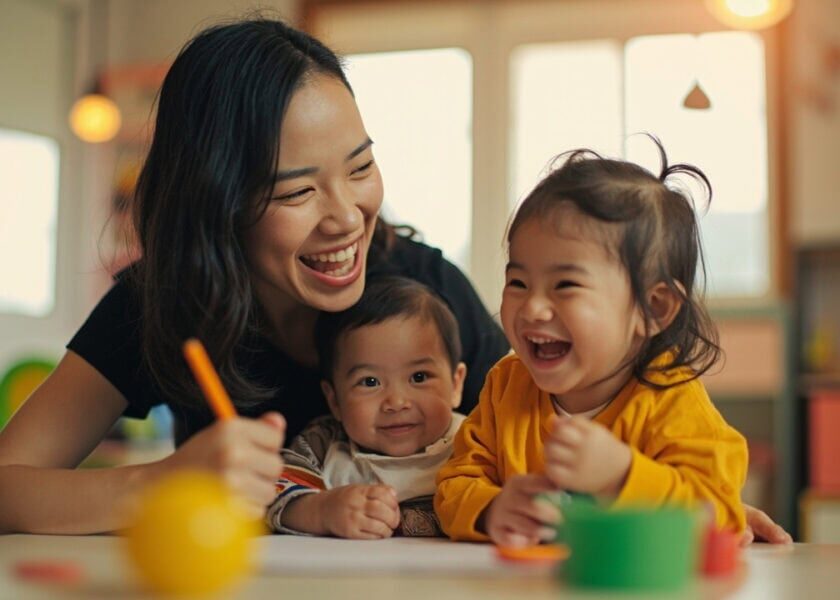
A well-designed childcare environment is, in the truest sense of the word, a social laboratory. It is a place where children encounter peers — real, messy, unpredictable peers — and where they learn, day after day, the hard and beautiful work of being human together.
The Red Truck Moment
Consider what happens in such an environment. A child wants the red truck. Another child is already playing with it.
In a high-quality setting, this is not a problem to be solved by an adult stepping in and enforcing a rule. It is an opportunity — a scaffolded moment where a trained caregiver helps both children find words for what they feel, think about what the other child might need, and discover a solution that works for everyone.
The red truck becomes a vehicle for learning something far more valuable than sharing. It becomes a vehicle for learning how to be a person in relationship with other people.
Guided Conflict Resolution
Guided conflict resolution is not a sign that childcare has failed to prevent problems. It is evidence that childcare is doing exactly what it should — providing a space where children can practice the hardest skills they will ever need, with adults nearby who know how to guide rather than simply intervene.
Children who learn to resolve conflict with peers — who learn that disagreements can be worked through, that everyone has needs worth considering, that apologies are possible and forgiveness is real — carry these skills forward into every relationship they will ever have.
Emotional Regulation
The same is true for emotional regulation. When a child falls down and scrapes their knee, when they lose a game, when another child says something that hurts — these moments are not disruptions to learning. They are learning.
A skilled caregiver in a quality environment does not rush to make the hurt go away. She helps the child name what they feel, sit with the discomfort, and discover that difficult feelings pass — that they do not have to be run from or acted out but can be held and understood.
This is emotional regulation. This is the capacity that will carry your child through the challenges of school, of friendships, of adolescence, of adulthood. And it is built in moments like these, repeatedly, patiently, by adults who understand what they are doing.
Supervision vs. Growth: The Distinction That Matters
There is a question that many Singapore parents carry quietly, sometimes with a flicker of guilt. They wonder whether their childcare choice is simply about keeping their child safe while they work — a practical arrangement without deeper developmental significance.
They wonder whether their child is truly growing there, or merely being minded.
This question deserves a direct answer, because the distinction matters enormously.
Childcare That Supervises
There is childcare that supervises children. It ensures they are fed, rested, and safe. It prevents accidents and manages routines. This is not nothing — it is valuable, and it is the baseline any parent should expect.
But supervision alone does not build relational capacity. It does not help a child learn to negotiate, to empathize, to persist, to connect. It keeps them occupied; it does not grow them.
Childcare That Grows Relational Capacity
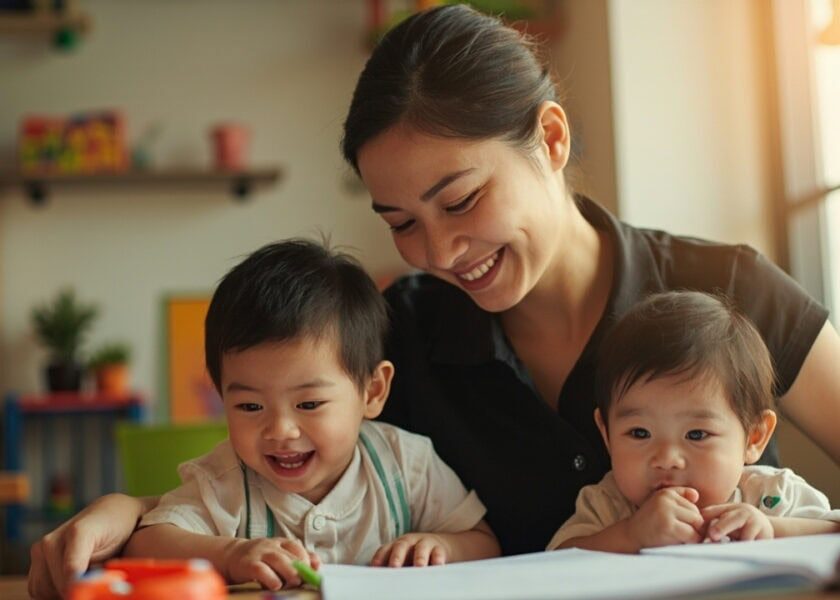
And then there is childcare that grows children’s relational capacity. This is a fundamentally different kind of environment — one where the curriculum is, in a very real sense, the social world itself.
Where caregivers understand that every interaction between children is a learning opportunity. Where emotional intelligence is not an add-on but a core objective, woven into the fabric of every day.
What to Look For at Pickup Time
You can recognize quality care, if you know what to look for. When you arrive, notice whether your child seems genuinely glad to see you — but also willing to finish what they were doing. Can they separate from the caregiver with warmth rather than anxiety?
When you ask what they did today, do they mention children by name? Do they talk about things they did together, or struggles they worked through?
These are signs of a child who is building relational confidence — who is learning that the social world is not something to be feared but something to be navigated with growing skill.
Questions to Ask When Choosing Infant Care
When evaluating childcare options, ask directly and observe carefully. The answers you receive will tell you whether you are looking at supervision or growth.
- What is the caregiver-to-child ratio? Smaller ratios allow for more responsive interaction and better emotional support.
- How do caregivers handle conflict between children? Look for answers that involve guiding rather than simply ruling.
- What does a typical day look like? Quality care will include unstructured peer time, not just structured activities.
- How do you communicate with parents? Regular, meaningful updates about social development — not just meals and naps.
- Can I observe a session? Quality providers welcome this. Watch for how children interact with each other and with caregivers.
- How do you support children who are struggling emotionally? The answer should mention helping children name and sit with feelings, not just distracting them.
Will My Shy Child Be Supported?
Children who are shy or slow to warm up are not being underserved in quality care — they are being given exactly what they need. Small ratios and skilled caregivers allow children to build confidence at their own pace, with patient support.
A shy child in a quality setting is not being ignored. They are being given the space and scaffolding to discover that the social world is safe.
The EduNanny Singapore Approach
At EduNanny Singapore, we believe that every child deserves to be known. Not just watched, not just kept safe, but truly known — their temperament, their social style, the specific ways they need support and the specific strengths they bring to relationships with peers.
This is why our model is built around the ECDA Childminding Pilot, which allows for small ratios — up to one caregiver for every three infants in our infant care settings — ensuring that each child receives the attention and responsive interaction that social-emotional development requires.
We offer pathways that meet families where they are:
- Home-based childminding for families who value the intimacy and familiarity of care in their own space
- Community and centre-based settings for families who seek the richer peer environment that comes with a broader social group
Both pathways are grounded in the same developmental understanding: that children learn to be with others by being with others, every day, in environments designed to support that learning.
Accessibility and Consistency
We understand that cost is a genuine consideration for Singapore families. The Child Development Account and Baby Bonus schemes are usability options we help families navigate, and our pilot fee structures are designed to make quality care accessible without compromising on the standards that matter.
Monday to Friday care blocks provide the consistency that social-emotional learning requires — the same children, the same peers, the same caregivers — because trust and friendship cannot be built in fragments.
Transparency as Foundation
We have built transparency into our model. Communication is not an afterthought — it is a practice. Parents receive regular updates that go beyond the perfunctory. Where deployed, CCTV measures offer additional reassurance, not because we have anything to hide, but because we understand that parents need to feel they can trust what they cannot always see.
The Skills That Make Learning Possible
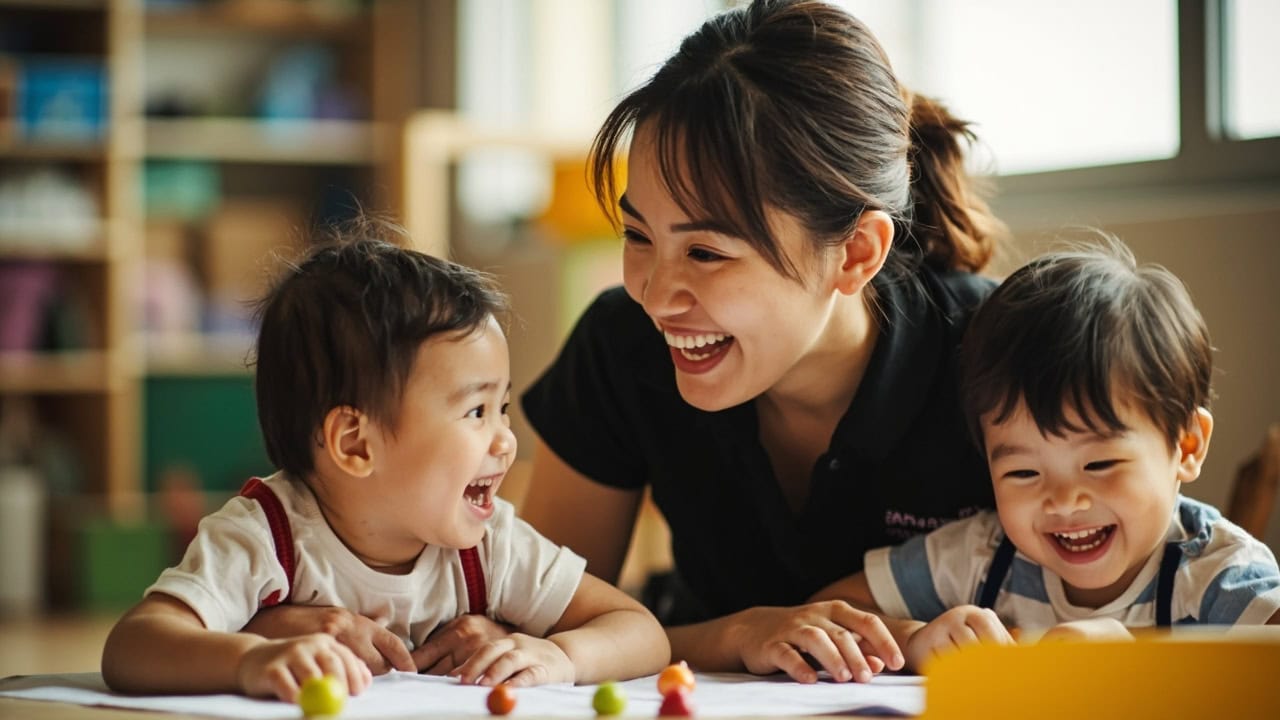
Every morning, when you bring your child to their childcare setting, you are not just dropping them off. You are placing them in a social world that is teaching them, hour by hour, what it means to be a person.
They are learning to share. To take turns. To apologize when they have hurt someone. To receive an apology. To be disappointed and recover. To be excluded and try again. To be included and make room for others. To notice when a peer is struggling and to offer help — not because an adult asked them to, but because they have felt the pull of empathy so many times that it has become part of who they are.
These are not small things. These are the foundations of a life.
When your child walks into Primary One — when they sit in a classroom with thirty other children, when they face their first group project, when they navigate the complex social world of school friendships — the academic skills they bring will matter.
But the social-emotional foundation they have built will matter more.
- Can they manage their frustration when something is hard?
- Can they ask for help?
- Can they disagree respectfully?
- Can they be a friend?
- Can they persist through difficulty?
These are the skills that make learning possible. These are the skills that make a child not just ready for school, but ready for life.
Because in the end, your child’s social world is not a distraction from what matters. It is, in the most profound sense, what matters most.
A Note on Trust
You are doing something brave, every day. You are entrusting your most precious person to others while you go out into the world to build the life your family needs.
That trust is not small. It is everything.
At EduNanny Singapore, we do not see ourselves as simply providing childcare. We see ourselves as cultivating the social intelligence your child will carry forward into every relationship, every challenge, every opportunity they will ever face.
We take this responsibility seriously — with warmth, with intention, with the deep respect for both children and parents that this work demands.
And we are honoured to earn it — one day, one interaction, one small moment of kindness and growth at a time.
Let us raise them well — together.
If this article resonated with you and you would like to learn more about how EduNanny Singapore supports social-emotional development, we welcome you to explore our approach or get in touch with our team.