What Your Child Is Really Telling You at Pickup Every Day
The Quick Summary: What Your Child Is Already Telling You
If you are reading this between meetings or during the commute, here is what matters most:
- Your child communicates every day — through their body, their mood, their language, and their play. These channels are open from the moment you say goodbye in the morning.
- Children are expressive long before they have words. The tension in their shoulders, the texture of their play, the stories they tell or refuse to tell — all of this is real information about their day.
- You do not need a report to understand your child. The child who runs into your arms is not necessarily the child who had a hard day. The child who walks out calmly is not necessarily the one who was indifferent to your return.
- Children process and share their experiences in ways as unique as their faces. One child bursts home with stories. Another returns quiet and tender. Both are telling you something true.
- The quality of care your child receives shows up in how clearly they communicate. A child who feels seen, secure, and stimulated will arrive home as a more articulate version of themselves — and that is the evidence that matters most.
The Wait That Every Parent Knows
So you wait. You watch for the shift in mood, the way your child climbs into your arms or runs ahead, the comment made in the car, the game they invent in the hallway. You piece together a story from fragments — the way an archaeologist reconstructs a civilization from a single shard.
And underneath all that piecing together, there is a question you may not even have articulated yet: Am I seeing my child clearly, or am I seeing what I hope to see?
In Singapore, this question is sharpened by context. Long working hours, extended commutes, professional pressure that previous generations of parents simply did not face — these realities mean that the hours your child spends in someone else’s care represent a larger proportion of their waking life than most parents would choose. The stakes feel higher. The uncertainty feels more acute.
So you have learned to read signs. You ask, “Did you have a good day?” and then triangulate the answer against a checklist of behaviors rather than taking seriously what your child offered you directly. You second-guess the child who ran into your arms, wondering if that was normal, if it was too much, if it meant something had happened. You distrust the child who walked out calmly, wondering if that calmness meant they had stopped needing you.
You become so worried about missing something that you stop receiving what is already being given.
The Reframe: Your Child Is Not a Mystery to Be Decoded
Your child is not a mystery. Your child is not waiting to be decoded by someone with more training, more distance, or more access. Your child is talking to you right now. Every day. From the moment you walk through that door in the morning to the moment you sit together at the end of the day.
The question is not whether your child is communicating. The question is whether we have been taught — not by anyone malicious, but by the quiet pressure of modern parenting — to listen only to the parts of our child’s communication that confirm what someone else has already told us.
Reading Your Child’s Signals at Pickup
Children communicate through three main channels, and each one is carrying real information about what your child’s day was actually like. Here is how to read them — and what they tell you when your child walks through the door.
The Body
The looseness in their shoulders when they are settled. The tension they carry when they are not. The way they hold your hand at drop-off — gripping tightly, releasing slowly, reaching for the caregiver, turning back to look.
These are not random physical behaviors. They are the body’s honest report on emotional state. A child who arrives at pickup with relaxed shoulders, who settles into your arms without urgency, who moves through space with a certain ease — this child is telling you something. A child who arrives stiff, clingy, or unusually withdrawn is also telling you something.
The question is not whether the message exists. The question is whether you are tuned in enough to receive it.
Mood and Play
Not just the obvious sadness or happiness, but the texture of their play, the way they involve you in it or move away from you.
Watch how your child plays when they first come home. Do they seek you out immediately and pull you into a game? Do they play alone, absorbed and focused, checking in periodically? Do they seem agitated, unable to settle, cycling through activities without depth?
Each of these patterns tells you something about the kind of day they had, the kind of emotional engagement they experienced, and the degree to which they felt secure enough to explore or needed to conserve their energy.
Language
Not just what they say, but what they choose to say, what they ask about, what they refuse to discuss, what they make into a game and what makes them go quiet.
Some children come home narrating every detail of their day — the song they sang, the friend they played with, the block tower that collapsed. This is not random chatter. This is a child who had enough security during the day to build up a store of experiences worth sharing.
Other children come home quiet, tender, processing. They may not say much until later in the evening, or the next morning, or in a moment of play that seems unrelated to the day at all. This too is communication. The child who is quiet is not necessarily the child who had a bad day. They may be the child whose day was full enough to require stillness to process.
What Thriving Looks Like at Pickup
| How Your Child Returns Home | What It Likely Means |
|---|---|
| Runs into your arms, bursting with stories | They felt secure enough during the day to build rich experiences worth sharing. They trust that you want to hear about them. |
| Walks out calmly, greets you with quiet warmth | They are at ease. They do not need to perform excitement to prove they are okay. The calm is genuine. |
| Arrives tender, leans into you, needs stillness | The day was full. They are still metabolizing it. This is not distress — it is the healthy processing of a rich experience. |
| Returns energized, laughing, full of ideas | They were engaged in a way that sparked something. The day had the right kind of stimulation. |
| Shows you something they made or learned | They want to share their accomplishment with you. This means they felt proud, which means they felt capable. |
None of these children are sending a distress signal. All of them are telling you something true about the day they had.
Why the Caregiver Matters More Than You Think
Most parenting advice tells you to watch your child more carefully, to develop a trained eye, to become the observer. And observation matters — it matters enormously.
But the deeper shift is not about you becoming a better observer. It is about recognizing that your child is already an expert at showing you what they need.
Your job is not to crack a code. Your job is to create the conditions under which your child’s communication can travel clearly from wherever they spent the day back to you.
And this is where the role of your child’s caregiver becomes something far more significant than most parents are told to expect.
What the Right Caregiver Actually Does
Think about what you want from the person who spends the most waking hours with your child each week. Safety, yes — and that is not a small thing, not in Singapore, not anywhere. Warmth, certainly. Routine, stimulation, developmentally appropriate activities. These are the things you read about. These are the things on the checklist.
But there is something deeper that the best childcare arrangements offer: the caregiver who helps your child arrive home more themselves, not less. The caregiver who understands that at the end of every day, your child is going to walk through a door and be met by you, and that the quality of what your child carries through that door is a direct measure of the quality of the care they received.
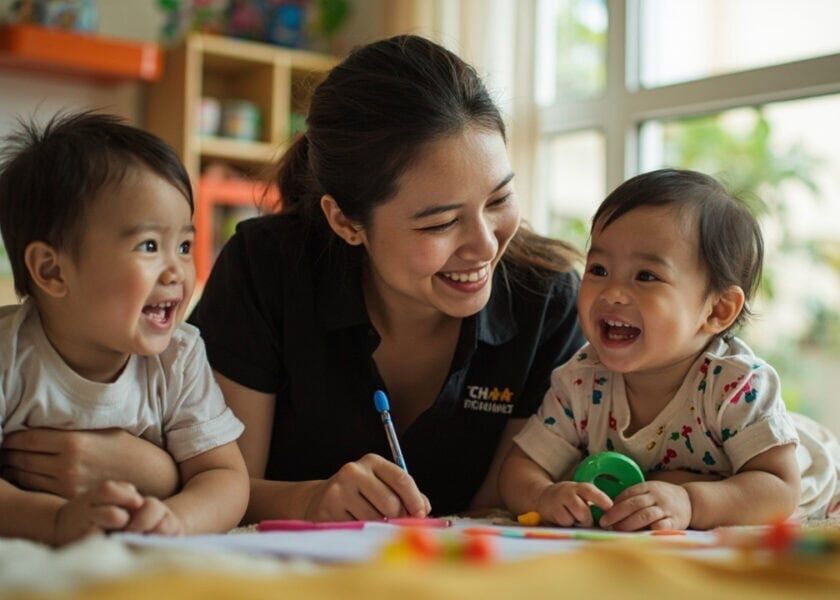
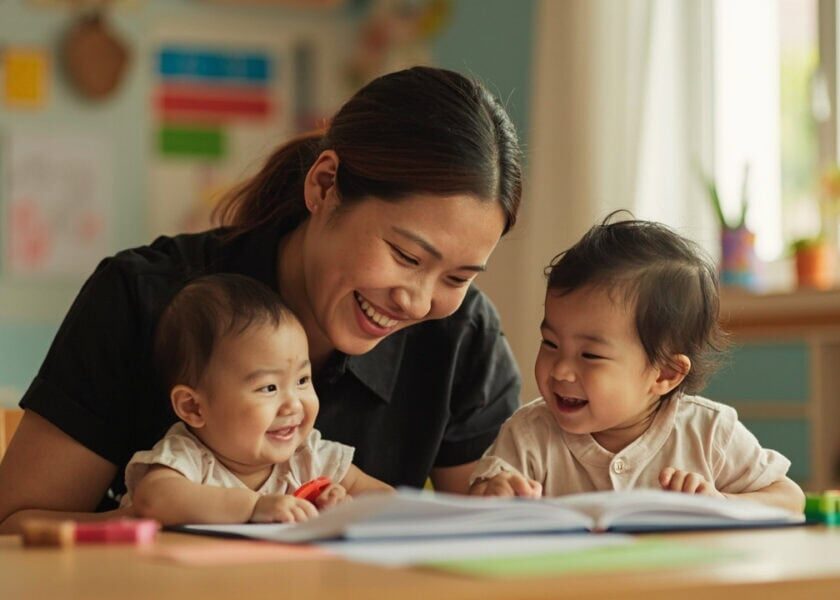
When a caregiver knows your child as one of three rather than one of many, they notice the morning that your child arrives with a certain tension in their shoulders and help that child find their footing before the day even begins. They notice when the afternoon nap was restless and what that might mean. They notice the moment your child starts to play differently — more freely, more imaginatively, more like themselves — because that is the moment they have settled into trust.
They notice because they are present enough to notice, and they communicate it because they understand that your child’s experience does not end when they leave the building. It comes home with them. It comes home in their bodies, in their language, in the way they climb into your arms or away from your arms, in the story they tell you or the story they are not yet ready to tell.
EduNanny Singapore: Built Around the Bridge
This is the philosophy that stands at the center of EduNanny Singapore, and it is why the work here feels different from the moment you encounter it.
EduNanny operates within the ECDA Childminding Pilot — a carefully structured framework designed to bring professional, home-based and centre-based childcare options to families across Singapore in a way that is genuinely responsive to how children develop and how parents actually live.
The pilot structure allows for ratios that make quality possible — your child is not one of fifteen but one of up to three, in settings where the caregiver is not a nameless figure in a hallway but a known, trusted, trained presence in your child’s early life.
The Word That Changes Everything: Reception
There is a word for what EduNanny has made central to its model. It is not observation. It is not surveillance. It is not reporting. The word is reception.
Reception means that the caregiver’s primary purpose is not to watch your child on your behalf but to help your child be so clearly, fully, confidently themselves that what they experienced during the day travels home intact.
It means building a relationship between caregiver and child so solid that your child’s communication becomes clear enough, reliable enough, and joyful enough that you do not have to guess. You get to receive. You get to sit with your child at the end of the day and listen to what they are telling you, and trust that it is real.
What EduNanny Parents Can Expect
- Monday to Friday care blocks designed to fit around real family life — the commute, the workday, the rhythm of a household managing its resources thoughtfully.
- Home-based and centre-based pathways available under the ECDA Childminding Pilot framework, giving families options that suit their circumstances.
- Small ratios — your child is one of up to three, not one of many — so caregivers can notice, respond, and support each child as an individual.
- Transparent communication without replacing the primacy of the parent-child relationship. Communication systems including CCTV where deployed support trust, but they are not a substitute for the connection between you and your child.
- Fee structures designed for accessibility under the pilot, with support for CDA funds and Baby Bonus where applicable.
How to Choose Quality Infant Care in Singapore
For parents in Singapore actively researching options, here is what to prioritize — based on everything we have discussed about how children communicate and what quality care looks like.
What to Look For
- Ask about ratios. How many children per caregiver? Small numbers matter — not because larger numbers are automatically harmful, but because small numbers make the kind of attention and noticing we have described here possible.
- Observe the goodbye. The morning drop-off is diagnostic. Watch how the caregiver receives your child. Do they greet your child by name? Do they notice how your child is arriving — tense, calm, excited, hesitant? Do they respond appropriately? This sets the tone for the entire day.
- Watch the pickup. What does your child look like when they come out? Not just emotionally but physically. Are they intact? Are they themselves? Do they reach for you with ease or pull away?
- Ask about the philosophy. A childcare service that can articulate its understanding of child communication, that speaks about the child as a person with agency rather than a subject to be managed — this is a service that is likely paying attention to the things that matter most.
- Notice how you feel. Your instincts are not irrelevant. If you feel anxious dropping off or picking up your child, if the environment does not feel warm or alive, if the caregivers seem overwhelmed or disconnected — these are data points. Honor them.
- Give it time. The first week or two of any new arrangement will involve adjustment. Your child may be tired, clingy, or behave differently. Look at patterns over a month, not moments in isolation.
Addressing Your Real Concerns
“How do I know my child is really okay during the day?”
The answer is not more surveillance. The answer is a better caregiver-to-child ratio and a model built on the understanding that your child’s wellbeing shows up in how they come home. Watch for the signs described above. Trust what you see. If your child is communicating clearly, if they are arriving home as themselves — not diminished, not distressed, not shut down — then the care they received was good.
“What if my child doesn’t tell me anything when I pick them up?”
Not all children narrate. Some process internally and share later — in the car, at dinner, during bathtime, or the next morning. This is not a sign that nothing happened. It is a sign that your child is integrating a full day of experiences, which is exactly what healthy development looks like. Pay attention over days and weeks, not just in the moment of pickup.
“Is it wrong to rely on the caregiver’s report?”
Not at all. Caregiver observation is valuable — it adds context and professional perspective. The problem arises when parents treat the caregiver’s report as the only valid source of information about their child, and discount what their child is directly showing them. The ideal is both: a caregiver who observes and communicates well, and a parent who trusts their own ability to receive what their child is offering.
“How do I know if the childcare arrangement is actually good for my child?”
Track your child over time, not in a clinical way but in the way you would track anything you care about. Do they seem generally at ease in the morning before drop-off? Do they return home in a state that allows them to play, connect, and wind down? Do they seem to be growing in confidence, in language, in their ability to manage emotions and navigate social situations? These are the truest measures of whether the care arrangement is working.
The First Thousand Days and Every Day After
When we talk about infant care and childminding in Singapore, we are not talking about a logistical convenience for working parents. We are talking about the first years of an entire generation of children — the years neuroscientists and developmental psychologists consistently identify as the most consequential of a person’s life.
These are the years in which the architecture of the brain, the patterns of emotional regulation, the capacity for secure attachment, and the foundational trust or wariness a child carries into all future relationships are all being laid down.
The first thousand days, and every day after them through the early years, are not a waiting room before real life begins. They are real life. They are the life your child is living right now.
Which means the choice you make about who cares for your child is not a logistical decision. It is a developmental one. It is an emotional one. It is one of the most profound acts of love you will perform as a parent — the act of choosing a partner in your child’s early life who will see them clearly, support them wisely, and send them home to you more themselves than when they left.
Your Child Is Already Showing You
Let me come back to where we began, because this is the thread that runs through everything.
Your child is already showing you. Not in some vague, mysterious, feel-good way. In a specific, observable, real way.
- The child who greets you with their whole body at the door is showing you that they feel safe enough to reach for you.
- The child who tells you a story in the car about the song they sang or the friend they played with is showing you that their day had texture and meaning.
- The child who is quiet and tender and leans into you on the sofa is showing you something too — that the day was full enough to require stillness to process.
- The child who is energized and impossible and laughing is showing you that they have been engaged in a way that sparked something.
None of these children are sending a distress signal. They are all sending a message. And the message is: This is what I experienced. This is what the day was made of. I was there, and I came home.
Your job — and I say this with complete sincerity, because I believe it is one of the most important jobs a parent has — is not to decode that message. It is to receive it. To sit with your child at the end of the day and be the person who is genuinely, fully present to what they are offering. And to trust that what they are offering is true.
That trust is not a feeling. It is a practice. It grows the more you pay attention, the more you resist the urge to interpret everything through the lens of anxiety, and the more you are supported by a childcare arrangement that understands its purpose as being not just to care for your child but to enable your child to come home communicating.
Ready to Begin
So the next time you stand at that threshold in the morning and your child looks up at you, pause for a moment. Not because the goodbye is hard — though sometimes it is, for both of you. Pause because what is happening in that moment is the beginning of a conversation that will last all day, and that will end with your child walking back into your arms with everything they experienced written on their face, in their body, in the language they choose, in the way they play, in the person they are becoming.
Your child is showing you. All you have to do is be ready to see.
EduNanny Singapore is built around this truth: that the child is the center, that the parent is the anchor, and that the caregiver’s highest purpose is to be the bridge between the two.
Under the ECDA Childminding Pilot, with home-based and centre-based pathways available, with ratios that make real attention possible, with fee structures that make quality accessible, and with communication systems that create transparency without replacing the primacy of the parent-child relationship — EduNanny has created the conditions for that bridge to be strong.
When your child walks out of EduNanny at the end of the day, they are walking toward you. And everything they carry — every story, every skill they practiced, every emotion they navigated, every new word or gesture or idea — is a gift they are giving you. Not because someone taught them to perform it for you. Because the quality of their day was real enough, secure enough, rich enough, and nurturing enough that they have something true to bring home.
EduNanny Singapore is here to make sure that what you see is real, that it is clear, and that it is worthy of the trust you have always had in your child, even when no one told you that trust was enough.
It is.
Because your child has always been speaking. We just help make sure someone is there to hear it clearly — and that it gets safely, joyfully home to you.
If you would like to learn more about EduNanny Singapore, about our approach or get in touch with our team, we would be glad to hear from you.