The Architecture of Your Child’s Emotional Foundation
The Quiet Architecture Being Built
In those hours apart, your child’s brain is doing something remarkable. It is building a model of the world — a template for how relationships work, how safe it is to explore, how worthy they are of warmth and attention.
Developmental psychologists call this an internal working model. You might think of it as the foundation of your child’s inner compass. And it is being laid down in every interaction, every response, every moment spent with a caregiver who is truly present.
This is not a metaphor. It is one of the most well-established findings in developmental science.
When infants experience consistent, responsive care — when someone notices their distress and responds with comfort, when someone celebrates their small discoveries with genuine delight, when someone creates a rhythm of trust — that child is constructing something lasting. They are building an internal sense that the world is reliable, that people are trustworthy, that they are worthy of care.
Your child is developing a story about themselves. A story that lives in the body, in the nervous system, in the automatic ways they will navigate relationships and challenges for the rest of their life. A story that goes something like: I am seen. I matter. When I reach out, someone will respond.
Security That Frees Curiosity
Here is what surprises many parents: this is happening whether you are there to observe it or not. The question is not whether it is happening. The question is what is being built.
And this is where the quality of care becomes not just practical, but profound.
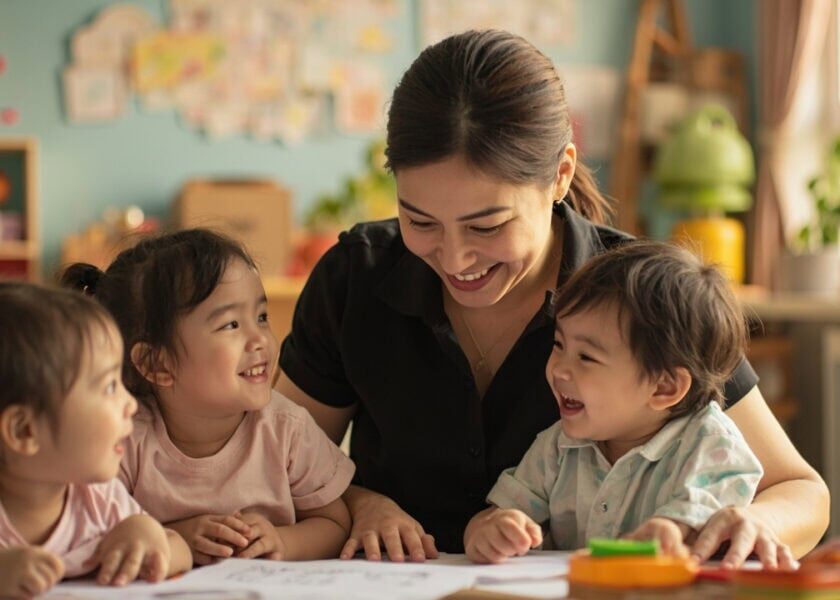
When a child is in an environment where their cues are noticed, where their cries are met with genuine attunement, where the caregiver is not just watching but truly relating, the internal model that forms is one of security. The child learns, at the deepest level of their being, that they can trust. That they are safe. That it is okay to be small and dependent and still completely deserving of love.
There is a misconception that comfort makes a child weak, that responding to need breeds complacency. But developmental science tells a different story.
A child who has a secure base — a caregiver they trust, a place they feel safe — is the child who eventually ventures further, explores more boldly, and takes genuine intellectual and social risks.
Security does not make a child clingy. It makes a child free. Because when the home base is solid, the exploring self can go further out and come back again. The child who knows they are held is the child who can eventually let go.
This is what quality childcare quietly gives your child. Not protection from the world, but a platform from which to meet it.
Four Capacities That Last
Emotional Literacy
In those hours with a responsive caregiver, your child is learning what it feels like to have an emotion and have that emotion matter. They are learning that frustration can be tolerated, that excitement can be shared, that sadness deserves comfort.
This is the beginning of emotional literacy — the ability to understand and eventually manage one’s inner world. It is the earliest form of self-awareness, and it develops not in isolation but in relationship, in the back-and-forth of being seen and responded to.
A Sense of Agency
The child in a quality care environment is also learning about agency. They are learning that their actions have effects:
- When they point at something, someone notices.
- When they express a need, someone responds.
- They are not passive recipients of care but active participants in their own world.
This sense of agency, planted early, grows into something essential: the belief that what you do matters, that you have some control over your circumstances, that you are not merely acted upon but are someone who can act. This is the seed of confidence — and it looks, from the outside, like a child who is comfortable in their own skin.
Relational Confidence
There is also something happening in the realm of relationship. The child who experiences consistent, warm caregiving is building a template for connection. They are learning, implicitly and profoundly:
- What it means to be close to someone
- How to read social cues
- How to trust
- How to repair trust when it frays
These are not skills taught in a lesson. They are absorbed, cell by cell, experience by experience, in the ordinary moments of care. And they become the relational architecture your child will carry into friendships, into school, into eventually their own families.
The Inner Compass
All of this — the security, the agency, the emotional vocabulary, the relational confidence — comes together in what you might call your child’s inner compass.
It is the quiet, lasting sense of self that guides them before they even know they are being guided. The internal voice that says: I am worthy, I can handle this, the world is not entirely unknown.
You will not always see this happening. That is the nature of the interior world. But you will see it later — in how your child walks into a room, how they handle disappointment, how they relate to other children, how they trust the world around them.
What Quality Care Looks Like in Practice
What builds a child’s inner compass is not elaborate curriculum or impressive facilities. It is human attention.
It is the ratio of caregivers to children that allows for genuine attunement — the ability to notice not just what a child is doing but what they are feeling. It is the consistency that allows a child to form a real attachment, to know that this person is mine, that they will be here tomorrow, that this relationship is stable and safe.
What to Look For
- Low caregiver-to-child ratios — especially for infants, where the ratio allows for real attunement rather than task-focused supervision
- Consistency of caregivers — your child forms a real attachment to specific people, not a rotating cast of faces
- Genuine responsiveness — your child’s cues are noticed and met with appropriate, warm responses
- Communication that goes beyond logistics — stories about your child’s discoveries, their social moments, their emerging personality
- An environment where your child is known — not as a statistic in a ratio, but as a person with preferences, rhythms, and a growing inner world
Addressing Your Real Concerns
How do I know what is happening when I am not there?
For many parents in Singapore, this is the central question. How do I trust what I cannot see?
These are not unreasonable questions. They are the questions of a parent who loves their child and takes their responsibility seriously.
Quality care providers understand this. Their approach includes the communication and transparency measures — including CCTV where deployed — that give parents the assurance they need without compromising the warmth and relational quality of the care itself.
Trust is not built by keeping parents out. It is built by giving parents windows into the world their child is inhabiting. By sending them home not just with a full tummy and a dry nappy but with stories of what made their child laugh today, what discovery they made, how they reached for another child and shared a smile. These are not just updates. They are proof that something real is happening in those hours.
How do we make this work financially?
For many families, there are practical considerations that make quality care feel out of reach. The ECDA Childminding Pilot addresses this with:
- Fee structures designed to be accessible for working families
- Care blocks that run Monday to Friday to fit working parents’ lives
- Usability of CDA and Baby Bonus funds that Singapore has thoughtfully made available to support early childhood
This is not about cutting corners. It is about removing unnecessary barriers so that more children can access the kind of care that builds what matters most.
The EduNanny Approach
EduNanny by BUTLER is built on the conviction that the early months and years are not just a period to be gotten through. They are a foundation to be built well — one interaction at a time, one consistent response at a time, one moment of genuine care at a time.
EduNanny’s approach recognizes that children need environments where the ratio of caregivers to infants — up to one to three in their infant care settings — allows for the kind of attention that actually builds that internal model of safety. Where caregivers are not rushing from one task to the next but are present, relational, attuned.
This is not a luxury. It is the mechanism by which your child’s inner world develops.
The Choice Before You
You are not less important because you are apart from your child during these hours. You are not failing them. You are making a choice — a choice that millions of parents in Singapore make every single day — and that choice does not have to mean a compromise in quality.
The hours you are not there do not have to be hours of lesser importance. They can be hours of profound, intentional, excellent care. Hours that are building the same architecture of security and worth that you would build yourself if you were there.
Here is the truth: the internal architecture I have been describing — the secure base, the inner compass, the emotional foundation — is not a privilege of the wealthy. It is a developmental right of every child.
Every infant in Singapore deserves to be in an environment that is building their capacity for security, for curiosity, for connection, for confidence. And every parent in Singapore deserves to have access to care they can trust, that they can believe in, that they do not have to second-guess.
A Note to the Parent Reading This
Your child is becoming someone in that room. Someone with an inner world that is rich and secure and full of possibility. Someone who has been held, not just physically but in their sense of self, by people who understood the weight of that holding.
Trust that. Trust the process. And trust that the choice you are making — the choice to seek out quality, to ask these questions, to care so much that it keeps you up at night — is already a sign that you are the kind of parent who builds children well.
The rest is just finding the right hands to build alongside you.
Questions to Ask When Choosing Infant Care
If you are researching childcare options in Singapore, here are some questions worth asking:
- What is the caregiver-to-child ratio, especially for infants?
- How consistent are the caregivers? Will my child form an attachment to specific people?
- How do caregivers respond to a child’s distress or need for comfort?
- What does a typical day look like in terms of responsiveness and interaction?
- How do you communicate with parents about what is happening beyond feeding and sleeping schedules?
- What training do caregivers receive in child development and attunement?
- How do you support a child’s emotional development and emerging sense of self?
The answers to these questions will tell you a great deal about whether the care environment is one that builds the internal compass your child deserves.
At EduNanny, every arrangement is designed to give parents the confidence that comes from knowing their child’s care environment is one where genuine attunement, consistent warmth, and thoughtful development are not afterthoughts — they are the foundation. If you are considering your options for infant care or childminding in Singapore, we would welcome the chance to speak with you about what quality care looks like in practice.
Because your child is becoming someone in that room. Make sure the room understands what it is building.