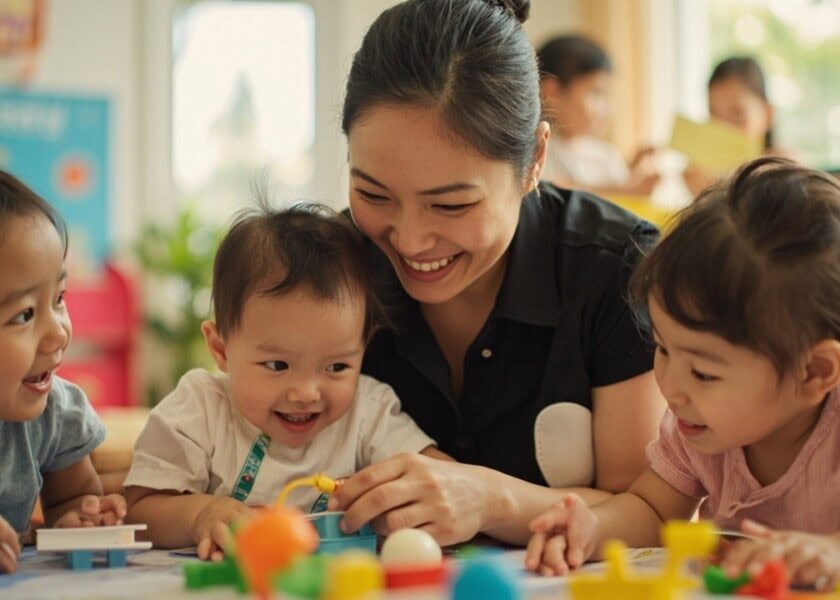
Building the Right Foundation: A Singapore Parent’s Guide to Childcare
The Quiet Weight of the Childcare Decision
There is a particular kind of quiet worry that lives beneath the surface of modern Singapore parenting. It does not announce itself at playgroup drop-offs or surface in conversation over coffee with other parents. But if you sit with it honestly, you will recognize it.
It is the feeling that something you do in these early years will matter enormously — and that you are somehow supposed to understand exactly what that something is, without ever being quite given the right framework to see it.
You know the decision matters. You feel it in your body when you visit a childcare centre, when you interview a caregiver, when you hand your child to someone new and watch their face for the reaction.
But knowing it matters and understanding why it matters and how it connects to everything that comes after — those are different things entirely.
This is where most parents in Singapore find themselves. Carrying an instinct they cannot quite articulate, surrounded by options that all look reasonable on paper, and searching for something that helps them see more clearly.
What I want to offer you today is exactly that: a way of seeing. Not a sales pitch, not a checklist. A framework. A lens through which the childcare decision becomes not just comprehensible but clarifying.
The Lens That Changes Everything: Childcare as Infrastructure
Here is the lens: quality childcare is not a service you purchase. It is infrastructure you build.
And like all infrastructure, its effects are invisible until they are decisive.
When engineers design a bridge, they are not thinking about how the bridge will look in photographs. They are thinking about load distribution, about stress points, about the way weight moves through a structure over time. They are designing for forces that will act on that bridge for decades, most of which cannot be seen on any given day.
A bridge that looks beautiful but was designed without understanding those forces will eventually fail. A bridge that looks modest but was engineered with precision will hold — through monsoon seasons, through heavy traffic, through the slow shifting of the ground beneath it.
Your Child’s Early Years Are That Kind of Structure
They look, from the outside, like a series of daily decisions. Who will look after my child? What hours do I need? How far is it from home or work?
These are real questions and they deserve real answers. But they are questions about the surface of the bridge, not the foundation beneath it.
The infrastructure that actually matters — the thing that will shape your child’s development, your family’s rhythm, your capacity to be the parent you want to be, your children’s readiness for school, the way your children relate to each other — that infrastructure is invisible on any given Tuesday. It shows up in years.
And by the time its effects are visible, the decision that shaped it is long past.
What Is Actually Being Designed: The Science of Early Experience
Let me take you inside that structure, so you can understand what is actually being designed.
The Architecture of a Developing Brain
In the first years of life, your child’s brain is constructing itself at a speed it will never again achieve. Neural connections are forming at a rate of more than one million per second in the earliest months. The pathways that form — the ones that strengthen, the ones that wither unused — will become the architecture of how your child thinks, feels, learns, and relates to others for the rest of their life.
This is not metaphor. This is developmental neuroscience, and it has been understood for decades.
What does this have to do with childcare? Everything. Because your child’s brain is not developing in a vacuum. It is developing in response to experiences, and the most consistent experiences in your child’s early life — beyond your own family — will be the care environment you choose.
What the Research Tells Us
The language that surrounds your child. The responsiveness of the adults around them. The emotional climate of the place where they spend their waking hours. The quality of interaction, not just the presence of supervision.
These are not soft considerations. They are load-bearing elements of your child’s developmental infrastructure.
A child who is consistently responded to — who learns that their signals matter, that the world is trustworthy, that their needs will be met — is building a different brain than a child who receives adequate but not attuned care.
A child who hears rich language, who is spoken to with genuine interest, who is included in conversations even before they can participate — is building different neural pathways than a child who is kept safe and comfortable but not engaged.
These differences do not appear on any report card in the first year. But by the time a child reaches Primary One, the developmental trajectories that began in infancy are already diverging in measurable ways.
The Singapore Reality: Why This Matters More Here
Now let me take this out of the abstract and bring it into the reality of Singapore family life, because this is where the stakes become unmistakably concrete.
Singapore is one of the most compressed parenting environments in the world.
- Dual-income families by economic necessity as much as by choice.
- A relatively compressed timeline between birth and the beginning of formal schooling.
- Parents working long hours, often far from extended family.
- One of the most demanding educational cultures on earth.
- A genuine shortage of what anthropologists call the village — the informal network of trusted kin and community that once surrounded every family raising young children.
This is not a complaint. It is a description of the structural reality that Singapore parents are navigating, whether or not they have named it clearly.
What This Means for Your Family
In this environment, the childcare decision is not just important. It is load-bearing.
If you are a dual-income family — and most of you are — then your childcare arrangement is the thing that allows your family to function. But that is only the most visible layer.
Beneath it, your childcare arrangement is also determining your family’s daily rhythm, your parental energy, your emotional reserves, your capacity to be present with your children when you are with them. It is either building you up or depleting you, week by week and year by year.
The families who have made a structurally sound childcare decision — who chose not just a convenient arrangement but a thoughtful one — they have a different quality of life. Not because they have more money or more help. Because they have a foundation.
Their mornings are not battles. Their evenings are not recovery marathons. They have capacity left over to enjoy their children, to be curious about them, to play, to read, to just be together without tension.
And this is not a luxury. This is what allows children to grow up feeling that their family is a reliable place, a place where they belong.
The Dimension Nobody Talks About: Siblings
The childcare decision is not only about your child. It is about your family’s capacity to function over years. Which brings me to siblings. This is a dimension that is almost entirely missing from the conversation about childcare, and its absence impoverishes both our understanding and our choices.
What You Are Actually Designing
When you have more than one child, you are not just managing logistics. You are shaping how siblings experience each other — how they learn to share, to compete, to cooperate, to love each other across the inevitable tensions of childhood.
The environment in which your children spend their days plays a significant role in shaping those sibling dynamics.
Think about it this way. If one child is in an environment that is warm and responsive, where they are flourishing, and the other child is in an environment that is merely adequate, where they are safe but not fully seen — what is happening to the relationship between those two children?
The child who is thriving may grow impatient with the child who is struggling. The child who is struggling may develop resentment or anxiety that spills into every interaction. The family dynamic shifts, often in ways that parents can feel but cannot name.
Or consider this: when siblings are in different care environments, they are having different developmental experiences every single day. They are building different skills, different social calibrations, different expectations. And then they come home and are expected to be a family together.
The infrastructure of their days is different, even within the same household.
Questions Worth Asking
Some families solve this by keeping siblings together in the same care arrangement. Others find that different children have different needs that are better met in different settings.
There is no universal right answer. But there is a question that almost no one is asking: What sibling relationship am I building through the choices I am making about how my children spend their days?
This is architectural thinking. It is not about finding the perfect solution. It is about understanding the forces at work and making choices that are in harmony with those forces rather than in ignorance of them.
The Truth About School Readiness
By the time a child reaches Primary One, the trajectory is largely set. Not irreversibly — children are remarkably resilient, and the brain retains plasticity throughout life. But largely set.
The foundations of attention, of emotional regulation, of language, of social confidence, of the love of learning itself — these are built in the years before formal schooling begins. And if they have not been built, you cannot build them quickly in Primary One. You can remedy, but you cannot compress the developmental work that should have happened in the years before.
The Misunderstanding That Costs Families
Singapore parents know, with a kind of low-grade terror, that the education system is demanding. They feel the pressure to prepare their children.
And so, in many families, the years before Primary One become a season of drilling — alphabet cards, math worksheets, Chinese vocabulary drills.
The assumption is that school readiness means academic readiness, and academic readiness means being able to do the things that school will ask.
This is a profound misunderstanding of what school readiness actually is.
What the Research Actually Shows
The skills that predict academic success are not the skills you can drill in the year before Primary One. They are things like:
- The ability to sustain attention
- To manage frustration
- To follow multi-step instructions
- To regulate emotional arousal
- To engage socially with peers and authority figures
- To be curious and to persist in the face of difficulty
- To be comfortable in a group setting
These are not academic skills. They are foundational capacities that emerge from the quality of early care, from the language environment, from the responsiveness of caregivers, from the richness of early experience.
The Difference That Matters
A child who has spent their early years in an environment that builds these capacities will walk into Primary One ready to learn. Not because they know more words or can count higher. Because they are ready — emotionally, socially, attentively — to engage with what school offers.
A child who has spent their early years in a merely custodial environment, however safe and however well-intentioned, may have the surface knowledge but not the underlying readiness. And you cannot give someone readiness in a year. Readiness takes years to build.
This is why the childcare decision matters so much for school readiness. It is not about finding the best enrichment centre in the year before Primary One. It is about what is being built in every year before that, in the daily experience of care.
What Quality Childminding Actually Looks Like
So let me now ask the practical question: what should you actually be looking for? If childcare is infrastructure, what are the load-bearing elements?
Continuity
Children develop trust and security through consistent relationships. When caregivers change frequently, children spend their emotional energy on adaptation rather than development. They are managing uncertainty instead of exploring the world.
Ask yourself: How long has the primary caregiver been in this role? What is the approach to minimising transitions for children?
Responsiveness
Not just supervision. Not just safety. The quality of being truly seen and responded to by the adults in their environment.
This is the thing that builds secure attachment, that supports emotional regulation, that tells a child their signals matter in the world.
Ask: What is the adult-to-child ratio? How do caregivers respond when a child is distressed? How is the emotional climate of the environment described?
Language Environment
The single most powerful intervention in early childhood development that we know of is the quality and quantity of language exposure.
Children who hear rich, responsive, conversational language — not baby talk, not television, not adult speech directed at other adults, but genuine conversation that includes the child — these children build dramatically stronger language and cognitive foundations.
Ask: How do caregivers talk with children? What does a typical day sound like? How are children included in conversation?
Emotional Climate
This is harder to define but essential to feel. Walk into a space and notice: Is this a place where children seem happy? Where adults seem engaged rather than stressed? Where there is warmth in the air?
You know the difference between a place that merely keeps children safe and a place that nurtures them. Trust that knowing.
What to Look For: The Questions That Matter
When you are evaluating childcare options — whether a centre, a family care arrangement, or a childminding programme — the questions that matter most are the ones that get at structure rather than surface.
These are the questions that thoughtful parents in Singapore are increasingly asking, because they understand that what happens in the early years shapes what happens for years to come.
Continuity and Consistency
Children develop trust and security through consistent relationships. When caregivers change frequently, children spend their emotional energy on adaptation rather than development. They are managing uncertainty instead of exploring the world.
Questions to ask: How long has the primary caregiver been in this role? What is the approach to minimising transitions for children? Will my child have a consistent, named caregiver?
Responsive Caregiving
Not just supervision. Not just safety. The quality of being truly seen and responded to by the adults in their environment.
This is the thing that builds secure attachment, that supports emotional regulation, that tells a child their signals matter in the world.
Questions to ask: What is the adult-to-child ratio? How do caregivers respond when a child is distressed? Is there genuine warmth in the interactions you observe?
Language Environment
The single most powerful intervention in early childhood development is the quality and quantity of language exposure. Children who hear rich, responsive, conversational language — genuine conversation that includes the child — build dramatically stronger language and cognitive foundations.
Questions to ask: How do caregivers talk with children? What does a typical day sound like? How are children included in conversation, not just directed?
Professional Standards
In an environment where every interaction between caregiver and child is load-bearing for development, professional standards are not a luxury. They are foundational. Training, ratios, oversight — these structural elements determine whether quality is an aspiration or a reality.
Questions to ask: What training do caregivers have? Is the programme registered with or recognised by relevant authorities? Are there structured approaches to child development, not just childcare?
EduNanny: Built for the Foundation Singapore Families Need
Now let me speak to whatEduNanny offers, because this is where the framework meets the reality of what Singapore families actually need.
EduNanny is built on a conviction that matches the framework I have been describing: that childcare is not a service to be purchased but a foundation to be built. It is designed as developmental infrastructure — the kind of thoughtful, structured care that supports what parents in Singapore are actually trying to create.
A Programme That Takes Development Seriously
EduNanny participates in the ECDA Childminding Pilot, representing a genuine commitment to professionalising and structuring the kind of home-based and community-based care that Singapore families need.
This is not a loophole or a workaround. It is a recognition that the village we need in Singapore will not be built by replicating the childcare models of other countries. It will be built by understanding what Singapore families actually need — the flexibility, the trust, the quality, the affordability — and designing for that.
The Numbers That Matter
The infant ratios that EduNanny maintains — up to one to three, depending on the arrangement — are a structural commitment to responsiveness. In an environment where every interaction between caregiver and child is load-bearing for development, ratio is not a detail. It is foundational.
Access and Affordability
The fee structures within the pilot are designed to make quality care accessible rather than a luxury. For families using CDA or Baby Bonus funds, these structures are designed to be usable, because the infrastructure of childcare should not be designed only for families who can pay premium rates. It should be designed for the families who need it.
Trust Infrastructure
The communication and transparency measures — including CCTV where deployed — are not about surveillance. They are about trust infrastructure. Singapore parents need to be able to trust the places where their children spend their days, and trust requires transparency. Parental peace of mind is not a soft concern. It is part of what allows families to function.
Support for Parents
One of the things that depletes Singapore parents — who are already running on compressed timelines, who are juggling demanding work with demanding family life — is the mental load of uncertainty.
What should I be doing? Is this normal? What do I do if?
Thomas, the AI chatbot that EduNanny offers, is designed as a resource for parents — a way of getting thoughtful, immediate answers to the questions that arise at odd hours, between appointments, in the moments when you need support and do not have a human expert immediately available.
The Decision in Front of You
Here is what distinguishes architectural thinking from transactional thinking.
A transactional relationship asks: Did they keep my child safe today? Did they follow the schedule? Did they feed him the right things?
These are reasonable questions. But they are questions about whether a service was rendered, not about whether a foundation is being built.
An architectural relationship asks: What is being built inside my child today? How is this environment shaping her developing brain, her sense of security, her language, her social confidence? Am I making structural choices that will serve my family well in five years, in ten years?
These are harder questions. But they are the right questions.
If You Are Wondering Whether You Are Overthinking This
You are not overthinking this. You are thinking about it at the level it deserves to be thought about.
The parents who build well in Singapore are not the ones who have the most resources or the most knowledge. They are the ones who ask the right questions. Who refuse to accept surface-level answers to structural questions.
If You Cannot See What Is Happening
Ask about ratios. Ask about caregiver training and continuity. Ask about the language environment. Ask to observe — and notice what you feel when you are there. Trust your instincts, but ground them in questions that get at structure rather than surface.
If You Made a Different Choice Before
Children are remarkably resilient. The brain retains plasticity throughout life. No single decision is irreversible.
If you are questioning your arrangement, that questioning itself is a sign of thoughtfulness. The question is not whether you were perfect in the past. The question is what you are building now and going forward.
Understanding Reframes Everything
Choosing childcare is not like choosing a restaurant for dinner. It is more like choosing a foundation for a house.
You will live in that house for decades. You will raise your children in it. You will have the life that this foundation can support — or cannot support.
That is what this decision is. Not a choice you make. A foundation you lay.
The children you are raising deserve nothing less than a foundation built with intention, with care, and with understanding of what is actually at stake.
Questions to Ask Yourself
Before you make your next decision about childcare — or before you evaluate the one you have — take a moment to ask yourself these questions:
- What am I actually choosing here: a service for today, or an environment that will shape my child’s development for years?
- Am I choosing based on what is convenient, or based on what is structurally sound?
- What does this arrangement say about what I believe matters in early childhood?
- Am I building the kind of family rhythm that will sustain us, or the kind that will deplete us?
- What sibling dynamics am I shaping through these choices?
- What capacities am I building — or not building — toward Primary One and beyond?
These are not comfortable questions. But they are honest ones. And honesty is the beginning of building well.
The anxiety you feel is not a weakness. It is your intelligence telling you that this matters.
Listen to it. Let it guide you toward the kind of thinking that matches the weight of the decision.
You have what it takes to make this decision well. You have been given a framework.
If you are looking for a childcare arrangement that was built with this kind of understanding — one designed as developmental infrastructure rather than as a transaction — EduNanny welcomes conversations with families who are thinking carefully about these questions.
Learn more about EduNanny’s approach to childminding in Singapore or read about who we are and what we stand for.