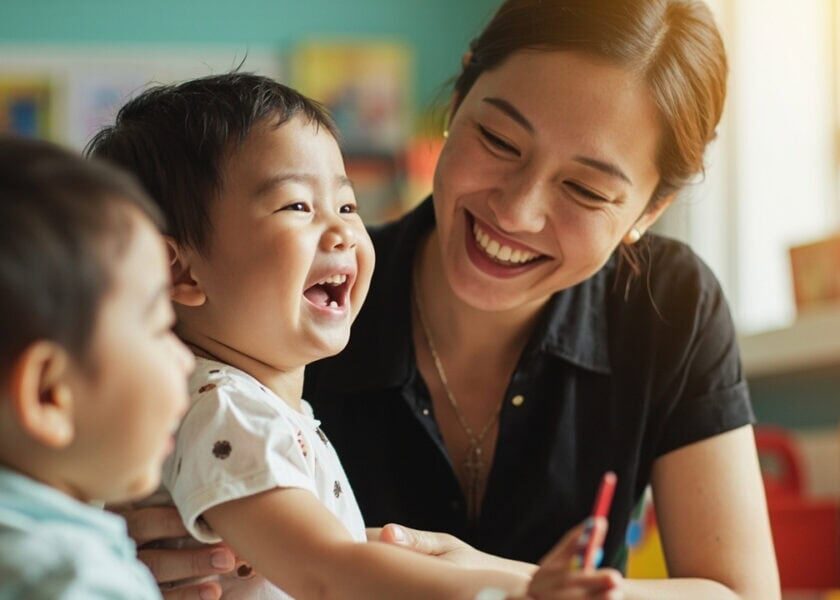
What Singapore Parents Learn to See in Childcare
The Quiet Question Every Singapore Parent Asks About Childcare
There is a moment that most parents in Singapore know well. It often comes at the end of a childcare visit—after the tour, after the conversation with the caregiver, after the credentials have been confirmed and the checklist reviewed.
You have done your research. The centre is well-reviewed. The ratios meet the standards. On paper, everything looks right.
And yet.
There is a small, persistent question that lingers—not loud enough to dismiss, not sharp enough to name. It asks whether the warmth you observed was genuine. Whether the connection you sensed was real. Whether the person who will spend their days with your child truly loves what they do or simply performs it well.
This is not doubt born of anxiety. It is something more honest than that. It is the voice of parental instinct, and it is asking the right question.
You are not wondering whether the facility is adequate. You are wondering whether the relationship is genuine.
And that question—that quiet and deeply reasonable question—is exactly where we need to begin.
Why Checklists Tell You Only Half the Story
For years, the conversation around choosing childcare has centred on what can be measured. We ask about certifications and ratios. We ask about curriculum frameworks and safety protocols. We ask about hours, fees, and proximity to home or work.
These are necessary questions, and they matter. A centre that meets the standards offers a baseline—a floor beneath which quality should not fall. In Singapore, where the Early Childhood Development Agency (ECDA) regulates childcare standards, these benchmarks provide important reassurance.
But here is what many parents discover: these measures tell you whether a childcare arrangement is possible. They do not tell you whether it is right.
A caregiver can hold all the right credentials and still offer only surface-level attention. A facility can be immaculate and bright and still lack the quiet attunement that a child truly needs in those early, formative years. Checklists confirm that certain conditions exist. They do not capture the relationship between the person caring for your child and the child themselves.
And that relationship—visible or invisible, spoken or silent—is the most honest signal you have.
What Genuine Attunement Looks Like in Practice
Let us talk about what this looks like, because this is where the abstract becomes real.
Imagine you are watching a caregiver with an infant—not performing for you, not aware of being observed, simply doing what they do. A moment comes when the child grows upset. Perhaps they are hungry, or tired, or simply experiencing the particular frustration of being unable to articulate a need.
Watch what happens next.
A trained and genuinely attentive caregiver does not simply respond to the distress. They receive it. There is a quality of attention that precedes any action—a stillness, a focus, an attempt to understand what is happening beneath the surface of the cry.
The caregiver is not thinking about what they should do. They are wondering what the child needs, and allowing that question to guide them.
Responsiveness that is trained can be quick and efficient. But responsiveness rooted in genuine attunement has a different texture. It is curious. It is patient. It adapts not to an abstract model of infant care but to the specific, unrepeatable child in front of them.
The Child’s Response
Now watch the child.
A child who feels safe with their caregiver responds to distress differently over time. The cry that once meant full-body panic begins to carry a different quality—not the panic of abandonment, but the frustration of a need not yet met.
The child looks toward the caregiver, not away from them. There is a reaching, a seeking, a trust that the one who understands them is nearby.
This is what secure attachment looks like in a childcare setting. It is not dramatic. It does not announce itself with grand gestures. It is quiet, ongoing, and consistent.
Reading the Transition Moments
Consider, too, the transition moments. These reveal the most, precisely because they are hardest to perform.
When a parent brings their child to the caregiver in the morning, watch what happens:
- Does the child move toward the caregiver with some willingness, some recognition, some ease?
- Does the caregiver greet the child with a warmth that the child receives rather than merely witnesses?
- Or does the child cling more tightly to the parent—not in the ordinary way that children sometimes do, but with a tension that suggests uncertainty about what lies ahead?
- Does the caregiver step back, waiting for the parent to manage the transition alone?
A well-trained, genuinely connected caregiver understands this. They do not force the handoff. They create a bridge. They allow the child to move from one relationship to another with as little friction as possible, because they understand that this bridge—built consistently over time—is what allows the child to feel safe enough to learn and grow.
Performed Care Versus Genuine Connection
Performed care looks good. It can be warm, attentive, and professional. It checks the boxes. A caregiver who is performing care will smile at the right moments, engage with appropriate enthusiasm, and follow the routines with competence. You might watch them and feel reassured.
But performed care does not have a quality of presence that goes beyond the script. It does not pause to wonder. It does not adapt to the specific child in front of them. It is consistent in the way that a well-rehearsed role is consistent, not in the way that a genuine relationship is consistent.
Genuine connection is harder to describe, but easier to feel. It has a quality of life in it. The caregiver is not just doing their job; they are in relationship. They notice things. They remember things. They respond to the child as a person, not a task.
Children know the difference. Long before they have language to tell you, they know. Their bodies know. Their nervous systems know.
A child in the presence of performed care will be manageable, perhaps even happy in a surface way. But a child in the presence of genuine connection will thrive in a way that is deeper and more visible over time.
Developing the Skill of Observation
If this relationship is so important, how do you find it? How do you know whether the caregiver you are considering is capable of this kind of genuine connection?
The honest answer is that you cannot know for certain, because any relationship takes time to form. But what you can do is learn to observe the conditions that allow this relationship to develop.
And this is one of the most important things we want to offer you: not a guarantee, but a skill.
The skill of observation. The ability to read the caregiver-child dynamic with growing clarity, so that you can make your decision with both your head and your heart, and so that you can continue to assess the quality of care over time—not just at the moment of choosing.
This skill is built through attention. It is built by watching—not just at the arranged visit, but in the quieter, more revealing moments we have been discussing. It is built by learning to notice:
- The quality of responsiveness when a child is distressed
- The texture of the transition between parent and caregiver
- The way a child’s body relaxes when their caregiver enters the room
- Whether the caregiver anticipates needs or only reacts to them
- Whether the child seeks the caregiver out during play, or remains peripheral to the interaction
When you develop this skill, something shifts. The anxiety of uncertainty does not disappear entirely, but it is replaced by something more useful. You develop what we might call informed intuition—the ability to see the relationship for what it is, and to trust what you see.
This skill extends beyond childcare decisions. When you learn to observe the caregiver-child relationship with clarity, you become more attuned to your own child’s signals. You become better at noticing when they are genuinely secure and when something is amiss. You become a more confident reader of your child’s emotional landscape, and that confidence changes how you parent.
How EduNanny Creates the Conditions for Genuine Connection
This brings us to why we do what we do, and why EduNanny exists as we do.
The childcare landscape in Singapore offers many options, and we do not pretend that ours is the only path to quality. But we have built our approach around a conviction that matters deeply: that the caregiver-child relationship is not a secondary concern. It is the primary condition. It is what everything else depends on.
Training for Attunement, Not Just Competence
Our caregivers are trained not only in the technical skills of infant care—though those skills are essential—but in the relational dimensions that make the difference between adequate care and excellent care. They learn to observe, to attune, to respond with curiosity rather than routine.
This means going beyond the standard curriculum to address questions that are harder to measure but no less important: How do you read a baby’s cry? What does it mean to wait before responding? How do you build trust with an infant who has just entered your care?
Home-Based and Centre-Based Pathways
We participate in the ECDA Childminding Pilot because we believe in the framework it represents. Home-based care, when it is truly excellent, offers something that centre-based care cannot always replicate: a smaller, more intimate environment where the caregiver-child ratio allows for genuine attunement.
We offer both home-based and centre-based pathways, because different families have different needs, and because the conditions that support excellent care can be created in more than one setting.
Ratios That Make Attention Possible
Our infant ratios—up to one to three, depending on the pathway—are designed not simply to meet regulatory standards but to make the kind of attention we believe matters actually possible.
When a caregiver is responsible for fewer children, they can know each one more fully. They can notice the subtle shifts in mood that precede a meltdown. They can respond to the child who is about to climb rather than the child who has already fallen.
For the youngest children, whose communication is still primarily emotional and non-verbal, this is not a luxury. It is a necessity.
Transparency for Singapore Parents
We know that Singapore parents carry a particular weight when it comes to childcare. You are navigating one of the most demanding urban environments in the world, balancing career expectations, family obligations, and the genuine desire to give your child the best possible start.
Where deployed, our centres have CCTV measures that allow parents to observe what is happening with their child in real time. We provide regular updates, and we take questions seriously. We do not believe that trust should be built on blind faith. We believe it should be built on honest information, shared openly.
We also understand the practical pressures that Singapore parents face. Our pilot fee structures are designed to be affordable. We accept CDA and Baby Bonus funds where applicable. Monday to Friday care blocks are structured around the realities of working parents. Our services are available across Singapore, because excellent care should not be available only to those who live in certain districts or work in certain industries.
Practical Advice for Choosing Infant Care in Singapore
If you are in the process of evaluating childcare options, here is guidance that may help:
During Your Visit
- Watch, do not just listen. Pay attention to moments when the caregiver is not interacting with you—their natural responsiveness to children reveals more than their responses to your questions.
- Observe transitions. How does the caregiver handle children arriving or departing? Do they create bridges or wait for parents to manage alone?
- Notice bodies, not just faces. A child’s body language—their ease or tension, their proximity to the caregiver—tells you something their face might not.
- Ask about their approach, not just their qualifications. “What do you enjoy most about this work?” and “How do you typically respond when a child is upset?” reveal relational priorities that certificates cannot capture.
After Your Visit
- Reflect honestly. Did what you observed feel alive, or performed? Your instinct is a data point, not a distraction.
- Ask to return. A second visit, perhaps at a different time, may reveal more than the first.
- Trust the accumulation of small signals. No single moment is definitive, but patterns emerge. Look for consistency across visits.
The table below summarises the key differences between performed care and genuine attunement:
| Observed Quality | Performed Care | Genuine Attunement |
|---|---|---|
| Response to distress | Quick, efficient, script-following | Curious, patient, adapted to the specific child |
| Transition handling | Waits for parent to manage handoff | Creates a bridge; meets the child where they are |
| Quality of presence | Warm but contained within professional role | Lived, relational, noticing and remembering |
| Child’s body language | Manageable, sometimes peripheral to caregiver | At ease, seeking proximity, trusting |
The Answer Was Always There
So let us return to that quiet moment we began with.
You are standing at the end of a visit, after the tour, after the conversation, after the checklist has been reviewed. You are wondering whether the warmth you observed was genuine. You are wondering whether the connection you sensed was real.
We want to tell you that this question is not a weakness. It is a form of wisdom. It is your parental instinct doing exactly what it is supposed to do—looking beneath the surface for the truth that matters most.
And we want to tell you that the answer to this question lies in learning to see what is already there.
The caregiver-child relationship is speaking to you, in every visit, in every transition, in every moment of responsiveness and attunement. You do not need special training to hear it. You need only to look, and to trust what you see.
When you see genuine attachment—real, observable, consistent connection between caregiver and child—you will know. Not because someone has told you what to look for, but because it will feel true.
It will feel like the kind of care your child deserves.
It will feel like peace.
When you are ready to know for certain, we are here. Get in touch to arrange a visit, ask your questions, and see for yourself what genuine attunement looks like in practice.
Learn more about who we are and how EduNanny supports Singapore families.