Why Sibling Conflict Is the Beginning of Partnership
The Question Every Parent Carries (But Doesn’t Always Name)
If you have more than one child, you know this feeling. It lives beneath the surface of the daily routine — the bickering over toys, the tears after a sharp word, the third timeout in an hour over the same toy truck. In those moments, a small and uncomfortable question whispers: Am I doing this right? Are they going to be okay? Are they going to be okay with each other?
Here is what I want to say clearly, because I think it matters enormously and we don’t say it clearly enough: sibling conflict is not a sign that you are failing. It is not a sign that your children are destined to be rivals or strangers.
Conflict between siblings is one of the most developmentally rich experiences a child can have. It is the raw material out of which the deepest relational skills are built:
- The ability to negotiate
- To be disappointed and recover
- To see another person’s point of view
- To learn that the world does not always give you what you want
- To discover that someone you love can be the one who doesn’t give it to you — and that you can survive that, and that your love can actually grow stronger because of it
But here is the tension every parent with multiple children feels. Conflict, on its own, does not build partnership. Conflict left without guidance can calcify. It can become the pattern — the sulking instead of speaking, the retreat instead of repair, the memory of the time she broke my toy and no one made her say sorry.
Children need more than the experience of conflict. They need a setting in which conflict is met with something — a hand on a shoulder, a calm voice, a question that helps them name what they’re feeling, a framework that says: what you did hurt her, and here is how we come back from that.
They need a place where disagreement does not end the relationship but becomes the very thing that makes the relationship stronger.
And this is where the question of childcare becomes so much more important than we typically let it be.
What Quality Childcare Actually Does
When we think about childcare — really think about it, not just as a logistics solution to who watches your children while you work — we tend to think about safety. We think about whether our child will be fed the right things, whether they will nap enough, whether they will be loved.
All of that is right. All of that matters. At EduNanny Singapore, we believe that all of that is non-negotiable.
But there is something else that quality childcare does that is less visible, harder to measure, and in many ways far more consequential: it creates a peer world.
A world in which children must learn to be in relationship with each other — not just with adults who love them unconditionally, but with other children who are also learning, also selfish in the way young children are selfish, also struggling, also magnificent.
The Mirror That Grows a Person
In this peer world, your children encounter something they cannot get from you or any single adult, no matter how devoted: a mirror.
A sibling — whether a biological sibling in the same programme or a peer who becomes something like a sibling in the texture of daily closeness — reflects back to your child who they are when they are not being protected by the biases of family love.
And that mirror is uncomfortable. It is challenging. It is precisely the kind of discomfort that grows a person.
What Trained Caregivers Actually Do
Now let me be specific, because this is where the difference between ordinary childcare and quality care becomes real.
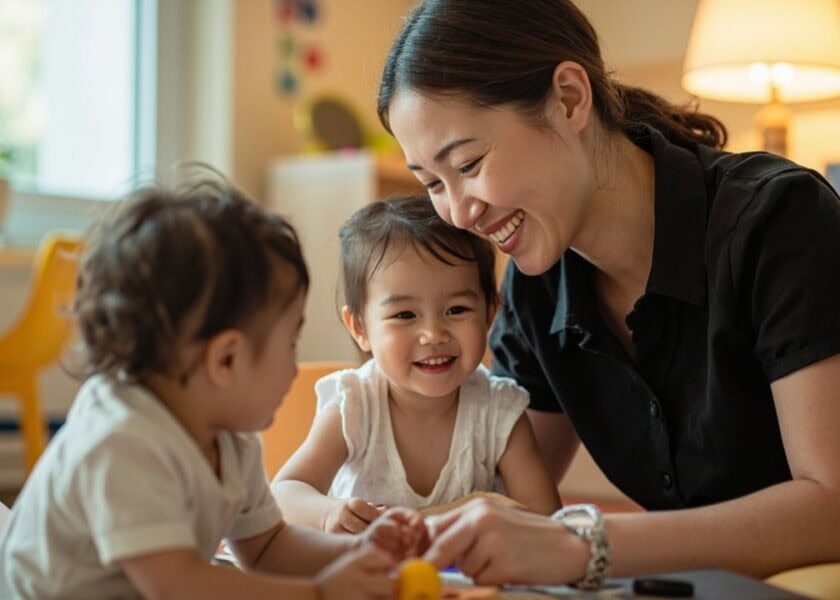
When two children in a quality care setting disagree over a block of wood that both of them wanted, a trained caregiver does not simply intervene with a ruling. That is what many of us do at home, and it is exhausting, and it rarely teaches what we think it teaches.
What a trained caregiver does is something more subtle and far more powerful:
- They slow the moment down
- They help each child name what they are feeling — “I see that you wanted that and you didn’t get it, and that made you feel angry”
- They ask questions that build perspective-taking — “Do you know why she reached for it? Do you know what she was feeling?”
- They stay with the discomfort. They do not rush to make the children be friends again. They give the children the dignity of working through it, with support, until the resolution comes from the children themselves — not from the adult who imposed it.
That process — the slow, patient, trained coaching of conflict into cooperation — is something that happens again and again in quality care settings. It is not accidental. It is not a happy coincidence. It is the result of caregivers who understand child development deeply enough to know that conflict is not a problem to be eliminated but a curriculum to be taught.
The Sibling-Specific Gift of Quality Care
Here is what this means for siblings specifically, because this is where we often lose sight of something important.
Siblings in the same household who bicker and fight and make each other cry are not necessarily learning to resolve conflict. Sometimes they are learning to escalate, or to avoid, or to win.
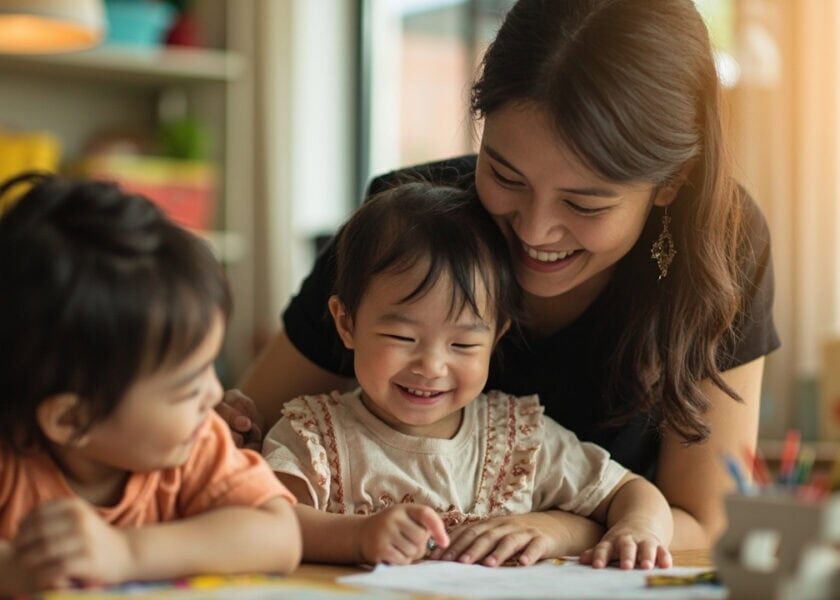
But siblings in a quality care environment who have that same conflict — who have that same pushing and pulling and frustration — and who are met by a caregiver who knows how to make something meaningful out of the moment — those siblings are learning something different.
They are learning:
- That disagreement does not end us
- That the person who upset me is also the person I can build something with
- That choosing each other is not just something we do because we have to, but something we learn to do because we have practiced it, and it works, and it feels like the beginning of something rather than the end of something
The Freshness of Skilled Observation
There is something that happens when siblings are in a quality care environment together — something almost impossible to replicate at home, no matter how intentional a parent you are.
At home, even with the most devoted and skilled parents, children are always, to some degree, in a hierarchy. There is the older one and the younger one. There is the one who gets to stay up later and the one who goes to bed earlier. There is the way parents naturally, and necessarily, protect the youngest and ask more of the older.
This is right. This is what parents should do.
But it means that at home, the sibling relationship is always filtered through the parent-child relationship. The children are not quite equals. They are not quite free to find their own footing with each other.
In a quality care setting, something shifts. The caregiver does not have the same parental hierarchy. They can see both children with fresh eyes — without the accumulated weight of years of parental memory, the time she said that thing in the car when she was four, the way he cried for three hours that one birthday, all the stories we carry about who our children are.
A skilled caregiver can see who your children are in this moment, with each other, and respond to that.
And that freshness is a gift. It allows the sibling relationship to breathe, to find its own shape, its own rules, its own rhythms — the way your children learn to include each other, defer to each other, challenge each other, amuse each other. It allows them to build something together that belongs to them, not just to the family.
The Shared Intelligence Siblings Build
Children are astonishing at this. Left in a quality environment with skilled guidance, siblings begin to develop what you might call a shared intelligence.
They learn each other’s rhythms, each other’s vulnerabilities, each other’s strengths. They develop a shorthand. They begin to protect each other, to advocate for each other, to find joy in each other’s company that is different from the joy they find with their parents.
And this — this shared intelligence, this bond that grows out of daily life together, shaped by skilled guidance — is the beginning of what we call sibling partnership.
Not just siblings who live together. Siblings who have chosen each other, and who have practiced choosing each other, in a setting that gives them the tools to do it well.
Why EduNanny Singapore: Trust, Access, and Partnership
The philosophy I have been describing is not just an ideal. It is a practice, and it is built into the very structure of what EduNanny offers families in Singapore.
The ECDA Childminding Pilot
EduNanny by BUTLER operates under the ECDA Childminding Pilot, and this matters for reasons that go beyond policy. The pilot reflects a conviction that childcare is not a one-size-fits-all equation.
For families who want their children in a home environment — where the ratios are small, where the care feels personal, where an infant or a young child can develop trust and security in a setting that resembles home — the home-based pathway through EduNanny offers up to a one-to-three infant ratio.
That number is not arbitrary. It is chosen deliberately, because it means that every child in that space is known. Not managed. Not supervised. Known.
And for siblings, that intimacy matters enormously. A smaller ratio means that the caregiver can do what I have described — the coaching, the staying, the patient work of turning conflict into partnership — because they are not spread across a room of ten children. They are present, in a way that is only possible when the numbers allow it.
Trust and Transparency for Singapore Parents
For Singapore parents, trust is not a small thing. You are entrusting your children — your most precious, irreplaceable gifts — to someone else’s care during the hours that you cannot be there.
We understand that. We do not take it lightly.
EduNanny’s programmes include open communication and transparency measures, including CCTV where deployed, because we believe that parents deserve to know not just what is happening in their child’s day but how it is happening, and why. You should never have to guess whether your child had a good day. You should be able to see it, hear about it, and feel confident that the people caring for your children are people you can trust — not just people you have to trust because you have no other choice.
Affordable Access to Quality Care
Quality care should not be a luxury available only to the wealthiest families. It should be within reach for families who want it, because what we are doing matters too much to be gated by economics.
The Childminding Pilot operates within fee structures designed to make quality care accessible to families across Singapore. Where applicable, parents can access their Children’s Development Account and Baby Bonus schemes to offset care costs.
EduNanny’s care is available Monday through Friday in structured care blocks, and the programme serves families across Singapore — because the need for quality care does not know a postal code.
Centre-Based Community Option
For families who prefer a centre-based community, EduNanny also offers pathways through centre-based programmes, where children benefit from peer interaction with a broader group of their contemporaries — a community that extends beyond the family and mirrors, in some ways, the broader social world they will grow into.
Both pathways share the same foundational commitment: that every child deserves care that sees them as a whole person, not a set of needs to be met.
Building Sibling Partnership: At Care and At Home
The partnership that quality care cultivates does not end when you pick your children up at the end of the day. In fact, some of the most important work happens in the hours between the end of care and bedtime.
Here is something practical and close to hand.
When you pick your children up, resist the urge to ask only about what they ate and when they napped. Ask instead about who they played with. Ask about a hard moment. Ask, if you have two children in the programme, what they did together.
- Did they build something?
- Did they argue?
- Did they make each other laugh?
These questions send a message — a profound, quiet message that says: the relationship between you matters. I am interested in it. I want to know about it.
And then, when conflict arises at home — and it will, because you are raising human beings, not angels — you can reference what the caregivers do. You can slow it down the way the caregiver would. You can ask the questions that build perspective-taking. You can say, remember when Teacher taught us that when someone is feeling big feelings, the kindest thing we can do is wait?
You are not alone in this. You are part of a village. And that village includes the trained, skilled caregivers at EduNanny who are doing this work alongside you every single day.
This is what we mean when we talk about partnership — not just between siblings, but between the family and the care environment. Between you and the people who hold your children for the hours you cannot. It is a relationship built on trust, on communication, on the shared conviction that your children deserve the very best of what early childhood care can offer.
The Hope That Is Also a Plan
The relationship between your children is one of the most important relationships they will ever have.
Not because it will replace the relationship they have with you — it never will, and it shouldn’t. But because it is the relationship that will outlast your own. Long after you are gone, your children will still be here, still navigating the world, still needing someone who understands the particular weight of having come from the same place.
And the sibling bond — the one that goes beyond obligation, beyond shared genetics, beyond the name on the mailbox — that bond is not something that just happens. It is built. Deliberately, patiently, over hundreds of small moments — moments of conflict and resolution, of sharing and being denied, of learning to see another person clearly and choosing to stay close anyway.
You cannot manufacture this alone. No parent can. Not because you are failing, but because the sibling relationship needs something that parents, by our very nature, cannot provide for our own children: it needs to exist outside the orbit of parental authority. It needs a space where children can find their own way to each other, with guidance that is skilled but not parental, present but not protective in the way that parents must be.
That space is quality childcare. And specifically, that space is EduNanny.
A Choice You Can Make with Confidence
Somewhere in the quiet of your own home, after the dishes are done and the children are finally asleep, have you ever found yourself watching them together and felt something that goes deeper than ordinary pride? Not just the pride of watching your daughter tie her shoe or your son learn a new word — but something else. Something that asks, without words, a question that feels almost too large to hold.
The question is this: will they still choose each other?
Not because they have to. Not because they share a name or a home or a set of parents who love them. But because, when they are thirty or forty or sixty years old, something in them will still reach for their brother or their sister — in joy, in crisis, in the ordinary middle of an ordinary Tuesday — and find a person who knows them in a way no one else alive does.
There is a hope that lives in the hearts of parents with more than one child. It is so quiet that sometimes we don’t even know it’s there.
It is the hope that our children will not merely tolerate each other, not merely coexist, but that they will choose each other. Again and again, across the whole of their lives. That when one of them falls, the other will reach down. That when one of them succeeds, the other will feel joy.
That the answer to the question — will they still choose each other — will always, always be yes.
That hope is not naive. It is not sentimental. It is one of the most profound and forward-looking hopes a parent can hold.
And it is not just a hope. It is something you can build — deliberately, patiently, with the right support, in the right environment, starting from the earliest years of your children’s lives together.
EduNanny Singapore is here for families across this island. Not just childcare. Not just a solution to a logistical problem. But a place — home-based or community-based, staffed by trained caregivers who understand child development with both the precision of professional knowledge and the warmth of human care — where your children learn to be in relationship, where they practice the skills of partnership, where conflict becomes a curriculum and not a catastrophe.
Where the invisible work of growing siblings who are also partners happens, quietly, every single day.
Your children are not just yours. They are also, already, beginning to belong to each other.
And what we do, in these early years, in the right environment, with skilled hands and open hearts — what we do is make sure that when they reach for each other, across all the years ahead, they know exactly how.
If you’re exploring quality childcare options for your family, we invite you to speak with our team about the home-based and centre-based pathways available. Learn more about who we are and how EduNanny Singapore can become part of the village helping your children become partners for life.