The Relay, Not the Surrender: Navigating Your Child’s Transition Morning
Understanding the Transition Morning
When you hand your child to a caregiver, your child’s nervous system registers a change. This is not a failure of attachment. This is a child whose attachment system is working precisely as it should—a child who experiences genuine distress at separation because the bond is real.
What happens next, in the next ten to fifteen minutes, tells you almost everything you need to know about whether the care arrangement is right for your family.
Healthy Adaptation vs. Genuine Distress
A child who is adapting—even if initially distressed—will gradually settle. The crying will soften or change in quality. The child will allow themselves to be soothed by the caregiver, will turn toward an offered toy or a window or the sight of other children.
There may be peaks and valleys. A moment of calm followed by renewed protest when your face is mentioned, or when the door opens and closes. But there will be a trajectory toward regulation. This is the expected arc of healthy adaptation.
A child who is in genuine distress will not show this trajectory. The crying will remain high and consistent. The child will not be comforted by the caregiver. Physical symptoms may emerge: refusal to eat, vomiting, fever that appears only at drop-off and disappears by pickup. The child may become withdrawn, refusing interaction entirely, or may become aggressive in ways that are uncharacteristic.
These patterns persisting beyond the first few weeks are signals worth taking seriously.
The difference matters. Recognizing it—the difference between the normal difficulty of separation and the genuine distress that signals a mismatch—requires something that most parents are never taught to trust: their own observation, informed by an understanding of what healthy adaptation actually looks like.
What Trained Caregivers Do During the Transition
Quality infant care is not simply what happens after the goodbye. It is what happens during it.
The trained caregiver understands that the transition morning is not a logistical obstacle to be managed quickly so that the real work can begin. The transition morning is the work. It is the moment when a child’s sense of safety is being constructed for the day. It is the moment when your child’s understanding of what it means to be loved and left is being formed, one morning at a time.
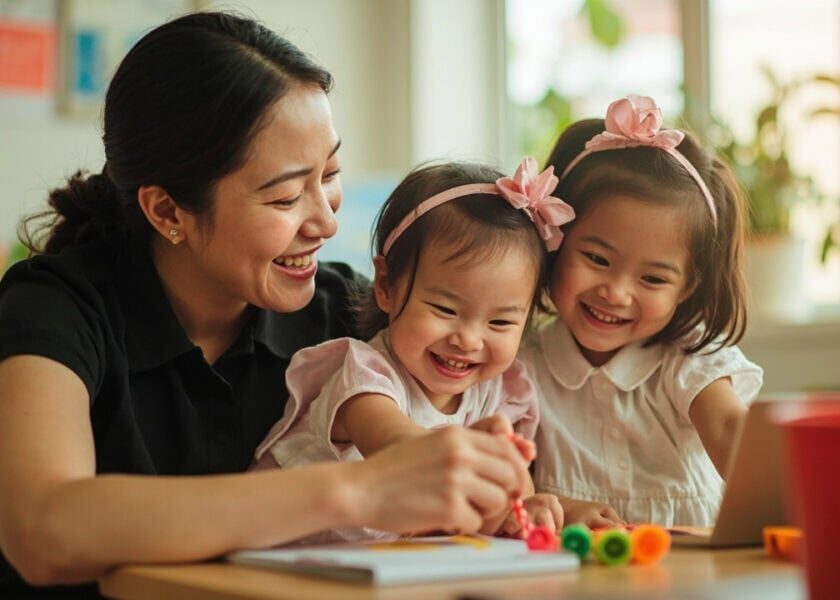
A caregiver who has been trained in observation does not simply take your child from your arms and attempt to distract them. She reads the child’s body. She notes the tension in the shoulders, the way the child reaches back toward you even while being held, the quality of the cry.
She does not rush the transition. She allows your child to feel what they feel, to express it, to know that it is witnessed. And then, with patience that is not passive but actively skillful, she begins the work of helping your child turn toward the morning.
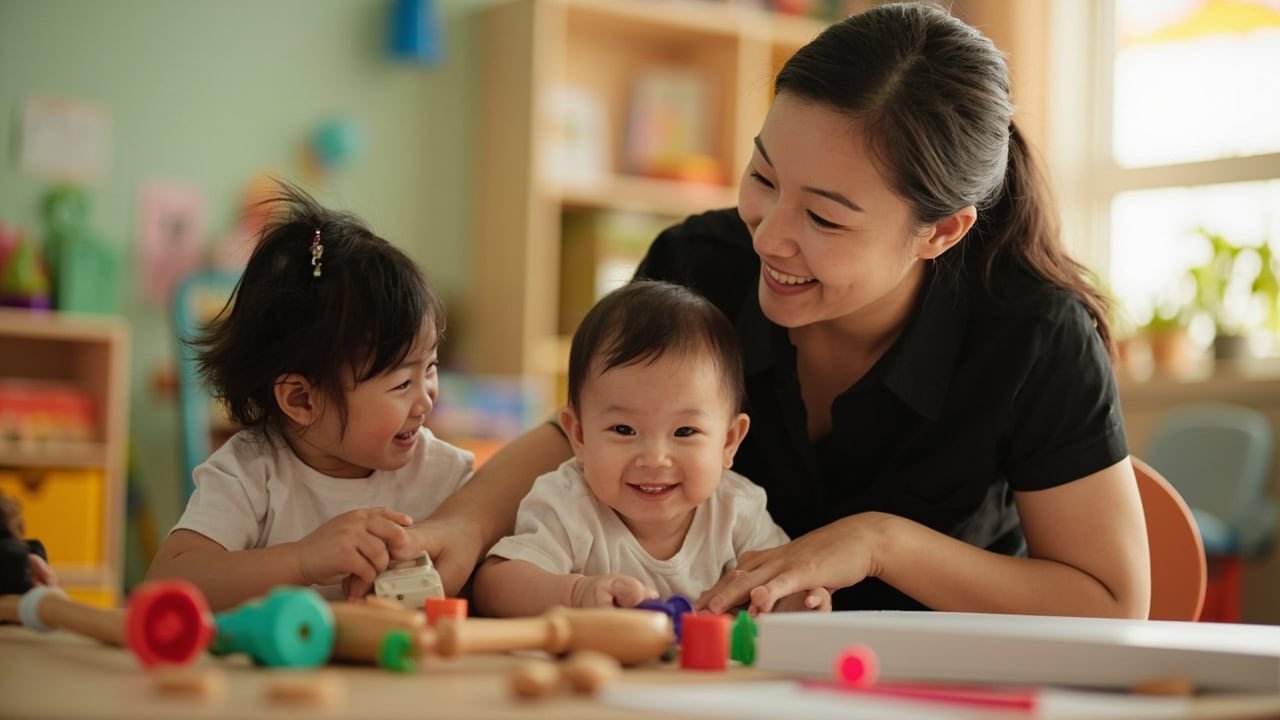
This requires a ratio that makes it possible. In home-based care within the ECDA Childminding Pilot, the one-to-three infant ratio means your child is not competing for attention during the most vulnerable moment of their day. It means the caregiver has the capacity to hold your child through the hard part without the pressure of attending to others who also need her.
And here is what matters most: the caregiver is not working in isolation from you. She is working in partnership with you. The transition morning is where your partnership is tested and, if it is the right arrangement, where it deepens.
Signs the Transition Is Working—and When It’s Not
Trust the pattern, not the moment. A single difficult drop-off, or even a difficult week, is not necessarily a signal of mismatch. Children are affected by teething, illness, disruptions at home, by the simple fact that development is not linear.
But a pattern that persists—your child becoming more distressed rather than less over weeks, your child seeming fundamentally altered by the experience, your child developing physical symptoms that clear only on weekends—these are worth taking seriously.
Red Flags to Watch For
- Consistent, high-pitched crying that does not change in quality over time
- Inability to be soothed by the caregiver, even after extended attempts
- Physical symptoms—vomiting, fever, refusal to eat—that appear only at drop-off
- Progressive withdrawal or uncharacteristic aggression that intensifies rather than eases
- Distress that worsens week after week instead of gradually diminishing
What the Caregiver’s Response Tells You
A quality caregiver will not dismiss your concerns. She will have observations to share, patterns she has noticed, a willingness to collaborate on what might help. She will not treat your questions as attacks or your worry as irrational.
She understands that you are entrusting her with the most precious thing in your life, and she will behave accordingly.
When the Transition Is Working
Your child, over time—days or weeks, depending on temperament and prior experience—begins to show a pattern of settlement after drop-off. The crying may not disappear entirely. Some children protest every single morning, and this is not a sign of damage; it is a sign of healthy attachment expressed through the only channel available to them. But the protest begins to co-exist with something else: curiosity, engagement with the caregiver, the ability to be distracted, the capacity to move into the morning’s activities.
You receive updates—photos, messages, a note at pickup—that show your child in a range of states throughout the day. Not only happy and settled, because that would be suspicious, but experiencing the full emotional range that children experience. A child in healthy care is not always calm. They are accompanied through their emotions, not managed into a performance of contentment.
Pickup is warm. Your child is happy to see you. There is no residual panic, no hypervigilance, no sense that your child has been holding themselves together all day. And your child may sleep differently after a day in quality care—better, more deeply—because they have expended energy playing and learning and growing, and because they have felt safe enough to truly rest.
Your Emotional Response Is Data, Not Doubt
What you feel when you walk away from your child is not doubt. It is not evidence that you should have chosen differently. It is information. It is your nervous system telling you that this boundary—this daily separation—is real, that it costs something, that you are aware of what you are asking your child to navigate.
Parents who feel nothing at drop-off, who walk away easily and without the knot in their stomach, are not better parents. They may simply have different nervous systems, different thresholds for this particular form of stress. What you feel is proportional to how much this matters. And it matters enormously.
The parent’s emotional response at drop-off can tell you something about how the transition is going, but it tells you far more about your own attachment patterns, your own history with separation, the particular way your love takes up space in your chest.
If you grew up with inconsistent caregiving, or with early separations that were not handled well, the transition morning may trigger old distress that has nothing to do with your child’s actual experience. This does not make your feelings invalid. It means they belong to you, and that working through them—with a therapist, with a trusted friend, with the caregiver herself—is part of building the confidence you want to have at the doorway.
The goal is not to feel nothing. The goal is to feel something and know that it is manageable. To trust that your child is in a place where their distress will be met with skill and patience. To walk away knowing that the morning will unfold in a way that will bring you both back together at the end of the day, changed but intact.
Practical Guidance: Before, During, and After Drop-Off
Before the Drop-Off
- Keep the routine consistent. Your child needs predictability around the transition. The same sequence of events, in the same order, builds a sense of safety.
- Arrive a few minutes early. There is no rush. The goodbye does not have to happen faster than either of you would like.
- Connect with your child’s eyes before you go. Give them your full presence in that final moment, so they feel truly seen rather than quickly passed over.
During the Drop-Off
- Stay calm. Your child is reading your face, your posture, your breathing. If you are anxious, they will believe there is something to be anxious about.
- Acknowledge the difficulty honestly. “This is hard for me too, sweetheart”—and then demonstrate through your actions that you believe it is manageable.
- Hand them over with confidence. Kiss them. Love them. Hand them to the caregiver with visible trust in the person you are handing them to.
After the Drop-Off
- Take thirty seconds to collect yourself. Text your partner. Sit in the car. Do not rush back. Your child will learn that you always come back because you always come back, not because you never left.
- Ask the caregiver what the morning was like. Not in surveillance mode, but in partnership mode. Share what you noticed at home. Ask what she noticed at drop-off.
- Build shared language. The observations you accumulate together over weeks and months will become a map of your child’s unique adaptation style.
What Quality Care Looks Like on Transition Morning
Communication is not an afterthought in quality infant care—it is part of the architecture of trust that makes everything else possible. Regular updates, transparency about the day, and consistent caregiver presence during transitions give parents the evidence they need to build real confidence.
Caregivers who are trained in this approach have learned to observe, to respond, to understand that the five minutes of the transition morning are as important as the five hours that follow. They know that your child’s crying is communication, not manipulation. They know that your anxiety is not weakness, and they do not exploit it or dismiss it. They meet you at the doorway with the same intentional presence they bring to everything else.
In home-based care through the ECDA Childminding Pilot, the familiarity of the environment and the consistency of the same caregiver from the first moment of the day can soften the boundary between home and care. In centre-based settings, the transition is designed with the same attention: a consistent greeting routine, a caregiver who is present at the door rather than somewhere deeper in the room, a handoff that feels like a warm passage rather than a cold cut.
Both pathways, when done well, share a commitment to making the transition morning a moment of connection rather than abandonment.
Singapore’s Support Ecosystem
The ECDA Childminding Pilot reflects a broader understanding in Singapore that infant care is not a luxury service but a foundational need for families. The fee structures, the subsidy pathways, the use of CDA and Baby Bonus funds—all of these exist because Singapore recognizes what every parent knows: that you cannot parent well if you are exhausted, unsupported, and anxious about the very thing you have entrusted to someone else.
These mechanisms make quality care accessible in a way that was not possible before. They are not just financial tools—they are statements about what Singapore believes families deserve.
The Reframing: A Relay, Not a Surrender
There is something I want to say directly to you now, because the weight of this choice deserves to be acknowledged.
You are making this decision, in most cases, not because you want to. You are making it because work requires it, or because you need time to recover your own identity beyond parenthood, or because you believe—and you are right to believe—that your child benefits from the stimulation and social environment that quality care provides.
You are making it with guilt you did not choose and cannot easily set down. You are making it while being told by well-meaning people that you should simply trust yourself, follow your gut, know that you are doing enough.
But trust is not a feeling you can summon through willpower. Trust is built through evidence. Through experience. Through the slow accumulation of mornings that went better than you feared, afternoons that ended with your child running toward you with genuine joy, weeks that showed you that your child was not damaged by your absence but was growing in your absence, becoming more themselves because they had the space and the safe people to do so.
This is what the right childcare gives you: not the absence of worry, but the evidence that worry is not needed. Not the guarantee that nothing will ever be hard, but the experience of navigating hardness with a partner who is as committed to your child’s wellbeing as you are.
The morning hand-off is not a surrender. It is a relay.
You carry your child into the doorway, and then, in that moment of release, you hand them to someone who will carry them through the morning with skill and care. When you pick them up at the end of the day, you take them back, and the carrying continues on your end.
This is what community has always been, at its best. Not parents alone, not caregivers alone, but a network of intentional care that surrounds the child and makes them feel, every single morning, that they are held.
You are building that network. One transition morning at a time. And you are not as alone in it as you feel.
The doorway is not the end of something. It is the beginning of the day, for your child and for you.
Walk through it, knowing that what you feel is love doing what love does, and that love, when it finds the right partner, does not diminish.
It expands.
If you are still standing at that doorway, uncertain whether any of this is possible: you are not failing because this is hard. You are not a bad parent because your child cries. You are not wrong to want more than adequate care for the person you love most in the world.
You do not have to navigate this alone. You do not have to rely only on instinct, or on the well-meaning but generic advice of strangers who have never seen your child.
Find a partner who will meet you at the doorway and walk through it with you.
Explore how EduNanny supports Singapore families through the transition morning at edunanny.com.