The Professional Mirror: Understanding Your Child Through Expert Partnership
The Moment That Catches You Off Guard
There is a moment that happens to most parents, and when it does, it catches you completely off guard.
You are at home in the evening, perhaps after dinner, and your child says something. They describe something they did at their childcare arrangement, or they react to something in a way that feels entirely new. They express a preference you did not know they had. They solve a small problem, or reach for a word, or show a flash of personality so clear and formed that you pause and think: when did this happen?
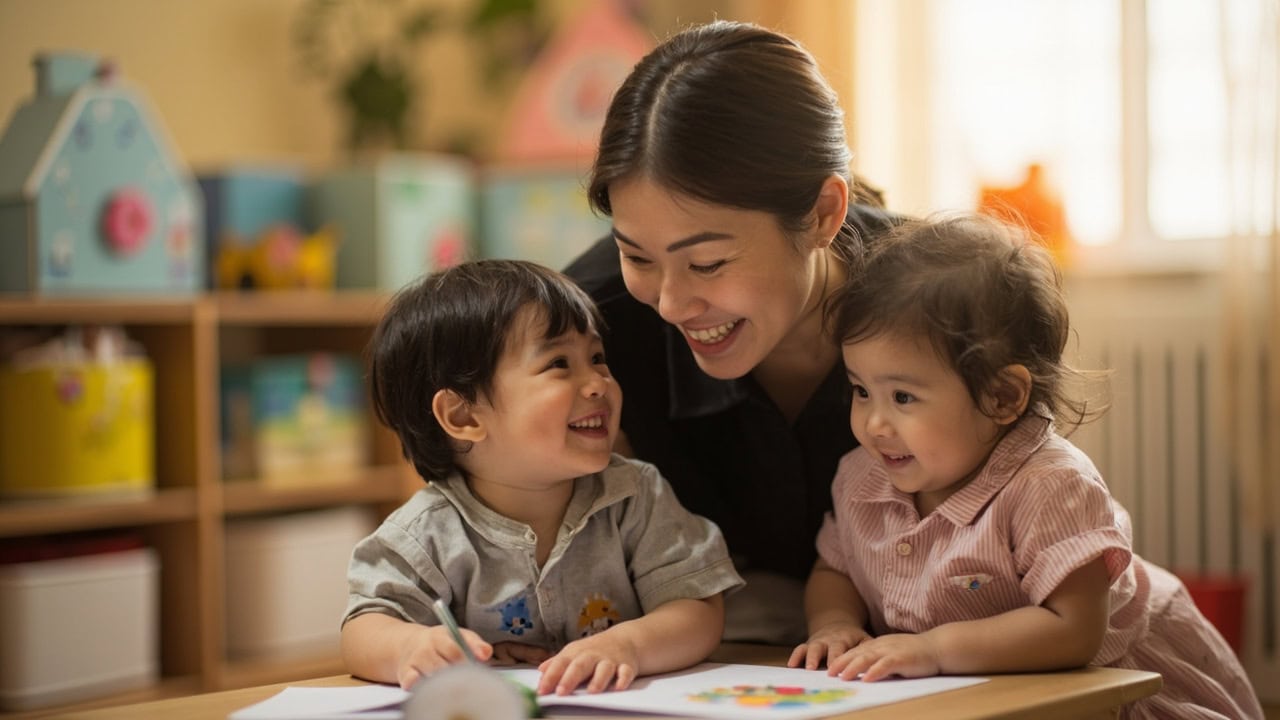
And then you remember that during the day, while you were at work or managing the demands of daily life, someone else was with your child. Someone who noticed this moment when it occurred. Someone who may have even told you about it in a note, or in a brief conversation at pickup, delivered with the quiet matter-of-factness of someone who sees these moments often.
The first feeling, if you are honest, is a small and strange one. It is not jealousy, exactly. It is not resentment. But it is something close to surprise, and underneath that surprise, if you look carefully, there is something that feels almost like being caught out. Your child is growing in directions you could not see. And someone else was watching.
This feeling is real. It is one of the most honest and important emotions that parents in Singapore experience when they make the decision to entrust their child’s care to someone outside the family. And it is time we talked about it openly.
Understanding What Is Actually Happening
We spend considerable time discussing what parents worry about when they leave their children in care—safety, trust, whether the food is appropriate, whether the environment is stimulating enough, whether the caregiver is qualified. These are real concerns, and they deserve serious attention.
But underneath all of those practical questions, there is something deeper and less often named: the fear that choosing quality care means becoming less important in your child’s life. That by inviting another adult into the intimate world of your child’s daily development, you are somehow stepping aside. Making room for someone else to know your child better than you do.
This fear is understandable. But it is also, I believe, based on a misunderstanding of how child development actually works.
The moment when your child shows something to their caregiver before they show it to you is not a loss. It is not a replacement. It is a mirror—and what that mirror reflects is something that every parent needs to understand about the nature of child development, the purpose of professional care, and the real reason why quality childcare is not a compromise that parents make, but an investment that makes parents better at understanding and loving their own children.
The Expansion of Your Child’s World
When a child begins to spend time with a trained caregiver, their world does not shrink. It expands.
A child’s world, in those earliest years, is not a single room or a single set of arms. It is a universe that grows larger with every new trusted adult, every new familiar space, every new context in which they feel safe enough to be themselves.
As that world expands, the child does not love their parents less for having other trusted adults in their life. They love them differently, and often more richly, because they have more to bring home. They have experienced the world beyond the walls of their own house, and they return to you carrying pieces of that world with them.
This is not a metaphor. It is the actual texture of developmental progress. When a child begins to show their caregiver things they have not yet shown their parents—new words, new fears, new jokes, new ways of asking for help—it is a sign that their relational world is growing. It is a sign that they are learning to trust more than one adult, to feel safe in more than one place, to experiment with parts of themselves in different contexts.
This is healthy. This is what we want for them.
The Developmental Mirror
But here is what is less often articulated: the child is not the only one who benefits from this expansion. The parent does too.
When a trained caregiver observes your child with professional skill—attentive not just to what the child is doing, but to the sequence and pattern of their development, to the small milestones and the larger shifts—they are holding a kind of mirror up to your child’s growth. They see things in the daylight hours that you, however devoted and however present in your evenings and weekends, simply cannot see.
Not because you are a worse parent. Because you are a parent, and the nature of the parent-child relationship is different from the nature of trained professional observation.
Trained Observation vs. Parental Intuition
This is not a competition. It is a collaboration.
Trained developmental observation is not the same as parental intuition. Parental intuition is powerful. It is a deep, emotional, often nonverbal understanding of your child that comes from the particular bond of being their parent. You know when something is wrong even before you can articulate why. You sense your child’s moods, their needs, their unspoken discomforts. This is real and it matters enormously.
But trained observation brings something different to the picture:
- The discipline of professional attention
- The ability to notice a sequence of small moments and see them as part of a larger developmental pattern
- The skill of documentation—not as bureaucratic exercise, but as a way of holding space for a child’s growth in a form that can be shared, reflected upon, and understood
When a caregiver notices that your child has been working on a particular skill for several days, or that they have moved through a phase of frustration into a new phase of mastery, or that they have begun to express a new emotion in a new way, they are building a picture that you, as the parent, can hold alongside your own picture of your child.
And when these two pictures come together—when you share observations at pickup, when you receive thoughtful notes about your child’s day, when you sit with a caregiver and compare what you are seeing at home with what they are seeing in care—something remarkable happens. You see your child more clearly than you could see them alone.
Why Multiple Perspectives Matter
The caregiver does not replace your vision of your child. The caregiver complements it. They stand in a different position, see from a different angle, and hold a different set of observations. When you bring those observations together with your own, you get a more complete picture. You get something closer to the truth of who your child is becoming.
There is a word for this in professional child development: triangulation. When you have multiple sources of observation, you reduce blind spots. You catch things that you might otherwise miss. You notice patterns that only become visible when you have data from more than one setting.
Consider this example: a caregiver tells you that your child spent the morning working on stacking blocks with intense focus, and that they finally succeeded and then looked around with visible pride—but did not clap or call for you, because they were absorbed in the achievement itself. That is information. It tells you something about your child’s relationship to perseverance, to mastery, to the satisfaction of independent work.
You could not have seen that at home, not because you are not watching carefully enough, but because you were not there. And now that you know, you can hold that piece of your child’s experience alongside everything else you know about them. You can marvel at it. You can encourage it in new ways.
This is what quality care makes possible. It does not take anything from your child or from you. It adds.
What Quality Childcare Looks Like in Practice
Parents need more than philosophy. You need to understand what this actually means for your child’s day, and for your own peace of mind.
There are several practical elements that distinguish quality care:
- Small caregiver-to-child ratios—Your child’s caregiver must not be stretched across too many children to notice the small moments that matter. When ratios are too high, observation becomes supervision. When ratios are appropriate, observation becomes possible.
- Regular communication rhythms—This means something real to talk about at pickup, not just that your child had a good day. It means knowing what made it good, what they worked on, what surprised their caregiver, what they are beginning to show signs of.
- Documentation with intention—Notes, observations, and records that are kept not as bureaucratic requirement but as a living picture of your child’s development that can be shared and reflected upon.
- Trained caregivers—Not randomly assigned adults who happen to like children, but professionals who understand the patterns of infant and toddler development, who know how to observe without projecting, who can distinguish between a passing phase and a meaningful shift.
Observation without training can be misleading. A trained caregiver understands typical developmental sequences. They know that a certain behavior at a certain age may be a passing phase, while a different behavior may signal an important shift. They know how to observe without projecting their own expectations onto what they see.
Parents sometimes worry that they are not qualified to understand their own child, that they need experts to tell them what is happening. We do not believe that. We believe that parents know their children deeply, and that trained caregivers add a professional layer of understanding that makes parental insight sharper, not redundant.
The combination is more powerful than either alone.
EduNanny’s Approach: Extending the Family
This is the philosophy that has shaped everything we have tried to build at EduNanny.
EduNanny by BUTLER is part of the ECDA Childminding Pilot. We believe that the best outcomes for children come not from replacing the family, but from extending it. From giving parents a trained ally in the work of understanding their child. From creating the conditions in which professional caregivers can serve as that developmental mirror.
We offer both home-based care and centre-based pathways, depending on what works best for your family. Our infant ratios are maintained at up to one to three, which means that your child’s caregiver has the time and attention to observe with genuine focus.
On the ground, this means:
- When you come to pickup, there is something real to talk about—not just that your child had a good day, but what made it good, what they worked on, what surprised their caregiver, what they are beginning to show signs of
- If something is happening that might be relevant to you—the beginning of a new phase, a challenge your child is working through, a joy they discovered—you hear about it
- There is a two-way flow of information, where you can share what you observe at home and the caregiver can place it in the context of what they observe in care
What makes EduNanny different is not just the training, not just the ratios, not just the communication systems—though all of these matter. What makes us different is the philosophy underneath all of it. We do not see ourselves as taking over from parents. We see ourselves as extending the family.
Addressing Common Concerns Honestly
What if my child behaves differently with the caregiver than with me?
Sometimes, children behave differently with caregivers than with parents. This is not a failure of parenting. It is a feature of developmental health.
Children often show their most challenging behaviors—their most honest rage, their most stubborn refusal, their most vulnerable fear—to the adults they trust most completely to hold them. And sometimes, children show their most emerging, forward-moving selves—their latest skills, their newest words, their boldest experiments—to adults outside the family, because they feel the freedom of a space that is not charged with all the history and expectation of home.
Both of these things can be true. Your child can love you and need you and also be someone slightly different when they are with their caregiver. And this is not something to fear. It is something to understand.
What if my child seems to prefer their caregiver?
When your caregiver tells you that your child had a meltdown at pickup today, or that they have been unusually clingy, or that they refused to eat the lunch they usually love—this is information. It is not judgment. It is not a report card on your parenting. It is data about your child in a different context, and when you hold it alongside what you know from home, you often find that it makes sense. That your child has been carrying something they did not show you, or that they are processing a transition you did not know they were in the middle of.
And when your caregiver tells you about something new—your child stacked six blocks for the first time, or used a new phrase, or showed an unexpected gentleness with another child—this is not a comparison. It is a gift. It is your child, growing in ways that you are now invited to witness and celebrate.
What about the hard days?
There are days when this is hard. There are days when you come home exhausted, when you are already carrying the weight of balancing work and family, when the last thing you have the energy for is comparing notes with a caregiver. There are days when a part of you does not want to hear that your child is doing something new, because it means they are growing in ways that do not include you in real time.
These feelings are real. They deserve to be acknowledged, not pathologized. Having them does not make you a bad parent. Having them does not mean you made the wrong choice about childcare. Having them means you are a human being who loves your child, and who is navigating the complex, beautiful, sometimes painful reality of watching that child become more and more their own person, in a world that is larger than you alone.
What quality care does, when it is done well, is hold space for both realities at once. It holds space for your child’s expanding world and for your place within it. It holds space for the professional skill of trained observation and for the irreplaceable bond of parental love.
What to Look for When Choosing Childcare
If you are researching childcare options in Singapore, here are some practical things to look for and ask about:
- How does the caregiver observe and document development? Ask to see examples of how they track and share observations. Good documentation reveals patterns and progress, not just daily activities.
- What is the communication rhythm? How will you hear about your child’s day? Is there genuine two-way dialogue, or just one-way reports?
- What are the caregiver ratios? Can the caregiver actually observe and notice things, or are they just managing logistics?
- How does the caregiver talk about development? Do they speak about milestones, patterns, and progress—or just routines and meals?
- Is there transparency? Do you feel you can ask questions and receive honest answers?
- Is the caregiver a partner or a service provider? Do they invite your observations and input, or do they position themselves as the experts who inform you?
The best test is practical: can you articulate what your child did today, why they seem a particular mood, what they are working on? These are signs that observation is happening. And can the caregiver tell you things about your child that expand your understanding? These are signs that the observation is professional and that the partnership is working.
Growing Alongside Your Child
Here is what I have come to believe, after years of working with families and watching children grow: the best thing you can do for your child is not to be the only adult who knows them.
The best thing you can do for your child is to be a parent who is always learning more about them, who is always growing alongside them, who is always willing to see them more clearly even when what you see is uncomfortable or surprising or full of things you did not expect.
And the best thing you can do for yourself as a parent is to accept the help that makes that possible. To find caregivers who are not threats to your role but allies in it. To build a partnership with the people who care for your child that is grounded in honesty, in shared observation, in the mutual commitment to understanding this small, complex, extraordinary person as fully as possible.
Your child is not yours alone. But that is not a loss. That is the nature of raising a human being. And the more eyes that are watching them with love and attention and professional skill, the more complete the picture becomes.
So when your child comes home and tells you something that their caregiver noticed first—when you feel that small, strange feeling that I described at the beginning—I want you to pause. I want you to notice it. I want you to sit with it for a moment, and then I want you to reframe it.
That feeling is not rejection. It is not replacement. It is your child, expanding. It is your child, growing a richer relational world. It is your child, trusting more adults, exploring more facets of themselves, becoming more fully themselves in a world that has room for more than one set of loving arms.
And it is also, if you let it be, an invitation. An invitation to see your child more clearly. An invitation to grow alongside them. An invitation to be part of something larger than your own daily presence with them—the shared, collaborative, beautifully complex work of raising a child who belongs not just to you, but to the world they are slowly and surely becoming ready to meet.
EduNanny is here to walk that road with you. Not as a substitute for your love. Not as a replacement for your presence. But as a professional partner, with trained eyes and attentive hearts, who will help you see your child more clearly than you could see them alone.
Because you deserve that clarity. And your child deserves a parent who is always learning, always growing, always ready to see them more truly.
That is what quality care makes possible.
To learn more about EduNanny’s approach to developmentally-oriented childminding in Singapore, or to begin a conversation with our team, we invite you to reach out. We would be glad to hear from you.