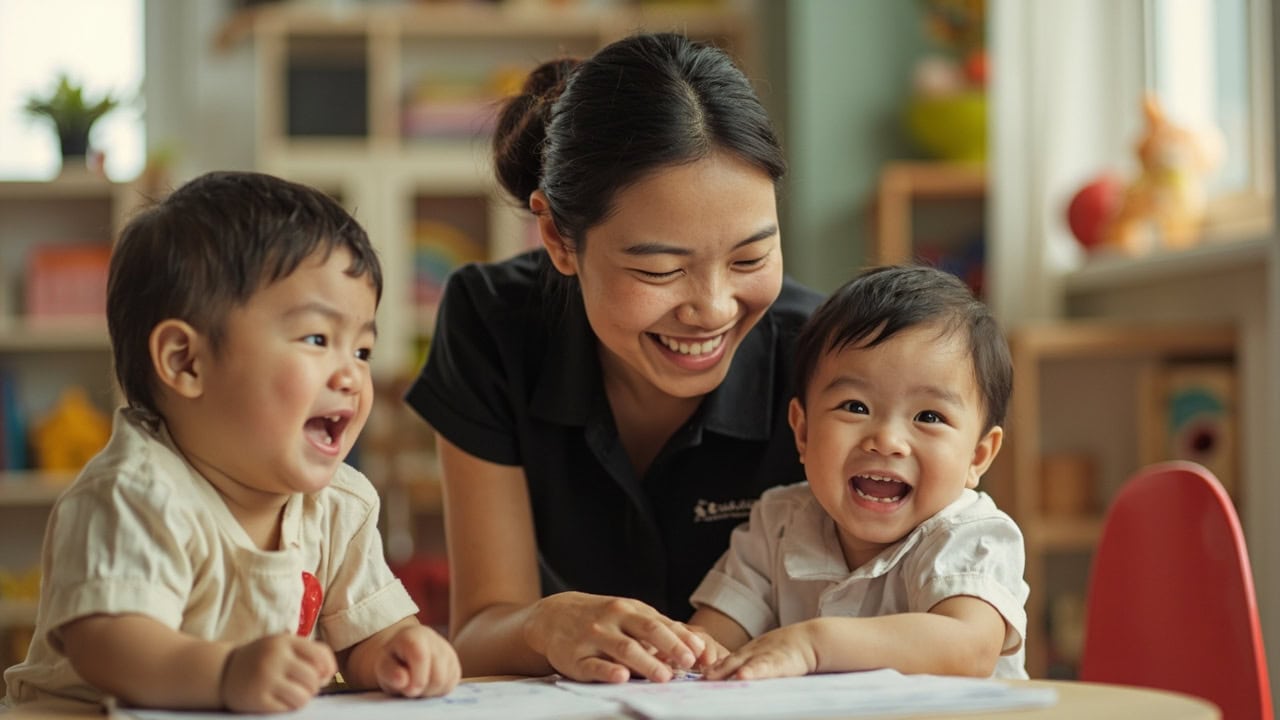
What Actually Happens in Quality Childcare Every Hour
What Actually Happens When Your Child Is in Quality Childcare
There is a particular quality of silence that fills a room after a parent leaves their child for the first time. It is not empty. It is dense with questions that have no immediate answers, with the weight of trust extended before proof has been earned.
Every parent in Singapore who returns to work, who hands their infant to someone else for the day, lives inside that silence. They carry it through their commute, through meetings, through the hours that stretch between morning goodbye and evening hello.
What they are really carrying is a question that no amount of research or recommendations can fully answer: what is happening to my child right now, in this moment, while I am not there?
This is not a question born of doubt. It is a question born of love, and it deserves more than a vague promise that everything is fine.
A Day in Quality Childcare: Hour by Hour
For parents who want to understand what quality looks like in practice, here is the architecture of an intentional childcare day.
8:00 AM — The Art of Arrival
When a child arrives at a quality childcare setting in the morning, the space they enter is not neutral. It has been prepared.
The lighting is considered. The temperature calibrated. The materials arranged with intention. This is not decoration. This is architecture for wellbeing.
A child arriving from the complexity of morning routines—perhaps from the compressed emotion of a parent’s hurried goodbye, perhaps from the sensory overwhelm of a commute through Singapore’s morning streets—needs a space that functions as a settling chamber. The room does not demand anything of the child. It does not require immediate engagement or performance. It simply offers: here is a place where you can arrive.
The caregiver who greets that child is reading. She notes the child’s posture, the tension in the shoulders, the way weight is distributed, the pace at which the child moves through the door. She notes whether the child reaches for her or hangs back, whether there is residual upset from the morning separation or a surprising ease.
She does not greet every child the same way, because every child arrives differently. This is not instinct alone. It is trained attention, developed through understanding the language of infants and toddlers who have not yet learned to articulate what they feel but who broadcast it constantly through their bodies and behaviors.
Research on attachment and transition confirms what many parents intuitively sense: the quality of the arrival experience sets the tone for the entire day. A child who feels seen and held during those first moments of separation carries that security forward. A child who is processed quickly through a doorway, greeted impersonally, and left to manage alone begins the day in a state of vigilance.
9:00 AM — Rhythm as a Developmental Tool
The morning unfolds in rhythm, and rhythm is not a soft preference. It is a developmental tool.
Young children are not capable of organizing time abstractly. They do not understand the concept of “later” or “soon” or “after lunch.” What they understand is pattern.
When a child knows that arrival is followed by free exploration, which is followed by a group activity, which is followed by snack, which is followed by outdoor time, they develop something precious: the capacity to anticipate.
Anticipation is the earliest form of trust in the predictability of the world. A child who can anticipate what comes next does not need to spend their emotional energy on constant vigilance. They can relax into the moment, because the moment is part of a known sequence.
Sensory-rich environments support this development profoundly. When a child kneads play dough, they receive input through their proprioceptive sense—the sense that tells the body where it is in space—which has a direct regulatory effect on the nervous system. When a child splashes in water or pours dried rice from one container to another, they are building neural pathways that will later support mathematics, scientific thinking, and the capacity to focus on a single task without distraction.
10:30 AM — Peer Learning Before Conventional Play
Peer interaction begins earlier than most parents realize. Long before children can play together in any conventional sense, they are learning from one another. They observe. They imitate. They notice when another child laughs and they store that information somewhere deep in their social learning.
In a high-quality infant care setting, these early peer experiences are facilitated, not managed from a distance. Caregivers position themselves as bridges between children, not walls.
When a nine-month-old reaches toward another child’s toy and the caregiver gently intervenes, she is not simply preventing conflict. She is teaching that other people have inner lives, that their desires matter, that there are ways of being with others that preserve dignity for everyone involved.
Many Singapore families rely heavily on grandparents or domestic helpers for childcare. While these arrangements offer genuine love and familiarity, they often cannot provide the structured peer interaction that quality care offers. Children in these arrangements may have limited opportunity to learn from other children at an age when observation and imitation are at their peak.
12:00 PM — The Midday Meal as a Developmental Moment
The midday meal is one of the most underestimated developmental moments in early childhood. At EduNanny, lunch is not a pause in learning. It is a continuation of it.
Children who are developmentally ready participate in the ritual of sitting together, of being offered food, of learning that their bodies have signals—hunger and fullness—and that they can trust those signals.
The caregiver does not rush a child through the meal. She creates a pace that honors the reality that eating is complex work for a young child, that it requires coordination of muscles that are still developing, that it involves sensory experiences that can be overwhelming on days when the child’s system is already taxed.
When an infant learns that their signals are honored—that someone is paying attention to what they need and adjusting accordingly—they develop what psychologists call internal working models of relationships. They carry these models forward into every future connection they will make.
1:00 PM — Rest and the Brain’s Night Shift
Rest follows, and rest is where the real work of development happens. Sleep is not the absence of activity in a child’s brain. It is the time when the brain consolidates learning, when neural connections that were formed during waking hours are strengthened and organized.
The nap environment at EduNanny is prepared with the same care as the play environment. The lighting dims. The sounds soften. The room temperature adjusts. Each child has their own rhythm, their own associations with sleep, their own preferences for how they settle.
When children wake from rest, there is a transition that requires particular skill. The shift from sleep back to wakefulness can be disorienting for young children. The caregiver provides a window for this reorientation. She does not immediately demand engagement or transition. She allows the child to arrive in the day twice.
3:00 PM — The Afternoon Reset
The afternoon has its own texture. There is often outdoor time, weather permitting, and Singapore’s climate makes this possible for much of the year.
Outdoor play offers something that indoor environments cannot fully replicate: the dynamic, unpredictable quality of the natural world. The way light falls through leaves. The feel of wind on skin. The novelty of an insect or a bird that cannot be predicted or controlled.
These experiences are not luxuries. They are essential inputs for sensory integration, for the development of the vestibular and proprioceptive systems that underpin coordination and balance.
As afternoon progresses, the pace slows. Children who are rushed from activity to activity without adequate transition time accumulate stress that expresses itself as dysregulation. At EduNanny, the wind-down is structured: a gradual reduction in stimulation, a calming activity, time for the caregiver to reconnect individually with each child, to close the loop on the day’s small ruptures and reunions.
6:00 PM — The Homecoming Bridge
The transition from care back to home is as significant as the morning transition, and it is often overlooked. A child who has spent the day in a caregiver’s attention must now make a shift from one relational world to another.
At EduNanny, the homecoming bridge is part of the day’s architecture. Caregivers communicate with parents not in rushed exchanges at the door but with intention. They share what happened. They note the milestones, the challenges, the small victories. They observe which rhythms the child seemed to need more of and which seemed to overwhelm.
This communication is relational. It is the caregiver saying to the parent: I see your child. I have been paying attention. I know them, and now I am handing them back to you.
When parents receive genuine information about their child’s day, they are better equipped to continue the same quality of responsiveness at home. This continuity between care environment and home is one of the most powerful predictors of positive childcare outcomes.
The Ratio That Changes Everything
At EduNanny, the infant-to-caregiver ratio is never higher than three children to one adult during the earliest months. This is not an administrative preference. It is a developmental requirement.
When a caregiver can only attend to three infants, she can notice when one child’s breathing changes, when another’s skin tone shifts slightly, when the third is about to experience a developmental leap that will leave them temporarily unsettled. These are not dramatic moments. They are subtle.
They require proximity and time and the kind of sustained attention that becomes impossible when a single adult is responsible for five, six, or seven children.
The ECDA Childminding Pilot, under which EduNanny operates, understands this. The pilot exists because Singapore recognized that home-based and community-based childcare pathways needed to meet a standard of quality that matched what parents expected and what children deserved.
When ratio numbers are low, something invisible but profound happens: children develop a felt sense that they matter as individuals. The caregiver is not managing a group. She is in relationship with each child. She remembers that this particular child slept poorly last night and might need extra support during the morning. She notices that child is cutting a tooth and adjusts expectations accordingly. She sees the micro-moments of frustration before they become meltdowns and offers presence before intervention is needed.
This is the difference between supervision and education. Supervision keeps children safe. Education helps them flourish.
Common Questions from Singapore Parents
These concerns come up in every conversation we have with parents. They deserve honest answers.
“Will my child feel abandoned?”
Separation distress is normal and healthy. It indicates that your child has formed an attachment—which is exactly what you want. The goal is not to prevent all distress but to ensure that distress is held and soothed rather than left unmanaged.
In quality care, caregivers are trained to receive a child’s distress without matching it, to provide consistent comfort that gradually builds the child’s trust in the new environment. Within weeks, most children develop what attachment researchers call a secondary attachment—a relationship with the caregiver that provides genuine comfort, even as the primary attachment with parents remains paramount.
“How do I know the caregiver is truly attentive?”
This is where ratios matter most. When you tour any childcare setting, ask about group sizes. Ask about the number of children per caregiver. Ask what training caregivers receive in reading infant cues.
Low ratios are not just about safety. They are about the quality of observation that becomes possible when a caregiver can truly attend to each child in their care.
“What if something goes wrong and I don’t know?”
This fear is legitimate, and it is precisely why daily communication matters.
When caregivers share observations about your child’s day—their rhythms, their challenges, their victories—you are receiving ongoing data that builds your understanding of the environment. You are not flying blind. You are in relationship with your child’s caregiver, receiving information that allows you to follow up, to ask questions, to notice patterns that might otherwise go unmentioned.
“Is home-based care really as good as centre-based care?”
This depends entirely on the quality of the specific setting. Under the ECDA Childminding Pilot, home-based care can offer advantages that centre-based care cannot: smaller groups, home-like environments, more individualized attention.
The key is not whether care is home-based or centre-based, but whether it meets the developmental standards that matter: appropriate ratios, trained caregivers, intentional curriculum, responsive relationships, and transparent communication.
What to Look For When Choosing Infant Care
For parents researching options in Singapore, here are the questions that matter most:
- What is the caregiver-to-infant ratio? For infants under 18 months, three children per caregiver should be the maximum. Anything higher compromises the quality of attention.
- What does the daily rhythm look like? Is there a predictable sequence of activities that gives children the security of pattern?
- How are transitions handled? Is there intentional support for arrival and homecoming, or are children processed quickly through doorways?
- What is the communication practice? Will you receive genuine information about your child’s day, or brief reassurances that tell you nothing?
- What training do caregivers receive? Are they trained in child development, attachment theory, and responsive caregiving?
- How is rest supported? Is naptime treated as a logistical necessity or as an intentional developmental moment?
- How are mealtimes structured? Is there unhurried time for eating, with attention to children’s cues about hunger and fullness?
- What is the outdoor access? Singapore’s climate makes outdoor play possible year-round. Does the setting take advantage of this?
- What subsidies and payment mechanisms are available? Can you access CDA or Baby Bonus funds? Are fee structures transparent?
- Can you picture your child’s day there? After a tour, can you close your eyes and see the rhythm of your child’s morning, afternoon, and evening? If not, ask more questions.
The ECDA Childminding Pilot has made quality care possible through pathways that were not previously available to Singapore families. Home-based care, with ratios that honor the developmental needs of infants, with standards that ensure caregivers are trained and supported, with fee structures that make quality accessible rather than a luxury reserved for families with significant resources. Subsidies are channeled through mechanisms that parents already understand: CDA and Baby Bonus usability, so that the financial logistics do not add another layer of complexity to an already demanding decision.
The Early Years Are Not a Waiting Period
They are not a gap to be filled until children are old enough for real school. They are the period in which the brain builds itself, in which the capacity for connection forms, in which the patterns of trust or anxiety, of exploration or withdrawal, of confidence or fear are laid down.
What happens during these years echoes across a lifetime.
This is why childcare is not a logistical problem to be solved. It is a developmental opportunity to be honored. And honoring it requires transparency, intentionality, and the kind of daily work that most parents never get to see but which is happening, hour by hour, in the spaces where their children spend their days.
We live in an age where parents have access to more information about child development than any generation before them. And yet, for all of this knowledge, there remains a gap between what parents understand conceptually and what they can actually picture when they imagine their child’s day.
This is the gap that matters most when you are making a decision. Not because other settings do not care, but because caring without visibility leaves parents in a position of faith rather than knowledge. Faith is valuable. But understanding is transformative.
Understanding Is Available
EduNanny Singapore was built for parents who want more than reassurance. We were built for parents who want to understand.
When parents ask us what makes EduNanny different, this is our answer: we do not ask you to trust us blindly. We show you why trust is warranted. We make the architecture of quality visible. We open the doors, not to impress you, but because we believe you have a right to understand exactly what your child experiences in the hours you are apart.
This is why we have built communication into the architecture of our service. When parents can see the day, they understand why the ratios matter, why the rhythm matters, why the caregiver’s training and attention matter. They stop relying on intangible signals of quality and start seeing quality in action. They gain the confidence to make a choice not from desperation or convenience, but from genuine understanding.
Because understanding is the foundation on which real confidence is built.
And real confidence is what every child needs from the adults who love them: not blind faith, but informed trust. Not ignorance, but knowledge. Not silence, but presence—even when that presence must, for a few hours each day, be carried by someone else.
We are honored to be that someone else, for the families who choose to walk this path with us.
We also know that parenting does not stop when the childcare day ends. The questions continue. The concerns continue. The need for reliable, thoughtful support continues. The Thomas AI Chatbot, integrated into the EduNanny experience, is designed to meet parents in those moments—not as a replacement for human guidance, but as an extension of our commitment to being present for families.
Ready to see what quality care looks like in practice?
If you are researching infant care in Singapore, we invite you to take a closer look at what EduNanny offers. Schedule a visit. Ask questions. Picture your child’s day. Let us show you the architecture of quality care, hour by hour, routine by routine.
You can also learn more about our approach or reach out to speak with our team directly.