The Quiet Shift Every Singapore Parent Deserves to Feel
The Silence Every Singapore Parent Knows
There is a particular silence that lives in the mornings of too many Singapore homes. It is the quiet before the door closes, the held breath before the handover, the moment when a parent leans down to kiss a small forehead and feels—somewhere beneath the love—a thread of worry pull taut.
That silence is so common it has become almost invisible. We have learned to carry it, to dress it up in practicality, to bury it beneath to-do lists and conference calls. But it is there. And it matters.
This article is about what it means to be a parent in Singapore right now—not the textbook version, not the Instagram version, but the real, daily, sometimes-exhausting version. It is about what happens inside a parent when the weight of childcare worry becomes so constant that it begins to shape everything: how you work, how you sleep, how you connect with your partner at the end of a long day, and perhaps most importantly, how present you are able to be when you are finally with your child.
It is also about what changes when that worry finally quiets—and why finding genuine peace of mind is not a luxury but a necessity, for you, for your child, and for the family you are building together.
The Invisible Tax: Worry and the Hidden Mental Load
Consider this scenario: You have returned to work after maternity leave ended. Part of your mind never really left the nursery. You have checked your phone seventeen times before noon—not because you are neglecting your job, but because you cannot fully inhabit your job while a small voice somewhere inside keeps asking: Is my child okay? Is she crying? Is he being held? Is she warm, is he fed, does she miss me?
This is the invisible tax that Singapore parents pay every single day. The cruelest part is that it is invisible even to the parents themselves—at least until someone names it.
You do not need a study to tell you what you already know in your body. When you are worried about your child, you are not fully anywhere else:
- You sit in meetings and catch yourself glancing at your watch, calculating the hours until homecoming.
- You play with your toddler at the end of the day and find your mind half-occupied with tomorrow’s logistics.
- You lie next to your partner at night and realize you have not had a real conversation in weeks—not because you do not love each other, but because you are both running on empty.
When Searching Becomes a Cage
You research and research. You visit centre after centre. You ask every parent you know for recommendations. And still, something holds you back. Not because you have not found good enough options, but because the fear of choosing wrong has become louder than the possibility of choosing right.
This is what decision paralysis looks like in real life. It is not laziness or indifference. It is a parent who loves so fiercely that the stakes feel impossibly high—so high that it feels safer to keep searching than to commit, because committing means accepting a measure of uncertainty that a worried heart does not want to bear.
So many Singapore parents live in this suspended state. They manage the logistics, they show up every day and do their best. But there is a part of them that never fully arrives—not at work, not at home, not even in the precious hours they spend with their child. Because they are still on sentry duty, even when they are not physically watching. Their mind is still the surveillance system, running in the background, scanning for danger.
The Shift: From Vigilance to Trust
There is a moment—and if you have found it, you will recognize it immediately—when something shifts. It is not dramatic. It is quieter than that.
It is the moment when you realize, for the first time, that you have stopped bracing for bad news. When you check your phone and find not a crisis but a photograph of your child playing happily, and you feel something in your chest loosen. When you walk through the door at the end of the day and realize you are actually glad to be there, because you trust the people who have been caring for your child—and that trust has freed you to be present in your own life.
This is the shift from vigilance to trust. And it is one of the most profound transitions a parent can experience.
What Trust Actually Means
The word trust is used so often in discussions about childcare that it has almost lost its meaning. Trust, in this context, is not blind faith. It is not the absence of reasonable caution. It is something more solid and more hard-won than that—it is the confidence that comes from evidence, from seeing, over time, that the people caring for your child are competent, responsive, and genuinely invested in your child’s wellbeing.
Trust is built in the small moments:
- It is built when your infant’s caregiver sends you a photo not because you asked, but because she noticed something beautiful your child did today and wanted you to see it.
- It is built when you receive a thoughtful update that shows your caregiver understands your child’s rhythms, preferences, and emerging personality—not as a chore to be logged, but as a human being to be known.
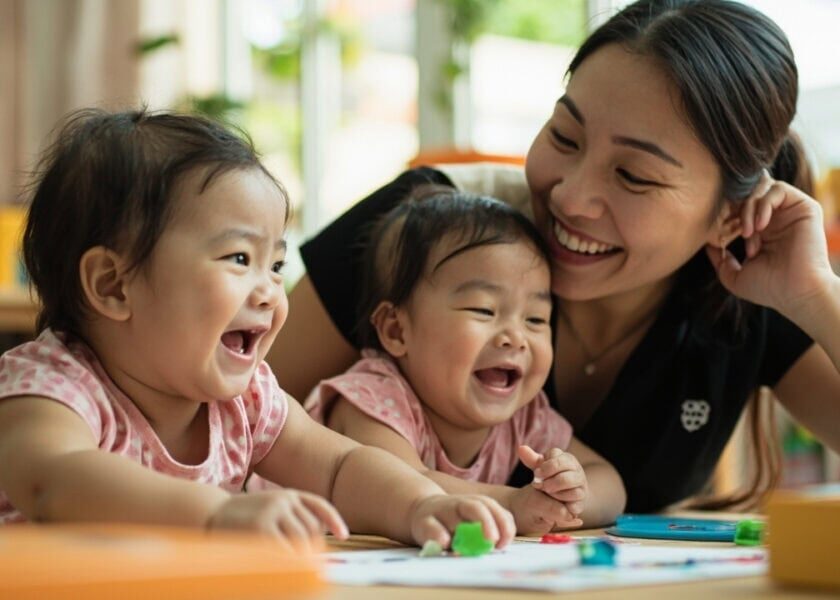
- It is built when your child runs to greet her caregiver in the morning with obvious joy, and you realize that your child has formed a secure, happy attachment to someone who is not you—and that this is not a betrayal of your bond but an extension of it.
A child who feels safe with multiple loving adults is a child who is learning that the world is a trustworthy place. The paradox becomes beautiful here: allowing your child to love and be loved by someone else does not diminish your role. It enriches it. It gives your child more security, not less.
Why Singapore Parents Need a Different Kind of Childcare
Singapore parents are navigating realities that previous generations did not face to the same degree. Dual careers have become necessity, not choice. Extended family support, once assumed, is often unavailable across borders or overstretched across competing demands. And the cultural context here—with its high expectations and reluctance to admit struggle—can make asking for help feel like admitting failure.
What parents need is not judgment. They need more support, more options, and more pathways to peace.
The old models—where childcare was treated as a logistical problem to be solved rather than an emotional ecosystem to be cultivated—are insufficient for these needs. Singapore families deserve childcare options that fit their lives, not just options that fit a standardized mold.
What Quality Childminding Actually Looks Like
Home-based childminding offers something increasingly rare in larger settings: individualized attention. With an infant ratio of up to one to three, your child receives the kind of responsive care that builds neural pathways and emotional security in those critical early years.
In larger centre-based classrooms, ratios of one to eight or higher for infants mean that caregiver availability becomes arithmetic: fewer children means more eye contact, more back-and-forth, more of the interaction that your child’s developing brain craves.
| Care Setting | Typical Infant Ratio | What This Means for Your Child |
|---|---|---|
| Centre-based care | 1:8 or higher | More competition for attention |
| Home-based childminding | Up to 1:3 | More individualized responsiveness |
This is not about suggesting that larger settings are wrong—many families thrive in them. It is about acknowledging that different children and different families have different needs, and that having options matters.
EduNanny Singapore: Building the Foundation for Trust
EduNanny Singapore operates under the ECDA Childminding Pilot—a government-supported initiative designed to expand quality home-based and community childcare options for Singapore families. This is not a workaround. It is a recognized pathway, designed with the same care and oversight as centre-based care, reflecting a growing understanding that families need flexibility.
What we are trying to build is not just a childcare service, but a trust infrastructure—a system of communication, transparency, and professional care that allows parents to move from anxiety to peace, one reliable day at a time.
Our approach centers on three pillars:
- Professional observation: Caregivers are trained not just in technical skills, but in the art of noticing—documenting your child’s small discoveries, the new sound, the new movement, the new way of expressing a feeling. A caregiver who pays this kind of attention earns trust through evidence, not promises.
- Transparent communication: Where deployed, our service incorporates open communication channels—not because we distrust our caregivers, but because we understand that trust, for a worried parent, needs to be supported by structures that make it visible and verifiable. When you can see what is happening in your child’s day, you do not need to imagine the worst. You can see the best instead.
- Accessible support: We offer Monday to Friday care blocks aligned with dual-income family realities. Our pilot fee structures are designed to be affordable, and we actively support families in accessing available subsidies, including CDA and Baby Bonus funds—because financial constraints should not force parents to settle for care that does not meet their standards.
Releasing the Guilt and Recognizing Real Trust
There is something important sitting in the background of every parent’s search, and it deserves to be named: guilt.
The guilt of returning to work before you felt ready. The guilt of not being the one there for the first word or the first wobbly step. The guilt of being tired when your child needs energy, of being distracted when your child needs attention, of being human when your child needs a parent who feels superhuman.
That guilt is not serving you. It is not serving your child. It is a wound that many Singapore parents carry without examining it, and it keeps them stuck in a narrative where they are failing at parenthood even when, by every objective measure, they are showing up with extraordinary love and commitment.
The parents who are most consumed by guilt are often the ones who are trying hardest. They are the ones who have read the parenting books, who have worried the most about doing it right, who have given more of themselves than they had to give. And yet the guilt tells them it is not enough.
Guilt is a liar.
The truth it obscures is this: your child does not need a parent who is never tired or never worried. Your child needs a parent who is emotionally available—who can be truly present, even if only in shorter bursts. A parent who is half-present for twelve hours is not giving twice as much as a parent who is fully present for six. Quality of presence matters more than quantity of hours.
What Vigilance Actually Says About You
That worry, that guilt, that inability to fully relax when your child is in someone else’s care—these are not signs that you are a bad parent. They are signs that you are a loving one.
The intensity of your concern is a measure of the depth of your bond. The fact that you lie awake at night wondering if you made the right choice is not weakness. It is proof that your child’s happiness matters more to you than your own comfort.
Your child is lucky to have a parent who worries this much. But here is the hard truth: that worry, however natural, can become a cage. The question is not whether you care enough. You clearly do. The question is whether you are ready to trust—not blindly, not foolishly, but genuinely and deservedly—in a partnership that will hold your child with the same reverence you do.
Signs That Trust Is Forming
How do you know when the shift has begun? Here are signals—not as a rigid checklist, but as a map of territory you may already be entering without realizing it.
You stop rehearsing explanations. In the early days of a new childcare arrangement, many parents spend their evenings mentally preparing for the next day’s drop-off—rehearsing the instructions, the allergies, the preferences. When you notice that this rehearsal has faded—that you do not need to repeat the same instructions every day because your child’s needs have been genuinely heard and remembered—that is a sign of trust forming.
Curiosity replaces worry. When something unexpected happens—your child comes home with a minor bump, or a different routine was followed one day—your first instinct shifts. You want to know what happened, and you can receive the answer without spiraling into worst-case scenarios. You are curious about your child’s day, not afraid of it.
Your child’s happiness becomes evidence. When your child runs to greet her caregiver with obvious joy, when she talks about her day with genuine enthusiasm, when she shows no signs of distress at the sight of the home where care is provided—these are not coincidences. They are data points. They are proof that your child is experiencing something good when you are not there.
Your presence changes. Ask yourself: When I am with my child, am I truly with my child? Or am I checking my phone for updates, mentally reviewing the day’s events, bracing for the moment when I will have to leave again? If you find that your time together has become more peaceful, more engaged, more joyful—that is not because your child has changed. That is because you have.
The Ripple Effect: How Parental Peace Transforms Everything
When the worry is quiet, you can be there—fully, warmly, without the background static of anxiety. You can leave for the day without that jagged feeling of abandonment. You can be productive at work, knowing your child is happy. You can come home with something left in the tank.
Those evening hours, the ones that used to be consumed by mental to-do lists and the weight of tomorrow’s logistics, can become what they were always meant to be: sacred time with the people you love most.
When this shift occurs, you begin to see it transform everything around you. You see marriages that were fraying at the edges begin to mend—not because the couple suddenly had more time, but because they were finally able to be in the same room without the exhaustion of unspoken stress pulling them apart. You see parents who were running on empty discover that they had more to give than they realized—once the burden of constant worry was lifted.
And you see children thrive in ways that might seem paradoxical to parents still in the grip of anxiety: children who are more secure, not less, because they have learned that there are multiple trustworthy adults in their world. Children who are comfortable with separation because they trust that reunion will always come.
Children who run to their caregiver in the morning not instead of loving their parents, but because they have learned that love is not a finite resource that gets divided—it multiplies when it is shared.
Choosing Quality Childcare Is an Act of Love
Let us reframe what you are doing when you search for quality childcare.
Choosing quality childcare is not a compromise. It is not an admission that you have failed to do it all yourself. It is not a lesser choice made necessary by circumstance.
It is an act of love.
It is the choice to give your child more—more attention, more consistency, more safe attachment figures, more environments designed for learning and joy. And it is the choice to give yourself something back that you may have forgotten you deserved: the freedom to be fully present in your own life. The capacity to show up for your work, your partner, your other children, your friends, and yourself—not depleted, not distracted, not running on the fumes of constant anxiety, but rested, connected, and emotionally available.
If you have been carrying the weight of this search for too long, you do not have to carry it alone anymore.
The research you have been doing, the questions you have been asking, the worry you have been wrestling with—all of that is evidence of how much you care. And caring is the beginning of everything good.
The question is not whether you care enough. You clearly do.
The question is whether you are ready to trust—in a partnership that will hold your child with the same reverence you do.
EduNanny Singapore is here. We are ready. And we would be honored to walk this road with you.
The door is open. And we would love to welcome you in.
EduNanny Singapore is a trusted home-based childminding service operating under the ECDA Childminding Pilot. We support families across Singapore in finding childcare that feels right—not justlogistically sound, but genuinely good for your child and your peace of mind. Get in touch to learn more about what we offer, or read our story to understand who we are.